


Credit-based AI writing prices access by the unit. One credit buys a finite amount of output, and different models and tasks burn through your balance at different rates. Instead of paying a flat monthly fee for unlimited generation, you pay for what you actually use, converted into credits at the point of consumption.
As a rough working rule, one credit tends to cover a small to moderate amount of standard-quality text, though the exact ratio shifts depending on the model and the platform. Premium models chew through credits faster because they demand more computing power per word.
Your first move should be small and low-risk:
- Start with a starter pack or free trial rather than committing to a large allowance upfront.
- Turn on usage notifications immediately, so you see spend building before it surprises you on an invoice.
- Generate one real piece of content in the first session to see exactly how many credits it costs.
How does credit-based AI writing actually work?
Every credit system is built on tokens, not words. A token is roughly three quarters of a word in English, and platforms convert your prompt, your instructions, and the AI’s output into these token counts before translating them into a credit charge. That is why the same 500-word brief can cost different amounts on different tools: the underlying token accounting varies, and so does the markup each platform applies.
Three things push per-request cost up:
- Model tier. Premium, higher-capability models cost more credits per token than entry-level ones, because they use more processing power to generate each response.
- Context length. Long conversation history or lengthy source documents get re-processed with every request, and credit consumption depends on model choice, task complexity and context window, with premium models and extended context both driving costs up. Accumulated conversation history above certain amounts can trigger additional base charges in some systems.
- Task complexity. A single-pass draft costs far less than a multi-stage job that involves research, drafting and summarising in sequence, because each stage is billed separately.
Here’s the maths that matters: drafting an 800-word product description with a basic model might cost 3 to 4 credits. Run the same brief through a premium model with a long product catalogue as context, and you could be looking at double or triple that, purely because the system is re-reading more tokens each time it responds.
What pricing structures do credit-based AI tools use?
Most platforms settle into one of four billing shapes, and picking the wrong one for your volume is the single easiest way to overpay.
- Pay-as-you-go packs. You buy a fixed block of credits upfront with no recurring commitment, which suits irregular or seasonal output.
- Monthly credit allowances. A subscription includes a set number of credits that refresh each billing cycle, ideal for teams with steady, predictable volume.
- Seat-based subscriptions. Pricing scales by number of users rather than credits alone, common where several team members need independent access.
- Enterprise contracts. Custom volume deals with negotiated rates, usually only worthwhile once monthly usage runs into the tens of thousands of credits.
Bulk discounts usually apply when buying larger packs, lowering the per-credit price with greater commitment. Expiry rules vary sharply between providers: some credits vanish at the end of the billing month if unused, while others roll over or never expire at all, and platform documentation on credit behaviour shows how differently these rules can be structured even within similar pricing models. Auto top-up, where the platform automatically buys more credits when your balance runs low, is convenient but needs a hard ceiling attached.
The rule of thumb: if your monthly output is consistent, a monthly allowance almost always beats a one-off pack on cost per word. If your usage swings wildly month to month, packs give you control without paying for capacity you will not touch.
How do you buy credits and protect your account from overspend?
Buying credits is usually straightforward, but the protections around that purchase are where most people get caught out.
- Locate the billing section. Most SaaS dashboards keep credit purchases under “Billing” or “Account”, with payment by card as standard and invoicing available on higher tiers.
- Decide on auto top-up carefully. It stops work grinding to a halt mid-task, but only enable it once you have tested how quickly a typical workflow consumes credits, so you are not caught by a runaway process.
- Set a spend cap. A hard monthly ceiling on top of auto top-up prevents a scripting error or a colleague’s bulk job from draining the account overnight.
- Separate billing profiles for teams. If several people or departments generate content, individual budgets stop one heavy user from exhausting the shared pool.
- Configure receipts and usage exports. Regular exports make it far easier to reconcile credits against actual published output later.
Pro Tip: Pair auto top-up with a daily usage notification rather than a weekly one. Catching an unexpected spike within 24 hours is the difference between a minor adjustment and an unpleasant invoice.
How can you cut credit costs on repeat catalogue work?
Catalogue-scale writing rewards a slightly different approach than one-off content, because the same prompt structure repeats hundreds or thousands of times. Small inefficiencies multiply fast.
- Build templates once, reuse constantly. A well-structured template amortises the “thinking” overhead across every product, so each subsequent generation costs closer to the token minimum rather than paying for structure every time.
- Batch similar products together. Generating variants of a product line in one session tends to burn fewer credits per item than starting fresh prompts repeatedly.
- Match model tier to the page’s value. Reserve premium models for hero product pages and category landers that drive real search traffic; use a cheaper model for routine variant descriptions, size updates or minor edits.
- Track credits per published item. Set a target, for example under 3 credits per description, and review it monthly to catch drift before it becomes a budget problem.
Insight worth acting on: moving from generic prompts to templates and batch publishing measurably improves per-unit cost, which is the single biggest lever most catalogue teams underuse. A structured template library does more for your credit efficiency than switching providers ever will.
Can you trust AI-generated content for publication?
Human review is not optional, and treating it as optional is where most quality problems start. AI systems can produce fluent, confident text that is factually wrong, a phenomenon researchers describe as hallucination, and verification against trusted sources is necessary before anything goes live, particularly for specifications, measurements or claims about materials.
A workable verification pass takes three steps:
- Fact-check every specific claim, measurement or comparison against the actual product data.
- Confirm brand voice and tone match your existing catalogue, since AI drafts tend to default to generic phrasing.
- Add a human editorial pass before publishing, even on templated, low-stakes descriptions.
Copyright on AI-assisted text sits with you as the publisher in most commercial contexts, but the underlying legal position still varies by jurisdiction and use case, so treat AI output as a first draft rather than a finished asset.
Google’s own guidance states that AI-generated content can rank well provided it is people-first and demonstrably high quality. The authoring method matters far less than whether the page shows genuine expertise, experience, authority and trustworthiness.
Google’s stated position on AI content makes clear that search quality is judged on outcome, not method. Generative tools can produce volume quickly but often need human editing for depth and accuracy, which is exactly why the review step above earns its place in every workflow, not just the risky ones.
Why credit efficiency matters more than credit price
Most advice on this topic obsesses over the headline price per credit, comparing one platform’s £0.02 rate against another’s £0.03 as though that settles the argument. It rarely does. A platform charging more per credit but requiring fewer credits per finished, publishable product description will beat a cheaper rate paired with sloppy prompting every time.

The conventional wisdom treats credits as a commodity to shop around for. The more useful frame treats them as a measurement of your own process discipline. Teams that template their prompts, batch their catalogue work, and reserve premium models for pages that actually need them consistently spend less than teams chasing the lowest advertised rate. The operational discipline of measuring credits per published item tells you more about your true cost than any pricing page ever will.
If there’s one thing worth prioritising first, it’s this: before optimising for price, optimise for waste. Work out how many credits a genuinely good, verified, published product description costs you today. Everything else, model choice, pack size, top-up settings, is secondary to that number.
Why MerchUp fits credit-based catalogue publishing
Catalogue teams do not need unlimited generation. They need every credit to produce something publishable on the first pass, and that is the specific problem MerchUp is built around. Its templates and visual editor cut the prompt overhead that normally inflates credit use on repeat product descriptions, while direct Shopify integration means generated content moves straight from draft to live listing without a separate export step.

Bulk generation lets you batch a product line in one session rather than restarting the “thinking” cost with every single item, and MerchUp’s own credit pricing breakdown explains exactly how templating and batch publishing lower cost per finished description. For merchants weighing platform choice, the Shopify-focused feature set also matters, since integration depth affects how many manual steps sit between generation and a live listing.
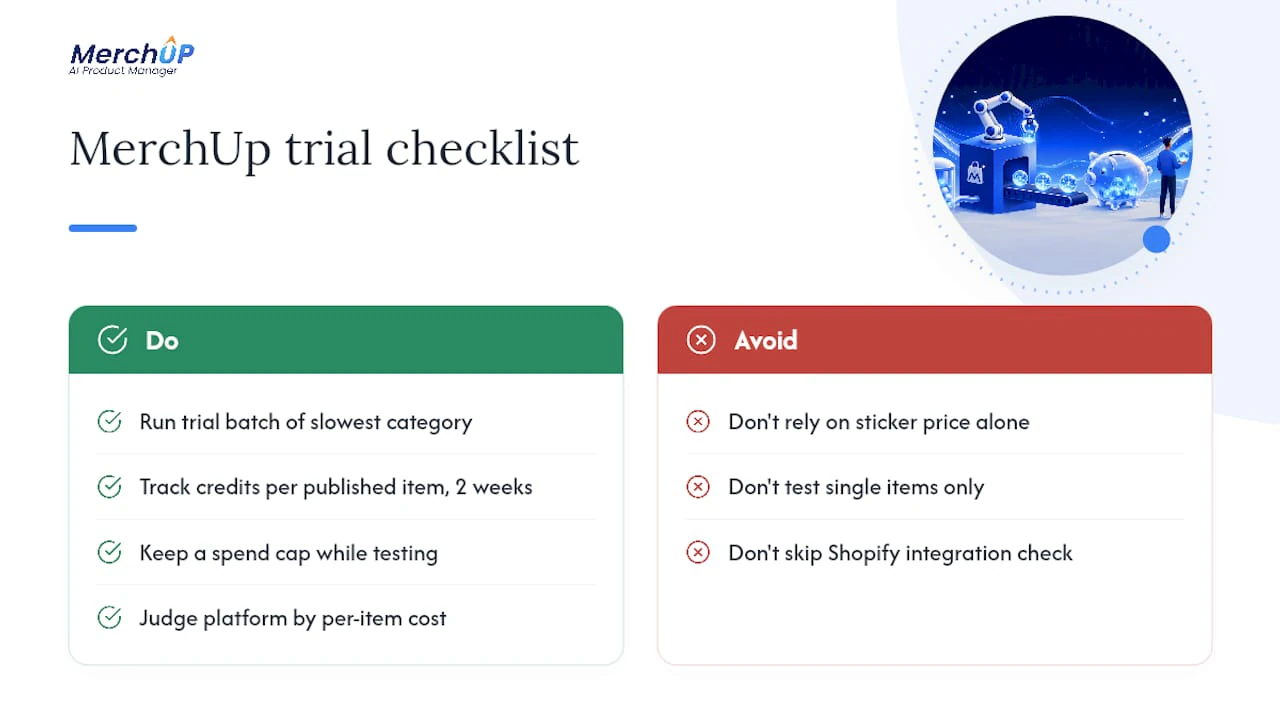
Start with a trial batch of your slowest-moving product category. Track credits per published item for two weeks, keep a spend cap active while you test, and judge the platform on that number rather than the sticker price. You can begin with MerchUp directly and see the real per-item cost on your own catalogue.
Frequently asked questions
How many words does one AI writing credit typically buy? It varies by platform and model, but a common working range is 150 to 300 words per credit on standard models, less on premium ones handling longer context.
Do unused AI writing credits roll over each month? It depends entirely on the provider. Some allowances reset and expire monthly, others roll over or never expire, so check the specific terms before assuming.
Is AI-generated product content safe to publish without editing? No. Human verification for accuracy and brand tone is necessary every time, since AI drafts can contain confident but incorrect claims.
Does using AI writing tools hurt search rankings? Not inherently. Google’s guidance confirms AI-assisted content can rank when it is people-first, accurate and demonstrates genuine expertise.
What’s the fastest way to reduce credit spend on a large product catalogue? Build reusable templates, batch similar products together, and reserve premium models only for your highest-value pages.
Sources
- Google Search and AI-generated content
- Addressing AI hallucinations and bias (MIT Sloan/EDTech)
- AI-generated content (IBM)


Comments
No comments yet — be the first to share what you think.