


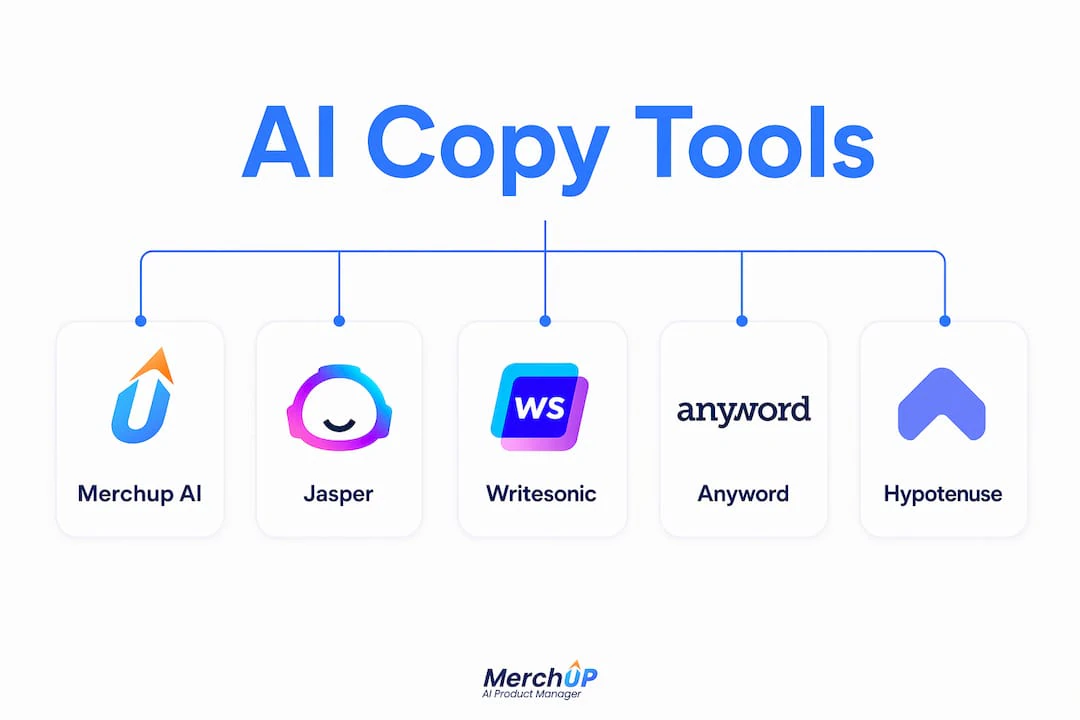
For UK Shopify stores that need SEO-first product descriptions at scale, the shortlist is: Merchup AI (top pick for direct Shopify publishing and bulk workflows), Jasper (best for marketing teams managing multi-channel content), Writesonic (strongest for GEO tracking and live SERP analysis), Anyword (best for conversion-focused copy with predictive scoring), and Hypotenuse AI (solid for catalogue-scale generation). Copy.ai itself has pivoted toward GTM automation, leaving a clear gap for teams who need specialist product-description workflows rather than enterprise sales tooling.
The criteria that matter for eCommerce are narrow: direct Shopify publishing, keyword-aware SEO fields, bulk-generate and bulk-publish, brand-voice ingest, and GDPR-ready data handling for UK merchants. Here is who each tool fits best:
-
Merchup AI — Shopify store operators who need to generate, edit, and bulk-publish hundreds of SKUs without leaving the platform
-
Jasper — marketing teams producing blogs, ads, and product copy across multiple channels from one workspace
-
Writesonic — SEO-focused teams who want live SERP data and AI-search visibility tracking baked into the writing interface
-
Anyword — stores running A/B tests on copy and wanting predictive performance scores before publishing
-
Hypotenuse AI — merchants with large catalogues who need fast, template-driven generation at volume
Which Copy.ai alternatives actually work for product descriptions?
The five tools above differ sharply on the dimensions eCommerce teams care about. The table below maps each one against the criteria that determine whether a tool earns its subscription or just adds another tab to your browser.
| Dimension | Merchup AI | Jasper | Writesonic | Anyword | Hypotenuse AI |
|---|---|---|---|---|---|
| Best for | Bulk Shopify product descriptions | Multi-channel marketing copy | SEO + GEO-tracked content | Conversion-optimised copy | High-volume catalogue generation |
| Pricing shape | Monthly/annual subscription + credits | — | — | Per-seat subscription | Per-seat or per-article |
| Free trial | Yes | trial | Free tier available | Free trial | Free trial |
| Shopify integration | Native app + API publishing | Limited; no native product-description app | Via API/export | CSV export | Shopify integration available |
| SEO features | Keyword fields, meta, schema output | Brand voice + SEO templates | Live SERP analysis, GEO tracking | Predictive performance scoring | SEO templates, keyword insertion |
| Brand voice | Catalogue ingest + drag-and-drop templates | Strong Brand Voice system | Style settings | Audience persona targeting | Brand profile setup |
| Bulk publish | Yes, native bulk-publish | No native bulk-publish | Limited | Limited | Yes, batch generation |
| Workflow & collaboration | Activity tracking, visual editor | Agent workspace, approvals | Team collaboration | Team workspaces | Team access |
| GDPR / UK support | GDPR-ready, UK available | UK available | UK available | UK available | UK available |
The sharpest distinction: Jasper and Writesonic are excellent writing tools, but neither was built around the generate-to-publish pipeline that a Shopify catalogue demands. Bulk-publish to live product pages, direct SEO field population, and activity tracking are Merchup AI’s core workflow, not an add-on.
Pricing models are diverging across this category: per-seat subscriptions suit small teams with predictable output, while credit-based models tend to be cheaper at scale for high-volume description runs. For stores with large catalogues refreshing product descriptions regularly, a credit model is often more cost-effective.
Statistic: SEO-first platforms with direct CMS integrations can reduce the time from keyword research to live publication dramatically compared to manual copy-paste workflows that typically take several minutes per SKU.
How to choose the right tool for your store
The most common mistake is buying on features. Expert guidance is clear: diagnose your primary bottleneck first, then match the tool to it.
-
Bottleneck: brand voice — prioritise tools with catalogue ingest and retrieval-augmented generation (RAG), not just a tone dropdown. Merchup AI and Jasper both offer this; Jasper’s Brand Voice system is the most developed at self-serve pricing.
-
Bottleneck: bulk publishing — you need a native Shopify app or API-level publishing. CSV export is a workaround, not a solution. Merchup AI and Hypotenuse AI are the strongest here.
-
Bottleneck: SEO performance — look for live keyword pulls, SERP intent analysis, and meta/schema output. Writesonic’s GEO tracking is a genuine differentiator for teams who care about AI-search visibility alongside Google rankings.
-
Bottleneck: conversion rate — Anyword’s predictive scoring lets you test copy variants before they go live, which is useful for high-margin product categories.
Vendor questions worth asking before you commit:
-
Does the Shopify integration publish directly to product pages, or does it export a CSV?
-
Can the tool ingest your existing product descriptions to learn your brand voice?
-
What are the bulk-publish limits per run, and does the plan cap daily credits?
-
Where is data processed, and do you have a Data Processing Agreement for GDPR compliance?
-
What are UK support hours, and what is the response SLA?
Red flags: opaque pricing that requires a sales call to see a number; no native Shopify app or API publishing; no ability to ingest an existing catalogue; SEO limited to a keyword-density slider.
Pro Tip: In a 30-minute trial, paste five of your existing product descriptions into the tool’s brand-voice or style settings, then generate three new descriptions for products you know well. Compare tone, terminology, and structure against your live listings. If the output reads like a different brand, the voice-matching will not improve at scale.
What an eCommerce AI writer must do differently
Generic AI writing tools treat SEO as an afterthought. For product descriptions, that is a ranking problem from day one. Treating SEO as secondary risks producing duplicate, unrankable content across a catalogue — exactly the outcome that manual rewrites were meant to avoid.
An eCommerce-ready tool needs to handle:
-
Keyword intent mapping — matching search intent (transactional vs informational) to the product page, not just inserting a target phrase
-
Meta description and schema output — generating structured data fields alongside copy, not as a separate step
-
Unique content per SKU — variant products (size, colour, material) need genuinely distinct descriptions, not templated swaps
-
Mobile-first length — product descriptions that scan well on mobile convert better; tools should enforce sensible length defaults
-
Canonical handling — awareness of duplicate-content risk across variant URLs
-
Direct CMS publishing — SEO-first platforms with live CMS integrations collapse the keyword-to-live workflow dramatically
SEO-focused platforms now integrate SERP analysis and real-time optimisation directly into the writing interface, removing the need to switch between a keyword tool, a writing tool, and a CMS. For a team managing hundreds of SKUs, that consolidation compounds quickly.
Pro Tip: Feed the tool a sample of 10–20 existing product descriptions before generating new ones. Tools that support catalogue ingest will use those examples to calibrate terminology, sentence structure, and tone. A single “professional” tone setting cannot replicate what real product data teaches the model.
Why Merchup AI is the recommended choice for UK Shopify stores
Merchup AI is built specifically for the generate-to-publish workflow: create a description, edit it in a visual editor, and push it live to Shopify in bulk, without leaving the platform. That pipeline is the job-to-be-done for most Shopify operators, and it is where general-purpose writing tools fall short.
Feature mapping against the buyer criteria:
-
Shopify app and API publishing — native Shopify integration with direct bulk-publish to product pages
-
Drag-and-drop templates — customisable templates that preserve brand structure across SKUs
-
Visual editor — edit descriptions in context before publishing, reducing review cycles
-
Bulk generation and bulk-edit — generate and edit hundreds of descriptions in a single session
-
Activity tracking — see what was changed, when, and by whom across the catalogue
-
SEO fields and schema output — keyword insertion, meta descriptions, and structured data generated alongside copy
-
GDPR compliance — data processing terms available for UK merchants; pricing plans are publicly listed with no sales-call requirement
Upcoming integrations include Webflow, Wix, WordPress, WooCommerce, and eBay, which extends the same workflow to merchants not yet on Shopify.
The feature checklist trap
Most store owners shopping for AI writing tools spend their evaluation time on the wrong things: model quality, template count, and integrations with tools they barely use. The question that actually predicts whether a tool earns its keep is simpler: how many manual steps sit between generating a description and it going live on your product page?
For a 50-SKU store, three manual steps per product is annoying. For a 500-SKU store refreshing descriptions ahead of peak season, it is a project that does not get done. That is why integration depth matters more than output quality at scale, and why tools built around a specific platform workflow outperform general-purpose alternatives in practice.
The other underrated factor is support responsiveness. UK merchants running Shopify stores need answers during UK business hours, not a 48-hour ticket queue. GDPR compliance and a clear Data Processing Agreement are not optional extras; they are baseline requirements for any tool that touches customer or product data. Check both before you sign up, not after.
Merchup AI: built for Shopify product descriptions
Bulk SEO product descriptions without the manual overhead: Merchup AI gives UK Shopify stores a native app, a visual editor, drag-and-drop templates, and direct bulk-publish to product pages, all on transparent monthly or annual plans with no sales call required to see pricing.
Plans are structured around monthly or annual subscriptions with a credit-based generation model, so you pay for what you produce rather than a flat per-seat fee that scales poorly at volume. Full plan details are on the pricing page. GDPR-compliant data processing terms are available for UK merchants, and support is accessible without enterprise-tier commitment.
Try Merchup AI on your Shopify store: install the app directly from the Shopify App Store listing or start a trial at merchup.ai to generate your first batch of SEO product descriptions today.
Frequently asked questions
What is the best Copy.ai alternative for product descriptions?
A tool built for product data rather than general copy. Purpose-built eCommerce generators — Merchup AI among those compared above — work from your SKU fields, brand rules and channel requirements, which keeps hundreds of descriptions consistent in a way prompt-by-prompt writing assistants struggle to match.
Is Copy.ai good enough for a Shopify store?
For one-off campaigns and social copy, yes. For a catalogue it gets slow: every product needs its own prompt and edit pass, and there is no direct publishing path into Shopify — the two frictions that push sellers towards the alternatives in this guide once SKU counts grow.
Do AI writing tools hurt SEO?
Google’s guidance judges content on usefulness, not on how it was produced. Descriptions generated from real product data, reviewed by a human and kept unique per page perform well; thin, duplicated AI text is what attracts trouble. The QA habits covered earlier in this guide are the difference between the two.
Sources and further reading
-
Merchup AI — product page and Shopify integration details
-
Merchup AI pricing plans
-
Copy.ai alternatives for B2B content workflows (Spike, 2026)
-
Best Copy.ai alternatives tested and compared (eesel AI, 2026)
-
Copy.ai alternatives with reviews and pricing (Leaps, 2026)
-
Byword — SEO content generation and CMS integration benchmarks
-
Byword pricing — per-article and per-seat model reference
-
AI-powered marketing tools for 2026 — vendor selection criteria (Errant Agency)
-
How to use AI in marketing: a 2026 practical guide (Errant Agency)


Comments
No comments yet — be the first to share what you think.