


Use AI for product descriptions. Start with Merchup AI if you sell on Shopify. The combination of speed, SEO-ready drafts, and built-in brand controls makes it the most practical entry point for UK sellers who need to scale content without sacrificing accuracy.
Two immediate benefits worth knowing:
-
AI generators produce keyword-rich, structured drafts in seconds, cutting hours from listing creation and keeping copy consistent across large catalogues.
-
The essential guardrail: every output needs a human check against real product specs. AI drafts from what you give it; feed it wrong inputs and it publishes wrong claims.
Start with a single SKU. Run the prompt template in Section 4, review the output against your product spec sheet, then publish. That first test tells you more than any benchmark.
What does an AI product description generator actually do?
At its core, an AI product description generator is a language model that maps product inputs to structured copy. You feed it a title, key specs, tone preference, and target channel; it returns a draft shaped to that brief. The model has learned patterns from vast amounts of commercial copy, so it knows that a Shopify PDP needs a benefit-led hook, while an Amazon listing front-loads keywords in the first sentence.
Typical inputs the model works from:
-
SKU data: title, material, dimensions, variants, price tier
-
Images (via image-to-text tools like Microsoft Copilot’s image search, which can identify objects from photos and accelerate description creation, though results always need verification)
-
Brand rules: tone profile, forbidden words, approved claims
-
Channel context: marketplace, PDP, email, ad copy
The model uses prompts and templates to shape length, register, and structure. What it cannot do is verify facts. If your input says a jacket is 100% merino wool and it is actually a merino blend, the output will say 100% merino wool. That is not a model failure; it is a data-quality problem. AI works best when connected to structured product data and governed inputs, which is why PIM integration reduces errors at scale far more reliably than a standalone prompt box.
Common limitations to plan around: hallucinated specifications, generic phrasing when inputs are thin, localisation errors (a US-trained model will default to inches and Fahrenheit), and brand drift when no tone constraints are set.

Who gets the most value from AI-generated product content?
The ROI calculation shifts dramatically depending on catalogue size. A single-SKU artisan shop can write one great description by hand in twenty minutes. A fashion retailer adding 200 new lines a season cannot, and that is where automated product descriptions pay for themselves quickly.
The most valuable use cases:
-
Initial listing creation at volume: new-season drops, supplier onboarding, marketplace expansion
-
A/B copy variations: generate two tone variants (e.g. functional vs. aspirational) and test which converts
-
Seasonal refreshes: update copy for Christmas, summer, or sale periods without rewriting from scratch
-
Marketplace-tailored versions: Amazon needs keyword density up front; Etsy rewards story and craft; Shopify PDPs benefit from longer benefit-led copy
-
Localisation: generating natively per market rather than translating. Native generation per market captures cultural nuance and correct keyword use in a way that machine translation consistently misses
Roles that benefit most: store owners managing their own listings, listing managers handling supplier catalogues, marketing teams running seasonal campaigns, and freelance copy editors who use AI drafts as a starting point rather than a blank page.
How to generate a high-quality product description step by step
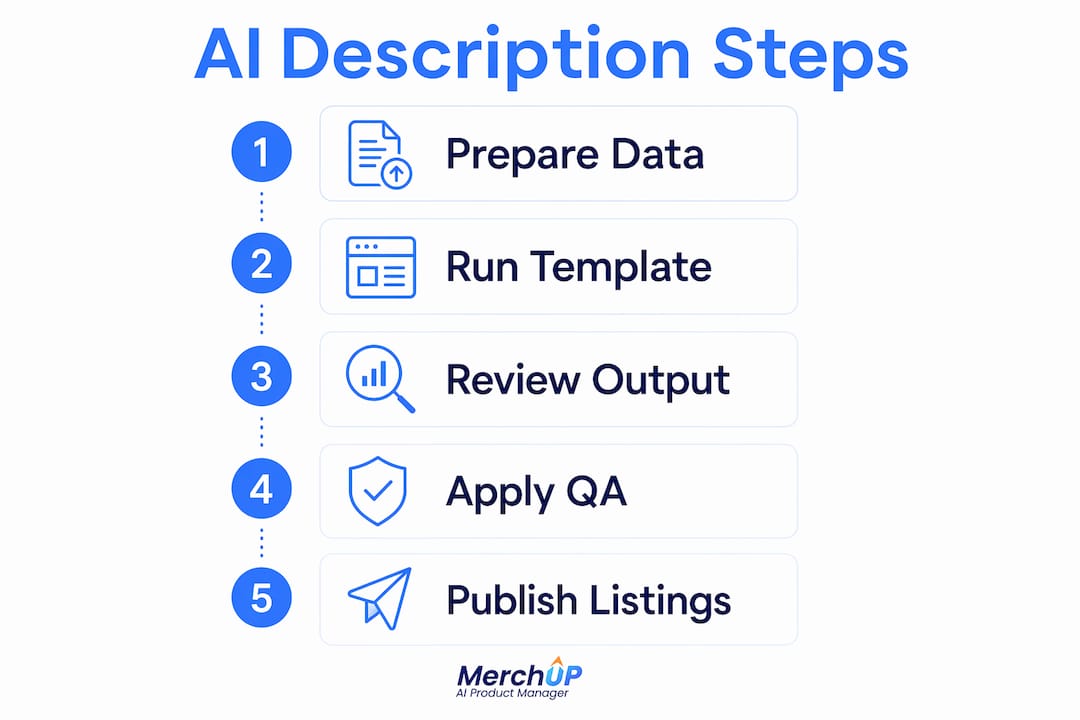
This is a five-step workflow that takes a raw product spec to a publish-ready listing.
-
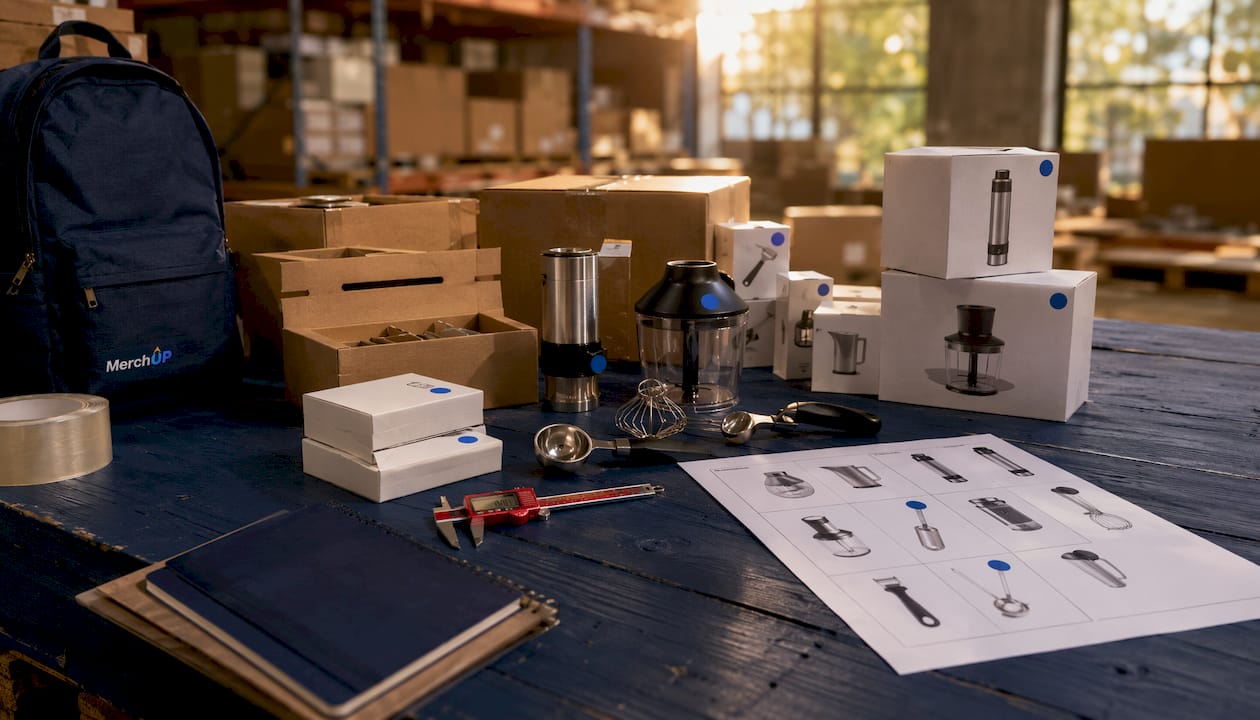
Gather product truth. Pull the confirmed catalogue fields: title, material composition, dimensions (in metric for UK listings), variant names, country of origin, compliance flags. Approved photography and existing PDP copy are also valid inputs. Never start generation with unverified supplier copy.
-
Set tone and channel rules. A Shopify PDP, an Amazon bullet list, and a promotional email are three different briefs. Decide the channel before you write the prompt. Tone options typically include: professional, conversational, premium, technical. Pick one and state it explicitly.
-
Write or select a prompt template. Here is a copy-ready prompt for UK sellers:
-
Run human QA. Check every factual claim against the spec sheet. Verify variant accuracy (colour names, size ranges). Flag any superlatives or certification claims the product cannot support. Confirm the copy reads naturally in British English, not translated American English.
-
Add structured data and publish. Apply schema markup to the PDP, write a distinct meta description (not a copy-paste of the first sentence), and set a performance review date. Track click-through rate and conversion rate at 30 days.
Pro Tip: Build a Brand DNA library before you scale. This is a short document containing your tone profile per category, a stop-word list (words your brand never uses), approved claim types, and negative guidance (what the AI must not say). Seed every prompt with a condensed version. It takes two hours to build and saves weeks of QA downstream.
SEO and conversion rules that make AI descriptions perform
AI drafts a structure; SEO and conversion principles determine whether that structure actually works. The two are not the same thing.
Keyword placement and density. Front-load your primary term in the first sentence or headline. For a 400-word description, keyword density guidance suggests the primary term appearing 2–4 times naturally. Beyond that, you are stuffing. Secondary and long-tail terms should appear once each, woven into benefit statements rather than bolted on.
Platform-specific length and format:
| Platform | Recommended length | Format |
|---|---|---|
| Shopify PDP | 150–300 words | Prose intro + bullet features |
| Amazon listing | 50–100 words (bullets) | 5 keyword-rich bullet points |
| Etsy | 150–300 words | Story-led prose, craft emphasis |
| eBay | 50–100 words | Spec-focused, condition stated |
Conversion elements every description needs:
-
Benefit-first hook in the opening line (not a feature list)
-
Feature-to-benefit translation: “100% merino wool” becomes “stays warm without the bulk”
-
Trust signals: materials, origin, returns policy reference, certifications where real
-
A soft CTA at the close: “Ships next working day from our UK warehouse” does more work than “Buy now”
Well-written descriptions can increase purchase intent by 14–20%, which makes the QA investment worthwhile. Pair your AI workflow with a content optimisation review to catch thin copy and duplicate phrasing before publishing at scale.
Ready-to-use templates and UK examples
Three formats cover most use cases. Replace every bracketed placeholder with verified product data. For worked before-and-after rewrites across UK categories, see our product description examples
Short hook (50–100 words, marketplace or card view)
Medium PDP (150–300 words, Shopify)
Amazon-style bullet list
-
[PRIMARY BENEFIT]: [One sentence translating the top feature into a customer outcome]
-
[MATERIAL/BUILD]: [Specific material, grade, or construction detail]
-
[COMPATIBILITY/FIT]: [Size, variant, or compatibility information in metric]
-
[COMPLIANCE/SAFETY]: [Any relevant UK or EU certification — only if verified]
-
[DELIVERY/RETURNS]: [UK fulfilment detail and returns window]
UK localisation notes: Always use metric measurements (cm, mm, ml, kg). Spell colour, grey, and flavour correctly. Reference “working days” not “business days.” For food, cosmetics, or electrical goods, include the relevant regulatory note (e.g. UKCA mark for electrical products sold in Great Britain post-Brexit). Price references should be in pounds sterling.
How to scale: bulk generation, integrations and Shopify workflows
Moving from one description to a thousand requires a governed production workflow, not just a faster prompt.
Typical bulk workflow:
-
Export SKU catalogue from Shopify or your PIM as a structured CSV
-
Map fields to prompt variables (title → [TITLE], material → [MATERIAL], etc.)
-
Select the appropriate template per product category
-
Run batch generation; set the tool to halt on missing critical fields rather than generating with gaps
-
Route outputs to staged QA: auto-check for forbidden claims, then human review for high-risk categories
-
Publish approved descriptions back to Shopify via direct integration or CSV re-import
AI connected to structured product data and PIMs produces fewer errors and scales more reliably than prompt-box workflows. The reason is simple: when the input data is governed, the output variance shrinks.
Tool categories and their tradeoffs:
| Category | Speed | Integration depth | Accuracy control | Best for |
|---|---|---|---|---|
| Entry-level generators | High | Minimal (copy/paste) | Manual QA only | Single sellers, small catalogues |
| PIM-integrated platforms | Medium | Deep (native sync) | Governed inputs, auto-checks | Mid-size to large catalogues |
| Enterprise platforms | Lower (setup cost) | Full stack | Workflow automation | Large retailers, multi-market |
For Shopify sellers specifically, direct API or app-based integration removes the CSV round-trip entirely. Descriptions publish to the correct product record without manual copy-paste, which eliminates a significant category of human error. Run a technical SEO audit after bulk publishing to catch duplicate meta descriptions or missing schema before they affect rankings.
Risks, brand trust and a QA checklist for safe AI use
The principal risks with AI-generated product content are not theoretical. They show up in published listings.
Hallucinated specifications are the most common: a model inventing a thread count, a battery life, or a compatibility claim that the product does not have. Brand drift happens when tone constraints are absent and the model defaults to generic marketing register. Representation issues arise when AI-generated images or copy imply product attributes (colour accuracy, scale, texture) that differ from the physical item.
Consumer trust is a real consideration. A notable proportion of UK shoppers report being bothered by AI-generated product content, with younger consumers expressing more concern. That figure does not argue against using AI; it argues for using it carefully and maintaining human editorial control over what goes live.
QA checklist before publishing:
-
[ ] Every specification (material, dimension, weight, variant) verified against the confirmed product spec
-
[ ] No certification or compliance claims unless the product holds that certification
-
[ ] Superlatives (“best”, “only”, “guaranteed”) removed unless substantiated
-
[ ] Copy reviewed for channel fit (Amazon tone ≠ Shopify tone)
-
[ ] UK spelling and metric measurements confirmed throughout
-
[ ] Disclosure added where required (e.g. synthetic media disclosure for AI-generated imagery)
-
[ ] High-risk categories (food, cosmetics, electrical, children’s products) reviewed by a human with category knowledge
Governed production workflows with channel-based review standards and an asset risk table are the structural answer to these risks. Assign risk levels: a standard apparel description is low-risk; a children’s toy with safety claims is high-risk and needs a senior review before publishing.
Pro Tip: Add a “forbidden claims” section to every prompt. List the specific claim types your brand or category cannot make: no “clinically proven”, no “100% natural” unless certified, no “fastest” without a source. Negative guidance in the prompt reduces QA load more than any post-generation filter.
Merchup AI: more descriptions, less manual effort
Scaling product content is where most Shopify sellers hit a wall. Writing descriptions one by one is fine for ten SKUs; at a hundred, it becomes a bottleneck that delays launches and leaves listings thin.
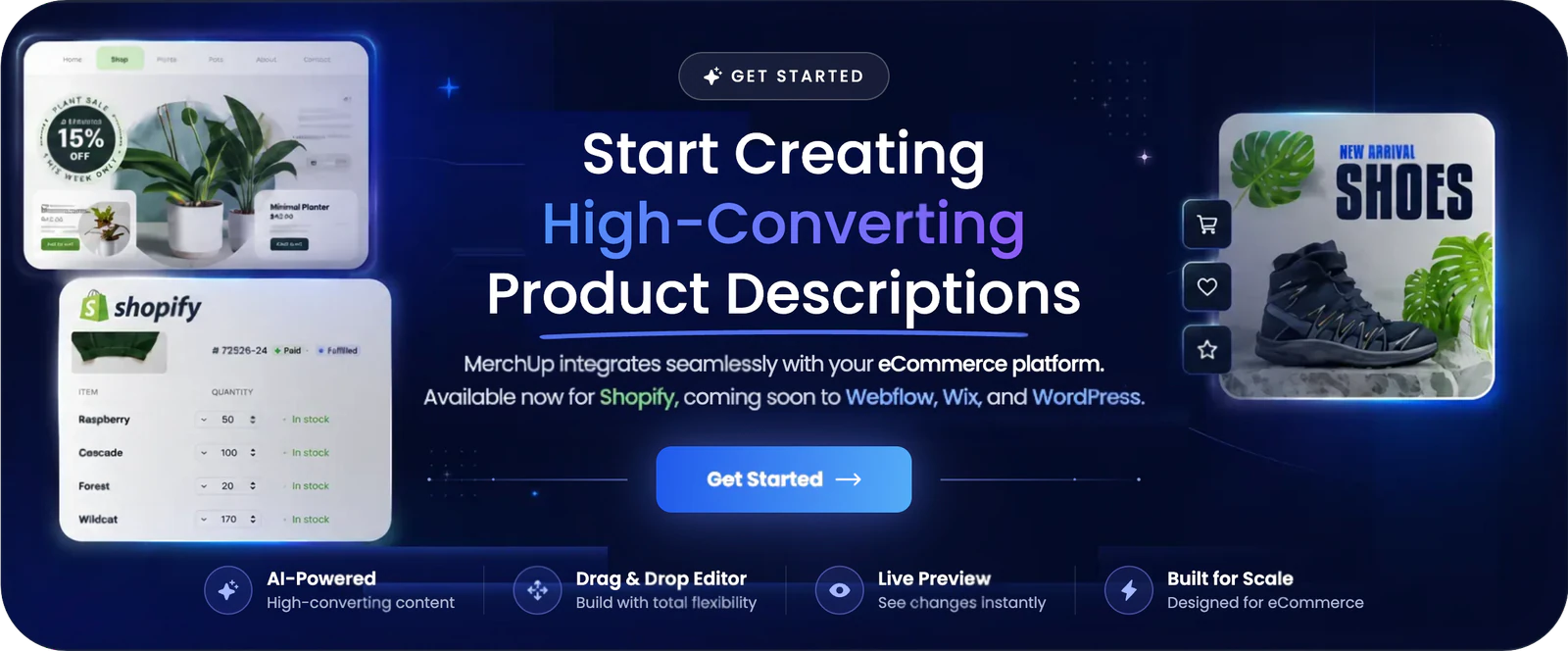
Merchup AI is built specifically for that problem. The platform generates, edits, and bulk-publishes SEO-optimised product descriptions with a direct Shopify integration, so descriptions go live without a CSV round-trip. The visual editor and drag-and-drop templates let you enforce brand rules at the point of creation rather than catching drift in QA. Credit-based generation means you pay for what you use, with monthly or annual plans that scale with your catalogue.
For UK sellers, the localisation controls matter: metric measurements, British English spelling, and channel-specific templates are all configurable. Upcoming integrations include Webflow, Wix, WooCommerce, and eBay, making it a practical long-term platform rather than a Shopify-only tool. View Merchup AI’s pricing and plans to find the tier that fits your catalogue size, or start with a trial to test bulk generation on a real product batch before committing.
The part most sellers skip
The conversation about AI product descriptions tends to focus on the generation step, as if the hard part is getting the first draft. It is not. The hard part is governance: deciding what the AI is and is not allowed to say, building the input quality controls that prevent hallucinated specs, and maintaining those standards as your catalogue grows.
Most sellers who struggle with AI-generated content skipped the Brand DNA step. They ran a prompt, got something that sounded plausible, published it, and later discovered the description claimed a feature the product does not have. That is not an AI problem; it is a process problem. The model did exactly what it was asked to do with the information it was given.
The sellers who get consistent results treat AI as a production system, not a magic box. They define inputs, constrain outputs, and review before publishing. That discipline is what separates a catalogue that converts from one that generates returns and complaints. Start small, build the guardrails first, and scale once the workflow is proven.
Useful sources and further reading
-
AI Product Content Without Breaking Brand Trust — Tolstoy’s guide to Brand DNA constraints, governed workflows, and channel-based review standards; the most practical framework for brand-safe generation.
-
Using AI for Product Content Creation — Inriver’s overview of PIM integration, productivity considerations, and the case for structured data inputs over standalone prompt workflows.
-
Consumer Sentiments on AI-Generated Product Content — Syndigo’s research on UK shopper attitudes, including the 36% scepticism figure and the argument for native-language generation over translation.
-
Free AI SEO Product Description Generator — InsightAgent’s tool page, useful for the purchase-intent uplift data (14–20%) and platform-specific length and keyword density guidance.
-
Automatically Generating Product Descriptions — Shopify’s own documentation on Shopify Magic; essential reading for anyone using native AI generation within the Shopify admin.
-
Merchup AI Platform — Full overview of Merchup AI’s generation, editing, bulk-publishing, and Shopify integration capabilities.
-
Merchup AI Pricing — Credit-based plan details, feature tiers, and trial options for UK e-commerce teams.


Comments
No comments yet — be the first to share what you think.