


For UK Shopify merchants who need SEO-optimised product descriptions at scale, Merchup AI is the clearest starting point. It connects directly to Shopify, generates copy in bulk, and ships with SEO templates built for product pages — with a trial available so you can test it on real SKUs before committing.
Get started in three steps:
-
Install the Merchup AI trial from the Shopify App Store
-
Run a sample generation on 10–20 products using an SEO template
-
Review outputs in the visual editor, then bulk-publish to your live store
What do Shopify SEO apps actually do?
The phrase “Shopify SEO app” covers a wide range of tools, and conflating them leads to poor purchasing decisions. There are four distinct categories worth knowing.
Technical SEO tools handle the infrastructure: fixing 404 errors, generating sitemaps, managing redirects, and compressing images. They rarely touch your copy. Content-generation tools use AI to write or rewrite product descriptions, meta titles, and alt text. Schema and structured-data helpers inject JSON-LD markup so Google can display rich results — star ratings, prices, availability. Speed optimisers focus on Core Web Vitals, lazy loading, and CSS/JS minification.
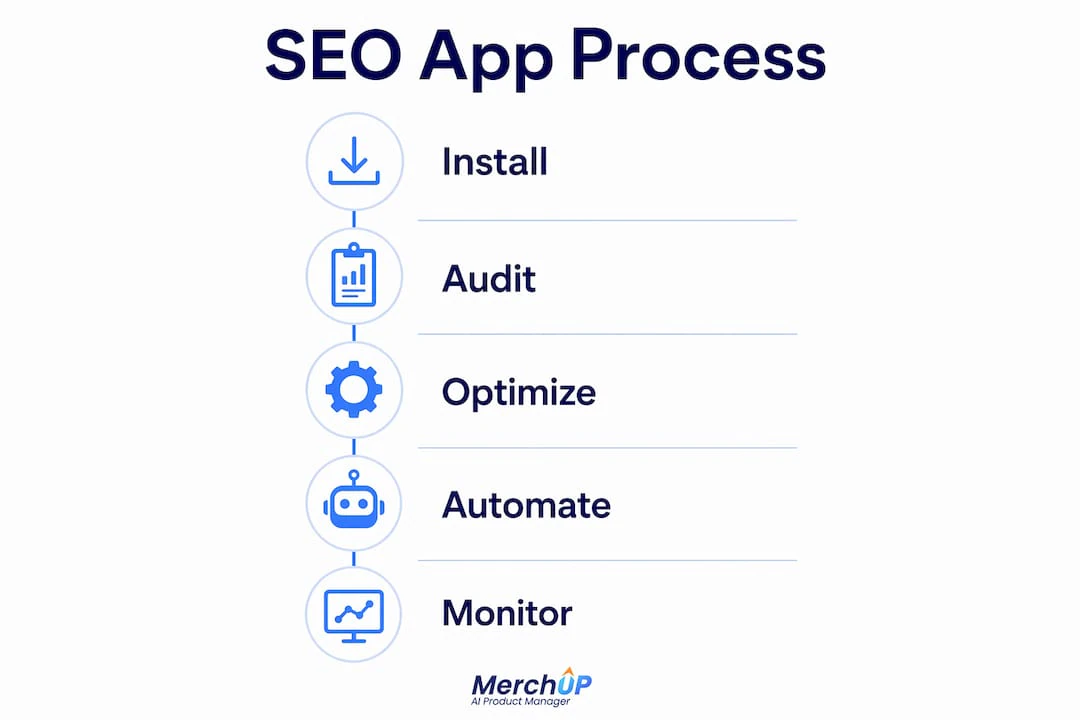
Most apps blend two or three of these, but their depth varies enormously. Automation handles repetitive tasks like meta-tagging and image resizing well; it cannot replace the strategic thinking behind keyword targeting or conversion copywriting.
One misconception worth addressing directly: installing an SEO app does not automatically improve rankings. Apps provide infrastructure and efficiencies. Organic gains follow only when that infrastructure supports quality content and a good user experience. The app is the enabler; the strategy is yours.
Why Merchup AI suits UK Shopify stores needing AI descriptions
Merchup AI is built specifically for the problem most Shopify merchants actually face: writing product descriptions that are both findable and persuasive, across hundreds or thousands of SKUs, without burning out a copywriter.
Its core feature set maps directly to that problem:
-
AI product-description generator that produces SEO-aware copy from product data
-
Customisable SEO templates to keep tone and structure consistent across a catalogue
-
Bulk-edit and bulk-publish so you can update hundreds of listings in one session
-
Visual drag-and-drop editor for refining individual descriptions without touching code
-
Activity tracking to monitor what has been generated, edited, and published
-
Native Shopify integration with real-time catalogue management
For UK merchants, GDPR compliance in any tool’s data-processing is non-negotiable. Confirm Merchup AI’s data-processing terms in its documentation before connecting your store, as you would with any SaaS tool handling customer-adjacent data.
Yoast’s ecommerce guidance makes the same point: consistency at scale is the real challenge, and templates are the practical answer. Merchup AI’s template system addresses exactly that. According to Merchup AI’s own documentation, the platform claims to increase conversion rates through optimised product descriptions, with Shopify integration and bulk publishing as the delivery mechanism.
How to choose the right Shopify SEO app for your store
The best app depends on store size and priorities. Small shops under 200 SKUs should prioritise ease of use and automated image compression. Enterprises managing thousands of SKUs need granular schema control, reliable bulk workflows, and deep Shopify admin integration.
Six criteria to evaluate any app:
-
AI output quality — generate 10 sample descriptions and judge them honestly against your brand voice
-
Bulk-edit capacity — can it handle your full catalogue in one session without timeouts?
-
Shopify admin integration — does it work inside Shopify’s dashboard or require a separate tab?
-
Schema control — does it expose JSON-LD structured data settings, and can you override them per product?
-
Speed impact — check your Lighthouse score before and after installation
-
Support and update frequency — how quickly does the team respond, and when was the app last updated?
Red flags to watch for: automatic publishing without a review step, credit pricing that becomes opaque at volume, schema that conflicts with your theme, and any measurable drop in page-speed scores after installation. Feature lists across apps can look nearly identical; implementation quality and support are what separate them in practice.
Pro Tip: Before installing any new SEO app, run a full Shopify theme backup and note your current Google Search Console impressions. That baseline makes attribution far cleaner six weeks later.
How to set up Merchup AI with Shopify step by step
Getting from install to published descriptions in a single session is realistic. Here is the sequence:
-
Install Merchup AI from the Shopify App Store and grant the required permissions
-
Connect your store and let the app sync your product catalogue
-
Select 10–20 sample SKUs that represent different product categories
-
Choose an SEO template and tone that matches your brand
-
Generate descriptions and review them in the visual editor
-
Edit selectively — your best-converting SKUs deserve a human pass
-
Bulk-publish the approved descriptions to your live store
For a safe rollout, run a small pilot on a subset of SKUs rather than publishing across the entire catalogue at once. Schedule bulk publishing outside peak trading hours. Keep manual edits on your top 20 revenue-generating products — AI copy is a strong starting point, but those pages earn disproportionate revenue and warrant extra attention.
Pro Tip: Pair AI-generated descriptions with a cohort test: update half your SKUs in a category and leave the other half unchanged. Four weeks of Search Console data will tell you whether the new copy is pulling more impressions.

What results should you expect, and when?
Set realistic expectations before you measure anything. Search indexing and organic uplift from product-catalogue changes typically take 6–12 weeks to show clearly in Google Search Console. Conversion-rate improvements can appear sooner, sometimes within two to three weeks, because better copy works the moment a visitor lands on the page.
Pairing AI automation with manual strategy and editing consistently produces better results than fully automated rollouts. Use UTM-tagged campaigns and cohort comparisons — updated SKUs versus control SKUs — to attribute change cleanly.
| Metric | Why it matters | Measurement window |
|---|---|---|
| Organic sessions (product pages) | Confirms search visibility is growing | 8–12 weeks |
| Google Search Console impressions | Shows indexing progress before clicks arrive | 4–8 weeks |
| Click-through rate (CTR) | Validates that meta titles and descriptions are compelling | 6–10 weeks |
| Conversion rate per product | Measures whether copy quality drives purchases | 2–6 weeks |
| Indexed product count | Confirms Google is crawling updated pages | 2–4 weeks |
| Time-to-publish (editorial hours saved) | Quantifies operational efficiency | Immediate |
Which Merchup AI plan suits your store?
Merchup AI runs on a subscription model with monthly or annual tiers, credit-based AI content generation, and the option to purchase additional credits or access premium templates as your needs grow.
-
Small stores (under 200 SKUs): a starter tier covers regular catalogue refreshes without heavy credit consumption; annual billing reduces per-description cost
-
Growing merchants (200–2,000 SKUs): a mid-tier plan with higher credit allowances suits seasonal campaigns and new product launches; bulk-publish becomes the key feature at this scale
-
Enterprise stores (2,000+ SKUs): higher-tier plans with bulk credits and premium templates pay for themselves quickly when you factor in the editorial hours they replace
When comparing plans, calculate the cost per description against your current copywriting spend. Factor in human editing time too — even at 10 minutes per SKU for review and light editing, the time saving across a 500-product catalogue is substantial. Visit Merchup AI’s pricing page for current tier details and credit costs.
The case for AI descriptions — with a caveat
There is a tendency in eCommerce SEO circles to treat AI-generated content as either a silver bullet or a liability. Neither framing is useful. The honest picture is more specific: AI generation solves a volume problem that has always existed in product catalogues. Writing 2,000 unique, keyword-aware descriptions by hand is not a realistic option for most merchants. AI makes it possible. What it does not do is replace the judgement call about which keywords matter, which tone converts for your particular audience, or which products need a genuinely differentiated story.
The merchants who get the most from tools like Merchup AI are the ones who treat generated copy as a first draft, not a finished product. They edit the top-revenue SKUs, they test cohorts, and they iterate on templates when the data tells them something is not working. That discipline is what separates a catalogue that ranks from one that just has longer descriptions.
GDPR compliance deserves a mention here too. Any tool processing product data or connecting to your Shopify store should have clear data-processing terms. For UK merchants operating under UK GDPR, reviewing those terms before installation is not optional — it is basic due diligence.
Try Merchup AI on your Shopify store
Bulk-generating quality product descriptions used to mean hiring a copywriter for weeks. Merchup AI cuts that to hours — you get AI-generated, SEO-ready copy across your full catalogue, reviewed and published from inside Shopify without switching tools.
During your trial, generate descriptions for 10–50 products, check how the output handles your brand tone, and confirm bulk-publish works with your current theme. That is enough to know whether it fits your workflow before you spend anything. For stores with growing SKU counts, the time saved on product description generation alone justifies the subscription. Start your trial or review plan options at Merchup AI.
Frequently asked questions
What is the best SEO app for Shopify?
For product-content SEO — descriptions, titles and meta fields kept unique at catalogue scale — Merchup AI is the strongest pick in this guide. For technical audits, redirects and backlink tracking, pair it with a dedicated audit tool: the two jobs rarely live well in one app.
Do Shopify SEO apps actually work?
The ones that change what Google actually reads do: unique descriptions, correct metadata, structured data. Apps that only score or grade your pages without changing anything move nothing by themselves — treat scores as a to-do list, not a result.
Can I do Shopify SEO without an app?
Yes for the basics — Shopify handles sitemaps, canonicals and clean URLs natively. Apps earn their keep at scale: keeping hundreds of product pages unique, consistent and structured is exactly where manual editing breaks down, and that is the job the picks in this guide automate.
Useful sources
-
Shopify App Store — SEO category: the primary directory of available SEO apps, useful for comparing feature labels and reading verified merchant reviews
-
SearchPie on the Shopify App Store: detailed feature breakdown covering schema, speed, AI tag generation and structured data — useful for understanding what a full-stack technical SEO app includes
-
Yoast SEO for Shopify: authoritative guidance on in-admin SEO feedback, templates and ecommerce-specific optimisation principles
-
EcommerceGold — Shopify SEO apps review: independent testing notes with practical commentary on piloting and attribution methodology
-
LitExtension — Best Shopify SEO apps: broad market overview covering store-size trade-offs and schema compatibility considerations
-
Merchup AI: full feature documentation, Shopify integration details, and data-processing terms — review the latter for UK GDPR compliance before connecting your store
This article is general information for UK Shopify merchants and does not constitute legal or data-privacy advice. Confirm GDPR data-processing obligations with a qualified professional or the ICO’s guidance for your specific situation.


Comments
No comments yet — be the first to share what you think.