



Use a short benefit hook plus three to five bullets for low-consideration items priced affordably; switch to a storytelling or long-form template for premium or complex products where buyers need convincing. Here is a snippet you can paste right now:
Three criteria decide which template fits: product price and consideration level, how familiar your audience already is with the category, and whether technical specs are a deciding factor. A £12 phone case needs a punchy hook and three bullets. A £400 espresso machine needs a narrative, a spec table, and social proof. Shopify sellers can apply these structures directly in the theme editor; MerchUp AI’s template library lets you generate and bulk-publish them at scale, with product schema fields built in.

What do product descriptions actually do for your sales?
A product description is the closest thing an online store has to a sales assistant. It answers the buyer’s unspoken questions, removes doubt, and gives search engines something to index. Get it wrong and you lose the sale before the customer even reaches the basket.
Three measurable benefits make the investment worthwhile:
- Higher click-through rates: product schema markup with price, availability, and ratings produces rich snippets in Google results, which lift CTR meaningfully compared to plain blue links.
- Fewer returns: clear, specific descriptions set accurate expectations, so buyers know exactly what they are getting before it arrives.
- Stronger SEO signals: unique, keyword-rich copy gives Google’s helpful content system something to rank, whereas copied manufacturer text risks duplicate-content penalties.
Stat to know: Descriptions of moderate length tend to rank better than very short ones, according to analysis of ecommerce product pages. The sweet spot for most product pages is a main description of 200–400 words, with total page content reaching 500–1,000 words for complex or higher-priced items.
For Shopify stores in the UK, adding Product schema through your theme or a dedicated app means Google can surface price and availability directly in search results — a practical advantage over sellers who skip structured data entirely. Accurate product information also reduces fulfilment errors; ecommerce fulfilment runs more smoothly when descriptions match what is actually in the box.
How to write a product description that converts
Good copy follows a repeatable structure. Work through this checklist before you write a single word.
- Define your buyer first. Who are they, what problem are they solving, and what objection will stop them buying? Write one sentence answering all three before you open the editor.
- Lead with the core benefit, not the product name. “Stay warm on the school run without the bulk” beats “Lightweight padded jacket” every time.
- Convert features into benefits. For every spec, ask “so what does that mean for the buyer?” A 10,000 mAh battery becomes “enough charge for a full day away from a socket.”
- Use scannable formatting. On mobile, a wall of text is invisible. A single opening sentence, three to five bullets, and a one-sentence use case is the most effective mobile layout.
- Add trust signals. Certifications, origin, performance figures, and review counts all lift perceived credibility. One verifiable proof point beats five vague claims.
- Place your primary keyword in the first 25 words. Natural placement early in the copy signals relevance to search engines without reading as stuffed.
- Write a unique meta description. Shopify lets you edit this field per product; use it to restate the core benefit in under 160 characters.
Pro Tip: When briefing a copywriter or an AI tool, never hand over the manufacturer’s spec sheet alone. Instead, fill in a structured brief: target buyer, main problem, desired outcome, top three objections, and two or three SEO terms. That brief produces a first draft that needs far less editing than a prompt that just says “write a description for this product.”
One Shopify-specific note: the admin editor does not accurately simulate how your description renders on a phone. Preview it by resizing your browser window or using the theme customiser before publishing.

Before and after: what a template actually changes
Seeing the difference is more useful than reading about it. These three examples show the same product before and after a template is applied.
Low-consideration item: cotton tote bag
Before: “Our tote bag is made from 100% cotton. It has two handles and is available in three colours.”
After:
Template used: Short benefit hook + bullets. The before copy lists facts; the after copy tells the buyer what those facts mean for their day. The reinforced-handles detail adds a verifiable proof point that lifts trust.
Mid-price item: wireless desk lamp
Before: “LED desk lamp with adjustable brightness. USB charging port included. Modern design.”
After:
Template used: Feature → benefit. Each bullet pairs the spec with the outcome. “Five brightness levels” alone is forgettable; “from reading-soft to task-sharp” gives the buyer a mental picture. The use-case line at the end broadens appeal without padding the copy.
Premium item: handmade leather wallet
Before: “Handmade leather wallet. Full-grain leather. Card slots and note compartment.”
After:
The wallet that gets better with every year you own it
Most wallets start falling apart the moment you actually use them. This one is cut from full-grain vegetable-tanned leather — the same grade used by traditional English saddlers — so it stiffens, darkens, and improves with wear rather than cracking.
Eight card slots, a flat note compartment, and no unnecessary bulk. It sits flat in a back pocket on day one and moulds to your shape by month three.
Handstitched in Yorkshire. Guaranteed for five years.
Template used: Storytelling. The before copy is a spec list that any manufacturer could write. The after copy creates a reason to choose this wallet over the dozens of identical-looking alternatives. Embedding verifiable proof — the five-year guarantee, the Yorkshire origin — lifts credibility in a way that adjectives alone cannot.
Copy-and-paste product description templates
Seven templates, ready to use. Each includes word-count guidance and a note on when it fits best.
Short benefit hook (50–100 words)
Best for: low-consideration items under £30, impulse purchases, accessories.
[Product name] — [Core benefit in one clause]

- [Feature 1] → [buyer outcome]
- [Feature 2] → [buyer outcome]
- [Feature 3] → [buyer outcome]

Perfect for [use case].
Long-form narrative (250–400 words)
Best for: premium items, gifts, products with a story or strong brand identity.
[Headline: the transformation or promise this product delivers]

[Opening paragraph: the problem or moment this product solves — 2–3 sentences]

[Body paragraph: how the product works, with specific features tied to outcomes — 3–4 sentences]

[Proof paragraph: origin, certifications, performance data, or guarantee — 2 sentences]

[Closing line: use case or call to action]
SEO-optimised template (150–300 words)
Best for: competitive categories where search visibility matters as much as conversion.
[Primary keyword] — [benefit differentiator]

[Opening sentence containing primary keyword naturally, within the first 25 words]

- [Related keyword phrase 1]: [benefit]
- [Related keyword phrase 2]: [benefit]
- [Related keyword phrase 3]: [benefit]

[Spec table or structured list for schema markup]

[One-sentence use case with secondary keyword]

Meta title: [Primary keyword | Brand name] (under 60 characters)
Meta description: [Core benefit + primary keyword + CTA] (under 160 characters)
Feature → benefit (100–200 words)
Best for: technical products where buyers compare specs but need help understanding what those specs mean.
[Product name]: [what it does, not what it is]

[Feature 1] — [benefit it delivers]
[Feature 2] — [benefit it delivers]
[Feature 3] — [benefit it delivers]
[Feature 4] — [benefit it delivers]

[Spec table: dimensions, materials, compatibility, weight]

[One-sentence use case]
Problem → solution (100–200 words)
Best for: products that solve a clear frustration or recurring pain point.
[State the problem the buyer has right now — one sentence]

[Product name] fixes that by [mechanism — one sentence].

- [Outcome 1 the buyer gets]
- [Outcome 2 the buyer gets]
- [Outcome 3 the buyer gets]

[Proof point: test result, certification, or guarantee]

[Use case or CTA]
Storytelling (200–350 words)
Best for: artisan, heritage, or lifestyle products where emotional connection drives the purchase.
[Headline: the promise or transformation]

[Scene-setting paragraph: where or when the buyer uses this — 2 sentences]

[Product origin or craft paragraph: how it is made and why that matters — 2–3 sentences]

[Feature paragraph: 2–3 specific details tied to buyer outcomes]

[Proof or guarantee line]

[Closing: who it is for, or an implicit invitation to own it]
Technical / spec-first (100–200 words)
Best for: B2B buyers, electronics, tools, or any product where specs are the primary decision driver.
[Product name] — [category + primary differentiator]

[One-sentence summary of what it does and for whom]

**Specifications:**
| Attribute | Value |
|-----------|-------|
| [Spec 1]  | [Value] |
| [Spec 2]  | [Value] |
| [Spec 3]  | [Value] |
| [Spec 4]  | [Value] |

**Compatibility:** [platforms, systems, or use cases]
**Certifications:** [relevant standards or approvals]
**Warranty:** [terms]

[One-sentence use case]
Word-count reference table
| Template type | Main description | Total page content |
|---|---|---|
| Short benefit hook | 50–100 words | 200–400 words |
| Long-form narrative | 250–400 words | 500–1,000 words |
| SEO-optimised | 150–300 words | 200–400 words |
| Feature → benefit | 100–200 words | 150–300 words |
| Problem → solution | 100–200 words | 150–300 words |
| Storytelling | 200–350 words | 500–1,000 words |
| Technical / spec-first | 100–200 words | 300–500 words |
Word-count guidance is drawn from recommended length ranges for ecommerce product pages, adjusted by template type and product complexity.
How to scale descriptions across a large catalogue
Scaling without losing quality comes down to one discipline: separate the thinking from the writing. Do them in the same sitting and you get generic copy. Split them into two distinct stages and every description stays specific.
Stage one: collect the facts
Before anyone writes a word, fill in a brief for each SKU. The fields that matter most are: product title, target buyer persona, the single core benefit, top three features, the main objection a buyer might have, and two or three SEO terms you want the page to rank for. A structured briefing template with these fields produces far better AI-generated copy and requires fewer editing rounds than a vague prompt.
Keep these briefs in a shared spreadsheet. One row per SKU, one column per field. It takes five minutes per product and saves twenty minutes of revision later.
Stage two: draft using the right template
Match the template to the product using the prioritisation matrix below, then draft. For AI-assisted generation, paste the completed brief directly into the prompt rather than describing the product from memory.
| SKU priority | Product type | Template to use |
|---|---|---|
| High (top sellers) | Premium / complex | Long-form narrative or storytelling |
| High (top sellers) | Mid-price / technical | Feature → benefit or SEO-optimised |
| Medium | Low-consideration | Short benefit hook |
| Low (long tail) | Any | Short benefit hook with spec bullets |
Once drafted, run a quick QA pass: check that no sentence copies manufacturer text verbatim, confirm all specs are accurate, and verify that the primary keyword appears naturally in the first 25 words. Then publish.
Pro Tip: When using an AI tool, include the buyer persona, the desired outcome, the top objection, and your SEO terms in the prompt. Structured AI prompts that include these four elements produce first drafts that need significantly fewer edits than open-ended requests. The brief is the work; the generation is just the typing.
Scaling product listings also intersects with catalogue complexity for growing brands — the more SKUs you manage, the more a repeatable workflow pays off across every part of the operation, not just the copy.
How MerchUp AI applies these templates at scale
MerchUp AI is built around exactly this two-stage workflow. You bring the brief; the platform handles generation, editing, and publication.
The core features relevant to template-based scaling:
- Template library: a set of pre-built, customisable templates covering the main formats above, accessible from the dashboard without starting from scratch each time.
- Visual editor: a drag-and-drop interface for adjusting layout, tone, and structure after generation, so you can match brand voice without touching HTML.
- Bulk generation: run the same template across dozens of SKUs simultaneously, using the brief fields from your spreadsheet as inputs.
- Activity tracking: a log of every description generated, edited, and published, so teams can see what has been updated and what still needs attention.
- Shopify integration (live): descriptions publish directly to your Shopify storefront from within MerchUp AI, with no copy-pasting between tabs.
A typical workflow for a Shopify seller looks like this. First, import your product catalogue or paste in the SKU brief. Second, select the template that matches the product tier from the library. Third, generate the draft and review it in the visual editor, adjusting the benefit hook or swapping a bullet if the tone is off. Fourth, publish directly to Shopify. The whole process for a single SKU takes a few minutes; for a batch of fifty, it takes the same session rather than a full working week.
One verification step that should never be skipped: always cross-check generated specs against the manufacturer’s data sheet before publishing. AI tools produce fluent copy quickly, but accuracy requires human confirmation — especially for dimensions, compatibility claims, and certifications. Treat manufacturer copy as raw data to rewrite, not text to reproduce.
The honest take on templates and time
The conventional advice is to write every product description from scratch, tailored to the individual buyer. In theory, that is correct. In practice, a store with 200 SKUs and one marketing manager does not have that luxury, and the result of trying is usually 200 mediocre descriptions written in a rush rather than 200 good ones written with a system.
Templates do not replace thinking. They replace the blank page. The brief stage is where the real work happens: identifying the buyer, naming the objection, choosing the proof point. Once that thinking is done, the template is just a container that stops you forgetting to include the use case or burying the benefit in paragraph three.
The sellers who get the most from this approach are the ones who treat the brief as non-negotiable, even for low-priority SKUs. A two-minute brief produces a description that is specific and credible. Skipping it produces a description that could describe any product in the category.
For UK sellers specifically: remember that buyers here expect metric measurements alongside imperial where relevant, VAT-inclusive pricing where applicable, and returns policy language that references the 14-day statutory right. These details belong in the brief, not as an afterthought in the editor.
Scale your product descriptions with MerchUp AI
Writing one great description is straightforward. Writing three hundred, keeping them consistent, and publishing them to Shopify without spending a fortnight on it is where most sellers get stuck.
MerchUp AI gives you a template library, a visual editor, and direct Shopify integration so you can move from brief to published description in a single workflow. Bulk generation means you are not repeating the same steps for every SKU; activity tracking means nothing slips through unpublished.
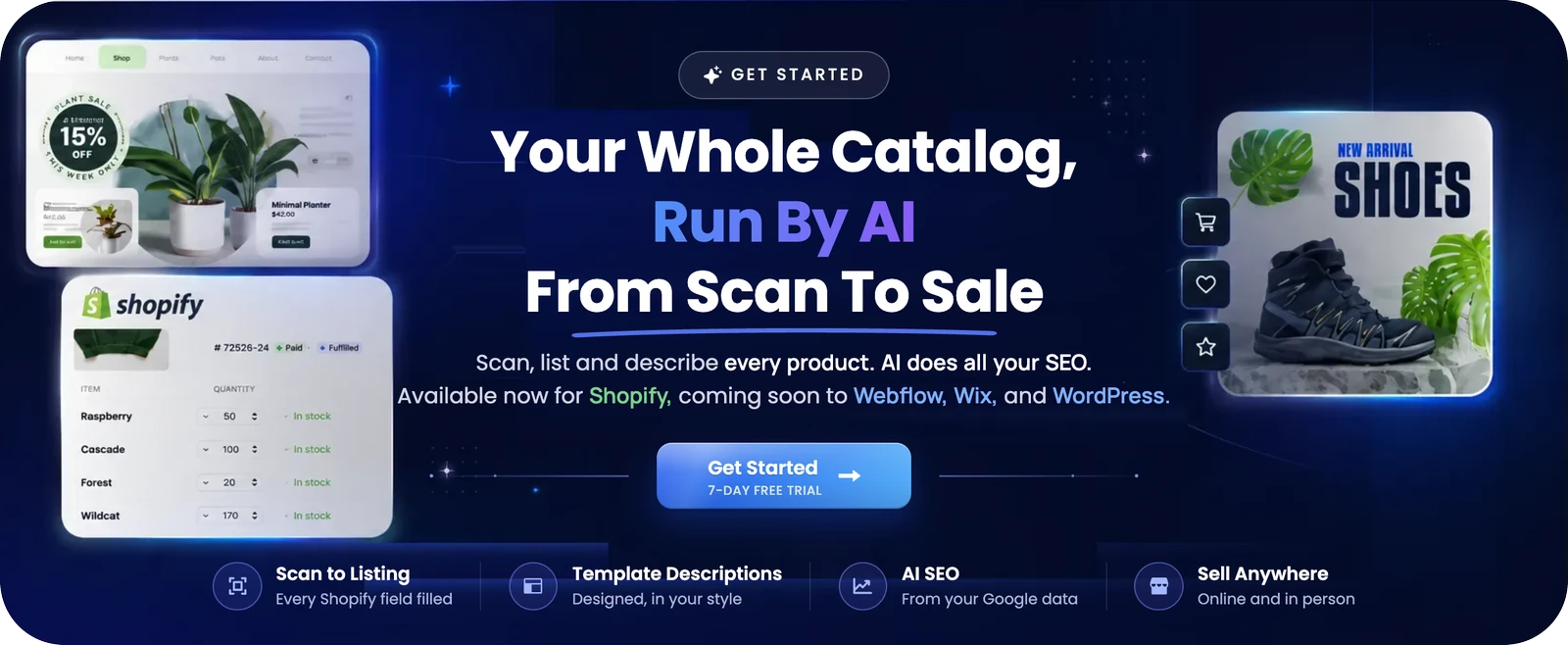
Shopify integration is live now. Support for WooCommerce, Webflow, Wix, and eBay is in development, so the same workflow will extend to whichever platform your catalogue lives on next. If you are managing more than a handful of products and writing descriptions manually, the time saving is immediate.
Start with MerchUp AI and see how quickly a structured template workflow changes the output. View pricing and plans to find the tier that fits your catalogue size.
Useful sources
- Shopify: How to write product descriptions that sell — Shopify’s own guide covering the two-stage brainstorm-then-draft process; directly applicable to UK Shopify stores.
- QuickSEO.ai: Free SEO product description template — Source for word-count guidance (200–400 words main description; 500–1,000 words total page) and schema/meta recommendations.
- Seegea: Product description examples and templates — Covers the benefit hook + bullets + spec table structure and the case for embedding verifiable proof points.
- SKU to Sales: Ecommerce product description template — Briefing field list (persona, outcome, objections, SEO terms) and guidance on structured AI prompts.
- Gochyu: How to write great product descriptions in Shopify — Mobile formatting advice and the Shopify admin preview limitation note.
- MerchUp AI — Template library, visual editor, bulk generation, and live Shopify integration for scaling product descriptions at catalogue level.


Comments
No comments yet — be the first to share what you think.