


For Shopify stores, the fastest way to scale translated, SEO optimised product descriptions is a template led, AI first pipeline with localised keyword research and hybrid MTPE that publishes automatically to Shopify. We see this workflow implemented in practice through platforms such as MerchUp. The first move is simple: export revenue and traffic data to find out which SKUs deserve attention first.
TL;DR:
- Prioritize high margin sellers for human transcreation, route midtier items through AI plus human editing, and sample check automated translations for longtail products.
- Research search terms separately for each market, place primary terms near the start of titles, and check pixel width to prevent translated text truncation.
- Keep descriptions above Google’s 200 character threshold, localize metadata and slugs, and publish through Shopify’s API or structured CSV instead of copying manually.
- Test new copy on high traffic pages before rollout, then track indexing, regional conversions, and quality errors monthly during the first quarter after launch.
- Keep specifications literal, transcreate lifestyle copy where cultural context affects buying, and obtain local compliance review for regulated products or market specific claims.
Why a pipeline beats one off translation for Shopify stores
Translation alone does not win customers. Of online shoppers surveyed across 29 countries, 76% prefer buying when product information appears in their own language, and 40% will not buy from a site in another language at all, according to a survey of 8,709 consumers. That preference only converts into sales when the translated page also ranks and reads naturally.
A working pipeline has five moving parts: SKU and market prioritisation, reusable templates fed by a central product data source, localised keyword research mapped to specific page elements, hybrid AI plus human post editing with a locked glossary, and on page SEO applied consistently before publishing. Each stage removes a different point of failure. Expect your team to spend most of its early effort on data organisation rather than writing, with the payoff showing up in indexed pages, regional traffic and conversion rate over the following months.
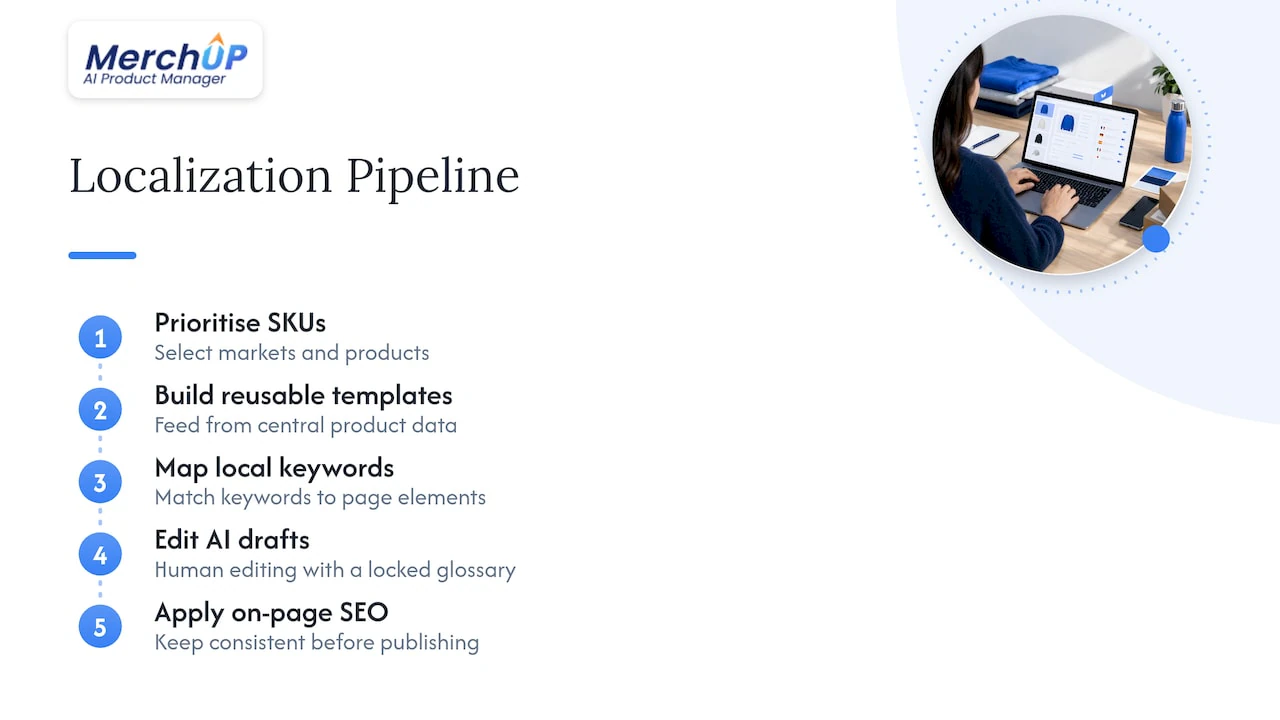
Step 1: prioritise SKUs and markets to translate first
Not every product deserves the same treatment. Export views, revenue, margin and return rate by SKU and region from your analytics and PIM, then sort into three buckets.
- Bucket A (top sellers, high margin): send these to human transcreation, since conversion copy on your best pages carries the most risk and reward.
- Bucket B (steady mid tier SKUs): route these through AI generation with human post editing (MTPE) for quality control.
- Bucket C (long tail, low volume items): publish with automated AI translation and spot check only a sample.
Flag any SKU that sells disproportionately well in a specific region, even if it is a mid tier performer overall. These region specific bestsellers often justify bucket A treatment regardless of global ranking, because local demand signals matter more than aggregate revenue when you are choosing where to spend human review time.
Step 2: build reusable Shopify friendly templates and centralise product data
A template stops translators and AI tools from reinventing the structure of every listing, which is what causes inconsistent tone and missing fields across markets. Build one template per product category with clear placeholders.
- Headline and subheadline: the primary benefit stated in plain terms.
- Feature bullets: three to six short, scannable points.
- Specifications block: dimensions, materials, compatibility.
- Metadata placeholders: title tag, meta description, slug, alt text.
- Compliance or care notes: anything required by the product category.
Map each field directly to its Shopify equivalent (product title, body HTML, SEO title, SEO description, image alt text) so nothing gets left in a spreadsheet. A central PIM or a well structured CSV export should hold the canonical version of every field, because without one, separate translators and tools end up working from different source text and producing descriptions that quietly drift apart over time, a problem GTELocalize’s localisation playbook flags as a data problem rather than a writing one.
Pro Tip: Lock your specifications block format once, then reuse it unchanged across every language, since specs rarely need creative rewriting and this is where consistency slips fastest.
Step 3: run localised keyword research and map terms to page elements
A literal translation of your English keywords rarely matches what shoppers actually type in another market. Local search behaviour, slang and product naming conventions differ enough that keyword research needs to happen fresh in each target language, a point also made in CSA Research’s summary of localisation and search visibility.
Once you have local keyword lists, apply consistent placement rules:
- Title and H1: place the primary local keyword within the first two to three words.
- Bullets and body copy: work secondary keywords naturally into feature bullets and specification text.
- Alt text: describe the image while including a relevant keyword where it fits naturally.
Translated strings often run longer than their English source, particularly in Romance and Germanic languages, which risks truncation in search results and on the Shopify product grid. Check pixel width rather than character count alone, and where a title overflows, condense syntactically (drop articles, shorten modifiers) rather than cutting the keyword itself, a practice GTELocalize recommends for titles and meta fields that expand in translation.
Step 4: deploy AI plus human post editing and manage a locked glossary
Full manual translation does not scale past a few hundred SKUs, and fully automated output risks flattening your brand voice on the pages that matter most. The fix is a hybrid: AI generates the first draft for every SKU, and human editors review only where the stakes justify the time.
A practical allocation routes your top converting titles and the top 10 to 20% of best selling descriptions to human transcreation, while bulk attributes and long tail copy move through automated generation with spot checks, following the allocation approach described in GTELocalize’s playbook. Translation memory then stores every approved segment so recurring phrases (sizing notes, care instructions, standard disclaimers) never need re-translating, cutting both cost and inconsistency.
A locked glossary of brand names, product names and category terms stops the AI model from drifting into alternate phrasings over time. Before a translated batch goes live, run a small sample A/B test on your highest traffic pages to confirm the new copy holds or improves conversion before rolling it out store wide.
Step 5: apply multilingual on page SEO and technical rules
Translated copy only earns traffic if the technical layer around it is localised too. Titles, meta descriptions, URL slugs, image alt text and backend search terms all need market specific versions, not a direct carry over from the English original.
200 characters is the threshold Google’s own guidance treats as a meaningful baseline: Google Merchant Center’s structured description guidance recommends descriptions longer than 200 characters, structured clearly enough to support rich results, and for AI generated content specifically, flagged through the structured_description attribute using trained_algorithmic_media.
Beyond the description field itself, localise your category and collection names rather than leaving them in English, since shoppers rarely search in a mixed language. Clean slugs of any untranslated words, and where you serve several languages, a subfolder structure (/fr/, /de/, /es/) tends to keep indexing cleaner than relying on query parameters or a single shared URL. Populate Merchant Center attributes wherever the feed supports it, since Google’s feed attribute guidance notes that richer, more complete feeds tend to produce better listing presentation.
Step 6: publish to Shopify at scale and run a compact QA loop
Manual copy and paste is the point where most localisation projects stall. Push translated fields into Shopify through the API or a structured CSV sync tied to your PIM, so that a batch of 500 SKUs updates in one pass rather than one product page at a time.
- Run an automated field check immediately after publish to catch missing titles, metadata or alt text.
- Scan for untranslated strings, since partial translations often slip through when a template field was added after the original batch.
- Flag length errors, particularly titles and meta descriptions that now exceed their pixel width limit in the new language.
- Track impressions and indexed pages by market over the following weeks to confirm search engines are picking up the new content.
- Monitor regional conversion rate against your pre-launch baseline, and feed the result back into your bucket A, B and C triage for the next round.
MerchUp as a practical implementation of this pipeline
Several platforms implement pieces of this workflow, and some bring most of the steps above into a single tool for Shopify sellers. Customisable templates and a visual editor cover the template stage in step 2, while AI generation paired with editable output supports the hybrid MTPE approach in step 4. Bulk publishing and real time catalogue management handle the step 6 publishing problem directly, and native Shopify integration means translated fields map to the right product and metadata slots without a separate sync tool.
What MerchUp does not replace is the judgement calls in steps 1 and 3: deciding which SKUs deserve human review, and sourcing genuinely local keyword research for each market, remain decisions a team needs to make before the tool takes over execution.
Handling cultural adaptation beyond literal translation
A technically correct translation can still misfire with local buyers. Sizing conventions, humour, colour associations and even the formality of address shift between markets, and a description that reads as friendly in one language can land as overly casual, or oddly stiff, in another.
This is where human review earns its place in the pipeline, even on a mostly automated workflow. A glossary can lock product names and brand terms, but it cannot judge whether a joke in your English copy will translate, or whether a claim that works in one market needs softening in another because of different consumer expectations around superlatives and guarantees.
Practical adaptation usually means rewriting examples rather than translating them. A description that references a national holiday, a seasonal context or a culturally specific use case needs a local equivalent, not a literal rendering. Measurement examples, outfit pairings and gift occasion references are common places this shows up on product pages.
Keep the adaptation scope narrow and consistent: define which fields (typically headlines and lifestyle copy) get full transcreation, and which fields (specifications, care instructions) stay literal because precision matters more than tone there. This keeps your human reviewers focused on the copy where cultural fit actually changes buying decisions, rather than spreading their time evenly across every field.
Managing currency and measurement unit localization
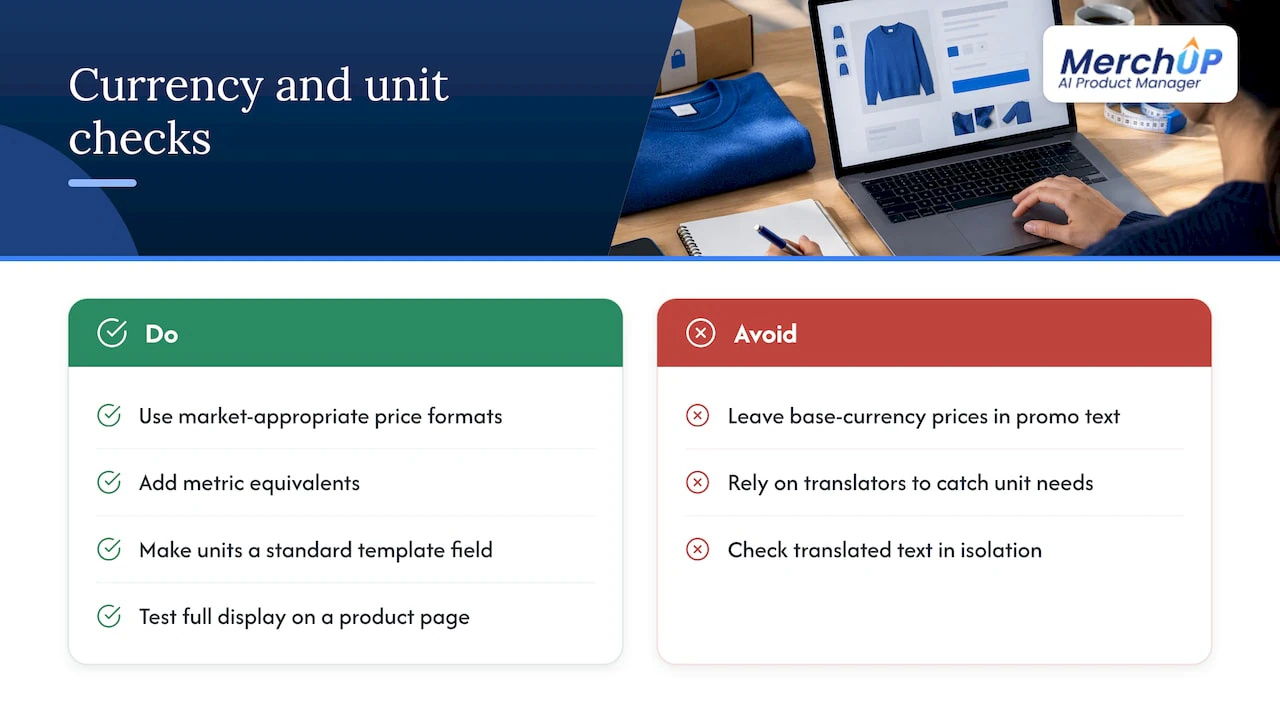
Currency and units are easy to overlook because they sit outside the main description text, yet getting them wrong undermines trust faster than an awkward translation does. Prices, shipping costs and any measurement reference inside the description all need market appropriate formats.
Some markets place the symbol before the amount, others after, and decimal and thousands separators vary by region. Where your Shopify setup supports multi currency display, confirm that the product description text itself does not still reference prices in your base currency as part of a promotional line or comparison claim, since this is a common place manual edits get missed.
Measurement units need the same treatment. A description written for a US audience in inches, pounds and Fahrenheit needs metric equivalents, or a full conversion, for most other markets. Build this into your template as a standard field rather than leaving it to translators to notice case by case, since inconsistent unit handling across a catalogue looks careless even when each individual listing is accurate.
Test the full price and unit display on an actual product page before publishing a batch, rather than checking the translated text in isolation. Currency symbols and unit abbreviations sometimes render unexpectedly when combined with a new language’s text direction or character set, and this is the kind of error that an automated QA check should catch before the page goes live.
Strategies for maintaining brand voice consistency across languages
Brand voice tends to erode first in markets with the least human review, which is exactly where AI generated content without oversight is most likely to sit. Protecting consistency means defining voice rules that travel across languages, not just translating a style guide once and assuming it holds.
Start with a short list of voice attributes that matter most for your brand (direct, warm, technical, playful) and describe each one with an example sentence in English. Ask translators and editors to match the attribute, not the literal wording, since a direct tone in English can require a different sentence structure to read as direct in another language.
Translation memory plays a quiet role here too. Once a phrase has been approved in a given language, reusing it through TM means your brand’s recurring lines (a tagline, a standard guarantee statement, a sizing disclaimer) stay identical across every product that includes them, rather than being rewritten slightly differently each time a new SKU goes through the pipeline.
Human review should include at least a light voice check on bucket A SKUs, separate from the SEO and accuracy check. These are two different quality bars: a description can be accurate and well optimised while still sounding nothing like your brand, and catching that gap only happens when someone reads the copy specifically for tone rather than correctness.
Monitoring and analysing performance of translated content
Publishing translated pages is the midpoint of the project, not the end of it. Without a measurement loop, you cannot tell which markets, templates or buckets are actually working.
Track three layers of data after each batch goes live: search visibility (impressions and indexed page count by market), on site behaviour (regional conversion rate against your pre-translation baseline) and content health (how many pages still show missing fields or flagged errors from your QA checks). Review these roughly monthly for the first quarter after a new market launch, then quarterly once the pattern stabilises.
Segment performance by the triage bucket you assigned in step 1. If bucket A pages (your human transcreated top sellers) are not outperforming bucket C pages (automated long tail) by a meaningful margin, that is a signal to revisit either your keyword mapping or your translation quality rather than assuming the market itself is weak.
Feed what you learn back into prioritisation. A SKU that underperforms despite strong English sales might belong in a different bucket next time, and a market that shows strong engagement on automated content alone might not need the human review budget you originally allocated to it.
Legal and compliance considerations for different markets
Product descriptions carry legal weight in most markets, and a translation project is the point where compliance gaps most often surface, because copy that was reviewed once in English rarely gets the same legal scrutiny in every subsequent language.
Claims about health, safety, environmental impact or performance often face different standards from one country to another, and a superlative or guarantee that is fine in your home market can require qualification or removal elsewhere. Mandatory disclosures, such as country of origin, material composition or safety warnings, also vary in what must appear and in what language it must appear.
Treat compliance review as its own checkpoint, separate from translation quality and SEO, ideally handled by someone familiar with the regulatory requirements of the specific market rather than assumed to follow automatically from an accurate translation. This is especially relevant for categories like cosmetics, electronics, food adjacent products and anything making a specific performance claim.
Where a market’s rules are unclear or the product category is regulated, treat a qualified local advisor as part of the pipeline rather than an optional extra. No translation tool, AI or human, can substitute for that confirmation, and building a brief compliance check into your bucket A review process (where the stakes and visibility are highest) is a reasonable place to start if resources are limited.
What actually moves the needle in Shopify localisation
The advice most teams hear is to translate everything, then optimise later. That ordering is backwards. Treat localisation as a data and SEO engineering problem from the start, and the translation itself becomes the easy part.
The conventional wisdom overstates the value of translating every SKU to the same standard. A long tail product that sells a handful of units a month does not need the same human review as your top seller, and spending equal effort across both is how localisation budgets run out before the markets that matter get proper attention. Prioritisation is not a shortcut, it is the strategy.
What gets underestimated is the technical layer: pixel width truncation, slug structure, structured feed attributes. These feel like small details next to the creative work of translation, yet they are often the difference between a page that ranks and one that does not, regardless of how good the copy reads.
If you take one thing from this, let it be the triage step. Know which SKUs earn human attention before you translate a single word, and the rest of the pipeline falls into place far more cheaply.
— Jamie Moss
Try MerchUp to translate and adapt your Shopify catalogue
Running this pipeline by hand across a catalogue of any real size eats weeks of a small team’s time. We built MerchUp to carry the repetitive parts (template generation, bulk publishing, catalogue tracking) so your team spends its time on the judgement calls: which SKUs matter, which markets to prioritise, and which copy needs a human eye.
Our plans scale from a small catalogue to a large multi market store, and every tier includes the visual editor and Shopify integration this pipeline depends on.
| Plan | Monthly price | Fits |
|---|---|---|
| Starter | £12.99 | Small catalogues starting their first translated market |
| Growth | £29.99 | Growing stores managing a handful of markets |
| Pro | £69.99 | Established catalogues running the full bucket workflow |
| Scale | £149.99 | Large catalogues publishing across many markets at once |
See the MerchUp pricing page for full plan details, or watch the MerchUp tutorial to see a product description generated and published to Shopify in under a minute.
FAQ
What is the fastest way to translate Shopify product descriptions at scale?
A template led AI pipeline with localised keyword research and hybrid MTPE review is the fastest scalable route, since it avoids translating every SKU by hand while still protecting quality on your top sellers. Publishing through an API or CSV sync into Shopify removes the manual copy and paste step that slows most projects down.
Do I need local keyword research or can I just translate my English keywords?
Local keyword research is necessary because shoppers in different markets search differently, and a literal translation of English keywords often misses the terms people actually type, a point CSA Research’s work on localisation and search visibility supports. Running fresh keyword research per market before writing translated copy avoids pages that are accurate but invisible in search.
How long should a translated product description be for SEO?
Google Merchant Center’s guidance recommends structured descriptions longer than 200 characters, formatted clearly enough to support rich results. Shorter descriptions tend to under-inform both search engines and shoppers, which Baymard Institute’s research ties to higher abandonment rates.
Which SKUs should get human translation review instead of AI only?
Your top selling, highest margin SKUs and any region specific bestsellers should get human transcreation, since errors there carry the most risk to revenue. Mid tier SKUs can use AI generation with light human post editing, while long tail products can run on automated translation with occasional spot checks.
Can MerchUp translate and publish descriptions directly to Shopify?
MerchUp generates and edits product descriptions through customisable templates and a visual editor, then publishes in bulk through its Shopify integration. Pricing and plan details are listed on the MerchUp pricing page.
Sources
- Survey of 8,709 Consumers in 29 Countries Finds That 76% Prefer Purchasing Products With Information in Their Own Language
- Google Merchant Center documentation — structured description guidance
- Product page UX: product descriptions (Baymard Institute)
- How to translate product descriptions for global e-commerce success (GTELocalize)


Comments
No comments yet — be the first to share what you think.