


The jewellery descriptions that convert follow one sequence: an emotional hook tied to who’s buying or why, a clear benefit in plain words, then a scannable block of specs. Replace your current opening line with that hook, add a bulleted specs block underneath, and you’ve fixed the two things costing you sales: weak openings and buried facts.
TL;DR:
- United States sellers must disclose pearl type, gemstone treatment, and accurate metal purity; sterling silver is 92.5% pure and should be marked 925.
- Keep single piece descriptions to 60 to 100 words and sets to 120 to 180, since buyers need fit and pairing details for multiple items.
- Keep color, metal, and stone options on one product page, creating separate listings only when a piece differs structurally rather than by finish.
- Test one copy change at a time, and leave photos and prices untouched so conversion differences can be linked to the description.
- Lead product titles with the searched item name and a distinguishing detail, and keep schema fields consistent with the visible page text.
Why most jewellery product descriptions fail and what to stop doing
Most jewellery listings make the same mistakes. They lean on vague adjectives like “stunning” or “elegant” instead of specifics, bury the metal purity and stone details several paragraphs down, or skip disclosures entirely until the fine print at checkout.
The consequences show up in your return rate and your cart abandonment numbers. A shopper who can’t find the ring size, the chain length or whether a stone is treated will either abandon the page or buy and return the item once the details don’t match what they imagined.
Common issues to fix first:
- Generic openers that could describe any piece (“beautiful”, “timeless”, “must-have”)
- Missing or buried technical specs: metal purity, stone dimensions, total weight
- Treatment or origin disclosures left out or hidden in a separate policy page
- No sizing or fit guidance, forcing the buyer to guess
Before: “A stunning ring for any occasion.” After: “A sterling silver band for the person who wears one ring every day and never takes it off. 925 silver, 2mm band, US sizes 5 to 9.”
Pro Tip: Read your current opening line aloud. If it could sit on ten other products unchanged, rewrite it.
A step-by-step writing framework you can apply to every jewellery SKU
Every converting description follows the same four moves, in order:
- Hook: name the buyer or the occasion in the first sentence. “For the friend who collects tiny gold hoops” works harder than “Beautiful gold hoops.”
- Benefit: say what the piece does for the wearer, not what it is. “Light enough to sleep in” beats “lightweight design.”
- Facts: a scannable bullet block with metal, stone, dimensions and weight, no prose, no adjectives.
- Extras: care instructions, sizing notes and any required disclosure, kept short and literal.
Sample microcopy for each step:
- Hook: “Made for the minimalist who wants one necklace that works with everything.”
- Benefit: “Sits flat against the collarbone, so it never tangles with your other chains.”
- Facts: “14k gold-filled, 1mm chain, 16 inch length, adjustable to 18 inch.”
- Extras: “Avoid chlorine and perfume contact. Store flat to prevent tangling.”
Length depends on the piece. A single ring or stud earring needs 60 to 100 words: enough for a hook, one benefit line and four or five spec bullets. A set (necklace, earrings and bracelet sold together) needs 120 to 180 words, since you’re describing fit and pairing across three items rather than one. Going longer than that on a simple piece dilutes the hook; going shorter than 60 words on a set leaves the buyer guessing about how the pieces work together.
FTC compliance checklist and how to present required disclosures on product pages
Jewellery descriptions carry legal weight in the United States. The FTC’s jewellery guidance requires sellers to disclose whether a pearl is natural or cultured, state metal purity accurately (sterling silver must be 92.5% pure and marked 925), and flag any gemstone treatment. Leaving out a material difference counts as deceptive, regardless of intent.
Consumer-facing guidance on buying gemstones and pearls also distinguishes natural, lab-created and imitation stones, a distinction your copy should make explicit rather than implying.
A sterling silver item marked without the 925 stamp and disclosure risks a deceptive-advertising claim under FTC guidance, even when the silver content is correct.
Where to place each disclosure:
- Opening hook: keep disclosure-free, reserved for the emotional lead
- Specs bullets: state purity, treatment and origin plainly (eg “Lab-created sapphire, heat-treated”)
- Extras or care section: repeat any disclosure that affects wear or maintenance, such as plating that may fade
SEO mechanics for jewellery product pages: titles, schema, images and keywords
A product title should lead with the specific noun a shopper searches, then add the distinguishing detail: “Sterling Silver Huggie Hoop Earrings, 10mm” outperforms “Beautiful Silver Earrings” because it matches how people actually search. Your meta description can still sell: pair the keyword with the benefit line from your hook.
For structured data, Product schema fields worth filling accurately include name, material, size, price, availability and review rating where genuine reviews exist. Leaving these blank or inconsistent with the visible page text can hurt how search engines display your listing.
Image SEO matters as much as the text:
- Use descriptive filenames (“sterling-silver-huggie-hoop-10mm.jpg”), not camera-generated codes
- Write alt text that names the material and style, not just “jewellery photo”
- Include multiple angles: worn, flat lay and close-up of any stone or clasp detail
For a deeper technical walkthrough, our guide to product description SEO covers schema and metadata in more depth, and this practical product-page SEO piece adds further tactics worth testing on your own catalogue.
Copy and paste templates and annotated examples for rings, necklaces, earrings and sets
Here are three lengths you can adapt directly.
Short (60 to 90 words, good for simple pieces like studs or bands): “For the person who wears one piece every day. [Material], [stone/finish], [key dimension]. [One care line].”
Mid (100 to 150 words, good for a single statement piece): “[Occasion or buyer hook]. [Benefit sentence about fit or feel]. Specs: [metal], [stone type and treatment], [dimensions], [weight]. [Sizing note]. [Care instruction].”
Long (160 to 220 words, good for sets or heirloom-style pieces): “[Hook naming the occasion or recipient]. [Two sentences on benefit and craftsmanship]. Specs: [metal and purity], [stone details], [dimensions per piece], [total weight]. [How the pieces pair together]. [Sizing guidance]. [Care and storage instructions]. [Any treatment or origin disclosure].”
Annotated examples:
- Ring: “For the person who never takes off their ring. 14k gold, 2mm band, US sizes 4 to 10. Hand-wash only; avoid harsh chemicals.” The hook names the wearer’s habit, the specs answer sizing instantly.
- Pendant: “A small gold disc pendant for layering with your existing chains. 10k gold, 12mm diameter, 18 inch chain.” Benefit line addresses how it’s worn, not just what it looks like.
- Statement earring: “Bold enough for a night out, light enough to wear all evening. Gold-plated brass, 45mm drop, 3g per earring. Plating may fade with heavy wear; store in a dry pouch.” Note the plating disclosure sits in the care line, not hidden.
Checklist for variants: keep colour, metal and stone options as selectable attributes on one product page rather than duplicating listings, which UX research on product variants shows preserves search visibility and simplifies comparison. Create a separate SKU only when the piece differs structurally, not just in finish.
Pro Tip: Write the facts block first, then the hook. It’s easier to find an emotional angle once the specs are locked.
How MerchUp and an expert workflow help you scale consistent, SEO ready descriptions
Once the framework works on one listing, the challenge becomes repeating it across hundreds of SKUs without losing voice. A template editor with locked fields for metal, stone and dimensions keeps specs consistent while leaving the hook and benefit lines open for variation. Bulk generation paired with a visual editor and Shopify integration lets a team update a whole collection in one pass rather than rewriting each listing by hand.
A practical workflow: group SKUs by collection, apply one hook template per collection, then adjust only the facts block per item. Our structure guide and attribute-based description guide walk through this in more detail for larger catalogues.
Writing hooks that lead with the buyer or the occasion
The first sentence of a jewellery description does more work than any other line on the page, since ecommerce UX research shows buyers read most carefully at the start of a listing and skim the rest.
Lead with who the piece is for or when it gets worn, not with what it’s made of. “For the bridesmaid who’ll wear this long after the wedding” tells a shopper more about fit and intent than “Gold-plated bracelet with cubic zirconia.” The material still matters, it just belongs in the facts block, not the opening line.
Occasion-first openers work especially well for gifting categories: anniversary bands, push-present pieces, graduation studs. Identity-first openers work better for everyday wear categories: stacking rings, layering necklaces, hoop earrings a buyer will put on without thinking. Match the opener to how the piece actually gets chosen and worn, and the rest of the description reads as confirmation rather than persuasion.
Choosing sensory words without falling back on generic adjectives
Sensory language makes a description vivid when it’s tied to something concrete: how the piece feels against skin, how light catches a facet, how a clasp closes. “Polished until it feels like silk” says more than “luxurious finish” because it describes a sensation rather than asserting a quality.
UX guidance on product pages recommends combining sensory verbs with concrete measurements, since the two together build trust that adjectives alone can’t. “Sits low enough for daily wear, 16mm drop” tells a shopper both how it feels and how it measures.
Words to avoid using on their own: “stunning”, “gorgeous”, “elegant”, “timeless”, “exquisite”. None of them describe a specific quality, and all of them appear on thousands of other listings. If a sensory word doesn’t lead to a measurement, a material or a wearing detail within the same sentence or the next one, cut it.
Letting craftsmanship and brand story build trust
A short craftsmanship note earns its place when it’s specific: how a setting is finished, which technique a stone-setter used, how long a piece takes to assemble by hand. “Each prong is hand-filed and polished before the stone is set” tells a buyer something a factory-stamped competitor can’t claim.
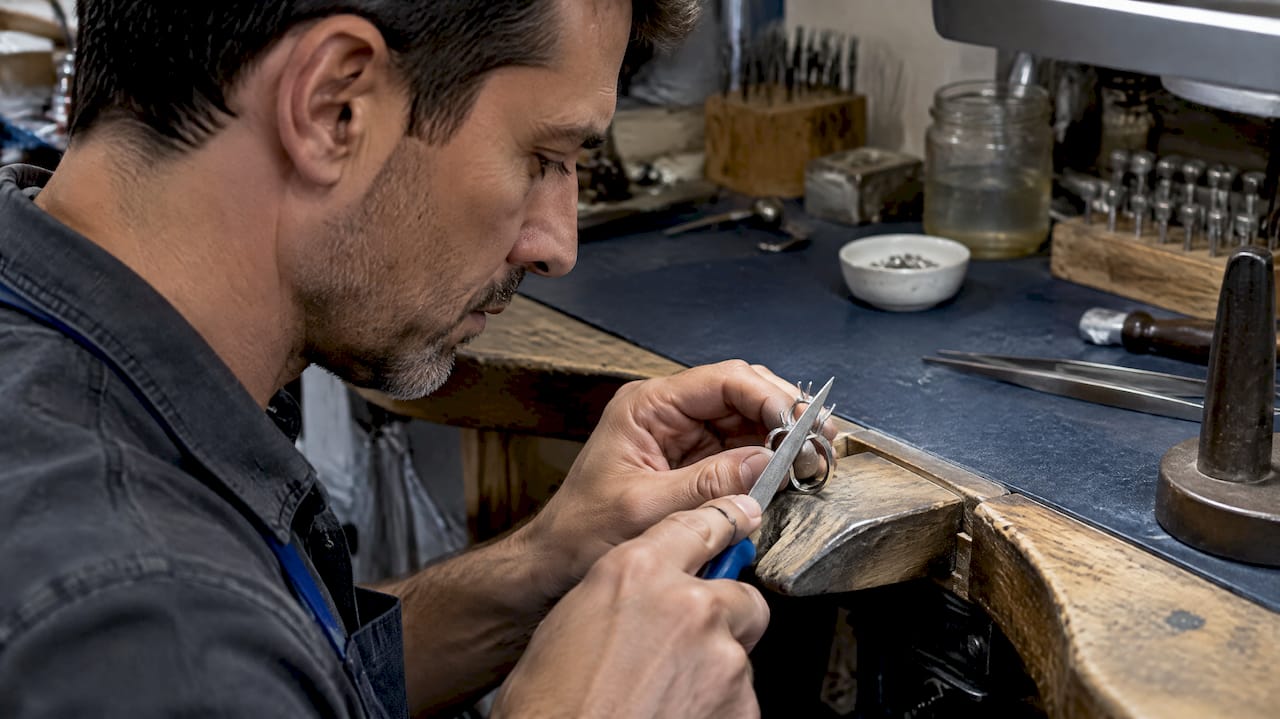
Brand story works best as one sentence, not a paragraph, and it works best when it explains a choice the buyer can see in the piece itself: why a particular alloy, why a particular stone cut, why a finish is left matte rather than polished. A story that doesn’t connect to a visible detail reads as padding.
Using storytelling to connect jewellery to how it’s worn
Jewellery carries meaning that most products don’t: an engagement, a milestone, a piece passed between generations. A short narrative line, placed after the facts block rather than before it, can describe how a piece is meant to be worn over time rather than just what it looks like on day one.
“Designed to be the ring you add a stone to with each anniversary” tells a story about use without inventing a claim about the product’s durability. Keep storytelling anchored to wearing habits and occasions rather than invented provenance or unverifiable claims about origin.
Testing description variations to find what converts
Running a controlled test between two versions of the same listing, one with an occasion-first hook and one with an identity-first hook, tells you more about your specific buyers than any general rule can. Change one variable at a time: the hook, the length of the facts block, or the presence of a care line, so you know which change moved the result.
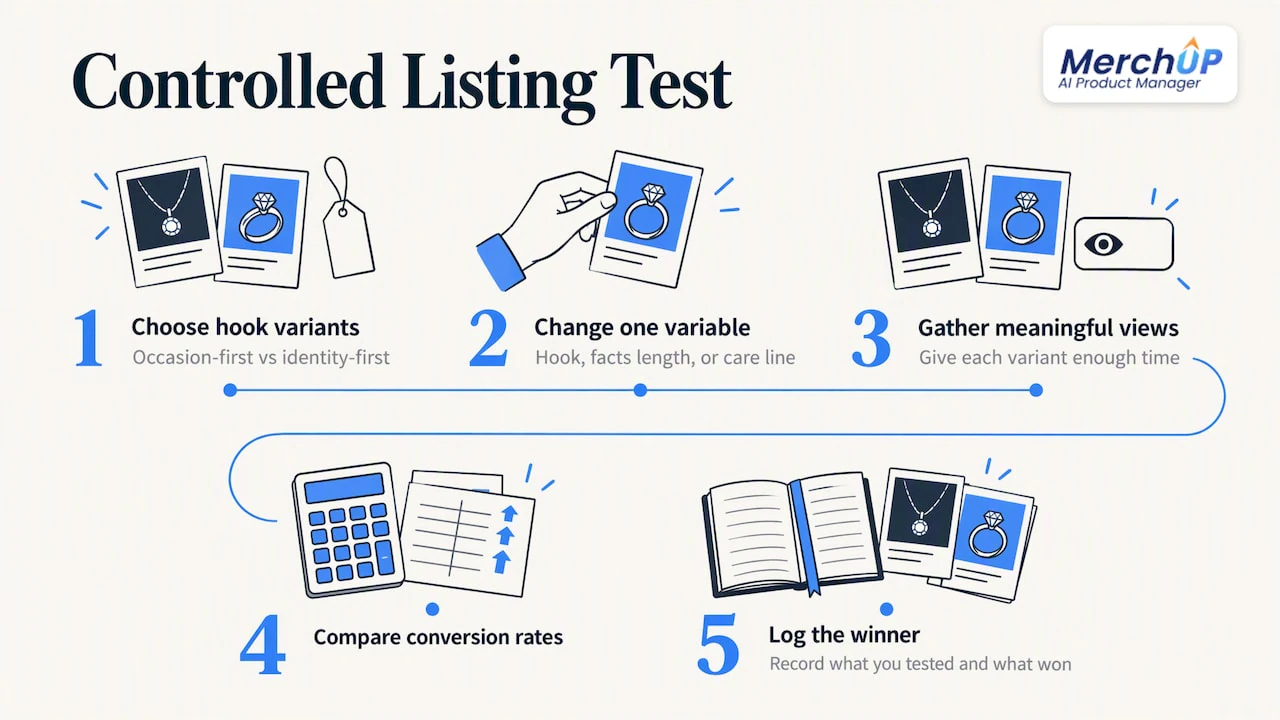
Give each variant enough time to collect a meaningful number of views before comparing conversion rate, and avoid changing the photos or price at the same time as the copy, or you won’t know which change caused the shift. Keep a simple log of what you tested and what won, since the same hook style often performs differently across categories: an occasion-first line might win on gift sets and lose on everyday stacking rings.
Addressing allergies and care questions inside the description itself
Putting allergy and care information directly in the description, rather than only on a separate policy page, answers the question at the moment a buyer is deciding whether to purchase. A line like “Nickel-free, suitable for sensitive ears” or “Rhodium-plated to resist tarnish; avoid contact with perfume and lotion” belongs in the extras section, right after the sizing note.
Care instructions also reduce returns by setting the right expectations about plating and finish. A gold-plated piece that fades with heavy wear isn’t a defect if the description says plating may wear over time with daily use. Leaving that detail out, by contrast, turns a normal wear pattern into a complaint.
Author perspective: applying the framework without losing brand voice
Let brand voice live in the hook, where personality earns attention. Keep the facts block literal, since a buyer comparing specs doesn’t want flourish. Batching by collection preserves voice across a catalogue without rewriting every line from scratch.
— Jamie Moss
Scaling this framework with MerchUp
Once the framework works on a handful of listings, applying it across a full catalogue by hand gets slow. We provide an AI generation tool paired with customisable templates, a visual editor and bulk publishing to help maintain consistent hook-benefit-facts structures across many SKUs without flattening every listing into the same sentence.
What this looks like in practice:
- Lock the facts block fields (metal, stone, dimensions, weight) so specs stay accurate across variants
- Generate and edit hooks per collection using the visual editor, then bulk-publish to your connected eCommerce platform
- Track changes and republish updates as your catalogue grows, without rebuilding each listing from scratch
Our plans range from Starter at £12.99 per month up to Scale for larger catalogues, and the fastest way to see the workflow is the 30-second tutorial.
FAQ
How to write a product description for jewellery?
Open with a hook naming the buyer or occasion, follow with one benefit sentence, then a bulleted facts block covering metal, stone, dimensions and weight. Close with care instructions and any required disclosure.
What words can I use to describe jewelry?
Pair sensory words with concrete details: “polished until it feels like silk” or “sits low enough for daily wear, 16mm drop” work better than standalone adjectives like “stunning” or “elegant”. Generic adjectives without a measurement or material attached tend to blend into every other listing.
What are the different categories of jewelry products?
The main categories are rings, necklaces and pendants, earrings, bracelets, and sets that combine two or more of these pieces. Each category has its own typical spec set: rings need sizing, necklaces and bracelets need length, earrings need drop length or stud size, and sets need pairing guidance.
What is the 2:1:1 rule in jewelry?
This isn’t a standardised industry rule with a single agreed definition, and no FTC or UX source defines it that way. If you’ve seen it referenced for proportion or styling, treat it as informal guidance rather than a regulatory or technical standard.
Sources
- In the Loupe: Advertising diamond, gemstones and pearls | Federal Trade Commission
- Buying gemstones, diamonds and pearls | Consumer Advice


Comments
No comments yet — be the first to share what you think.