



What makes a product description example worth following?
A product description example is more than a writing sample. At its best, it is a working template that shows you exactly how to combine what a product is with what it does for the buyer, framed around the specific person most likely to purchase it. The difference between a description that sits there and one that converts is almost always that second layer: buyer context.
The highest-converting descriptions follow a clear structure. They open with a benefit or a problem the buyer recognises, move through the product’s specific advantages, and close with a trust signal or a nudge to act. All of that, ideally, in under 300 words. Leading with a strong benefit-oriented proposition in the first 80 words reduces bounce rates by 35%, which tells you where the real work happens.
Here is what separates good product description examples from forgettable ones:
- Buyer identity: the reader feels the copy is written for them specifically
- Benefit-first framing: the outcome comes before the specification
- Sensory or emotional language: the reader can picture using the product
- Objection handling: the copy pre-empts the most common reasons not to buy
- Scannability: bullet points and short paragraphs for skim readers, depth for those who need it
Pro Tip: Write two versions of every new description, one leading with a functional benefit and one leading with an emotional hook. Run both for two to four weeks and let your click-through and add-to-cart data decide which framing your audience prefers.
Features vs benefits: the distinction that changes everything
Most product pages list what a product is. The ones that sell tell you what it does for you. That gap is the features-versus-benefits distinction, and it is the single most reliable lever for improving copy that is already technically accurate but failing to convert.
A feature is a factual attribute: “400-thread-count Egyptian cotton.” A benefit is what that attribute means for the buyer’s life: “hotel-quality sheets that feel softer and stay cooler than standard cotton, so you sleep better.” The feature earns credibility; the benefit earns the sale.
The practical test is to ask “so what?” after every feature you write. “Lithium-ion battery with 10-hour runtime” — so what? “Use your wireless headphones all day without charging, from your morning commute to your evening workout.” That second sentence is what goes in the description. Benefit-driven copy significantly improves buyer confidence and sales, particularly for products priced above £50, where shoppers need more emotional reassurance before committing.
Translating features into benefits in practice:
- Material quality → how it feels, lasts, or performs in daily use
- Technical specification → the real-world problem it solves
- Size or weight → what becomes easier or more convenient as a result
- Certifications or standards → what the buyer no longer has to worry about
For format, a short narrative paragraph works well for the emotional hook, followed by a tight bullet list for the specifics. That combination serves both the buyer who reads every word and the one who scans for the detail they care about most.
How to surface customer pain points and use them in your copy
Buyers do not search for products. They search for solutions to problems. Writing copy that names the problem before presenting the product is one of the most reliable ways to capture attention immediately.

The research part is straightforward. Read your one-star and three-star reviews on Amazon and Trustpilot, not to find complaints about your product, but to understand the frustrations buyers had with whatever they were using before. Browse relevant subreddits and Facebook groups. Run a short post-purchase survey asking customers what problem they were trying to solve. The language buyers use in those places is the language that belongs in your descriptions.
Once you have that language, use it early. An opening like “Back pain from sitting all day?” works because it names the exact experience the buyer is living. The product then arrives as the answer, not as a random item on a shelf. This structure, problem then solution, is what storytelling and buyer context upfront achieves in the descriptions of leading brands, and it consistently outperforms copy that leads with the product name or a generic headline.
Practical techniques for pain point-driven copy:
- Open with a question or statement that names the frustration
- Follow immediately with the product as the resolution
- Address the top objection (price, durability, complexity) within the first paragraph
- Use empathetic language without dwelling on the negative; pivot quickly to the positive outcome
The balance matters. Copy that lingers too long on the problem feels heavy. Name it, validate it, then move to the solution within two sentences.
Brand tone of voice in product descriptions: examples from real brands
Tone is not decoration. It is the signal that tells a buyer whether this brand understands them. Get it right and the copy feels like a recommendation from someone who knows their taste. Get it wrong and even accurate, well-structured copy feels off.
Brands with consistent tone in product copy increase repeat purchase rates by up to 40%. That figure reflects something most sellers underestimate: tone builds familiarity, and familiarity builds trust over time.
Here are four distinct tone styles with real examples:
Playful and irreverent (Happy Socks): “Brighten up your sock drawer and your day. These bold, colour-blocked socks are made from combed cotton so soft you’ll forget you’re wearing them — until someone spots them and asks where you got them.” The tone is light, the product detail is present, and the copy ends on a social moment that flatters the buyer.
Sensory and indulgent (Lush): Lush descriptions read like someone describing a spa experience rather than a product. “A buttery, skin-softening treat packed with cocoa butter and shea, this melts on contact and leaves your skin feeling like you’ve just stepped out of a five-star hotel.” Every word earns its place by adding to the sensory picture.
Clean and confident (Levi’s): Levi’s copy tends to be short, direct, and rooted in heritage. “The original. Straight-leg fit, five-pocket styling, and the denim that started it all. Wear them in, wear them out, wear them forever.” No superlatives, no filler. The brevity is the brand.
Warm and purposeful (KIND): KIND leads with values before product. “Made with whole almonds, real honey, and nothing you can’t pronounce. A snack that’s kind to your body and kind to the world.” The tone matches the brand’s ethical positioning without being preachy.
Tips for maintaining tone across a product range:
- Write a one-page tone guide with three or four example sentences before you write a single description
- Define what your brand would never say as clearly as what it would say
- Read descriptions aloud; if they sound like a different person wrote each one, they need editing
Educating customers without losing them halfway through
Around 80% of shoppers read only the short description and bullet points on a product page. The remaining 20% want the full detail before they commit. Writing for both groups simultaneously is the real challenge.
The solution is layered content. Lead with a short, benefit-driven paragraph of two to three sentences that gives the skim reader everything they need to decide. Follow it with a bullet list of four to six specific features or advantages. Then, for the detail-oriented buyer, add a collapsible section or a specifications table below the fold.
A practical example: a skincare brand selling a vitamin C serum might open with “Brighter skin in four weeks, or your money back. This lightweight serum absorbs in seconds and works while you sleep.” That is the skim layer. The bullet list then covers concentration percentage, key ingredients, and skin type compatibility. A hidden tab holds the full clinical study summary for the buyer who wants it.
Formatting principles that help:
- Bold the benefit in each bullet, not the feature
- Keep paragraphs to three or four sentences maximum
- Use subheadings for descriptions over 200 words
- Avoid jargon unless your audience specifically expects it (a professional audio buyer wants impedance ratings; a casual music listener does not)
The goal is not to write less. It is to structure information so that every type of buyer finds what they need without wading through what they do not.
Common mistakes that kill product description performance
The most damaging error is also the most common: copying the manufacturer’s description verbatim. Stores that rewrite product descriptions see 2–3x higher conversions compared to those using manufacturer copy, partly because unique copy ranks in search engines and partly because it actually speaks to buyers rather than to a spec sheet.
Beyond duplication, these are the errors that consistently reduce performance:
- Generic adjectives with no proof: “high quality,” “premium,” “best in class” — these phrases mean nothing without a fact to back them. Replace “premium materials” with “full-grain leather that develops a patina over years of use.”
- Ignoring the top objection: every product has one. For a £200 kitchen knife, it is probably durability. For a supplement, it is probably efficacy. If your copy does not address it, the buyer’s doubt does.
- Excessive length with no structure: a 600-word wall of text loses most readers before the second paragraph. Length is fine; structure is non-negotiable.
- Mobile-unfriendly formatting: mobile traffic accounts for 65–70% of ecommerce visits. Long sentences, dense paragraphs, and no bullet points are conversion killers on a phone screen.
- Vague claims about the buyer: “perfect for everyone” is a signal that the copy was written for no one in particular.
Pro Tip: Before publishing any description, paste it into your phone and read it as a first-time visitor. If you would scroll past it, rewrite it.
7 real-world product description examples from brands that get it right
The following examples are drawn from brands whose product copy is consistently cited as best-in-class. Each one does something specific worth borrowing.
| Brand | Tone | Key technique | What to steal |
|---|---|---|---|
| Happy Socks | Playful, warm | Social moment ending | Close with a scene the buyer wants to be in |
| Lush | Sensory, indulgent | Tactile language throughout | Make the reader feel the product before buying |
| Califia Farms | Clean, purposeful | Ingredient transparency | Lead with what is in the product and why it matters |
| Revlon | Confident, aspirational | Outcome-first framing | State the result before the formula |
| Helzberg Diamonds | Romantic, personal | Emotional occasion anchoring | Connect the product to a moment, not just a category |
| Bacardí | Bold, experiential | Lifestyle positioning | Sell the experience the product enables |
| Levi’s | Direct, heritage-led | Brevity as authority | Say less; let the product’s reputation carry weight |
Happy Socks opens descriptions with the emotional payoff: the compliment you will receive, the mood lift from a bold colour choice. The product detail is present but secondary to the feeling. That ordering is deliberate.
Lush uses sensory language so specifically that add-to-cart rates improve by 18% when shoppers can vividly imagine product use. Every description names a texture, a scent, or a physical sensation.
Califia Farms leads with ingredient honesty. “No dairy, no soy, no carrageenan” appears early because their buyer’s primary concern is what is not in the product. Addressing that objection in the opening line removes the biggest barrier to purchase.
Revlon frames every description around the outcome: the finish, the wear time, the look. The formula comes second. This is textbook benefit-first writing applied to beauty.
Helzberg Diamonds anchors descriptions to occasions: engagements, anniversaries, milestones. The copy does not describe a ring; it describes a moment. That emotional anchoring justifies the price point without ever mentioning value for money.
Bacardí sells the occasion, not the spirit. Descriptions reference the gathering, the evening, the ritual of making a cocktail. The product is the enabler of an experience the buyer already wants.
Levi’s copy is worth studying for what it leaves out. No padding, no superlatives, no lifestyle fantasy. The brevity signals confidence in the product’s reputation, and it works because the brand has earned that confidence over decades.
How MerchUp helps you write descriptions like these at scale
Writing one great product description is a craft exercise. Writing five hundred of them, consistently, across a changing catalogue, is an operational challenge. That is the problem MerchUp is built to solve.
MerchUp is an AI-powered SaaS platform that generates, edits, and bulk-publishes product descriptions with SEO optimisation built in. It integrates directly with Shopify, with support for Webflow, Wix, WooCommerce, and eBay coming. The practical effect is that you can go from a product data sheet to a published, keyword-optimised description without the copy sitting in a queue waiting for a writer.
Key capabilities:
- AI generation with brand voice controls: define your tone, your audience, and your product category, and the output reflects those parameters rather than producing generic copy
- Bulk publishing: update hundreds of descriptions simultaneously rather than one at a time
- Visual editor and drag-and-drop templates: customise descriptions without touching code
- Activity tracking and real-time catalogue management: see what has been updated, what needs attention, and what is live
- Credit-based generation: buy what you need; no commitment to a volume you cannot use
The human-in-the-loop principle matters here. AI tools using structured prompts that define task, customer context, and reference copy achieve a 23.7% average increase in conversion rate by tailoring content to persona and context. MerchUp’s workflow is built around that principle: the AI drafts, you refine, and the output carries your brand’s voice rather than a generic template’s.
| Feature | Benefit |
|---|---|
| AI description generation | Reduces writing time from hours to minutes per product |
| Shopify integration | Publish directly without copy-paste errors or formatting loss |
| Customisable templates | Maintain brand consistency across your full catalogue |
| Bulk publishing | Scale from 10 to many descriptions without adding headcount |
| SEO optimisation built in | Keywords placed naturally, not forced |
Pro Tip: When setting up MerchUp, write three to five “gold standard” descriptions for your best-selling products first. Use these as reference copy when generating descriptions for the rest of your catalogue. The AI output will align far more closely with your brand voice when it has real examples to work from.
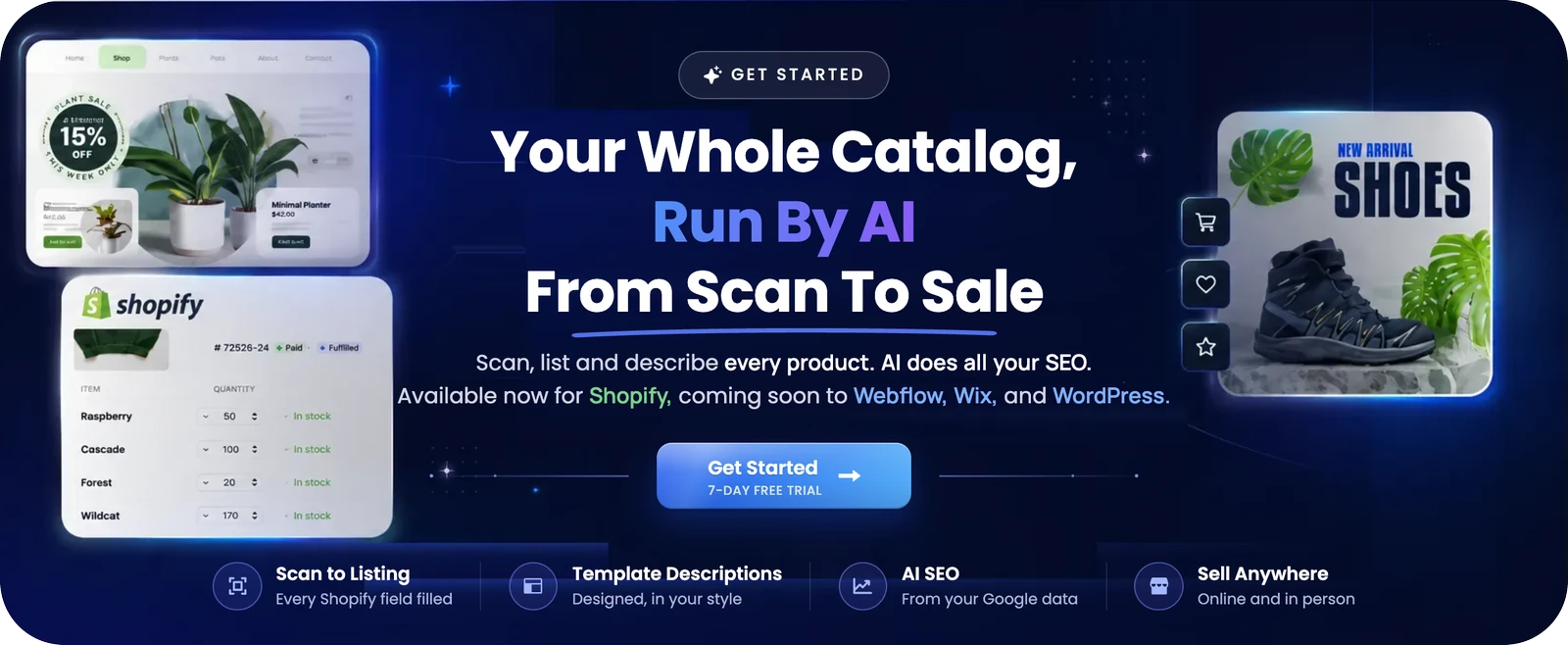
If you are managing a Shopify store and spending hours on product copy, MerchUp’s AI description generator is worth a look. The pricing tiers are structured for businesses at different catalogue sizes, from small shops to large-scale operations.
Structure and length: how long should a product description actually be?
There is no universal answer, but there is a reliable principle: the more complex or expensive the product, the more copy it earns. A pair of trainer socks can be described in 80 words. A pair of running trainers with specific cushioning technology probably needs 250–400 words to address all the questions a buyer has before spending £120.
The structure that consistently performs well follows four layers:
- Hook and problem identification (two to three sentences): name the buyer’s situation or frustration and position the product as the answer
- Benefits and specific details (four to six sentences): translate features into outcomes, mixing practical and emotional benefits
- Scannable bullet list: four to eight points covering the specifics that detail-oriented buyers need
- Trust signal and close (one to two sentences): a warranty, a review count, or a returns policy
For eBay specifically, the platform does not enforce a strict character limit on product descriptions in the traditional sense, though listing titles are capped at 80 characters. eBay product descriptions benefit from the same layered structure above, with particular attention to mobile formatting given how many buyers browse on phones. Clear headings, short paragraphs, and a bullet list of key specifications tend to outperform dense prose on that platform.
The ecommerce website design principles that apply to product pages more broadly also apply here: white space, readable font sizes, and logical information hierarchy all affect whether a buyer reads your description or skips it.
SEO best practices for product descriptions
Google favours unique, keyword-rich content with natural language over duplicated manufacturer text. That single fact should drive your entire approach to SEO for product pages.
The practical steps:
- Primary keyword in the title and first paragraph: if you are selling a “blue maxi summer dress with sleeves,” that phrase belongs in both places, not buried in the third paragraph
- Long-tail keywords over short ones: “wireless charging station for nightstand” has less competition and higher purchase intent than “wireless charger”
- Natural placement only: forcing keywords into sentences where they do not belong makes copy read as spam and signals low quality to search engines
- Unique descriptions for every product: duplicate content across variants (different colours, sizes) means Google picks one page to rank and ignores the rest
- FAQ additions where relevant: a short FAQ on a product page targets additional long-tail queries and provides extra value to buyers who are close to purchasing
For ecommerce SEO more broadly, product descriptions are one of the highest-leverage pages on your site because they sit at the bottom of the funnel. A buyer searching for a specific product name with a specific specification is ready to buy. Your description just needs to confirm they are in the right place and remove any remaining doubt.
Rewriting product descriptions uniquely is consistently cited as the top SEO strategy for distinguishing ecommerce pages on Google. It is also one of the most time-consuming tasks at scale, which is where tools like MerchUp earn their keep.
Short vs long, bullets vs paragraphs: which format should you use?
Format is not a stylistic preference. It is a strategic decision based on product type, price point, and where the buyer is in their decision-making process.
Short descriptions (under 150 words) work for low-consideration purchases: everyday consumables, accessories, products with obvious use cases. The buyer knows what they want; your job is to confirm you have it and remove friction.
Long descriptions (200–500 words) work for high-consideration purchases: electronics, furniture, skincare, anything where the buyer has specific requirements or concerns. More copy gives you more space to address objections and build confidence.
Bullet points are best for specifications, feature lists, and anything a buyer might scan for a specific detail. They are not a substitute for narrative copy; they are a complement to it. A description that is only bullet points tends to feel like a spec sheet rather than a sales argument.
Narrative paragraphs carry emotional weight. They are where you tell the product’s story, name the buyer’s situation, and make the case for why this specific product fits their life. The best descriptions use both: a short narrative opening followed by a bullet list, or a bullet list of benefits followed by a paragraph that handles the main objection.
The format that consistently underperforms is the wall of text: no bullets, no subheadings, no visual breaks. Even buyers who want detail will not read it if the page looks like a terms-and-conditions document.


Comments
No comments yet — be the first to share what you think.