


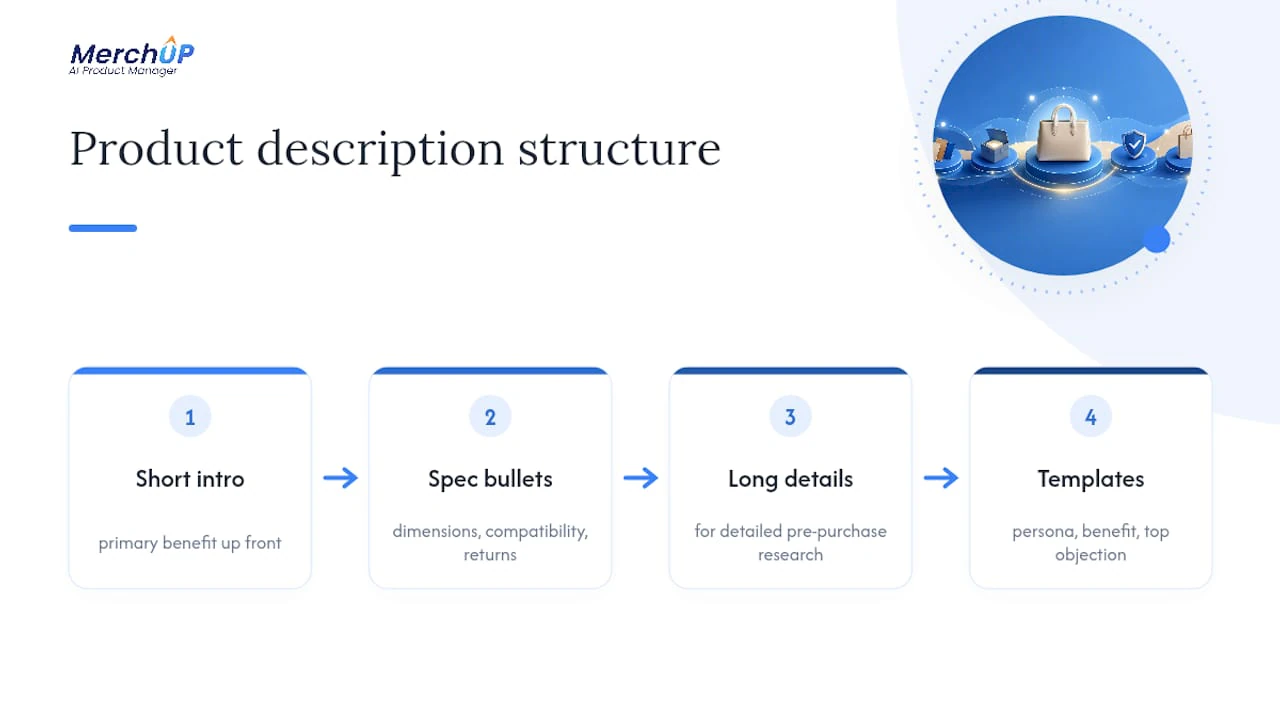
The recommended product description structure is: benefit-led hook (15–25 words) → 3–5 benefit-first bullet points → expanded story paragraph (50–120 words) → specification block → closing CTA with social proof anchor. That five-element format, validated across high-converting listings, covers everything a shopper needs to decide and everything a search engine needs to rank the page.
Here is how it looks pasted directly into a product page:
- Hook: “Stay warm on every commute — this merino-blend jacket regulates temperature from 5°C to 20°C.”
- Bullet 1: Merino-blend fabric wicks moisture so you arrive dry, not damp.
- Bullet 2: Packable to the size of a paperback — fits any bag without bulk.
- Bullet 3: YKK zips and reinforced seams hold up to daily wear for years.
- Bullet 4: Available in four colours and sizes XS–XXL for a precise fit.
- Paragraph: Who it is for, the problem it solves, one sensory detail, and one objection handled.
- Specs block: Weight, dimensions, materials, care, compatibility.
- CTA + social proof: “Add to basket — rated 4.8 stars by 1,200 customers.”
The short intro and bullets serve the majority of shoppers who scan rather than read; the long paragraph and specs block convince the smaller group doing deeper research before a high-consideration purchase.
What does a product description actually need to achieve?
Every description carries four jobs simultaneously, and dropping any one of them costs you either conversions or search visibility.
Qualify the shopper first. A description that speaks to everyone persuades no one. State clearly who the product is for (“ideal for runners logging 30+ miles a week”) so the wrong buyer self-selects out and the right one leans in.
Persuade with outcomes, not features. Two or three compelling reasons to buy — framed as buyer outcomes, not engineering specs — do more work than a paragraph of technical detail. Consumer research cited by ConversionStudio shows product descriptions rank as a critical purchase signal for the vast majority of online shoppers, which means weak copy is a direct revenue leak.
Inform with precision. Missing dimensions, vague materials, or absent compatibility notes drive returns. A shopper who cannot confirm the product fits their situation will not buy, or will buy and send it back.
Rank in search. Unique, keyword-aware copy per SKU is the baseline. The KPIs that tell you whether the description is working: conversion rate, add-to-cart rate, return rate, and organic impressions per product page. Track all four; optimise the one that is furthest from your category benchmark.
The product description structure, element by element
According to Seegea’s analysis, the vast majority of high-performing listings follow the same underlying template. Here is each component with suggested lengths and placement guidance.
| Element | Suggested length | Where it appears on the page |
|---|---|---|
| Product title | under 80 characters | Above the fold, H1 |
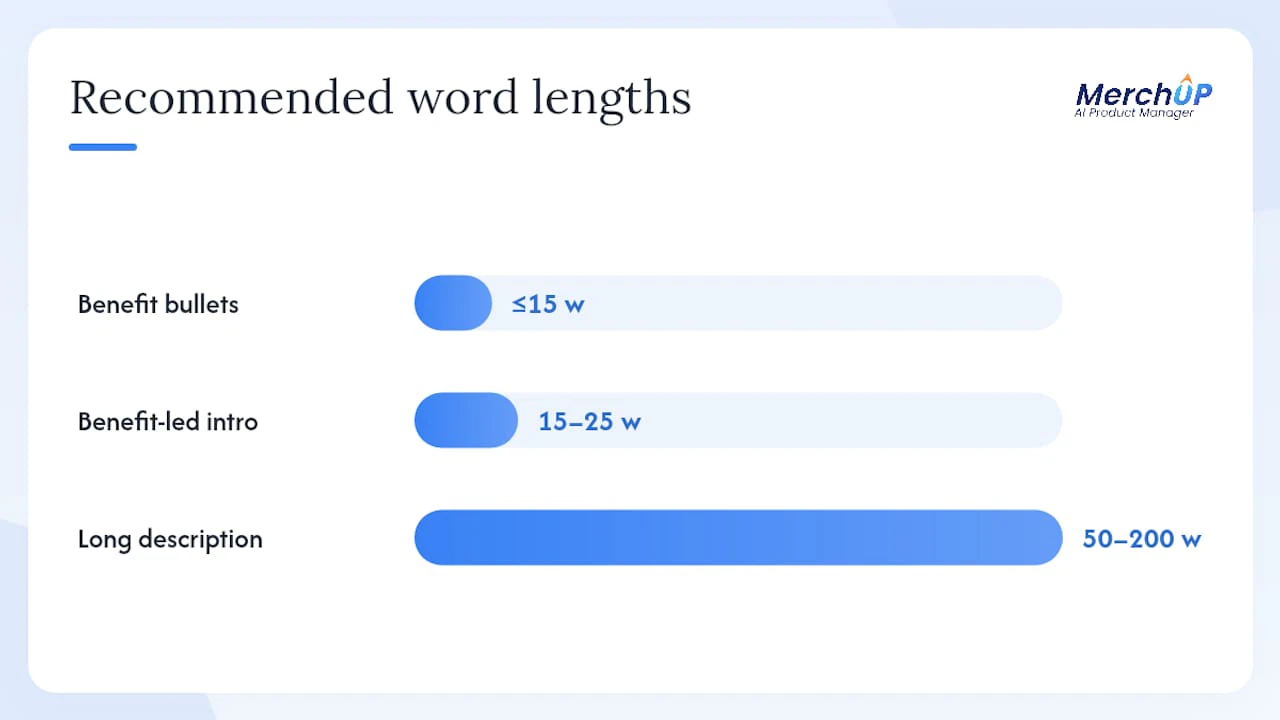
| Benefit-led intro | 15–25 words | Immediately below title/price |
| Benefit bullets | 3–5 bullets, ≤15 words each | Below intro, above fold on desktop |
| Long description | 50–200 words | Below add-to-cart button |
| Specifications block | Table or structured list | Tabbed or accordion section |
| CTA + social proof | 1 line | Adjacent to add-to-basket button |
| Meta description | 120–160 characters | Search snippet only |
Product title. Structure it as: primary keyword + key attribute + brand name (when brand recognition adds value). “Merino Running Jacket — Windproof, Packable — Arcton” works; “Jacket Product Item” does not. Keep it under 80 characters so it renders fully in search results.
Benefit-led intro. Lead with the primary keyword within the first 50 words. Fifteen to twenty-five words is the target. This is the sentence a shopper reads in two seconds and decides whether to keep scrolling.
Benefit bullets. Each bullet opens with the buyer outcome, not the feature. Three to five bullets is the sweet spot; more than five and attention drops. Keep each under 15 words. Bold one key phrase per bullet so scanners catch the point without reading the full line.
Long description. Fifty to 200 words for standard products; up to 500 for high-ticket or complex items. Cover: who it is for, how it solves a specific problem, one sensory or use-case detail, and one objection handled. This is where storytelling earns its place.
Specifications block. Dimensions, weight, materials, compatibility, variants, and care instructions belong in a structured table or list, not buried in prose. Shoppers looking for a specific measurement scan straight to this block.
CTA and social proof anchor. “Add to basket — rated 4.8 stars by 1,200 customers” does two things: it prompts action and it reduces purchase anxiety in the same line. A guarantee (“free 30-day returns”) works equally well here.
Meta description. 120–160 characters, written for the searcher not the algorithm. Include the primary keyword, one benefit, and a soft call to action. Sample: “Windproof merino running jacket, packable to paperback size. Sizes XS–XXL. Free UK delivery. Shop now.”
How to write each element so it actually converts
Turning features into benefits
The fastest rewrite formula: “[feature] so you can [benefit].” Three quick examples:
- “Merino-blend fabric so you can regulate temperature without layering.”
- “One-touch magnetic clasp so you can open the bag with one hand.”
- “Compatible with iOS and Android so you can switch devices without re-pairing.”
For a deeper look at why this distinction changes conversion rates, the features vs benefits guide on the Merchup AI blog is worth bookmarking.
Tone by category
Tech products reward precision and compatibility detail. Apparel needs sensory language — how it feels, moves, and wears over time. Homeware sits between the two: lead with the aesthetic story, close with care and dimensions. Switching tone between categories is not inconsistency; it is matching the register your buyer already uses when they think about that product type.
CXL’s analysis of high-converting descriptions makes the point well:
When to use storytelling vs. straight benefit claims
Storytelling earns its place on high-consideration or emotionally driven purchases: a handmade ceramic piece, a premium skincare set, a piece of furniture. For commodity or repeat-purchase items — a USB cable, a replacement filter, a pack of batteries — straight benefit claims and specs convert faster. Shoppers buying a USB cable do not want a narrative; they want to confirm it fits their port.
Pro Tip: Write the long description last. Draft the hook and bullets first, then ask yourself what objection a buyer might still have after reading them. The long description’s job is to answer that objection.
SEO best practice for product descriptions in the UK
Keyword placement
Place the primary keyword in the product title and within the first 50 words of the description. Use long-tail variants naturally in the bullets and body copy. For a UK audience, include location-specific modifiers where they genuinely apply (“next-day delivery across the UK”, “CE-marked for EU and UK compliance”).
Pro Tip: Check Google Search Console’s Performance report filtered to your product pages. The queries driving impressions but low clicks often reveal long-tail keywords your descriptions are not yet using.
Unique copy per SKU
Moz’s guidance on duplicate content is unambiguous: identical copy across product variants or lifted directly from a manufacturer’s feed dilutes search visibility. Write unique descriptions for every SKU that matters. For colour or size variants sharing a parent page, differentiate the copy by emphasising the variant-specific benefit (“the slate grey reads as charcoal under artificial light — better for office wear”).
For a full technical walkthrough of keyword placement and structured data, the product description SEO guide covers the UK-specific detail.
Product schema and rich results
Implement Product schema on every product page. Required fields for rich results: name, image, description, sku, offers (with price, priceCurrency, availability). Adding aggregateRating unlocks star ratings in SERPs, which lifts CTR meaningfully.
Official editorial rules specify that the description attribute should list features, technical specifications, and visual attributes in the first 160–500 characters, avoiding promotional language and product names.
Google’s Manufacturer Centre guidelines specify that the description attribute should list features, technical specifications, and visual attributes. The field accepts up to 10,000 characters, but the most important detail belongs in the first 160–500 characters. Do not start with the product name, do not include promotional language (“best ever”, “unbeatable price”), and do not embed category paths or business history. Marketplace feeds on major platforms follow similar editorial principles: structured attributes in dedicated fields, not buried in prose.
How should you format descriptions for mobile and accessibility?
Eye-tracking research summarised by UX Myths confirms what most sellers already suspect: shoppers scan, they do not read. Attention flows from the hero image to the price, then to the bullets, then to the add-to-cart button. The long description and specs get read by a minority.
That scanning pattern has direct formatting implications:
- Visual hierarchy: hero image → title → price → short intro → bullets → add-to-cart → long copy → specs → reviews. Never bury bullets below a wall of prose.
- Bold one phrase per bullet so the key point is visible at a glance without reading the full line.
- Short paragraphs: three to four sentences maximum in the long description. A single dense block of text loses most mobile shoppers immediately.
- Accordion or tabs for specs: on mobile, a wide specs table breaks layout. Use an accordion so shoppers tap to expand only what they need.
- Alt text on every image: write descriptive alt text (“slate grey merino running jacket, front view, worn over a white base layer”) rather than file names or keyword strings. This serves screen readers and image search simultaneously.
- Semantic HTML: use
<h1>for the product title,<ul>for bullets, and<table>for specs. Avoid styling<div>elements to look like headings — screen readers cannot interpret them correctly. - Contrast: body text on product pages should meet WCAG 2.1 AA contrast ratios (4.5:1 for normal text). Low-contrast grey-on-white copy is a common accessibility failure on UK ecommerce sites.
Preview every description on a 375px-wide screen before publishing. If the spec table scrolls horizontally or the bullets run to four lines each, the formatting needs work.
Fillable templates and short examples you can copy now
Three templates cover the majority of product categories. Fit Small Business’s format guidance and CXL’s template analysis both point to these three as the most transferable.
| Template | Best for | Structure |
|---|---|---|
| Problem → Solve | Functional / utility products | State the problem, introduce the product as the fix, list benefits, close with specs |
| Sensory Story | Apparel, homeware, food, beauty | Hook with sensory detail, describe the experience, add practical specs, close with CTA |
| Spec → Benefit | Electronics, tools, technical gear | Lead with the headline spec, convert each spec to a buyer outcome, close with compatibility |
Apparel: premium jacket
Hook: Stay warm from the morning commute to the evening run — this merino-blend jacket works from 5°C to 20°C. Bullets:
- Merino-blend fabric wicks moisture so you arrive dry.
- Packable to paperback size — fits any bag.
- YKK zips and reinforced seams for years of daily wear.
Paragraph: Designed for commuters who refuse to choose between performance and appearance, this jacket layers over a shirt or under a coat without bulk. The merino blend handles temperature swings that synthetic fabrics cannot.
Specs: Weight 380g | Sizes XS–XXL | Machine wash 30°C | Colours: slate, navy, black, olive.
CTA: Add to basket — rated 4.8 stars by 1,200 customers. Free UK returns.
For more ready-to-use copy, the product description examples library has annotated samples across twelve categories.
Electronics: wireless headphones
Hook: 30-hour battery, active noise cancellation, and USB-C charging — these headphones work as hard as you do. Bullets:
- ANC cuts ambient noise by up to 35dB so you can focus in open offices.
- 30-hour playback means a full working week between charges.
- Compatible with iOS, Android, and Windows via Bluetooth 5.3.
Specs: Driver size 40mm | Frequency response 20Hz–20kHz | Weight 250g | Foldable for travel.
Homeware: ceramic vase
Hook: Hand-thrown in Stoke-on-Trent, this ceramic vase brings texture and warmth to any shelf or table. Bullets:
- Reactive glaze means no two pieces are identical.
- Weighted base keeps tall stems stable.
- Food-safe glaze — doubles as a utensil holder.
Specs: Height 28cm | Diameter 12cm | Dishwasher safe | Available in three glaze colourways.
For category-specific starting points, the product description templates guide has copy-and-paste versions for apparel, electronics, homeware, and more.
How to test descriptions and what to measure
Primary metrics
Track these four on every product page: conversion rate, add-to-cart rate, bounce rate, and organic impressions with CTR from Search Console. Returns and customer service contacts about product fit are lagging indicators that also reflect description quality.
A/B test ideas
- Short hook vs long hook: a 15-word opener against a 40-word opener. Hypothesis: shorter converts better on mobile; longer wins on desktop for high-ticket items.
- Bullets-first vs paragraph-first: does leading with bullets outperform leading with a narrative paragraph for your category?
- Spec table vs accordion: does a visible spec table increase add-to-cart rate compared with a collapsed accordion?
Running the test
Write a clear hypothesis before you start (“Bullets-first will increase add-to-cart rate by 10% on mobile”). Choose one metric as the primary. Run the test for a minimum of two weeks on stable traffic; shorter periods produce unreliable results on low-traffic SKUs. Tag each page version with an experiment ID in your analytics platform so you can segment cleanly.
Pro Tip: Start A/B tests on your top 10 SKUs by traffic, not your best sellers by revenue. High-traffic pages reach statistical significance faster, giving you learnable results in two weeks rather than two months.
Once a variant wins, roll the structure across similar SKUs in the same category. A winning bullet format for running shoes likely transfers to trail shoes and gym trainers.
The product page conversion playbook has a staged rollout framework for exactly this.
Common mistakes and a QA checklist before you publish
Top mistakes that kill conversions or rankings
- Manufacturer duplicate copy. Pasting the supplier’s text verbatim means your page competes with every other retailer using the same feed. Unique copy per SKU is non-negotiable for SEO.
- Missing specs. A shopper who cannot confirm dimensions, materials, or compatibility will not buy. Incomplete specs are the single biggest driver of avoidable returns.
- Feature-led bullets. “Made from 100% merino wool” is a feature. “Stays odour-free for three days of wear” is a benefit. Bullets that list features without translating them to outcomes underperform.
- Inaccessible images. No alt text means screen reader users and image search both miss the product.
- Keyword stuffing. Repeating the primary keyword four times in 80 words does not help rankings and reads as spam to shoppers.
QA checklist
Run through this before every publish:
- [ ] Copy is unique — not lifted from a manufacturer or another page on the site
- [ ] Primary keyword appears in the title and within the first 50 words
- [ ] Bullets lead with buyer outcomes, not raw features
- [ ] Specs are complete with units (cm, kg, °C, not “medium” or “standard”)
- [ ] Every image has descriptive alt text
- [ ] Meta description is 120–160 characters and includes the primary keyword
- [ ] Page previewed on a 375px-wide screen
- [ ] Product schema implemented with
name,image,offers, andaggregateRating
Legal and compliance notes for UK sellers
Product descriptions should be accurate and not misleading, in line with UK consumer law, to ensure compliance and build trust with buyers. Claims such as “clinically proven”, “hypoallergenic”, or “organic” carry specific regulatory requirements. If your descriptions include health, safety, or environmental claims, confirm compliance with the relevant authority (the ASA for advertising standards, the CMA for consumer-facing claims) before publishing. This is general guidance; a qualified legal adviser should review regulated claims.
The part most sellers get wrong about product copy
There is a persistent belief in ecommerce that more words equal more trust. Sellers write 400-word descriptions for a phone case and wonder why conversion rates are flat. The research points the other way: the short intro and bullets carry the weight for the majority of shoppers, and the long copy exists almost entirely for the minority doing careful pre-purchase research on high-consideration items.
The more interesting mistake is structural, not length-related. Most sellers write descriptions as if the shopper is reading a brochure from top to bottom. They are not. They are scanning for the one piece of information that resolves their specific hesitation — usually a dimension, a compatibility note, or a returns policy. A description that buries that detail in paragraph three loses the sale to a competitor whose spec block is visible above the fold.
The other thing worth saying plainly: templates are not a shortcut to mediocrity. A repeatable structure with clear placeholders for persona, primary benefit, and top objection is what lets a team of three maintain quality across a catalogue of 3,000 SKUs. Without that structure, copy quality degrades as the catalogue grows, and the pages that suffer most are the mid-traffic SKUs that never get individual attention. Those pages, collectively, often represent more revenue than the top ten.
Publish optimised descriptions at scale with Merchup AI
Writing one great product description is straightforward. Writing five hundred of them, keeping them consistent, and updating them when stock changes is where most teams hit a wall.
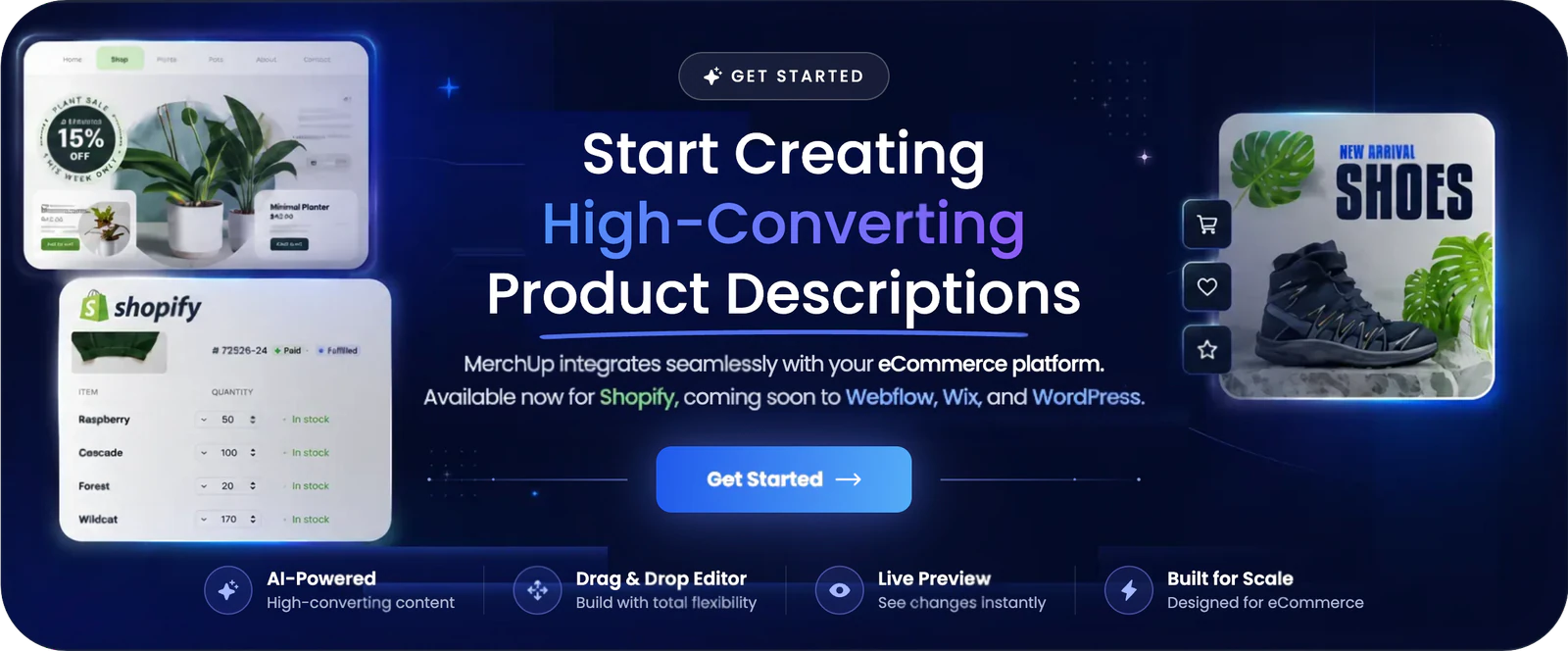
Merchup AI generates product descriptions that follow the five-element structure outlined in this article — benefit-led hook, scannable bullets, story paragraph, specs, and CTA — across your entire catalogue in a fraction of the time manual writing takes. The visual editor lets you adjust tone and emphasis by category, the drag-and-drop template builder enforces your editorial guardrails, and the Shopify integration publishes directly to your store without copy-paste. Bulk publishing, activity tracking, and real-time catalogue management mean your team spends time on strategy, not repetitive copy tasks. WooCommerce, Wix, and Webflow support are in development for sellers on those platforms.
Start with a free trial at Merchup AI and see how many descriptions your team can publish in a single session.
Sources
- How to Write Product Descriptions That Sell (2026) - Scale Growth Digital
- Description description - Manufacturer Center Help
- Product description: structure, examples and AI generation | Seegea
- Product description writing guide | ConversionStudio
- How to Write a Product Description + Template & Examples | Fit Small Business
- Writing product descriptions that convert (CXL)
- Duplicate content - Moz
- Myth: People read on the web - UX Myths


Comments
No comments yet — be the first to share what you think.