


SEO-optimized product descriptions are the single most underinvested conversion lever in most ecommerce stores. They do two jobs at once: help Google understand what you’re selling and give shoppers a reason to buy. Get both right, and you rank higher and convert more. Get either one wrong, and you’re invisible or forgettable.
The core of product description SEO is writing copy that is keyword-targeted, benefit-led, and formatted for both humans and search engines. That means no copied manufacturer text, no keyword stuffing, and no two-sentence descriptions that give Google nothing to work with. Unique, benefit-focused descriptions convert about 78% better than generic manufacturer copy. Pair those descriptions with 11–30 reviews, and conversion improves by 68% compared to pages with no reviews and recycled text.
Every high-performing product page shares the same core structure:
- Keyword-optimized title (the H1, your strongest ranking signal)
- Benefit-led opening paragraph (the first 160 characters often become your meta description)
- Scannable bullet points covering features translated into buyer benefits
- Expanded copy with use cases, context, and social proof
- Structured data (schema.org/Product markup) for rich results eligibility
- User-generated content like ratings and reviews integrated on the page
The payoff is real: better rankings, lower bounce rates, and more add-to-cart clicks. The sections below cover exactly how to build descriptions that deliver all three.
7 best practices for SEO-friendly product descriptions in 2026
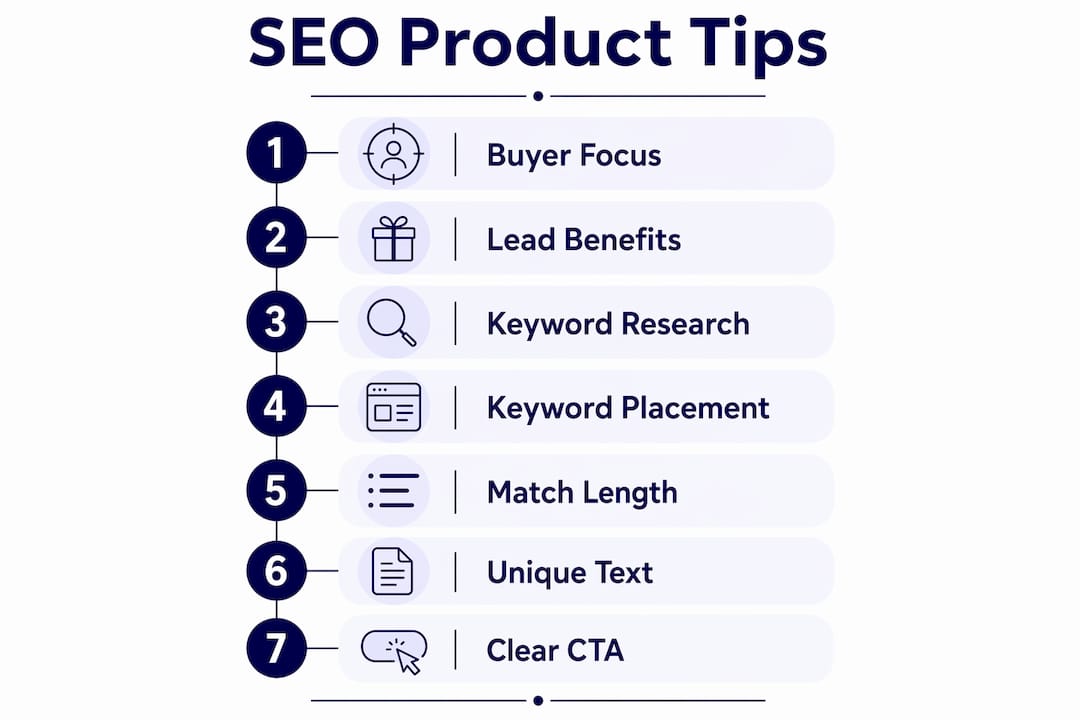
1. Write for buyers first, search engines second
The fastest way to kill conversions is to write for crawlers. Keyword-stuffed copy like “buy the best leather wallet men wallet RFID wallet” gets penalized by Google and repels real shoppers. The Problem-Solution-Proof framework works better than any keyword formula: name the frustration your buyer has, position your product as the fix, then back it up with evidence. That structure mirrors how buyers actually think, which means it converts better and reads naturally enough that keywords fit without forcing them.
2. Lead with benefits, then back them up with features
Features describe what a product is. Benefits describe what it does for the person buying it. Most sellers list features because they’re easier to write. “300-thread-count Egyptian cotton” is a feature. “So soft you’ll feel like you’re sleeping in a hotel” is a benefit. The translation formula is simple: [Feature] so you can [benefit]. Run every spec through that filter before it goes on the page.

3. Do real keyword research before you write a single word
You can’t optimize what you haven’t researched. Before writing any description, identify the exact phrases your buyers type into search. Google Autocomplete, Amazon’s top-ranking product titles, and your own customer reviews are three of the most reliable sources. The language customers use in reviews is often the exact language they search. If they call it a “travel mug,” don’t optimize for “portable beverage container.”
Target one primary transactional keyword per product page, plus two or three related long-tail variations. Long-tail phrases like “women’s lightweight waterproof hiking jacket” are less competitive and convert better than broad terms like “jacket,” because they match what a buyer with purchase intent actually searches.
4. Place keywords where they carry the most weight
Keyword placement matters as much as keyword selection. Put your primary keyword in the product title (H1), the first paragraph, one subheading, image alt text, the URL slug, and the meta description. That covers every location Google weights heavily without repeating the phrase awkwardly. If a sentence sounds unnatural when you read it aloud, remove that keyword instance.

| Location | Priority | Example |
|---|---|---|
| Product title (H1) | Highest | “Organic Cotton Baby Blanket” |
| First paragraph | High | “This organic cotton blanket is the softest…” |
| One subheading | Medium | “Why organic cotton matters for baby skin” |
| Image alt text | Medium | “organic cotton baby blanket in sage green” |
| URL slug | High | /products/organic-cotton-baby-blanket |
| Meta description | High | “Wrap your baby in 100% organic cotton…” |
5. Match description length to the product and buyer
Word count should follow product complexity: 150–300 words for standard products, 300–500 for high-ticket or complex items. Under 100 words gives Google too little to rank. Over 500 adds friction for buyers who already know what they want. Impulse purchases need shorter, punchier copy. Considered purchases, where the buyer is weighing options, need more detail: specs, use cases, and answers to the questions they’d otherwise email you about.
6. Write a unique description for every product
Duplicate descriptions are one of the most common and most damaging mistakes in ecommerce SEO. When dozens of stores use the same manufacturer text, Google has no reason to rank your version over any of theirs. It may not index your page at all. Rewrite every description in your own voice. Even changing 50% of the text meaningfully differentiates your page. For product variants (different colors, sizes), add at least one unique opening sentence that names the specific attribute.
Pro Tip: For product feed descriptions on Google Merchant Center, write copy that differs from your on-page description. Feed descriptions target feed-specific attributes and AI content needs, so keeping them separate avoids duplication penalties and gives you a second shot at visibility in Google Shopping.
7. End with a clear call to action
Most product descriptions stop at the last feature bullet and leave the buyer hanging. A direct call to action, even a single sentence, closes the gap between “I like this” and “I’m buying this.” Keep it specific to the product: “Order before 2 PM for same-day shipping” works harder than a generic “Buy now.” Urgency and specificity together push hesitant buyers over the line.
How buyer awareness should shape your description length and content
Not every shopper arrives at your product page at the same stage. Someone who Googled “best RFID-blocking leather wallet” already knows what they want and why. Someone who landed on your page from a broad search like “gifts for men” needs a lot more convincing. Writing the same description for both groups means you’re underserving one of them, usually the less aware buyer who needed more and left.
The buyer awareness spectrum runs from high familiarity (ready to buy, just comparing options) to low familiarity (still figuring out what they need). Here’s how to adjust:
- High awareness buyers: Keep copy tight. They’re scanning for specs, price, and proof. Lead with the key benefit, follow with a concise feature list, and close with a trust signal like a review count or guarantee.
- Low awareness buyers: Go deeper. Explain the problem the product solves, walk through how it works, and use lifestyle context to help them picture owning it. This is where the Problem-Solution-Proof structure earns its keep.
- Mobile readers (both groups): A majority of ecommerce traffic is mobile. Short paragraphs, bullet points, and white space aren’t optional formatting choices. They’re the difference between a description someone reads and one they scroll past.
- Complex or high-value products: Longer copy isn’t padding. A $400 piece of outdoor gear needs to answer every hesitation a buyer might have before they commit.
- Impulse or low-cost items: Two or three punchy sentences plus a strong benefit bullet list is often enough. Don’t over-explain something the buyer already understands.
The goal is always the same: give the buyer exactly what they need to say yes, and nothing more. Matching depth to awareness level also helps SEO, because longer, more detailed pages naturally incorporate more long-tail keyword variations without any forced stuffing.
Advanced SEO strategies and AI’s growing role in product descriptions
Structured data is no longer optional
Google recommends adding schema.org/Product markup to every product page and pairing it with a Google Merchant Center feed to maximize eligibility for rich results. Structured data tells Google the product’s name, price, availability, review rating, SKU, brand, dimensions, and material in a format it can read directly. Pages with that markup become eligible to show price, availability, and star ratings directly in search results, which lifts click-through rates over standard blue-link results. Skipping schema means competing at a disadvantage against every store that has it.
The Merchant Center feed is a separate layer. It powers Google Shopping listings and free product listings, and it should contain descriptions that differ from your on-page copy to avoid duplication issues and better target feed-specific queries.
AI-assisted writing at scale
AI tools save a large portion of writing time compared to manual efforts, making them a practical option for stores with hundreds or thousands of SKUs. The catch is that AI without human review produces generic copy. Bad AI turns thin supplier text into longer thin text. Good AI takes structured product data, customer questions, and keyword intent and turns them into clearer, more specific descriptions. The workflow that works: feed the AI accurate product facts, generate a draft, then edit for voice, accuracy, and uniqueness before publishing.
For sellers evaluating how AI fits into their broader product strategy, tools like the Spark Concept idea checker can help pressure-test whether a product’s positioning and description angle actually match buyer intent before you scale content production.
Conversion impact: Uniquely written, benefit-focused product descriptions convert about 78% better than pages using generic manufacturer text. Add 11–30 reviews to a strong description and conversion improves by 68% compared to pages with no reviews and generic copy.
Measure, then rewrite
Product description optimization is a cycle, not a one-time project. Use Google Search Console and ecommerce analytics to identify which pages have impressions but low click-through rates, traffic but poor conversion, or high return rates tied to buyer confusion. Those are the pages to rewrite first. The metrics that matter most are CTR, average ranking position, add-to-cart rate, and return rate. A product page with declining rankings and a two-sentence description is a straightforward fix. A page with solid rankings but a low conversion rate usually has a copy problem, not a keyword problem.
Advanced tactics worth adding to your workflow
- Separate feed descriptions from on-page copy. Google Merchant Center descriptions can be up to 5,000 characters and should target feed-specific attributes, not mirror your product page.
- Write custom meta descriptions for every product. Shopify auto-generates them from your description text, and the result is usually poor. A custom meta description around 155–160 characters, with the primary keyword and a reason to click, directly affects your SERP click-through rate.
- Integrate user-generated content. Reviews, ratings, and Q&A sections add fresh, keyword-rich content to your product pages without any extra writing. They also address the hesitations buyers have right before they leave.
- Audit image alt text. Every product image needs descriptive alt text in the format “[Brand] [Product Name] [Color] [Use Context].” Alt text is both an accessibility requirement and an SEO signal that supports Google Image traffic.
- Test before you scale. Rewrite your top 20 products first, measure the impact over 4–6 weeks, then apply what works to the rest of your catalog.
MerchUp makes SEO product descriptions faster and more consistent
Writing unique, keyword-optimized descriptions for every product in your catalog is the right strategy. Doing it manually for 500 SKUs is not realistic. That’s the gap MerchUp fills.
MerchUp is an AI-powered platform built specifically for ecommerce sellers who need to produce SEO-optimized product descriptions at scale without sacrificing quality or consistency. You feed it accurate product data, choose from customizable drag-and-drop templates, and get descriptions that are benefit-led, keyword-aware, and ready to publish. The visual editor lets you refine copy before it goes live, and bulk publishing means you’re not copying and pasting across hundreds of pages. Shopify integration is live now, with Webflow, WooCommerce and eBay support coming. If your catalog has grown faster than your content has, see MerchUp’s plans and find the tier that fits your volume.


Comments
No comments yet — be the first to share what you think.