


A good apparel product description does two jobs at once. It answers the questions a shopper cannot ask a sales assistant (how does it fit, what is it made of, how do I wash it), and it gives Google clear, consistent text to rank. The best ones run to roughly 150 to 300 words, open with a one-sentence hook, and then get specific: fit, fabric, care, model size.
This guide shows the structure, a worked example, the US labelling points sellers often miss, how to handle sizes and colours, and how to do it across a whole catalogue without every page sounding the same.
TL;DR
- Use a fixed structure: a one-sentence hook, 3 to 5 feature bullets, fit notes, fabric, care and model info, at about 150 to 300 words.
- Lead with accurate specifics (fibre content, measurements), then add sensory language to show what wearing it feels like.
- US law requires most textile products to carry a label with fibre content, country of origin and the responsible business. Your page copy must not contradict it.
- Treat sizes and colours as variants of one product, not separate pages with separate essays.
- Write the template once, then generate and review at scale. We built MerchUp AI to do that on Shopify.
What a clothing description has to do
Shoppers cannot touch the fabric or try the garment on. Fit and fabric uncertainty is what keeps people from clicking Add to cart, and it is a big part of why clothes get sent back. A description earns its place by removing that uncertainty.
It also has a second reader. Shopify’s own guidance on writing product descriptions treats the text as something that helps customers decide and helps search engines understand the page. Write for the person first. The keywords you need mostly arrive on their own when you name the garment, cut, fabric and use plainly.
The structure that works
One widely shared apparel format, from Tailor Size Guide, runs in this order: a one-sentence hook, 3 to 5 feature bullets, fit notes, fabric details, care, and model info, kept both emotional and specific. We agree with the order, because it follows the questions in the order shoppers ask them.
| Section | What it contains | Rough length |
|---|---|---|
| Hook | What the garment is and the one reason to want it | 1 sentence |
| Feature bullets | Cut, details, pockets, closures, finish | 3 to 5 bullets |
| Fit notes | Relaxed, true to size, cropped; measurements | 1 to 2 sentences |
| Fabric | Fibre percentages, weight, feel | 1 to 2 sentences |
| Care | Wash, dry and iron instructions | 1 line |
| Model info | Model height and size worn | 1 line |
The whole description should land at about 150 to 300 words. Shorter is fine for a plain basic. Longer only works when the garment has a real story, such as a technical fabric or a made-to-order process.
Start with the technical, then add feeling
Garment writing guidance from Fashion-Incubator separates technical, marketing and legal descriptions, and treats the technical one as the base of the other two. That is a useful order of work. Get the facts down first (dimensions, fibre, construction), then lay the voice on top.
Sensory words help once the facts are in place. Soft, crisp, flowing and sculpted all tell a shopper something about drape and handfeel. “Perfect for any occasion” tells them nothing. If a word could describe any garment in your store, cut it.
A worked example
Here is a description for a fictional linen shirt, following the structure above.
The Harbour Shirt: breathable linen that looks better every time you wash it.
- Garment-washed linen with a soft, slightly textured hand
- Two chest pockets and a curved hem that sits well untucked
- Mother-of-pearl-effect buttons, reinforced at the placket
- Relaxed through the shoulder and body, with a back length of 29 in
Fit: Relaxed. If you are between sizes, take the smaller one for a closer line. Fabric: 100% linen. Care: Machine wash cold, tumble dry low, iron while damp. Model: 6 ft 1 in, wearing size M.
Notice what is missing: no “high-quality”, no “must-have”. Every line gives the shopper something to act on. Notice also that the fabric line is a plain statement of fibre content. That matters for the next section.
US labelling: the part retailers underestimate
If you sell in the US, the description sits next to a legal obligation. According to the FTC, federal labelling requirements for textile and wool products mean that most of them need a label listing fibre content, country of origin and the identity of the manufacturer or another responsible business. The FTC’s business guide, Threading Your Way Through the Labeling Requirements, is the place to read how it applies to your product.
Practical points for a store owner:
- Make the page match the label. If the garment label says 60% cotton, 40% polyester, the page must not say “cotton”. Copy fibre percentages from the label, not from memory or a supplier’s marketing sheet.
- Be careful if you remove or replace tags. Relabelling, especially for private-label or resold stock, can put the responsibility on you. Check the FTC guide before you do it.
- Do not leave care to guesswork. The FTC says its Care Labeling Rule requires manufacturers and importers to attach care instructions to garments. Reproduce those instructions on the page as they appear on the label.
- Keep a record of what you published. A history of each listing’s text makes it easy to check what a page said on a given date.
This is a compliance topic, not a copywriting one. If you import, relabel or make your own clothing, check the FTC pages above or speak to a lawyer who works in textile compliance before you finalise your copy. Rules and penalty levels change, so confirm the current position on the FTC’s site.
Fit, size and model information
Fit is where most apparel pages are weakest. “True to size” is a start but not enough on its own. Do these things instead:
- Give two or three garment measurements (chest, length, sleeve or inseam) in inches, with a size chart that reflects the actual garment, not body measurements.
- Say whether the item runs small, large or true, and what to do between sizes.
- State the model’s height and the size worn on every product photo set, not only the hero image.
- Describe the fabric’s stretch (none, a little, four-way) because it changes how a size will feel.
For print-on-demand and supplier-fed stores, this is also where pages start to look identical. If many products share a supplier’s boilerplate, add your own fit line and model info to each one. That small change separates your page from every other store selling the same blank.
Sizes and colours: one product, many variants
The mistake we see most with larger apparel catalogues is treating every size and colour combination as its own page with its own long description. That produces thin, repeated text and splits your ranking signals.
Google’s documentation on product variants describes apparel as a typical case of one product sold in different sizes, colours, materials or patterns, and explains how ProductGroup markup tells it which variants belong together. In practice:
- Write one strong parent description that covers the garment.
- Put what changes (colour name, size, availability, image) at variant level.
- Keep colour-specific copy to a sentence only where it truly differs, for example a different fabric finish in one colourway.
We cover how to do this inside Shopify in our guide to variant descriptions.
Structured data and metadata for clothing
Google’s merchant listing documentation lists name, image and offers as required Product properties. For clothing, the attributes worth adding where you have them include brand, colour, pattern, material, size, gender and age group. These are the same facts your description already contains, so write them once and reuse them.

The meta title and meta description are the other half. Aim for a title that names the garment, the key attribute and your brand, and a description that gives the shopper a reason to click. Tools that combine search data with AI, such as this Shopify SEO academy, can help with keyword discovery for page metadata. For a deeper look at the markup itself, see our Shopify product schema guide, and for the wider checklist, our Shopify SEO checklist.
A reusable template you can copy
Save this as your house format and fill it in per product:
- Hook (one sentence): [Garment] + [main benefit] + [who or when].
- Bullets (3 to 5): [Fabric feel], [key construction detail], [practical detail], [fit detail].
- Fit: [Relaxed/regular/slim], [between-sizes advice], [key measurement].
- Fabric: [Fibre percentages exactly as on the label], [weight or finish].
- Care: [Instructions as on the label].
- Model: [Height], wearing [size].
The same skeleton works for tees, knitwear, denim, activewear, dresses and outerwear. Only the bullets change: a coat needs insulation and weather details, denim needs rise and wash, activewear needs moisture and stretch information.
Our perspective: consistency beats inspiration
We build MerchUp AI for Shopify sellers who add new products every week, and the same pattern shows up in apparel stores. The descriptions are rarely bad because the writer lacked talent. They are bad because the 40th product gets written at 5pm on a Friday, with half the specs missing.
So we treat a description as a product-data job first. The tool starts from a product photo (or barcode), builds the listing fields (title, type, vendor, price, tags and SEO), and writes the description into a designed template so every garment has the same structure, from hook to care line. The designed template is also where your brand voice goes, so the emotional copy stays yours while the technical backbone stays consistent.
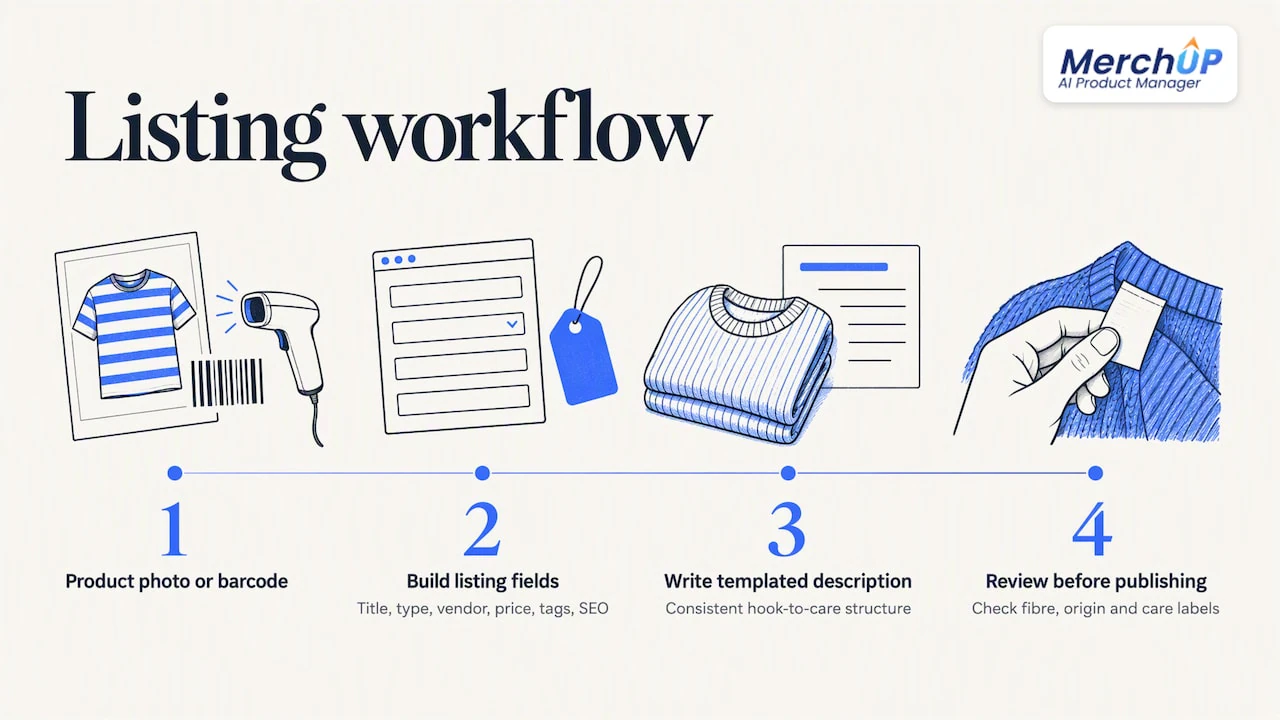
We also think nothing should go live unreviewed. Every change in MerchUp AI is reviewed before publishing, with full history and the option to restore an earlier version. For clothing, where a wrong fibre percentage is a legal and a customer-service problem, that review step is the feature that matters most. Always check fibre content, origin and care against the garment’s label before you approve.
The SEO side works the same way. MerchUp AI does all your SEO in one click: it reads your store’s own Google Search Console data and live Google results, picks keywords, writes meta titles, descriptions and image alt text, checks rankings on live Google and pushes everything to your store. You do not need SEO knowledge to use it.
— Jamie Moss
Doing it across a whole catalogue
A ten-piece capsule can be written by hand. A seasonal drop of 200 SKUs cannot, not well. A sensible workflow:
- Fix the template above and agree your tone in a short style note.
- Gather the facts per product: label photo, measurements, model details.
- Generate drafts in a batch, starting with a small group of 20 to 50 products so you can catch pattern errors early.
- Review each draft against the label, then publish.
- Check which pages earn impressions in Search Console and refine the top ones by hand.
Our article on bulk generating product descriptions goes into governed templates for larger catalogues, and our tutorial shows the flow from product to published description.
Try it on your own range
MerchUp AI is available now for Shopify. There is a free plan, and paid plans start at £12.99 a month (Starter), with Growth at £34.99, Pro at £79.99 and Scale at £199.99 a month. See what each includes on the pricing page, then run a handful of your own garments through it and judge the output against the checklist in this article.
Common mistakes to avoid
- Adjective stacking. “Luxurious, stylish, premium” says less than “heavyweight 12 oz brushed cotton fleece”.
- Copying the supplier’s text. Other stores have it too, which weakens the page.
- Missing model info. Shoppers cannot judge size from a photo alone.
- Fibre mismatches. The page, label and structured data must agree.
- One essay per variant. It dilutes the page and makes updates painful.
- Skipping alt text. Image alt text should describe the garment and colour plainly, which helps both accessibility and image search.
FAQ
How long should an apparel product description be?
Most guidance, including Tailor Size Guide, suggests about 150 to 300 words. Use the lower end for simple basics and the upper end for technical or higher-priced garments. What matters more than length is that fit, fabric, care and model info are all present.
Should I write a separate description for every size and colour?
No. Write one parent description and keep size and colour as variants, which is how Google’s variant guidance treats apparel. Add a short colour-specific line only when something genuinely differs between colourways.
Do I have to list fibre content and care instructions online?
US rules apply to the product label, not to a web page as such, but your page must not contradict it. The FTC explains the labelling requirements for textile products. Copying fibre content and care details from the label is the safest habit, and a compliance lawyer can advise on your specific situation.
Can AI write apparel descriptions safely?
Yes, if you treat it as a first draft with a review step. Check every fibre percentage, measurement and care instruction against the garment before publishing. We built MerchUp AI so changes are reviewed before they go live, with history and restore.
Sources
- Apparel and Labeling, Federal Trade Commission
- Threading Your Way Through the Labeling Requirements Under the Textile and Wool Acts, FTC
- Clothes Captioning: Complying with the Care Labeling Rule, FTC
- Product Variant Structured Data, Google Search Central
- How To Add Merchant Listing Structured Data, Google Search Central
- How to Write Product Descriptions That Sell Apparel, Tailor Size Guide
- How to write garment and product descriptions, Fashion-Incubator
- Writing product descriptions, Shopify Help Center


Comments
No comments yet — be the first to share what you think.