


A buyer persona helps your product copy when it tells you what one specific shopper is trying to get done, what worries them, and which words they use. Build it from real customer data, write it down on one page, and check every title and description against it before you publish. This guide shows how to do that for a Shopify store, from research to finished copy.
- ✓Shopify product titles and details
- ✓Descriptions in a designed template
- ✓SEO titles, descriptions and image alt text
TL;DR
- A buyer persona is a research-based, semi-fictional profile of one customer segment. It is narrower than a target audience and built around motivations, not just demographics.
- Build it from what you already have: customer interviews, order data, site analytics, support emails and reviews. Then check it against real customers.
- Turn each persona into copy by answering its top questions and objections, leading with the benefits it cares about, and using the search phrases it types in titles.
- Avoid stereotype personas. A stock photo and a catchy name is not research.
- MerchUp AI can draft listings and descriptions at scale, so your persona work goes into every product, not just your bestsellers.
What a buyer persona is, and what it is not
A buyer persona is a composite representation of a specific type of customer in a market segment, drawn from shared traits and reasons for buying. It is semi-fictional: the person is invented, the patterns behind them are not.
That separates it from two terms people mix up with it:
| Term | What it describes | What it is good for |
|---|---|---|
| Target audience | A broad group defined by shared characteristics, such as age band or location | Choosing channels and budgets |
| Buyer persona | One representative buyer, with motivations, behaviours and pain points | Deciding what your copy says and in what tone |
| User persona | The person who uses the product day to day, with their workflows and frustrations | Product and feature decisions |
The distinction is real: a target audience is defined by demographics, while a persona focuses on motivations, behaviours and pain points. And a user persona centres on the person who uses the product, who is not always the person who pays.
That last point matters for copy. A parent buys a gift for a teenager. A shop manager orders supplies for a team. A collector buys a card for their binder. Your copy has to persuade the buyer and reassure the user, and sometimes they are two different people.
Why persona-led copy beats generic copy
Generic copy describes the product. Persona-led copy describes the shopper’s problem and shows how the product solves it. Amazon’s advertising guidance describes personas as fictitious representations grounded in customer insights, used to understand what customers want, need and value so that messaging can be tailored to them.
In practice, a persona stops three habits that weaken product pages:
- Writing for “everyone”, which usually means writing for no one.
- Listing specifications without saying why they matter.
- Leaving obvious questions unanswered, so the shopper leaves to look for the answer elsewhere.
If you want the deeper reasoning on the second habit, our piece on features versus benefits covers it.
Research: what data to build a persona from
Start with people who already buy from you, not the customer you wish you had. You probably hold more data than you think.
Data you already have
- Order history. Order frequency, average order value, which products are bought together, and how long customers take to buy. These behaviours are exactly the kind of observable signals ecommerce persona guidance points to.
- Customer emails and support tickets. Questions about sizing, compatibility, delivery or returns are objections in the customer’s own words.
- Product reviews. Look for the reason people bought and the thing that surprised them.
- Site analytics. Which pages they land on, what they search for on your site, where they leave.
- Search Console queries. The phrases that already bring people to your store show how shoppers name your products.
Data you need to go and get
A short conversation beats a dashboard. Interview five to ten recent customers and, if you can, a few people who looked and did not buy. Ask what they were trying to do, what else they considered, what nearly stopped them, and what made them decide. Surveys, interviews, website analytics and sales-team feedback are the standard inputs for persona research, according to HubSpot’s persona guide.
Segment by the job, not just the demographic
The American Marketing Association suggests that marketers segment by required outcomes, meaning what the customer is hiring the product to do, rather than by descriptive demographics alone. For a store owner this is a useful shortcut. Two buyers of the same candle may be a person treating themselves after a long week and a person who needs a safe, quick gift. Same age, same postcode, different copy.
The AMA also reports that Hilton’s ad built on psychometric data outperformed its control group by 340%. That is one company’s result, not a promise for your store, but it shows why motivations tend to be a better guide to messaging than age and income.
Building and validating the persona
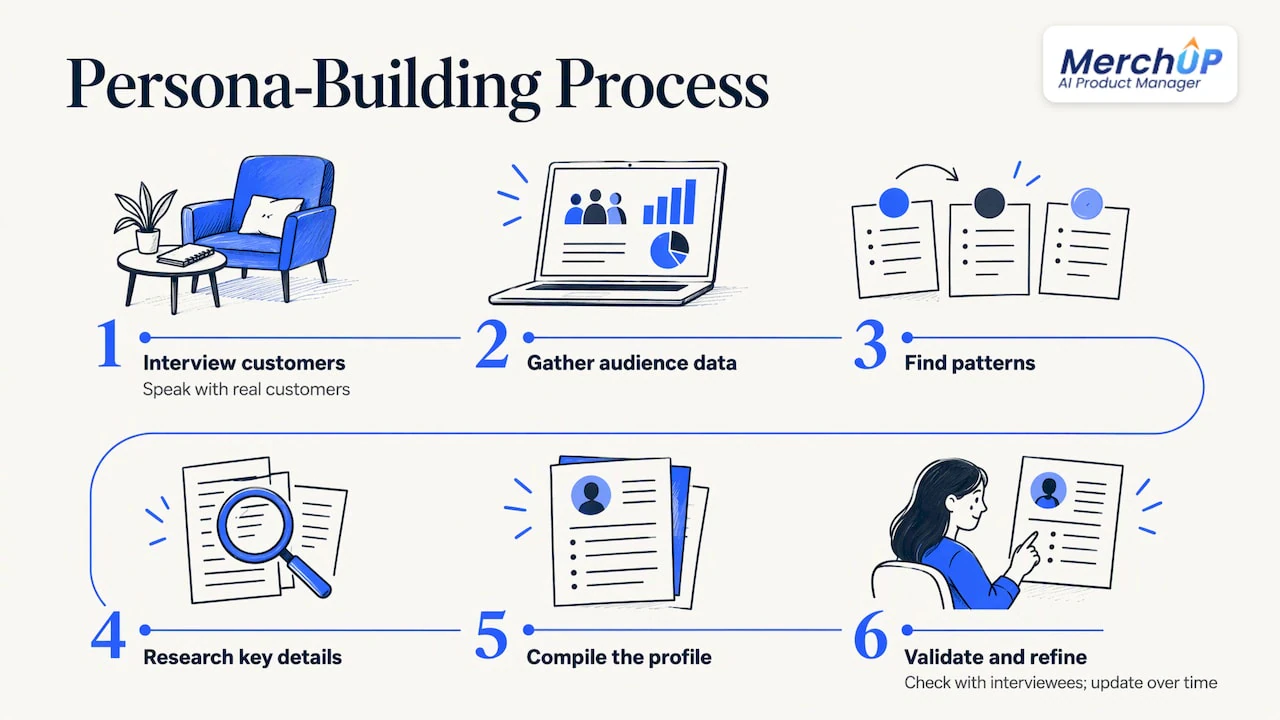
Keep the process light. A practical sequence, in line with Shopify’s guidance on building personas: interview customers, gather audience data, find the patterns, research the key details and compile the profile. Then check it against the customers you spoke to and refine it over time.
A one-page persona template
For product copy, you do not need a poster with a stock photo. You need these fields:
- Name and label. For example “Gift-buying Grace”. Use it as shorthand for the team.
- The job. What they want the product to do for them.
- Situation. When and where they shop, on what device, how rushed they are.
- Top three questions. Taken from emails, reviews and interviews.
- Top three objections. Price, trust, fit, delivery time, returns.
- Words they use. The exact phrases from reviews and search queries.
- Proof they trust. Reviews, photos, specifications, guarantees, size charts.
Validate before you rely on it
Personas are hypotheses until tested. At the light end, show the page to the customers you interviewed and ask whether it sounds like them. At the heavier end, MeasuringU describes a mixed-method approach: qualitative interviews, a larger survey, statistical clustering of segments, and then prediction of which segment a customer belongs to. Most small stores do not need that rigour, but the principle holds: check your guess against more than one data source.
Then watch the numbers. If copy written for a persona raises add-to-basket rate or lowers pre-purchase questions, keep going. If not, the persona is wrong or too vague.
A worked example: one persona, one product
This is an imagined example to show the method, not a customer case study.
Suppose you sell insulated stainless steel water bottles. Your order data and reviews suggest two main groups. One is commuters who carry the bottle daily. The other is parents buying for school lunches. Take the second.
Persona: School-run Sam.
- Job: a bottle that survives a school bag and does not leak onto the homework.
- Top questions: Is it dishwasher safe? Will it fit a standard bag side pocket? Is the lid easy for a small child?
- Top objections: “It will get lost or dented within a month.” “Is the lid hard to clean?”
- Words used in reviews: “leakproof”, “survived the bag”, “easy to open”.
A generic description might read: “Double-wall vacuum insulation. 500 ml capacity. Stainless steel.”
A persona-led version leads with Sam’s job and answers the questions in order:
Leakproof in a school bag, cold by lunchtime. The sealed lid stays shut when the bottle gets thrown in with books and a lunchbox. Double-wall insulation keeps water cold through the school day. It fits standard side pockets, the lid opens with one hand, and everything goes in the dishwasher.
The facts are the same. The order, the benefits and the objections handled are different. Notice too that each claim should be true of your actual product. Persona research tells you what to emphasise, not what to invent.
Turning a persona into titles and descriptions
Titles: use the words your persona searches
Product titles should include the long-tail phrases prospects actively search for, so the page matches their purchase intent. Your persona’s “words they use” field is where those phrases come from. “Leakproof kids water bottle 500 ml” speaks to Sam more clearly than a brand name and a model code. For the mechanics, see our guide to optimising product titles for search and ads.
Descriptions: a repeatable structure
Use this order for each persona-led description:
- A headline that names the job. What the product does for this shopper.
- Two to six highlights, each translated into a benefit. Baymard Institute’s research recommends structuring descriptions as feature highlights, each with an image or graphic, a short headline and a paragraph, and finds it encourages users to explore features in more depth.
- Answers to the top questions. Size, compatibility, care, what is in the box, delivery and returns.
- Proof. A review line, a specification, a guarantee you actually offer.
- A plain next step. Add to basket, choose a size, check the size chart.
For a bank of ready-made layouts, see our product description templates, and for finished pieces, our product description examples.
Handle objections where they arise
Place each answer next to the claim that triggers the worry. If the objection is “will it fit”, put dimensions beside the fit claim, not in a tab three screens down. If it is trust, put the return policy near the price. This is the practical difference between persona-led copy and decorated generic copy.
Keep it readable
A persona who shops on a phone in a queue will not read a wall of text. Short paragraphs, bullets for specifications and one idea per sentence help. Our guide to product description readability goes through the checks.
One product, several personas
Most products have more than one buyer. Do not write three descriptions for one page. Pick the persona that accounts for most of your revenue, write the main description for them, and serve the others through the title variants, collection pages, email segments and ad copy. Segmenting email or content lists by persona allows for more relevant messaging for each group, as HubSpot’s persona material notes.
Mistakes that make persona copy fail
Stereotype personas. The AMA warns that many marketers rely on personas that are mostly stereotypes, sometimes a random stock photo with a catchy name. If your persona could have been written without talking to a single customer, it will produce copy that sounds like everyone else.
Too many personas. Five personas for a store with 40 products means nobody uses any of them. Start with one or two.
Demographics only. “Women aged 25 to 40” tells you nothing about what to write. Motivation, situation and objections do.
Writing the persona, not the product. Copy should not say “Perfect for busy parents like you!” over and over. Show the situation in the benefit instead.
Never updating. Customers change, and so do your products. Revisit the persona when your order data, reviews or support questions shift.
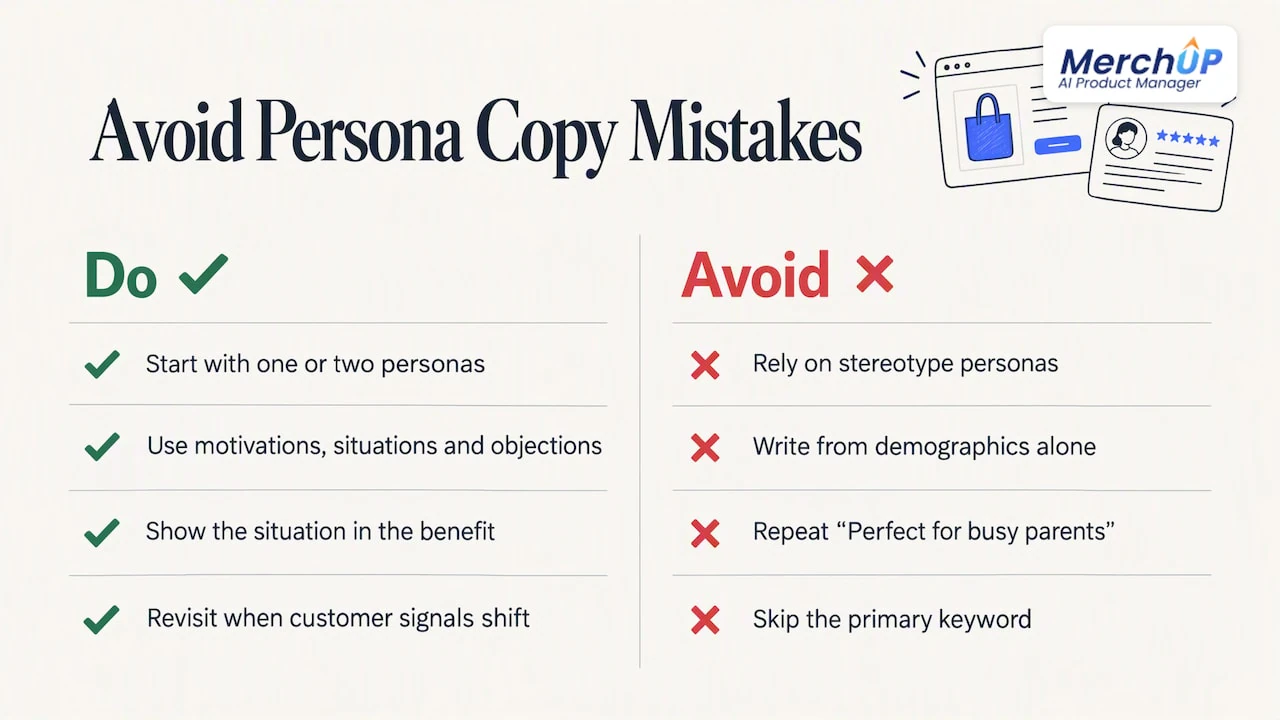
Skipping the keyword. A persona informs tone and content, but shoppers still arrive from search. Pair the persona work with one clear primary keyword per page, as in our guide to product page keywords, and with product description SEO.
Our perspective
Most store owners we speak to already know their customer. What they lack is the time to put that knowledge into every product page. The persona gets written once, then the bestsellers get careful copy and the other 200 products get a quick line and a spec list.
We built MerchUp AI to close that gap. It works as an AI product manager: you scan or photograph a product and it creates the whole Shopify listing, then writes the description into a designed template and can create AI product photos. Your persona decides what matters. The tool makes sure that thinking reaches every listing, and every change is reviewed before it goes live, with full history and restore.
For trading-card sellers the persona is often the collector who wants to know exact condition and centering, so copy and data have to agree. That is why we pair card identification and market pricing with AI centering and condition estimates, and why the same store can sell online and in person through Shopify POS.
Our advice: write the one-page persona first, keep it in front of you, and judge every generated description by one question. Does it answer what this buyer actually asks?
Jamie Moss
Put your persona to work with MerchUp AI
If you add new products every week, the hard part is consistency. MerchUp AI turns a product photo or barcode into a complete Shopify listing with title, type, vendor, price, tags and SEO, and writes the description into a designed template. You review the result before it goes live, which is where your persona does its job: check the headline, the benefits and the answers to the top questions.
You can try the AI description generator for Shopify on the free plan. Paid plans start with Starter at £12.99 a month, and you can compare all plans on the pricing page. MerchUp AI is available now for Shopify.
FAQ
How many buyer personas does a small store need?
One or two is enough to start. Pick the segment that brings most of your revenue and write for them first. Add a second persona only when you can see a distinct group in your orders, reviews or support emails.
Is a buyer persona the same as a target audience?
No. A target audience is a broad group defined by shared characteristics. A buyer persona is a narrower profile of one representative customer, built around motivations, behaviours and pain points. You use the audience to pick channels and the persona to decide what the copy says.
Where do I find the data if I have few customers?
Start with interviews: talk to five recent buyers and ask what they were trying to do and what nearly stopped them. Add reviews, support emails and the search queries that bring people to your store. Label the result as a working hypothesis and check it as orders grow.
How do I know the persona is working?
Compare pages written with the persona to those without. Look at add-to-basket rate, conversion and the number of pre-purchase questions that reach your inbox. If questions drop and conversion rises, the copy is answering what buyers need.
Can AI write persona-led product descriptions?
Yes, as a first draft, as long as you supply the context and review the result. Tell the tool who the buyer is and which questions to answer, then check every claim against the real product before publishing. MerchUp AI keeps a review step and full history for exactly this reason.
Sources
- What Are Buyer Personas? (TechTarget)
- What Is a Buyer Persona? (Dovetail)
- Ideal Customer Profile vs Target Audience vs Personas (Nati Marketing)
- What is a Buyer Persona? (Amazon Ads)
- Make My Persona Education Offer (HubSpot)
- Better Segmentation for Better Insights (AMA)
- Marketers and the Lost Treasure of Psychology-Based Segmentation (AMA)
- What Is a Buyer Persona? (Shopify)
- How To Make Personas More Scientific (MeasuringU)
- Structuring Product Page Descriptions by Highlights (Baymard Institute)


Comments
No comments yet — be the first to share what you think.