


A good B2B product description helps a business buyer decide, justify and order. It leads with the outcome the product delivers, backs it with complete specifications, and answers the questions a buying team will ask before anyone signs off. This guide shows how to build one, from research to structure to measurement, and how to do it across a whole catalogue without losing quality.
TL;DR
- B2B copy supports a group decision, so write for the user, the technical evaluator and the person who approves the spend, not one shopper.
- Lead with the outcome, then give features equal weight and a scannable specification table.
- Complete specs persuade: vague or missing details push buyers to contact support or leave.
- Build titles from brand, product type and the key differentiating specification, with part and model numbers.
- Measure with Google Search Console (impressions, clicks, click-through rate) and your store’s orders, page by page.
How B2B product descriptions differ from consumer copy
Consumer copy mainly persuades one person that a product is worth buying. B2B copy has a harder job: it has to help a business evaluate, justify and purchase. EazyCreatives describes the difference as a decision that involves several people and stages, with a higher standard of justification.
In practice that changes what the page needs:
- More stakeholders. The person who finds your page is rarely the person who approves the budget.
- Longer decisions. Buyers compare, ask for approval and check implementation before ordering.
- Less emotion, more evidence. Dimensions, tolerances, compatibility and compliance matter more than a clever line.
- Repeat orders. Many B2B buyers reorder the same item. They need the exact part number and pack size, not a story.
The tone can still be human. It just has to survive technical scrutiny.
Know the buyer before you write
Before drafting, work out who is involved and what each person needs to believe. Aethera’s buyer-brief approach names the roles worth mapping: economic buyers, users, technical evaluators and procurement, along with their pains, triggers and buying criteria.
For a product page, a short brief per product line is enough. Write down:
- Who uses it day to day, and what problem it removes for them.
- Who checks the details, and which specifications they will look for first.
- Who signs off, and what they need to justify the cost: total value, risk, support, delivery terms.
- What triggers the purchase: a replacement cycle, a new site, a regulation, a bulk reorder.
- What objections come up: compatibility, minimum order quantity, lead time, returns.
- What proof you hold: certifications, test results, case studies, warranty terms.
If you sell through a Shopify wholesale or B2B setup, the same brief tells you which of these answers belong in the description and which belong in other store pages such as shipping and terms.
What to put in a B2B product description
Specifications that answer the technical questions
Nielsen Norman Group’s B2B specifications guidance lists what buyers look for: footprint or dimensions, components or materials, requirements and integrations, performance, tolerances and durability, plus capacity, weight, power and operating conditions. For performance figures, state the conditions of the measurement and the margin of error, and link to relevant standards or independent compliance verification where you have it.
The same source makes a point worth remembering: completeness persuades. Incomplete specs force buyers to contact support or abandon the page, while detailed ones help both the decision and search visibility.
Features and benefits, in equal measure
Consumer-style benefit language alone rarely satisfies a business buyer. Copywriter Steve Slaunwhite’s advice, summarised by John Cole, is to give features and benefits equal weight. Each feature earns its place by connecting to an outcome.
| Feature | Weak benefit | Outcome a buyer can justify |
|---|---|---|
| 600 PSI rated brass valve | Strong and reliable | Fits existing high-pressure lines without a redesign, so no re-certification of the system |
| Barcode-ready packaging | Easy to handle | Goods can be received and shelved without relabelling |
| Bulk packs of 50 | Great value | Fewer purchase orders per quarter and a lower unit cost |
| Documented compatibility list | Works with lots of things | Procurement can confirm fit before ordering |
The shift is from describing what the product is to explaining what the buyer gets, which is the core change EazyCreatives identifies in B2B copy.
Proof and comparisons
Business buyers need material they can forward. Useful additions include datasheets, certifications, manuals, a compatibility table, and a short comparison against alternative approaches. Ahrefs notes that answering common buyer questions, adding sizing charts or material breakdowns, and comparing against other solutions all help decision-making. Only include proof you actually hold: a certification you cannot document does more damage than a gap.
A structure that works on the page
The structure recommended by Growmax’s B2B guide is a good base: a title with brand, product type and the key specification; a two to three sentence overview of application and benefits; a scannable specification table; then application, compatibility, installation or usage notes.
WebUp adds that the most important benefits should come first, supported by features, with specs such as material, power, weight, capacity and diameter in a clear table.
Nielsen Norman Group’s framing of the buying journey explains why: early content should state the problem solved and the high-level benefits, while later content must give specific, realistic product and integration details. One page serves both, in that order: overview on top, detail below.
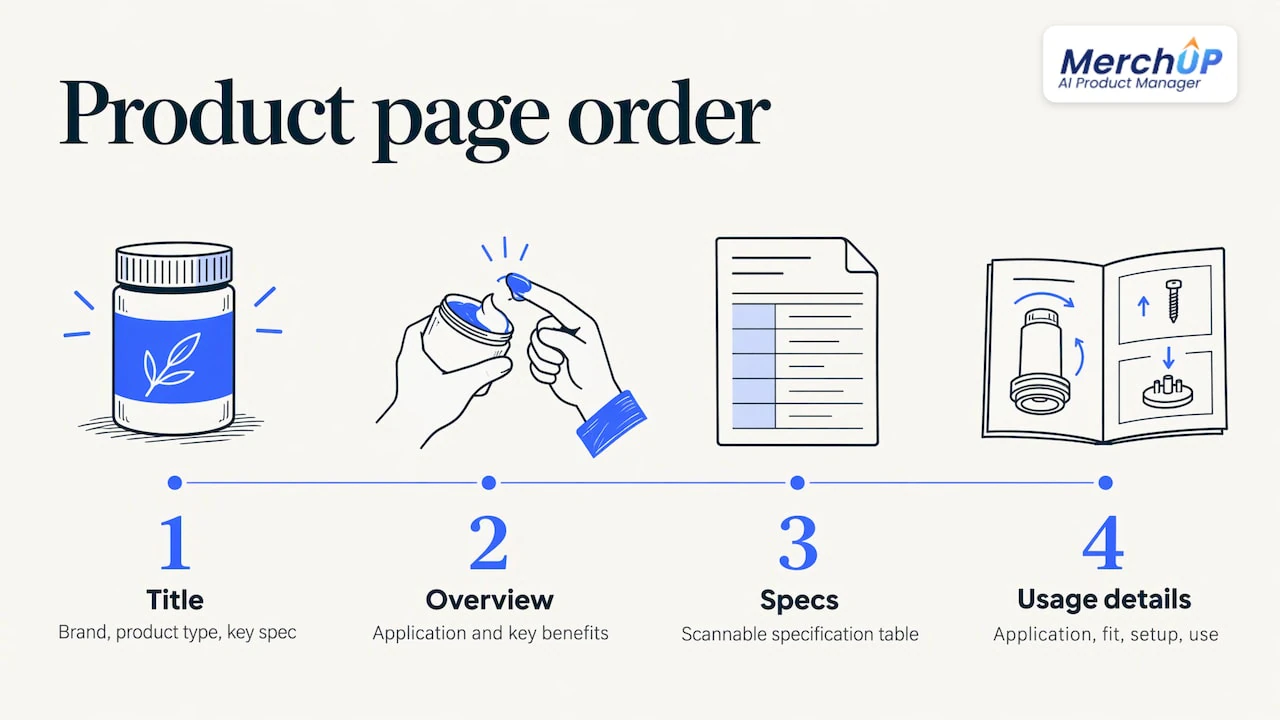
A template you can copy
Title: Brand + product type + key specification + model or part number
Overview (2 to 3 sentences): Who it is for, the job it does, the result they get.
Key benefits (3 to 5 bullets): Each one an outcome, each tied to a feature.
Specification table: Dimensions, materials, capacity, weight, power, operating conditions, certifications, pack size, minimum order quantity.
Compatibility and use: What it works with, what it replaces, installation or setup notes.
Buying terms: Lead time, bulk pricing tiers, warranty, returns and support.
Documents: Datasheet, manual, compliance certificates.
For more layouts, see our product description templates and the guide to product description structure.
A worked example
Take a trade supplier selling brass ball valves. Growmax’s example title is the model for the format: brand, product, size, material and rating, such as “Parker Hannifin 3/4" NPT Brass Ball Valve, 600 PSI WOG.”
The overview underneath might read: “A full-port brass ball valve for water, oil and gas lines up to 600 PSI. Quarter-turn operation and a threaded NPT connection let maintenance teams isolate a line quickly without specialist tools.”
The table beneath then carries connection size, body material, pressure rating, temperature range, seat material and the standards it meets. Nothing in the overview is a claim the table cannot back up.
Write for search without hurting readability
Business buyers search with precise terms: part numbers, model numbers, sizes and cross-references. Growmax recommends titles that include these, plus relevant keywords used naturally and notes on application and compatibility.
A few practical rules:
- Put the specific phrase in the title and first sentence, then write normally. If a sentence reads badly aloud, rewrite it.
- Make every description unique. Variants that differ only in size or colour tempt you to copy and paste. Our guide to unique product descriptions at scale covers how to avoid it.
- Write meta titles and descriptions per product, naming the product type and the specification a buyer would search for.
- Write image alt text that describes what the image shows, such as the product from a given angle or a dimension diagram.
- Use the spec table as content. Buyers scan it, and it holds the terms they search for.
This is also where catalogues fall down. A B2B store with several hundred SKUs rarely has time to hand-write meta data for each one. MerchUp AI does all your SEO in one click: it reads your own Google Search Console data and live Google results, picks keywords, writes meta titles, descriptions and image alt text, checks rankings on live Google and pushes everything to your store. No SEO knowledge is needed, and every change is reviewed before it goes live, with full history and restore.
Scale it across a catalogue
The hard part of B2B copy is rarely the first description. It is the five hundredth, written to the same standard. Three habits help:
- Fix the template first. Agree the sections and the specification fields once, then fill them for every product.
- Keep your data clean. Descriptions are only as complete as the product data behind them. Collect dimensions, materials and compatibility in one place.
- Review before publishing. A person with product knowledge should check numbers, units and claims. A wrong tolerance is worse than a missing one.
Our guides to bulk product descriptions and electronics product descriptions show how technical categories work with templates. If your store runs on Shopify, the Shopify description templates playbook covers the setup.
Measure whether it is working
A description has done its job when more of the right buyers find the page and more of them order. Measure both sides.
Visibility. Google Search Console’s Performance report shows clicks (visits from Google Search), impressions (how often your site appeared) and click-through rate, and you can view them by page. Its default view covers the past three months, and you can change the metrics, dimensions and date range. After rewriting a product page, compare the same page before and after over equal periods.
Sales. In your store analytics, track orders, conversion rate and average order value for the rewritten products against ones you have not touched. Reorder rates and the volume of pre-sale questions to your team are also useful: a good description reduces the questions.
How to read the results:
- High impressions, low click-through: the title or meta description is not matching the search.
- Good clicks, few orders: the page is missing something buyers need, usually a spec, a price tier or a terms detail.
- Rising enquiries about the same detail: add it to the page.
Change a handful of products at a time so you can tell what made the difference.
Our perspective: treat the product as one job
We build MerchUp AI around a simple idea: a product description is one step in a longer job, and it goes wrong when the steps are handled in different tools by different people.
For a B2B catalogue, that job runs from the product data to a complete listing: title, type, vendor, price, tags and SEO, a description written into a designed template, and product photos that match. MerchUp AI is built to do all of it from a photo or barcode and publish it to Shopify, so the structure stays the same from the first product to the last.
We also think SEO should not be a separate project. Because MerchUp AI reads your Google Search Console data and live Google results before it picks keywords and writes meta titles, descriptions and alt text, the search work follows what buyers actually type. You review each change before it goes live, and you can restore any earlier version.
B2B copy rewards consistency and completeness. Our aim is to make both the default, so your team spends its time on the details only they know: the specs, the proof and the terms.
Jamie Moss
Put it into practice with MerchUp AI
If you sell on Shopify and add products every week, you can turn a photo or barcode into a full listing with MerchUp AI’s description generator. It writes the description into a designed template, can create AI product photos, and handles the SEO for the store.
There is a free plan, and paid plans start at £12.99 a month with Starter, then Growth at £34.99, Pro at £79.99 and Scale at £199.99. You can compare them on the pricing page. To see how the tools fit together, look at how MerchUp AI’s tools work together. MerchUp AI is available now for Shopify, with Webflow, Wix and WordPress coming soon.
FAQ
What should a B2B product description include?
A clear title with brand, product type and key specification, a short overview of the application and benefits, and a specification table. Add compatibility, usage notes, buying terms and documents. Nielsen Norman Group’s guidance stresses that complete, realistic specifications help buyers decide.
How long should a B2B product description be?
Long enough to answer the questions a buying team would otherwise email you. For a simple consumable that may be a short overview and a table. For equipment or software-linked products, expect more detail on integration, installation and support. Put the summary first so quick readers still get the point.
Should I write features or benefits?
Both. B2B buyers need the feature to verify and the benefit to justify. Pair each major feature with the outcome it produces, such as faster changeover or fewer returns, and keep the specification table for the raw detail.
How do I write B2B descriptions for hundreds of products?
Set one template, standardise the data fields, and generate drafts from that structure. Then have someone who knows the products review every description before publishing. Our guide to descriptions that sell and the examples article show the patterns.
Sources
- Product Description Copywriting for B2B, EazyCreatives
- Build the Buyer Intelligence Brief Before Writing, Aethera
- B2B Product Specifications Guidelines, Nielsen Norman Group
- 14 Ways to Improve Ecommerce Product Pages for SEO, Ahrefs
- How to Write Product Descriptions That Sell in B2B, Growmax
- Tips for Creating Compelling B2B Product Descriptions, WebUp
- A Formula for Writing B2B Product Descriptions, Copy Engineer
- Performance report (Search results), Search Console Help


Comments
No comments yet — be the first to share what you think.