


Luxury product descriptions work by restraint and precision. They replace adjectives like “exquisite” and “unparalleled” with facts a buyer can picture and check: where the leather was tanned, how many hours a maker spent on the piece, how the clasp feels when it closes. They keep one calm voice across every product page. In the United States they also have to stay on the right side of the FTC, because a claim that sounds grand but cannot be backed up is a legal risk, not just weak copy.
This guide covers tone, structure, the US shopper, legal limits, worked examples and a way to keep the standard when you have hundreds of products.
TL;DR
- Specifics beat superlatives. Name the material, origin, maker and process, and cut every word that only says “expensive”.
- Keep one tone of voice across the whole catalogue. Change its temperature for the moment, never its character.
- Put fit, fabric, care and shipping where a US shopper can scan them in seconds, then tell the story underneath.
- Every objective claim needs evidence before you publish it. Verifiable specifics are safer and more persuasive.
- A template and a review step let you hold this standard at scale. MerchUp AI builds the listing, description and SEO for Shopify, and you approve every change.
Why luxury copy is a different job
Most product description advice assumes a shopper comparing features and price. Luxury buyers are rarely doing that. They are buying an object, an experience and a signal about themselves, and your words have to carry all three without shouting.
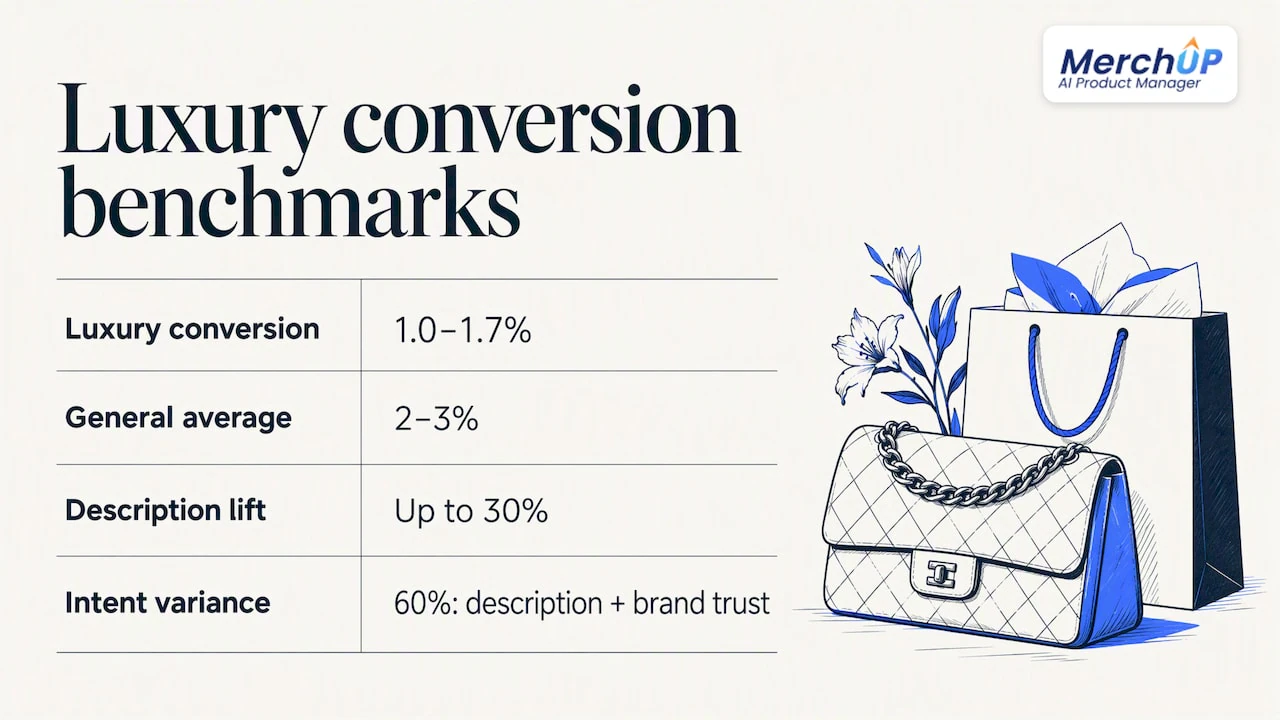
The numbers show why the page matters. A benchmark summary cited by Tashvi puts jewellery and luxury ecommerce conversion at roughly 1.0% to 1.7%, below the 2% to 3% general average, and says better descriptions can lift it by up to 30%. Treat the 30% as a ceiling, not a promise. The same source reports that descriptions and brand trust together explain 60% of the variance in luxury purchase intent. An academic study of 196 luxury second-hand shoppers, published through Seattle Pacific University, examined the same pair of drivers: brand trust and the product description.
So the description is not decoration around the photo. It is part of how trust gets built.
Show restraint: the quiet language of luxury
The single most useful principle comes from the copywriters who work in this field. Ink Copywriters argues that quiet luxury is about sounding like you have nothing to prove, and that restraint is persuasive. When every competitor, and every AI tool, can produce an “elevated” paragraph on demand, the only thing that still separates a brand is genuine specificity.
In practice that means three habits.
Swap adjectives for evidence
Words such as “finest”, “world-class” and “exceptional” cost nothing to write, so readers treat them as worth nothing. A fact costs something to know.
| Empty claim | Verifiable specific |
|---|---|
| Finest Italian leather | Vegetable-tanned calfskin from a named tannery, aged for 12 weeks |
| Expertly crafted | Hand-stitched by one maker, about nine hours per bag |
| Timeless design | Unchanged pattern since 1998, with the original pattern drawings kept in the studio |
| Premium gold | 18ct yellow gold, hallmarked, 4.2 g |
The right-hand column above is illustrative: use only facts you can document for your own products. If you cannot name the tannery, you should not imply there is one.
Use fewer, more exact words
Hamad Hayyat of Refina makes the point that precision and restraint signal confidence, and that a few exact words for each idea make copy read as considered and calm. A useful edit pass: for each sentence, ask which word you could delete without losing information. Delete it.
Be concrete, not abstract, where the buyer is deciding
Research on luxury language by Amatulli and colleagues tested abstract versus concrete wording and how brand prominence changes the effect on attitudes and willingness to buy. The takeaway for a store owner is not a single rule but a test: write both versions of a hero product, and judge which one fits how well known your brand is. A newer label has less credit to spend on abstraction, so it usually needs concrete detail to earn belief.
Get the tone of voice right
A luxury tone of voice is not a list of fancy words. It is a set of decisions made once and applied everywhere.
Refina describes a voice that stays consistent while its temperature shifts with the moment: warmer in a welcome, more measured in a formal notice. Apply that to a store:
- Product page: calm, factual, sensory where it helps.
- Order confirmation: warm, brief, unhurried.
- Returns and care pages: measured and exact.
Laura Cattaneo, in her language of luxury toolkit, argues that luxury is an experience rather than just an object, and that brands need a unique verbal identity to escape generic luxury language. Her point is that history, values and the emotional benefit of ownership belong in the description.
Write a one-page voice sheet
Before you write or generate a single description, write down:
- Three words your voice is (for example: assured, warm, exact) and three it is not (loud, chatty, breathless).
- Words you ban: the superlatives you keep catching yourself using.
- Sentence length: a typical range and a hard maximum.
- How you refer to the maker, the material and the customer.
- One approved sample paragraph for each product category.
This sheet is what a freelance writer, a team-mate or an AI template should be held to.
Build the page for how US shoppers actually browse
A lovely paragraph fails if nobody reads it. Contentsquare’s digital consumer behaviour report found that US luxury shoppers spend 19% more time on homepages, visit product pages for shorter, and click 19% less on product descriptions than the global average. Note the report dates from 2019, so treat it as a directional signal, not current gospel. The lesson holds up: these are determined shoppers who use search to find what they want, and they want fit, fabric and care answered at a glance.
A practical structure for a luxury page:
- Opening line (one or two sentences). What it is and the one detail that makes it special.
- Scannable facts. Material, dimensions, weight, fit, care, origin, in a short list or small table.
- The story. Maker, process, heritage, who it is for. Two short paragraphs at most.
- Practical reassurance. Delivery, returns, authentication, packaging.
Do not hide the copy. A conversion test run by Blue Stout on a luxury jewellery brand moved product descriptions above the Add to Cart button, out of an accordion, and the agency reported a 15% conversion lift. It is a single case, so test it on your own store rather than assuming the result.
High-ticket items also raise a checkout question. If your average order is large, explain payment options near the description; a guide to recovering revenue at checkout covers how financing and checkout friction affect completed orders.
Worked examples: from generic to luxury
Here are three rewrites. The products are invented for illustration, so the details are placeholders for facts you would supply.
A leather bag
Before: “Our exquisite handbag is crafted from the finest leather for the discerning woman. A true statement of luxury.”
After: “The Marlow tote, in vegetable-tanned calfskin. Each bag is cut and stitched by a single maker and takes about nine hours. The leather darkens with use and develops its own patina. Interior: suede-lined, one zip pocket. Dimensions: 34 × 28 × 12 cm.”
The second version has no superlative, yet it sounds more expensive, because every phrase can be checked.
A fine-jewellery ring
Before: “A dazzling ring that radiates elegance and timeless sophistication.”
After: “A 0.50 ct round brilliant diamond, set in 18ct white gold. Four-claw setting, low profile for everyday wear. Certificate included. Made to order in 3 to 4 weeks.”
If you describe precious metals, gemstones or pearls, the FTC’s Jewelry Guides in 16 CFR Part 23 set out how those terms should be used, including laboratory-created and imitation stones. Read them before you write “gold” or “diamond” in a title.
A skincare product
Before: “The world’s most effective serum. Visibly erases wrinkles in days.”
After: “A lightweight serum with 2% niacinamide and hyaluronic acid. Apply two to three drops after cleansing, morning and evening. Fragrance-free. 30 ml.”
The first version makes an objective performance claim. That brings us to the legal side.
Stay inside US advertising law
Luxury copy often drifts into claims: “clinically proven”, “lasts a lifetime”, “100% pure”. In the United States these are not harmless flourishes.
An overview of US advertising rules for online businesses summarises the two core principles: advertising must be truthful and not misleading, and advertisers must have evidence for their claims before making them. A statement that is technically true can still mislead if it leaves a false impression.
The FTC’s own complaints show what enforcement looks like. In one FTC complaint over body-shaping skincare products, the agency challenged the performance claims made for them. The lesson for any luxury seller: if you say a product slims, lasts or purifies, hold the substantiation before the page goes live.
A safe working rule:
- Describe what the product is (materials, dimensions, origin), which you can document.
- Describe what it does only with evidence on file.
- When in doubt about a health, beauty or performance claim, have a qualified US advertising lawyer review it. This article is general information, not legal advice.
Happily, the habit that makes luxury copy good, replacing superlatives with verifiable specifics, is also the habit that keeps it defensible.
Get the SEO basics right without cheapening the voice
Luxury brands sometimes treat search optimisation as the enemy of elegance. It need not be. Shoppers who search tend to type what they want exactly: material, type, maker, occasion. Your specific copy already contains those words.
Check the fundamentals: a unique title tag and meta description per product, descriptive image alt text, sensible headings, and fast pages. An on-page SEO checklist is a handy way to audit those basics. For Shopify specifics, our guides on product description SEO and product schema go deeper.
What we think: precision scales, adjectives do not
We build MerchUp AI as an AI product manager for Shopify stores, so we see what happens when sellers add products every week. The failure is rarely a lack of words. It is sameness: fifty descriptions that all open with “elevate your” and could belong to any shop.
Our view is that luxury copy is a data problem before it is a writing problem. The tannery, the carat weight, the maker, the care instructions: these exist in your records or in the product itself, and the description should be built from them. That is why we start from a product photo, a barcode or, for trading-card sellers, a card scan, and build the full listing (title, type, vendor, price, tags and SEO) from what is actually there, then write the description into a designed template so that every page keeps the same structure and voice.
We also believe a person should stay in charge. Nothing in MerchUp AI goes live without your review, and there is full history and restore if you change your mind. For a brand whose value is trust, that matters more than speed.
— Jamie Moss
Keep the standard across a whole catalogue
One hero product can be written by hand. A catalogue of 300 cannot, at least not consistently. This is where luxury brands slip: the flagship has a gorgeous page and the rest read like an export from a spreadsheet.
A workable system:
- Write the voice sheet and three approved sample descriptions.
- Turn the sample structure into a template with fixed slots: opening line, facts, story, care.
- Feed in real product data for every item, never invented detail.
- Review a batch of ten before releasing the rest.
- Revisit quarterly: check which pages convert and which rank.
If you work with a team, our guides to governed templates for bulk generation and bulk product descriptions that convert show how to set this up. If you sell abroad, see product description localisation. For the hands-on editing flow, read the Shopify product description editor workflow.
Where MerchUp AI fits
MerchUp AI is available now for Shopify. It turns a photo or barcode into a complete listing, writes the description into a template you design, creates AI product photos and publishes. It also handles SEO in one click: it reads your own Google Search Console data and live Google results, picks keywords, writes meta titles, descriptions and image alt text, checks rankings on live Google and pushes it all to your store, with no SEO knowledge needed. Every change is reviewed before it goes live.
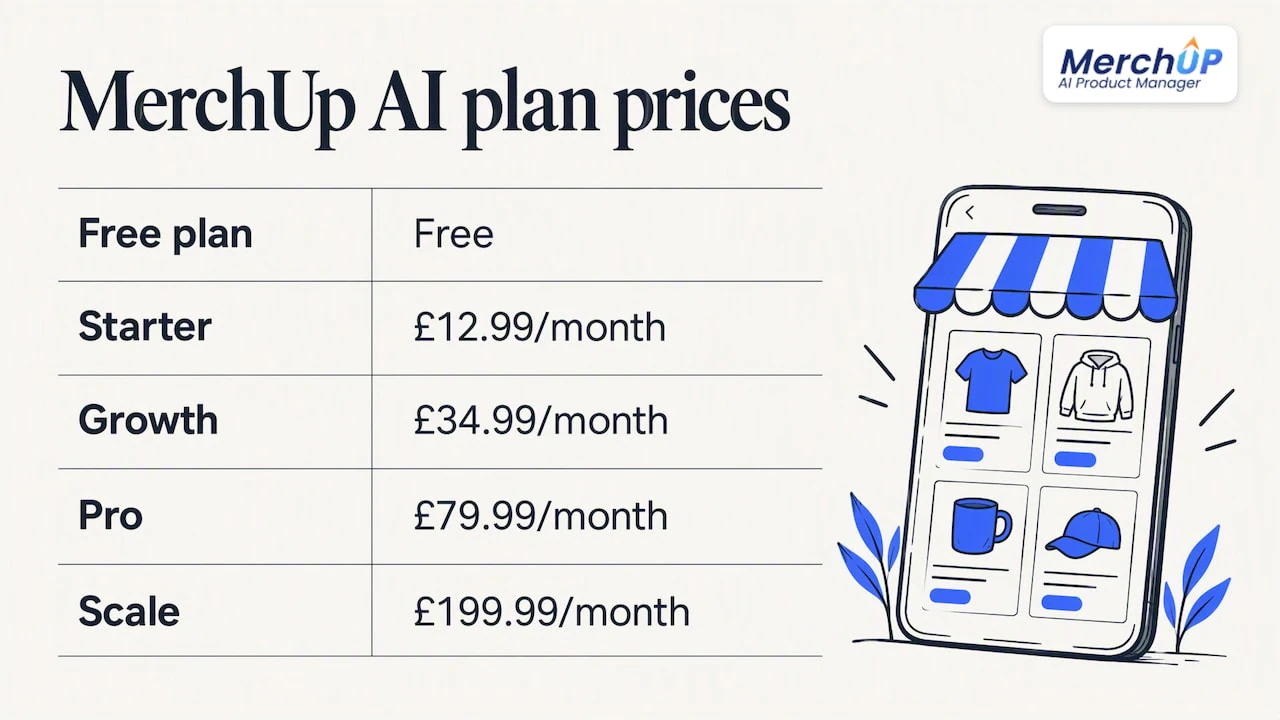
There is a free plan. Paid plans are Starter at £12.99 a month, Growth at £34.99, Pro at £79.99 and Scale at £199.99 a month; see the pricing page for what each includes. If you would like to see the flow first, the 30-second tutorial walks through it.
Selling collectibles? Trading-card sellers get identification against real catalogues, market pricing and estimated centering and condition, with a card scanner add-on from £7.99 a month.
A checklist before you publish
- Does the opening line say what the product is and what makes it special?
- Can you source every fact in the description?
- Is any claim objective (performance, health, purity, durability)? If so, is the evidence on file?
- Are jewellery and precious-metal terms used the way the FTC guides expect?
- Are fit, material, care and shipping findable in five seconds on a phone?
- Does the voice match the sheet, with no banned words?
- Are the meta title, description and image alt text written and unique?
FAQ
How do you describe a high-quality product without sounding generic?
Name what makes it high quality: the material and its origin, the method, the maker, the tolerances or the testing. Readers believe facts they could verify. Cut adjectives that only assert quality, such as “premium” or “finest”.
What tone of voice should luxury brand copywriting use?
Calm, precise and confident. Use few words, exact ones, and keep the same character on every page while letting the warmth shift with the context, warmer in a welcome and more measured in a returns notice.
Can AI write luxury product descriptions?
It can draft them quickly, but its output is only as specific as the data and template you give it. Build from real product facts, define the voice in a template and review before publishing. That is how MerchUp AI works: nothing goes live until you approve it.
Do luxury product descriptions need to follow FTC rules?
Yes, if you sell to US customers. Advertising must be truthful and you need evidence for objective claims before you make them, and jewellery has its own FTC guides. For anything health- or performance-related, ask a US advertising lawyer to review the wording.
How long should a luxury product description be?
Long enough to answer the buyer and no longer. A short opening, a scannable facts block and a brief story is usually enough. Test longer and shorter versions on your best sellers and keep what converts.
Sources
- Tashvi: how to write product descriptions that sell jewellery online
- Seattle Pacific University: product descriptions and brand trust in luxury second-hand ecommerce
- Ink Copywriters: the quiet language of luxury
- Refina: luxury brand voice
- Amatulli et al.: abstract versus concrete language in luxury
- Laura Cattaneo: language of luxury toolkit
- Contentsquare: digital consumer behaviour report
- Blue Stout: copy above add to cart
- eCFR: 16 CFR Part 23, Jewelry Guides
- Advertising regulations for online businesses
- FTC complaint on skincare performance claims


Comments
No comments yet — be the first to share what you think.