


Yes: ChatGPT can generate SEO-friendly Shopify product descriptions at scale when you run it inside a bulk workflow that keeps your metadata intact and includes a human review step. For large catalogues, pair structured prompts with an export, generate, import loop. A rules-driven tool such as MerchUp adds the governance and publishing controls that a spreadsheet or a chat window cannot.
TL;DR:
- Bulk generation of Shopify product descriptions with ChatGPT requires a structured CSV workflow, careful metadata preservation, and a human review step for quality control.
- Using a rules-driven platform like MerchUp streamlines large catalog updates by maintaining SEO fields and metadata during import and publishing.
- Prompt templates should include verified product data, target keywords, and tone, with templates saved for consistency across similar products.
- Shopify’s guidelines and Google policies demand unique, value-added content and proper labeling of AI-generated data to avoid policy risks.
- For small catalogs, in-shop tools suffice, while larger inventories benefit from automation platforms that integrate review, governance, and bulk publishing features.
How the ChatGPT to Shopify workflow works at scale
Scaling product copy with ChatGPT follows the same four-step loop whether you have 50 SKUs or 5,000:
- Prepare your data: pull current titles, specs, variants and images into a single file.
- Export a CSV using Shopify’s native export or a dedicated tool such as Matrixify.
- Generate new copy with ChatGPT or the OpenAI API, using a consistent prompt template per product category.
- Map the outputs back to the correct fields and re-import.
Several fields need to survive this round trip untouched or deliberately updated:
- SEO title and meta description
- Product title and handle
- Variant details (size, colour, material)
- Image alt text
- Custom metafields used by your theme or apps
For a single product tweak, Shopify Magic or Sidekick is usually faster since it works inside the admin without an export step. ChatGPT earns its place when you need templated, batch generation across hundreds of listings at once. Once volume grows past what you can review by hand comfortably, API scripts or middleware connectors that trigger on a schedule become worth setting up.
Prompt templates and content rules for SEO-friendly, brand-aligned descriptions
A good prompt is modular. Build it from six blocks every time: product facts, the customer it’s for, the primary benefit, the format you want (short blurb, long narrative, or bullet list), the SEO keywords to work in, and the tone and word count.
A short blurb prompt might specify the product, one key feature, the buyer, and a 40-word limit. A long narrative prompt adds a brand voice reference and a call to picture the product in use. A technical bullet-point prompt strips out narrative entirely and asks for specs only, ordered by what buyers compare first.
To keep ChatGPT from inventing details it doesn’t have:
- Feed it only the specs you’ve verified, never let it infer dimensions or materials.
- Ask it to flag anything uncertain as “to confirm” rather than stating it as fact.
- Build in a human check against the source data before anything goes live.
- Reject copy that repeats stock phrases across multiple products, since that undermines the uniqueness Google expects.
Before publishing, run each batch through a short quality check: is the copy unique against other listings, does it contain the target keyword naturally, does every spec match the product data, and does it sound like your brand rather than a generic assistant.
Pro Tip: Save your best-performing prompt per category as a template, then only swap the product facts each time, rather than rewriting the whole prompt from scratch.
Bulk workflows: tools and practical steps for exporting and importing product data
Matrixify’s export, upload, generate, import sequence is the pattern most merchants end up using, whether they run it manually or script it. In practice:
- Tag a test set of 10 to 50 SKUs that represent your typical catalogue.
- Export a CSV with the columns you need: handle, title, description_html, SEO title, SEO description, and relevant metafields.
- Run each row through your ChatGPT prompt template.
- Validate outputs against the checklist above before touching the live store.
- Import the test subset first and check it renders correctly.
- Roll out to the full catalogue once the test batch holds up.
Map your CSV columns deliberately: description_html takes the generated body copy, SEO Title and SEO Description take the metadata ChatGPT produces for search snippets, and any custom metafields need their own prompt instructions so they aren’t left blank.
Keep a backup of the original export before you overwrite anything, and watch search traffic on the test batch for about a week before publishing the rest. One-time CSV batches suit a seasonal catalogue refresh; API-based automation suits stores adding new products continuously and needing descriptions generated the moment a product is created.
Pro Tip: Never import directly into your live catalogue on a first run. Duplicate a handful of products in a draft state and test the full round trip there first.
SEO and policy guardrails for AI-generated listings
Google’s own guidance is direct: AI features rely on standard indexing and structured data, and automation aimed purely at manipulating rankings counts as spam rather than useful content. The same documentation notes that AI-generated content is fine as long as it adds genuine value to the reader, which rules out mass-producing near-identical descriptions with a keyword swapped in.
Google’s Merchant Center guidance goes further for product feeds specifically: it requires AI-generated product data to be specified and labelled where that applies, and it flags scaled, low-value content as a policy risk rather than a shortcut.
A large majority of merchants already use AI tools for content generation, and product descriptions are the most common use case, which means the bar for distinct, well-structured copy is rising rather than falling.
A practical checklist for staying compliant and visible:
- Write genuinely unique copy per product rather than templated filler.
- Use structured data and schema markup where your theme supports it.
- Write descriptive alt text for every product image, not just the hero shot.
- Keep meta titles and descriptions within standard length limits.
- Check canonical tags on variant pages so you aren’t competing with yourself in search.
Shopify’s own help documentation on generating descriptions recommends including the product type and at least two features in any prompt, a rule worth applying to ChatGPT prompts too.
Practical playbook for scaling and where MerchUp fits
An operational checklist keeps bulk generation from turning into bulk mess: a template library per product category, a content queue with review gates before anything publishes, automated checks that required metadata fields aren’t blank, and a measurement plan to track what changed.

The right platform can build several of these steps into itself: customisable templates, a visual editor for reviewing copy before it goes live, bulk publishing, and integration that keeps SEO fields intact during import. For teams managing more than a few hundred SKUs, that removes the manual CSV juggling described above.
Worth tracking once you’re running at scale:
- Time saved per SKU compared with manual writing.
- Conversion rate shift by cohort of updated products.
- Percentage of descriptions that are genuinely unique.
- Organic impressions and click-through rate on refreshed listings.
Pro Tip: Set your measurement window before you publish, not after, so you can tell whether a conversion shift came from the new copy or something else entirely.
When to use ChatGPT directly, Shopify Magic, or a rules-driven platform
A small catalogue rarely needs more than Shopify Magic for quick, in-admin edits. A medium catalogue benefits from ChatGPT paired with CSV templates and a review step, since that balances speed against oversight. Once a catalogue grows large, or several people need to approve copy before it ships, a rules-driven platform earns its cost by handling governance that spreadsheets and chat windows weren’t built for.
— Jamie Moss
MerchUp: how to get started
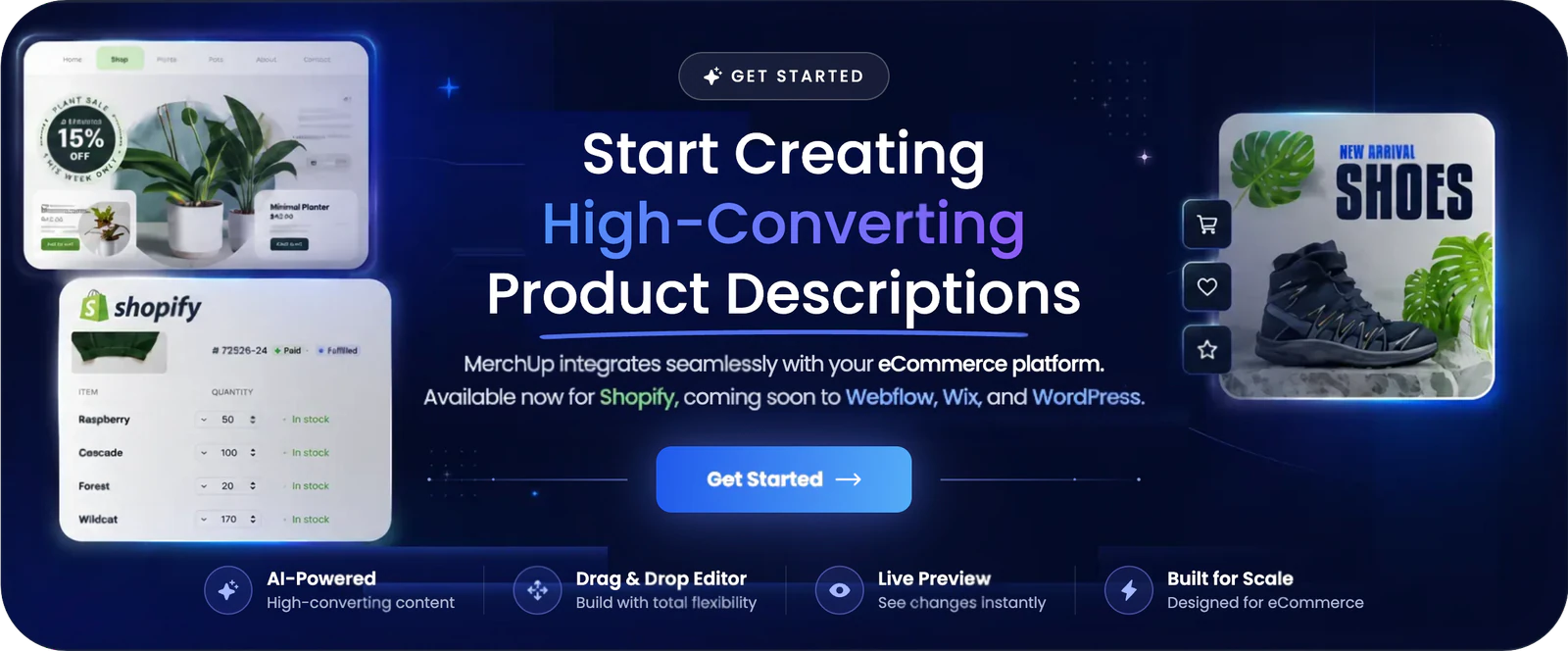
MerchUp turns the workflow above into something you don’t have to rebuild every time you add products: templates, a visual editor, and bulk publishing that keeps SEO fields intact on the way into Shopify.
If you want to see it before committing:
- Watch the 30-second tutorial to see the generate-and-publish flow in action.
- Compare plans on the pricing page, from Starter at £12.99 per month up to Scale at £149.99 per month, with Growth at £29.99 and Pro at £69.99 in between.
- Visit the MerchUp homepage to start a trial or request a demo for larger catalogues.
For technical SEO work alongside your content refresh, a partner resource on Shopify SEO automation covers the optimisation side in more depth.
FAQ
Can ChatGPT design my Shopify store?
No, ChatGPT writes text but doesn’t build store layouts or themes. For design work, Shopify’s own Magic and Sidekick tools handle some in-admin suggestions, while theme design itself needs a dedicated builder or developer.
Can you make £10,000 a month on Shopify?
Revenue depends on product, pricing and traffic rather than any single tool, so there’s no fixed figure that applies to every store. Better product descriptions can lift conversion rate, but they’re one factor among many in overall sales.
Is there a free product description generator available?
ChatGPT’s free tier can generate descriptions one at a time, which works for a small catalogue. For bulk generation with templates, metadata handling and Shopify publishing built in, a paid tool such as MerchUp’s Starter plan at £12.99 per month is usually faster.
How do I bulk edit product descriptions in Shopify?
The standard route is exporting your catalogue to CSV, editing the description and SEO fields in bulk (often with an AI tool generating the new copy), then re-importing. Tools like Matrixify handle this export and import step, while some platforms can generate and publish the updated copy directly without the manual CSV round trip.
Do I need to label AI-generated product descriptions?
Google’s Merchant Center guidance requires AI-generated product data to be specified and labelled where that applies to your feed. Check the specific labelling requirements for your product category before listing AI-written copy in your feed.
Sources
- How AI features work and how site owners should approach them — Google Developers
- Google Merchant Center policy on AI-generated product data


Comments
No comments yet — be the first to share what you think.