


Use customer and product signals to fill a structured template, run it through an LLM generator, check the output with an evaluator pass, then publish. This sequence produces accurate, SEO-safe personalised product descriptions at scale, and it keeps a human accountable for anything a model gets wrong. Done well, it lifts click-through and conversion; done carelessly, it risks the kind of misleading claims regulators are now watching closely.
TL;DR:
- Personalised product descriptions rely heavily on high-quality signals such as customer purchase history, recent searches, and product attributes to ensure relevance.
- Structured input fields, including images and behavioral data, improve accuracy and facilitate auditing by isolating specific shopper and product details.
- Using templates with clear constraints, image-to-text augmentation, and evaluation passes helps maintain factual accuracy and compliance before publishing.
- To stay compliant with platform policies, submit AI-generated descriptions through designated fields, focus on early content placement, and avoid unsupported claims.
- Prioritize high-traffic, attribute-rich products for initial personalization efforts to maximize value and reduce the risk of inaccurate or thin content.
What personalised product descriptions are and why they work
A personalised product description does not reinvent the product story for every visitor. It shifts emphasis and phrasing to match what that visitor already cares about, so a gluten-free snack bar leads with “gluten-free” for a shopper who has searched that term before, while a fitness-focused shopper sees the protein count first. Amazon describes using generative AI this way, repositioning attributes within titles and descriptions depending on what a customer has shown they prioritise, rather than simply rewriting the tone of the copy.
The clearest use cases include:
- Loyalty or membership tiers, where a “Gold” member sees early-access phrasing that a first-time visitor does not.
- Dynamic on-site search results, where the same product card highlights different attributes depending on the search query.
- Segment-specific landing pages built for a particular audience, such as parents or outdoor enthusiasts.
- Personalised email campaigns that reuse the same product data but reorder the selling points.
Academic work backs the commercial logic. Research presented at CIKM found that personalised product descriptions, including personality-matched phrasing, increased purchase likelihood and perceived appeal compared with generic copy. The gain does not come from novelty; it comes from relevance: the description answers the question the shopper actually has.
Data and signals to power personalisation
Personalisation lives or dies on the quality of the signals feeding the generator. Weak or missing signals produce bland output or, worse, invented detail. Structure the inputs as explicit context fields before they ever reach a prompt.
- Customer signals: purchase history, recent on-site searches, membership or loyalty level, device type, and coarse location context (for shipping or seasonal relevance).
- Product signals: core attributes such as material, size and variant, plus any images and their alt text, which describe colour, fit or finish that copy alone might miss.
- Behavioural context: what the shopper clicked or searched immediately before landing on the product, since this often signals the single attribute that matters most right now.
- Structured field mapping: convert each signal into a named field such as
membershipLevel,productName,productImageorpreferredAttribute, rather than pasting raw data into a prompt as free text.
Each field earns its place because it answers a specific question the model would otherwise guess at. membershipLevel tells the generator whether to mention early access or member pricing. productImage, run through an image-to-text step, supplies visual detail that the product feed might not capture in words, such as a stitching pattern or a strap style. Treating signals as discrete fields, rather than a paragraph of context, also makes it far easier to audit which input produced which output later.
Practical workflows: templates, image-to-text and publishing
A repeatable workflow matters more than any single clever prompt. Start with a template that constrains length, names the attributes that must appear, and reserves space for an SEO anchor phrase. A template is not a finished sentence: it is a set of rules the generator must follow, such as “mention material and size, keep to 300 characters, do not use superlatives unless sourced from the product feed.”
Image-to-text extraction adds detail templates often miss. Running a product photo through a vision model can surface a texture, pattern or finish that the feed’s structured data left out, and that detail can then be fed into the generation prompt as another context field.
The orchestration flow that ties this together looks like this:
- Pull the product feed and customer segment data into a single record per SKU-visitor pair.
- Pass that record through a segmenter that assigns the relevant context fields, including membership level and preferred attribute.
- Send the structured prompt to the LLM generator, which produces a draft description.
- Route the draft to an evaluator, either a second LLM pass or a human reviewer, before it goes live.
- Stage approved copy in a review queue, then bulk-push it to the storefront or ad platform.
Staging matters because personalisation at scale means hundreds or thousands of variants, and no team can manually check every one before launch. Set review rules instead: flag anything mentioning a claim not present in the source feed, anything touching health or safety, and anything outside the approved length range for automatic human review, and let the rest publish on a schedule.
Pro Tip: Route only the descriptions that trigger a rule (an unverified claim, a missing attribute, an out-of-range length) to human review, and let the rest publish automatically; this keeps oversight meaningful instead of a rubber stamp.
AI techniques and prompt patterns that work
The prompt skeleton that performs consistently well has four parts: a role instruction (“you are writing a product description for an online store”), the context fields (product name, attributes, membership level, preferred attribute), style constraints (length, tone, banned superlatives), and an explicit list of facts the model must keep unchanged, such as material composition or size specifications.
A few parameter choices make a measurable difference:
- Keep temperature low, generally below 0.4, when factual accuracy matters more than variety, since higher temperatures increase the chance of invented detail.
- Set a firm token or character limit that matches the platform’s display constraints, rather than trimming a longer draft after the fact.
- Use two or three few-shot examples of approved descriptions in the prompt so the model matches house style rather than guessing at it.
- Add an explicit “do not invent” instruction covering any specification not present in the supplied fields, an approach used in practical implementation recipes that pass structured attributes directly into the prompt.
An evaluator LLM pass, run as a second call after generation, checks the draft against the source fields for factuality, flags prohibited claims, and catches hallucinated specifications before a human ever sees the text. This two-step pattern is worth building even on a tight budget, since the FTC’s July 2026 guidance treats AI systems that produce misleading outputs as a Section 5 risk regardless of whether the seller intended to deceive anyone.
For high-risk categories such as supplements or electricals, extractive approaches, which select and rearrange verified phrases rather than generating new sentences, are the safer default. Attribute-fusion research shows these methods can match or beat purely generative output on informativeness while carrying far less hallucination risk. Reserve fully generative templates for lower-risk categories once your evaluator and review rules are established.
SEO and platform requirements to follow
Search visibility and platform compliance both depend on where and how personalised copy is submitted. Google Merchant Center’s guidance requires AI-generated descriptions to be submitted through the structured_description attribute with digital_source_type set to trained_algorithmic_media, and it recommends placing the most important details within the first 160 to 500 characters, since truncation and ranking both favour early placement.
Keep these constraints in view:
- Submit AI-generated copy through
structured_description, not the standard description field, when the content qualifies as algorithmically produced. - Match the served description to the landing page content; a mismatch between what an ad promises and what the page shows is both a policy risk and a trust problem.
- Keep the promotional field free of gimmicks such as fake urgency or unverifiable superlatives, which platform policy and consumer protection rules both discourage.
- Maintain one canonical product description for indexing, and treat personalised variants as staged, served-experience content rather than replacements for that canonical text.
This split, canonical text for search engines, personalised variants for the actual visitor, avoids duplicate-content confusion while still letting each segment see copy suited to them. Our SEO guide for product descriptions covers the technical side of this in more depth.
Best practices, measurement and staying compliant
Every personalisation programme needs guardrails before it needs volume. Define required factual fields (material, size, core specification) that must appear unchanged in every variant, maintain a list of prohibited claim types (medical, safety, unverified comparatives), and tag generated content with its model source so provenance is traceable later.
- Set factual fields as non-negotiable: the evaluator rejects any draft that alters them.
- Run A/B tests with a fixed look-back window and a primary metric set in advance, typically click-through rate, conversion rate and return rate together, since a description that boosts clicks but raises returns has not actually won.
- Document which descriptions were AI-generated and by which model version, since the FTC’s guidance expects systems to serve users’ actual interests rather than a hidden agenda, and a paper trail is the easiest way to demonstrate that.
- Review flagged descriptions on a set cadence rather than only when a complaint arrives.
How MerchUp supports this workflow
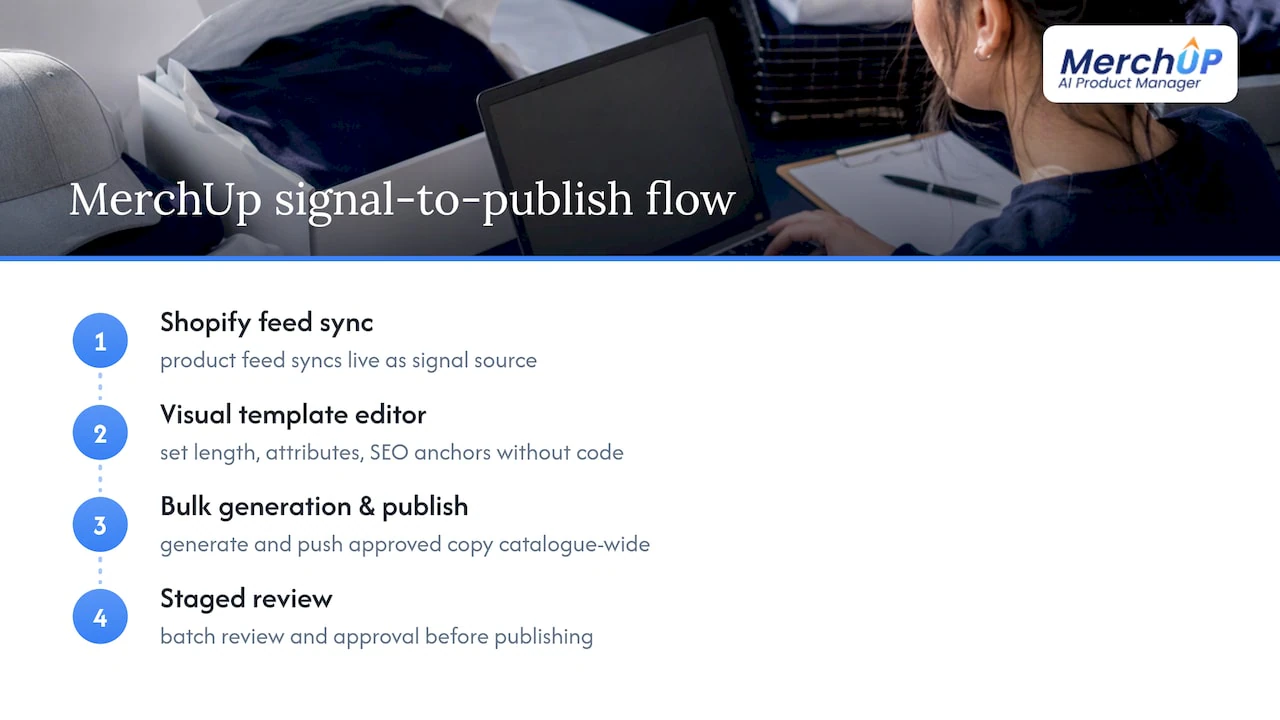
A platform similar to MerchUp builds this signal-to-publish loop into a single tool rather than a set of separate scripts. Its visual template editor lets teams set the length constraints, required attributes and SEO anchors described above without touching code, and bulk generation and publishing tools push approved copy across a catalogue in one pass. Live integration with Shopify means product feed data, the core signal source for personalisation, syncs directly rather than needing a manual export. For a seller managing a catalogue of any size, the friction removed is mostly in the middle steps: template setup, batch generation and staged review, the parts of the workflow most teams currently do by hand.
Choosing which products to personalise first
Not every SKU deserves personalised copy on day one. Prioritise products with meaningful traffic, healthy margin and attribute-rich data (multiple variants, clear specifications), since these give the generator enough to work with and the business enough upside to justify the review effort. Thin product data produces thin, or invented, personalisation.
Start a pilot on 50 to 100 SKUs with one clear metric and a fixed review window. Decide upfront what result triggers a wider rollout and what result sends you back to the template.
— Jamie Moss
Starting a MerchUp pilot
Running this workflow by hand across a large catalogue is slow, and hand-built pipelines are exactly where factual fields get missed. A MerchUp pilot follows the same shape as the workflow above: connect your Shopify store, select 50 to 200 SKUs, and run generation with review rules switched on so nothing publishes unchecked.
The fastest way to see the workflow in practice is the 30-second tutorial, which walks through connecting a store and generating a first batch of descriptions. Plans start at £12.99 per month on the Starter tier, with Growth, Pro and Scale tiers available as catalogue size and template needs grow.
Sources
The guidance in this article draws on Google Merchant Center’s policy for structured, AI-generated descriptions, FTC guidance published in July 2026 on deceptive AI practices, Amazon’s own account of using generative AI in product personalisation, and academic research from CIKM on personalised description generation. For a broader look at product page optimisation and its effect on conversion, see this partner guide on optimising product pages.
- How Amazon is using generative AI to improve product recommendations and descriptions
- FTC guidance / rulemaking (July 2026) on AI and deceptive practices
- Description description and structured description structured_description - Google Merchant Center Help
- Learning to generate personalized product descriptions (CIKM paper)
FAQ
How do I write a good product description?
A good product description leads with the attribute your reader cares about most, states specifications accurately, and stays within the platform’s display length. For personalised versions, pull that leading attribute from a signal such as recent search behaviour or membership level, rather than guessing.
What are personalised product recommendations?
Personalised product recommendations are product suggestions or description variants adjusted to an individual shopper’s behaviour, such as past purchases or browsing history. Amazon uses this approach to reposition attributes like “gluten-free” within a listing depending on what a shopper has shown interest in.
Can AI create a product description for me?
Yes, an LLM can generate a product description from structured product data and customer context fields, though accuracy checks matter. Running an evaluator pass after generation, and keeping factual fields like size and material fixed, reduces the risk of invented specifications reaching a live listing.
How do I write a good item description for a marketplace listing?
Follow the marketplace’s own field requirements first, since platforms such as Google Merchant Center require AI-generated copy to be submitted through fields like structured_description rather than the standard description field. Within that field, prioritise the details a buyer needs in the first 160 to 500 characters, since truncation and ranking both favour early placement.


Comments
No comments yet — be the first to share what you think.