



Yes, you can automate product descriptions reliably by combining structured product data, reusable templates, and AI generation with human-in-the-loop quality gates. Tools like MerchUp follow exactly this pattern. Done properly, this approach delivers SEO-aware, consistent descriptions published at catalogue scale, without the manual bottleneck that stalls most ecommerce content teams.
TL;DR:
- Structured product data must be complete and accurate, as poor inputs produce weak and generic descriptions regardless of the generation model used.
- Proper templates and style guides are essential to ensure consistent brand voice and to control elements like tone, measurement units, and banned claims.
- A quality scoring system is critical to route low-confidence outputs to human reviewers, reducing errors and maintaining legal and brand compliance.
- Automating catalog updates enables significant time savings, reduces costs per SKU, and allows for quick changes during seasonal or promotional periods.
- Using a phased rollout with clear KPIs and clean data at the start improves success rates and minimizes the risk of errors at scale.
Why automate product descriptions: benefits and business outcomes
The maths on manual product writing breaks down fast once a catalogue passes a few hundred SKUs. Writing and editing a single description by hand typically takes several minutes once you include research, formatting, and proofreading. Multiply that by a large catalogue and you face weeks of dedicated copywriting time before a single listing goes live.
Automation collapses that timeline. A generation pass across an entire category can run in minutes, leaving the remaining hours for review and refinement rather than first-draft writing. That shift in where time gets spent is the real win, not just raw speed.
The SEO case is just as strong. Shopify’s own guidance notes that generated descriptions improve markedly when you feed the system a product title plus at least two product features or keywords rather than a bare title alone. Unique, keyword-aware copy at scale also solves the duplicate-content problem that plagues catalogues built on manufacturer copy.
Consistency is the quieter benefit. When every listing runs through the same template and style rules, brand voice stops drifting between whoever happened to write it that week. That matters more than it sounds: inconsistent tone across a catalogue is one of the fastest ways to erode buyer trust on category pages.
Marketing teams are adopting AI content tools at a rapid clip, and HubSpot’s state of AI reporting points to speed and consistency as the recurring benefits, alongside a persistent need for human oversight. That oversight point isn’t a footnote. It’s the difference between automation that scales cleanly and automation that quietly ships errors at volume.
What this changes operationally:
- Cost per SKU drops because writing time no longer scales linearly with catalogue size.
- A/B testing cycles shorten, since you can generate three description variants for a listing almost as fast as one.
- Seasonal and promotional copy updates (new features, restocks, sale messaging) become a batch job instead of a rewrite project.
- Multilingual or multi-market listings become feasible without hiring a translator for every SKU.
Pro Tip: Run your first automation pass on a category with strong structured data (clear attributes, sizes, materials) before touching anything ambiguous like bundles or refurbished stock. Clean inputs make the ROI case obvious fast.
Key components of an automation system: the data and content building blocks
Automated product content isn’t one tool doing one job. It’s a stack of five interlocking pieces, and skipping any one of them is usually where teams get burned.
- Structured product attributes. Your generation engine needs a canonical source of truth: material, dimensions, colour, use case, compatibility, and whatever else defines the product. Fragmented or inconsistent attribute data is the single biggest cause of generic-sounding output, because there’s nothing specific for the model to work with.
- Templates and a style guide. A template encodes your brand voice, sentence structure, and required elements (a hook line, a feature list, a closing call to action) so every description follows the same shape without sounding identical. This is where you also lock in things like measurement units and banned claims.
- Generation controls. Prompt structure, target length, tone parameters, and guardrails against unverifiable claims all sit here. Academic work on attribute-conditioned text generation shows that constraining a model to specific product fields materially improves factual accuracy, which matters enormously for spec-heavy categories like electronics or appliances.
- SEO output fields. A proper system generates more than the long description: meta titles, short summaries for search snippets, and schema-ready structured markup. Generator tools like SEOptimate treat these as standard outputs alongside the main copy, not an afterthought.
- Publishing connectors with rollback. Direct-publish integrations to your storefront save enormous manual effort, but only if you can also version and roll back. A bad batch push without version history turns a five-minute fix into an afternoon of manual correction.
Shopify’s help documentation is blunt about the first component: description quality improves proportionally with the detail you feed the generation tool. Thin product data produces thin copy, no matter how good the underlying model is. Get your attribute data clean before you evaluate any AI product description generator, because a poor first test on messy data will make a genuinely capable tool look weak.
How do you implement automated product description writing?
Treat this as a four-phase rollout, not a single flip-the-switch launch. Each phase has its own KPI, and you shouldn’t move to the next until the current one clears its bar.
Phase 1: Pilot. Pick one high-value category, ideally 50 to 200 SKUs with reasonably complete attribute data. Define your templates and style rules before generating a single description, and agree on what “good” looks like with whoever will be reviewing output.
- Success metric: a target quality score (however your team defines it) hit on at least 80% of first-draft outputs.
- Success metric: reviewer time per item under a set ceiling, so you can prove the labour saving before scaling.
Phase 2: Integration. Connect your generation system to your CMS, PIM, or storefront, and map attributes cleanly so the right fields flow through automatically. For Shopify merchants this is usually the fastest integration point, because platform-native tools plug straight into the existing publish flow. Reuters reporting on Shopify’s AI feature rollout describes exactly this pattern: platforms bundling generation directly into merchant workflows to cut friction.
- Map every required field (title, attributes, images, category) to your generation system’s inputs.
- Confirm the publish path writes back correctly, including meta fields and schema markup.
- Test rollback on a small batch before trusting it on your full catalogue.
Phase 3: Testing. Set a quality-score threshold below which items get routed to a human reviewer rather than auto-published. Run A/B tests on description variants against your existing copy, and track both conversion rate and organic ranking movement over four to six weeks; SEO changes take time to show in search results, so don’t judge this phase on a week of data.
Phase 4: Scale. Automate the full publish pipeline, add enrichment steps like image alt text and translation, and schedule recurring audits rather than treating the rollout as finished.
- KPI: publish error rate under a strict ceiling once automation covers the full catalogue.
- KPI: sustained or improved conversion rate against your pre-automation baseline.
- KPI: reviewer hours per thousand SKUs trending down quarter over quarter.
Best practices and quality controls you must enforce
The gap between teams who automate successfully and teams who ship embarrassing errors at scale almost always comes down to enforcement, not tooling. The tool rarely fails; the process around it does.
- Set a confidence threshold and stick to it. Practitioner guidance from the US Chamber recommends routing only low-confidence or attribute-incomplete outputs to human reviewers, rather than checking every single item. This is what actually makes human-in-the-loop review sustainable past a few hundred SKUs.
- Build variation into your attribute mapping. Two products in the same category will read identically if your template leans on generic filler rather than pulling from distinct attribute fields. Force the template to surface at least one unique specification per listing.
- Front-load your primary search term. Put the main keyword or category term in the first sentence and the meta title, and keep meta descriptions within your platform’s display limits rather than letting them truncate awkwardly in search results.
- Validate specs before publishing, not after. Never let generated copy state a claim (materials, certifications, compatibility) that isn’t backed by your structured data. Unsupported claims are the fastest route to returns disputes and marketplace policy strikes.
- Treat AI output as a draft, not a final. Guidance from tools like Omnisend’s generator is consistent on this point: generation drafts, humans finalise for brand voice and factual accuracy before anything goes live.
- Audit on a schedule, not just at launch. Product attributes change, promotions expire, and stock states shift. A quarterly audit catches stale claims before customers do.
Pro Tip: If your reviewer queue is growing rather than shrinking, the fix usually isn’t more reviewers. It’s a poorly calibrated confidence threshold sending too many items to manual review that the model was already getting right.
What does a scaled human-in-the-loop workflow actually look like?
At volume, the workflow that works looks less like “write, check, publish” and more like a pipeline with a quality gate built in: generate → score → enrich → review → publish.
Generation happens first, using your template and attribute data. A quality score gets assigned automatically, based on factors like attribute completeness, length compliance, and confidence in factual claims. Anything above your threshold flows straight to enrichment (alt text, schema markup, translation where needed) and then publishes without a human touching it. Anything below the threshold routes to a reviewer queue, where the only job is fixing or approving flagged items rather than reading every listing from scratch.
- Items scoring above threshold: auto-published, typically the majority once your attribute data is clean.
- Items scoring below threshold: routed for review, usually because a required attribute is missing or the claim confidence is low.
- Items flagged for repetition: sent back for template variable remapping rather than a manual rewrite.
Enterprise pipelines take this further. Platforms like Amplience Workforce pair text generation with image standardisation and translation, so a “description” is really a complete listing package shipped in one pass rather than a text field updated in isolation.
Human-in-the-loop review is the biggest scaling bottleneck in automated content, and the fix isn’t removing humans. It’s concentrating their attention only where the model is genuinely uncertain, using automatic quality scoring to route the rest straight to publish.
Some AI product description tools follow this pattern: AI generation feeds a visual editor where flagged items get reviewed, while confident outputs move through the Shopify publish pipeline without manual intervention. Teams using this kind of gated workflow report that review workload concentrates on a small fraction of the catalogue rather than the whole thing, which is the entire point of the quality-scoring step.
Tools, integrations and resource categories to evaluate
Four categories cover most of what’s on the market, and each trades control against convenience differently.
- Platform-native generators (built into Shopify and similar storefronts) offer the tightest publish flow and the least setup, at the cost of some flexibility.
- PIM-integrated platforms give stronger data governance for catalogues with complex, frequently changing attributes.
- Custom API/LLM pipelines offer maximum control but require engineering resource to build and maintain.
- No-code automation platforms sit in between: faster to launch than a custom build, more flexible than a pure platform-native tool.
Whichever category you choose, check for direct Shopify publish support, attribute sync, content versioning, and genuine API availability if you’ll ever need to extend the workflow. A visual editor for Shopify listings that handles versioning natively saves real time when a batch push needs correcting.
Addressing legal and compliance considerations in automated product copy
Automated copy carries the same legal exposure as manually written copy, and in some ways more, because volume makes errors harder to catch before they ship. The core risk is unsupported claims: a generated description that states a certification, a material composition, or a health or safety benefit not actually backed by your product data can expose you to consumer protection complaints or marketplace policy strikes, particularly in regulated categories like cosmetics, supplements, and electronics.
The practical fix is structural, not manual proofreading. Generation should only be permitted to state claims present in your validated attribute data, never claims inferred or invented to sound persuasive. Build a banned-claims list into your style guide (words like “cures”, “guaranteed”, or unearned superlatives) and enforce it at the template level, not just at review.
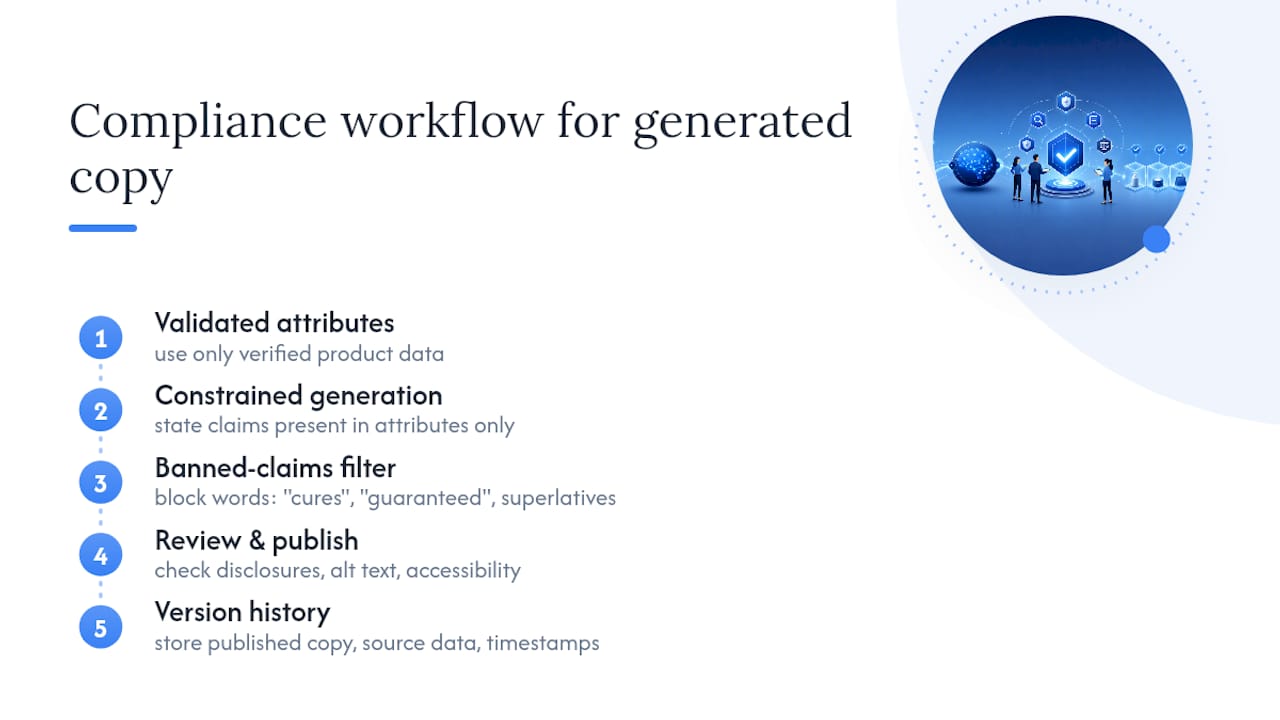
Accessibility and disclosure rules also apply to generated content exactly as they do to human-written copy. Alt text still needs to describe the image accurately, and any required disclosures (country of origin, safety warnings, allergen information) still need to appear, regardless of who or what drafted the surrounding copy.
Keep a version history of published descriptions. If a claim is challenged later, being able to show what was published, when, and against what source data is far stronger footing than trying to reconstruct it after the fact. This isn’t a substitute for legal review in genuinely regulated categories, but it’s the operational baseline that keeps automation from becoming a liability generator.
Author perspective: what actually separates the teams that succeed
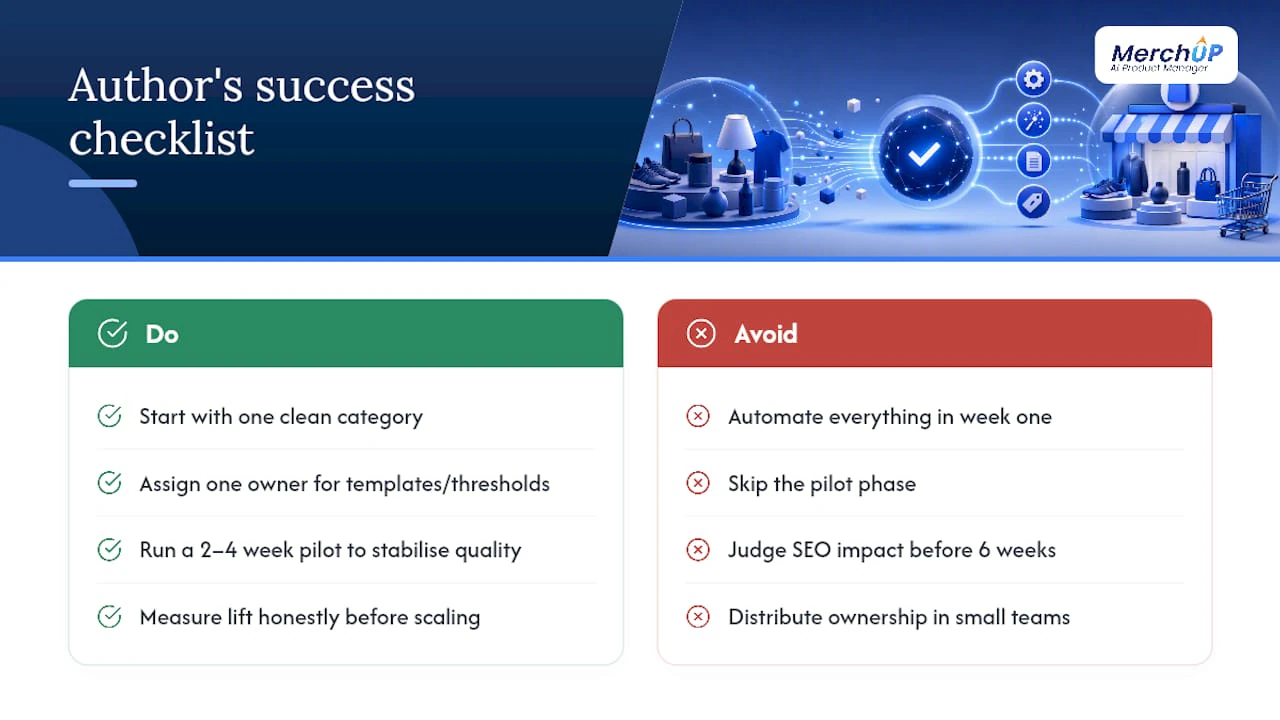
The teams that get this right rarely start with the biggest catalogue problem. They start small, on a category with clean data, and resist the urge to automate everything in week one. Under resourcing isn’t usually the issue; skipping the pilot phase is. Small teams can run this well with one person owning templates and thresholds; larger organisations need that role formalised, not distributed.
Expect two to four weeks before your quality score stabilises, and don’t judge SEO impact before six weeks of data. Start with one category, measure the lift honestly, then scale.
— Jamie Moss
Getting started with MerchUp
Some platforms exist to support the workflow this article describes: AI generation, drag-and-drop templates, a visual editor for the review step, and direct Shopify integration for publishing.

Where a custom API pipeline demands engineering time and a pure platform-native tool limits you to whatever the storefront ships, some tools offer a middle ground: enough control to enforce templates and attribute rules, without needing a development team to maintain it. The generate, score, review, publish pattern described above is included in some products, allowing piloting on a small category before committing to a full catalogue rollout.
If you want to see the workflow before setting anything up, the MerchUp tutorial walks through generating and publishing a Shopify listing in under a minute. For a fuller look at templates, the visual editor, and integration details, the MerchUp product page covers what’s available on each plan.


Comments
No comments yet — be the first to share what you think.