


A unique product description is one that could only describe this product, sold by your store, to your customer. It is not the manufacturer’s blurb, not a spun copy of a rival’s page and not an AI paragraph that sounds like every other AI paragraph. The way to get there is to start from specific facts about the product, add what you know about the buyer, and run every listing through the same structure so the copy stays distinct without taking an hour per item.
This guide covers what “unique” really means, a method you can repeat, a worked before-and-after, and how to keep it up when you add products every week.
TL;DR
- Unique does not mean clever. It means specific: real materials, sizes, uses and customer questions that only apply to this product.
- Manufacturer copy and bulk-generated generic text are the two big sources of sameness. Both are fixable with a short fact sheet per product.
- A repeatable structure (benefit first, highlights, specs, answers to doubts) keeps pages distinct and easy to scan.
- AI can do the heavy lifting if you feed it real product data and review the output before it goes live.
- MerchUp AI turns a photo, barcode or card scan into a full Shopify listing with a designed description, and you approve each change before publishing.
What “unique” means for a product description
Most shop owners hear “unique” and think of plagiarism checkers. That is only one layer. A description can pass a duplicate check and still be interchangeable with a hundred others.
There are three levels worth separating:
- Textually unique. The words do not match the supplier’s feed or another store’s page.
- Informationally unique. The page says something a shopper cannot get from the next tab: your sizing advice, your testing notes, how the item looks in real light, what it pairs with.
- Positionally unique. The copy reflects who you sell to and why they should buy from you.
Most advice stops at level one. Level two is where conversions and search visibility are won. Google’s own ecommerce guidance encourages creating content that meets differing customer needs, beyond the bare product data feed. A page that only repeats the feed gives shoppers, and search engines, no reason to prefer it.
Why the same text is a problem
If you resell branded goods, the supplier’s copy is probably on dozens of other sites. If you use a generic AI prompt, you get a different problem: text that is technically new but follows the same pattern, with the same adjectives and the same closing line. Shoppers notice. Readers on forums complain that AI tools all sound the same, even when prompts are varied. The cause is almost always thin input. A model given a product title has nothing specific to say.
For the search side of duplicate copy, see our guide to duplicate content on product pages.
Why it matters beyond rankings
Descriptions are not decoration. After running hundreds of A/B tests on product pages, the conversion team at The Good concluded that optimising product descriptions is one of the most useful things a store can do. The product page is where the buyer decides, and Nielsen Norman Group’s ecommerce research says the page must give complete product information in a straightforward way.
Completeness is a quiet form of uniqueness. Baymard’s testing found that around 10% of ecommerce sites have descriptions that are insufficient for what users need. If your page answers the questions shoppers actually have, you are already ahead of those stores.
There is also the AI-search angle. Search Engine Land argues that to appear in AI-driven results, product pages must connect what you sell, why someone wants it and what they need it for. Generic copy does none of the second and third. Specific copy does both.
A method for writing unique descriptions
The trick is to separate gathering from writing. Gathering is where uniqueness comes from. Writing is where structure and tone come in.
Step 1: Build a fact sheet for each product
Before you write a word, collect five to ten facts. Not claims, facts. For a leather card wallet, that might be:
- Full-grain vegetable-tanned leather, 1.8 mm thick
- Holds 6 cards plus folded notes
- Measures 10.5 cm by 7.5 cm
- Edges are burnished by hand, so tone varies slightly between pieces
- Develops a darker patina over months of use
- Made in a small batch, ships in a recycled box
Notice that every line is something a competitor selling a different wallet could not copy. If you cannot find five such facts, the product may need better sourcing of information, not better prose. Handle it, photograph it, measure it, ask the supplier.
Step 2: Name the buyer and the job
Shopify’s help centre advises focusing on your ideal customer when writing descriptions. Write one sentence: “This is for [person] who needs [outcome] in [situation].” For the wallet: someone who is tired of a bulging back-pocket wallet and wants something that stays slim for years.
Step 3: Lead with the benefit, let specs prove it
A description has two jobs that pull in different directions: it has to sell and it has to inform. One pattern that handles both is to lead with the benefit and let the specs do the convincing. Open with the outcome, then back it with measurable details.
Step 4: Structure by highlights
Baymard has found that descriptions structured by feature highlights lead users to explore in more depth, yet 78% of sites do not do it. A short intro, three to five labelled highlights and a spec block is easy to scan and easy to keep different from product to product, because the highlights come from your fact sheet. Our product description structure guide breaks down the layout in more detail.
Step 5: Answer the doubts
Think about the last three questions a customer asked about this item. Fit, care, compatibility, delivery, returns. Put the answers into the page. Baymard’s research found that FAQ and Q&A sections are irreplaceable companions to the description for handling even obscure concerns. Your answers are, by definition, yours.
Step 6: Read it against a swap test
Replace the product name with a competitor’s. If the description still works, it is not unique. Rewrite the lines that survive the swap.
A worked example
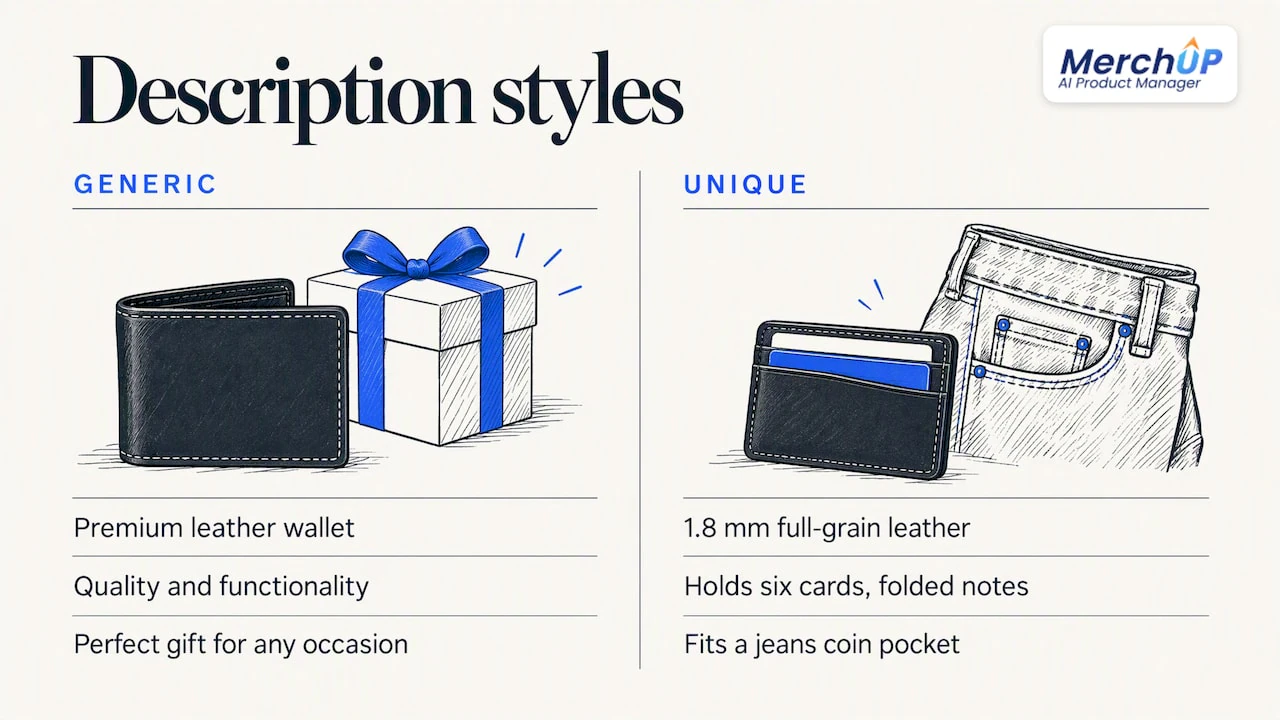
Here is the same product written twice.
Generic version
Elevate your everyday style with this premium leather wallet. Crafted with care, it combines quality and functionality for the modern customer. A perfect gift for any occasion.
Unique version
Slim enough for a front pocket, strong enough to last a decade. This card wallet holds six cards and folded notes without stretching, thanks to 1.8 mm full-grain leather that softens rather than sags.
Highlights
- Hand-burnished edges, so no two pieces are exactly the same shade
- Darkens to a deeper patina with use
- Fits in a jeans coin pocket
Specs: 10.5 cm by 7.5 cm, 6 card slots, 1 note sleeve
Common question: Will it stretch? Leather gives slightly in the first few weeks, then holds its shape.
The second version is about the same length. What changed is that every sentence now carries information. It also reads differently from a wallet by another brand, because the facts differ.
Where AI helps and where it fails
AI is the only realistic way to keep this level of detail across hundreds of SKUs. But the output is only as unique as the input.
It fails when:
- You give it only a product title.
- You use one prompt for the whole catalogue and never vary the structure or the facts.
- You publish without reading.
It works when:
- It starts from real attributes: images, barcodes, variants, materials, dimensions.
- It writes into a defined template so layout is consistent while content differs.
- A person approves the result.
We go deeper on this in our guide to AI product descriptions that convert, and for large catalogues, attribute-based descriptions show how structured data keeps each page distinct. If you are starting from a blank page, our product description templates give you layouts to fill in.
Our view: uniqueness is a data problem
We build MerchUp AI as an AI product manager for Shopify stores, so we see the same pattern in almost every store that comes to us. Owners say their descriptions are bland and blame the writing. In practice the cause is that the listing started with no data. A title and a price were typed in, and the description had to be invented from nothing.
That is why we start earlier in the process. You can scan a product, photograph it or read its barcode, and the listing is built from what is actually there: title, product type, vendor, price, tags and SEO fields. The description is then written into a designed template, so the layout is consistent across the catalogue while the content reflects the real product. For trading-card sellers, the same idea applies at a finer grain: cards are identified against real catalogues and priced from the market, so each listing says exactly which card it is.
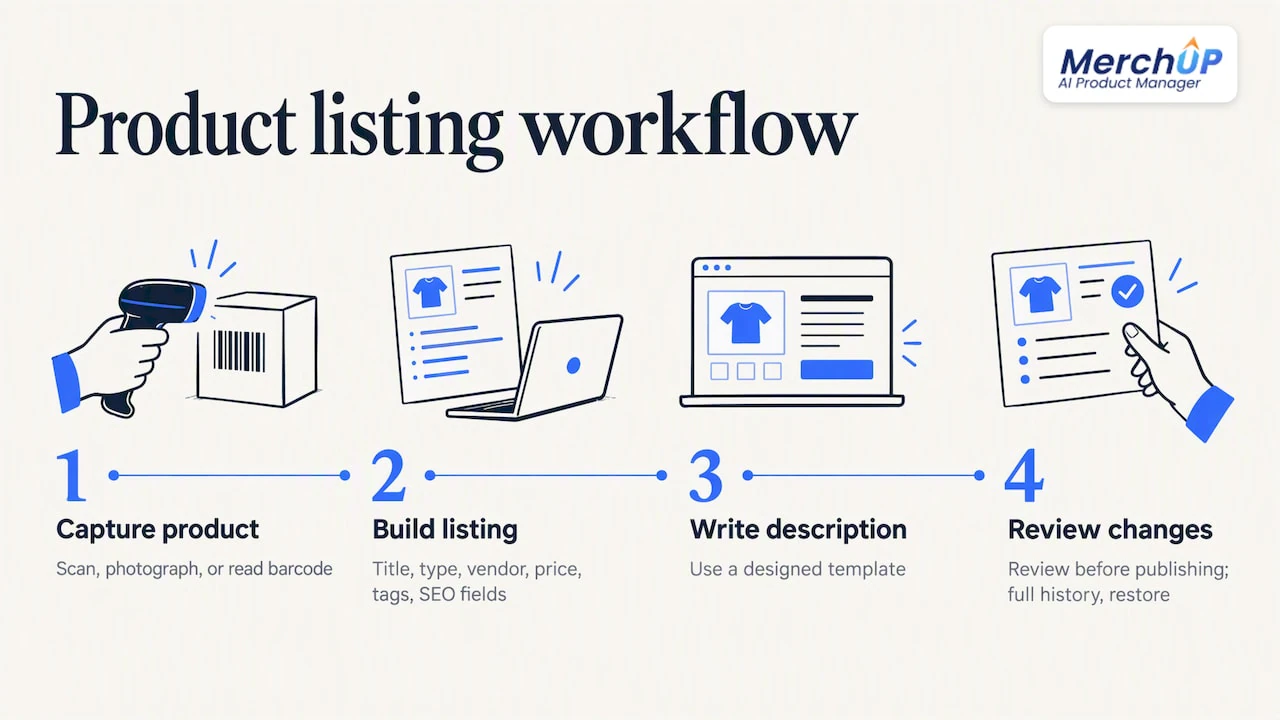
We also think nothing should go live unseen. In MerchUp AI every change is reviewed before it is published, and there is full history with restore. A unique description is a decision about your brand, and the final call should be yours.
One more point from experience: do not chase uniqueness at the cost of clarity. A plain, specific sentence beats a clever, vague one every time.
— Jamie Moss
Making the SEO side unique too
The description is only half of a product page’s text. Meta titles, meta descriptions and image alt text are also copied across catalogues, often in a templated way that makes every page look the same in search results.
MerchUp AI does all your SEO in one click. It reads your store’s own Google Search Console data and live Google results, picks keywords, writes meta titles, descriptions and image alt text, checks rankings on live Google and pushes everything to your store. You do not need SEO knowledge, and every change is reviewed before it goes live. For the wider picture, read our product description SEO guide.
Keeping it unique when you add products every week
The real test is week twelve, when you have 40 new items and no time. A few habits help.
- Standardise the fact sheet, not the sentences. Use the same fields for every product, with different values.
- Batch by collection. Products in the same collection share structure and buyer, so you can review them together. Our guide to bulk product descriptions covers how to do this without flattening the copy.
- Fix the top sellers by hand. Spend the manual effort on the ten pages that bring in most revenue.
- Audit quarterly. Search a distinctive sentence from a few product pages in quotation marks. If other sites show up, rewrite.
- Update with real feedback. When a customer asks a question twice, add the answer to the page.
Try it on your own catalogue
If you sell on Shopify and add products regularly, MerchUp AI can build the listing, the description and the product photos from a single scan or photo, then publish it, and you can sell online or in person with Shopify POS. There is a free plan, and paid plans start with Starter at £12.99 a month, then Growth at £34.99, Pro at £79.99 and Scale at £199.99 a month. Trading-card shops can add the card scanner from £7.99 a month. See the plans and pricing, or watch the 30-second tutorial first. You can also try the AI description generator for Shopify.
FAQ
Do I need to rewrite every manufacturer description?
Ideally yes, starting with your best sellers and the products many other stores also carry. Add your own facts, such as sizing notes, use cases and photos, rather than just rewording the supplier text. Small, honest additions often beat a full rewrite of the same information.
How long should a unique product description be?
Long enough to answer the buyer’s questions, and no longer. Baymard’s testing shows the real risk is insufficient information, not excess length. A short intro, a few highlights and a spec block works for most products.
Is AI-written copy unique enough?
It can be, if the AI works from real product data and writes into a defined structure, and if you review the result. Copy produced from a title alone tends to be generic. Check each listing against the swap test before it goes live.
What is the quickest way to check whether a description is unique?
Paste a distinctive sentence from the page into Google in quotation marks and see who else uses it. Then run the swap test: replace your product name with a rival’s and see whether the copy still fits. If it does, add more specific facts.
Sources
- Ecommerce Product Data and Content on Google, Google Search Central
- Your Guide To Building A Product Detail Page That Boosts Sales, The Good
- How to make ecommerce product pages work in an AI-first world, Search Engine Land
- Writing engaging product descriptions, Shopify Help Center
- Structuring Product Page Descriptions by Highlights, Baymard
- Nielsen Norman Group E-commerce report: Product Pages
- 10% of E-Commerce Sites Have Insufficient Product Descriptions, Baymard
- Product Page UX: FAQs and Community Q&As, Baymard
- Ecommerce Product Page Optimization Guide, Ecomhint


Comments
No comments yet — be the first to share what you think.