


AI product page optimisation means restructuring your product pages so both shoppers and AI systems, chatbots, shopping agents and generative search can read, trust and recommend them. The single highest-impact move is completing your Product and Offer JSON-LD, including price, availability and seller data, plus FAQPage schema. Sellers using generative AI to build or refresh listings see roughly a 40% lift in listing quality, and tools like MerchUp AI help teams apply that at scale.
TL;DR:
- Completing and properly implementing Product and Offer JSON-LD schema is essential to ensure AI systems can read, trust, and recommend your product pages effectively.
- Using specific schema types like aggregateRating, Review, and FAQPage, and validating schema regularly, significantly improves AI visibility and recommendation likelihood.
- Clear, fact-based copy with front-loaded specifications and matching social proof enhances both human trust and AI extraction of relevant product details.
- Ensuring crawler access, correct variant schema, and accurate page signals is crucial for your product pages to be discoverable and accurately represented by AI tools.
- Regularly tracking AI citation rate and conducting controlled tests help measure optimization efforts and prioritize scaling across large product catalogues.
Schema and structured data: the technical foundation for AI visibility
AI shopping agents do not read your page the way a person does. They parse structured data first and treat everything else as supporting evidence, so an incomplete schema is often the difference between being recommended and being skipped entirely.
Five schema types matter most for product pages. Product carries the core identity (name, brand, SKU, GTIN). Offer supplies price, currency and availability. AggregateRating and Review give trust signals. FAQPage answers the conversational questions shoppers actually type into AI tools. A return or warranty policy, where relevant, closes the gap on post-purchase questions that otherwise get answered with a guess.
Google’s own documentation is clear that Product structured data is required to qualify for enhanced search experiences, and that Merchant listings specifically need active Offer data supplied directly by the seller, not inferred from page text. The Product structured data guidelines also recommend implementing this markup in the initial HTML rather than injecting it with JavaScript after load, because fast-changing fields like price and availability are less reliable when rendered dynamically.
| Property | Schema type | Why it matters to AI |
|---|---|---|
| price, priceCurrency | Offer | Confirms the exact cost an agent can quote |
| availability | Offer | Prevents recommending an out-of-stock item |
| aggregateRating | AggregateRating | Signals trust without the agent reading reviews |
| sku, gtin | Product | Stops variants being merged or misattributed |
| mainEntity (Q&A) | FAQPage | Maps directly to conversational queries |
Before you consider a page done, run through a short validation pass:
- Test the URL in Google’s Rich Results Test to confirm every required property is detected.
- Check your Merchant listings report for rejected or partial offers.
- Run a JSON-LD validator, such as the free JSON-LD schema tool from BabyLoveGrowth, to catch syntax errors before they reach production.
- Re-check after any template change, since one broken include can silently strip schema from thousands of pages.
Write product copy for AI and humans: semantic density and extractable facts
Structured data tells an AI agent what your product is. Your visible copy tells it, and the shopper, why it matters. Both need to carry facts an agent can lift cleanly, not just persuasive language a human skims past.
Start with the title. A reliable formula is brand, then product, then the differentiator, then size or variant: “Fjällräven Kånken Backpack, Water-Resistant, 16 Litre, Ochre.” That order lets both a search algorithm and a shopping agent match intent quickly, rather than guessing which word is the differentiator.
Front-load your first two sentences with the specs that answer “will this fit?” before any brand storytelling. A visible spec list or short table under the headline does double duty: shoppers scan it, and AI systems extract it without needing to parse prose.
- Lead with the fact that decides fit or suitability, not the brand story.
- Turn vague claims into numbers or standards a machine can quote, “waterproof to IPX7” beats “great in the rain”.
- Keep one visible spec block per page so facts are not scattered across paragraphs.
According to practitioner guidance on AI-driven shopping discovery, AI crawlers tend to read DOM facts and miss attributes buried inside flowery copy, so a dual structure, a clean spec block alongside marketing paragraphs, prevents key details from becoming invisible to machines.
Pro Tip: Pair a specific review snippet with a matching spec claim, “customers say it lasts through a 6-month ski season” next to “shell rated for -20°C”, so the AI has social proof and a hard number in the same breath.
Trust signals that make AI engines more likely to recommend your product
AI agents recommend the option with the least uncertainty, which makes trust signals as important as the product facts themselves.
- Implement AggregateRating and Review schema only with genuine, current review data, stale or fabricated ratings are a fast way to get a listing quietly deprioritised.
- Set priceValidUntil accurately and keep availability current, since Google’s guidance treats mismatched Offer data as a reason to exclude a listing from Merchant experiences.
- Surface a handful of reviews that mention a specific use case and how long the product has been in use, “used daily for eight months”, rather than generic star ratings alone.
- Refresh review and pricing data on a schedule rather than leaving it static for months at a time.
Contextual reviews do more work than volume. A short quote that states a use case and a duration gives an AI agent, and a hesitant shopper, a concrete reason to trust the page over a competitor’s.
Technical checklist: crawler access, robots, performance and variant clarity
Even flawless schema is worthless if crawlers cannot reach it. Run through this before investing further in content.
- Check robots.txt for accidental blocks on common AI crawlers, an overly broad disallow rule written for a different purpose often catches them by mistake.
- Serve Product and Offer schema in the initial HTML rather than injecting it after JavaScript renders, in line with Google’s own recommendation for fast-changing fields.
- Use ProductGroup schema for variants, with a unique URL and SKU per variant, so colour or size options are not merged into one confused listing.
- Confirm canonical tags point to the correct variant page, not a generic parent URL that hides the specific option a shopper wants.
- Check for accidental noindex tags left over from staging environments, a common and easily missed cause of pages vanishing from both search and AI results.
- Test rendering with a tool that mimics how crawlers see the page, not just how a browser renders it for you.
Measure and iterate: A/B testing, AI citation rate and reporting
Treat AI visibility as a KPI you track, not a one-off project. The metrics worth watching are AI citation rate, or how often your product is surfaced in AI shopping answers, alongside conversion rate, organic clicks and referral traffic from AI platforms specifically.
- Run A/B tests that isolate one variable at a time, schema completeness in one test, copy rewrites in another, so you know which change moved the number.
- Give each test enough runtime to gather a meaningful sample before drawing conclusions, borrowing the same discipline app-store listing optimisation uses for its own page tests.
- Cross-check Search Console’s Merchant reports and server logs for crawler activity against any third-party AI monitoring you use.
- According to guidance on optimising product pages for AI, tracking citations across tools like ChatGPT, Gemini and Perplexity alongside conversion data shows where further investment actually pays off.
MerchUp 30/60/90 playbook: an operational path to scale AI-ready product pages
Fixing one page is straightforward. Fixing a catalogue of thousands needs a phased plan.
- Days 1 to 30: audit existing schema and copy gaps, fix the highest-traffic pages first, and put in place the templates that will scale the fix.
- Days 31 to 60: apply templated schema and copy fixes catalogue-wide, validating each batch before publishing.
- Days 61 to 90: bulk-generate remaining descriptions, run final validation passes, and set up ongoing monitoring.
MerchUp’s integration with Shopify supports this path directly, automating description generation, applying schema-ready templates, and bulk-publishing updates across a catalogue rather than page by page. The full 30/60/90 day playbook walks through each phase with the specific checks to run before moving on.
Pro Tip: Validate a sample batch of 20 to 30 pages before running a bulk publish, catching a template error early is far cheaper than fixing it across an entire catalogue.
Personalisation techniques using AI for product page optimisation
Personalisation adjusts what a shopper sees based on who they are and what they have shown interest in, and AI makes that adjustment possible in real time rather than through static rules.
The most common application is dynamic content blocks that reorder or reword based on referral source or browsing history, a shopper arriving from a “best hiking boots” search sees durability specs first, while one arriving from a style-focused social post sees colour options first. The underlying product data does not change, only the emphasis.
Segment-based copy variants work similarly. Rather than one fixed description, an AI system can serve a version weighted towards the attributes that segment has historically cared about, price sensitivity, technical specs, or sustainability credentials. The schema stays constant underneath, which matters because AI shopping agents still need one clean, unambiguous source of product facts regardless of which copy variant a human sees.
Personalisation should never touch price, availability or core specs shown to different visitors, doing so creates the exact inconsistency that damages trust with both shoppers and AI systems reading the page. Keep personalisation confined to framing and emphasis, and leave the factual layer untouched and singular.
Utilising AI-driven image and video optimisation on product pages
Images and video carry information that text alone cannot, but they are largely invisible to AI systems unless supported by structured markup and accurate alt text.
AI-driven tools can now generate alt text automatically, describing what is in an image with enough specificity that both accessibility tools and AI crawlers can use it. Generic alt text like “product photo” gives an agent nothing to work with, while “grey merino wool jumper, crew neck, folded flat” gives it a fact to extract.
Image and video schema, using ImageObject and VideoObject properties, tells an AI agent which images belong to which product and variant, reducing the risk of a colour swatch being misattributed. For video, a short transcript or captioned summary of what the clip demonstrates, sizing, assembly, texture, gives AI systems a text anchor they can cite even though they cannot watch the footage.
AI upscaling and background-cleanup tools can standardise image quality across a large catalogue quickly, which matters because a listing with genuinely useful photography, and clean markup describing it, has more chance of being surfaced than one with a single low-resolution thumbnail and no supporting data.
AI-powered dynamic content recommendations and cross-selling
Cross-selling used to mean a static “customers also bought” block. AI-driven recommendation engines now generate that block dynamically, based on the specific product, the shopper’s session behaviour and broader purchase patterns across the catalogue.
The mechanism matters less than the discipline behind it: recommendations should be genuinely relevant to the product being viewed, not just popular items pulled from elsewhere in the store. A hiking boot page recommending wool socks and trail gaiters builds trust; the same page recommending unrelated electronics accessories undermines it, and AI shopping agents reading the page pick up on that mismatch too.
Dynamic recommendations also feed back into schema. Where a bundle or “frequently bought together” set exists, marking it up clearly, rather than leaving it as an unstructured carousel, gives AI systems a chance to understand and potentially recommend the combination rather than just the single item.
Keep recommendation logic separate from the core Product schema for the page itself. A recommended item should never bleed into the primary product’s price or availability data, that separation is what keeps an AI agent confident about which facts belong to which product.
Leveraging AI for customer behaviour analysis to inform product page layout and content
AI tools that analyse scroll depth, click patterns and exit points reveal which parts of a product page actually get read, and which sit below the point most shoppers give up.
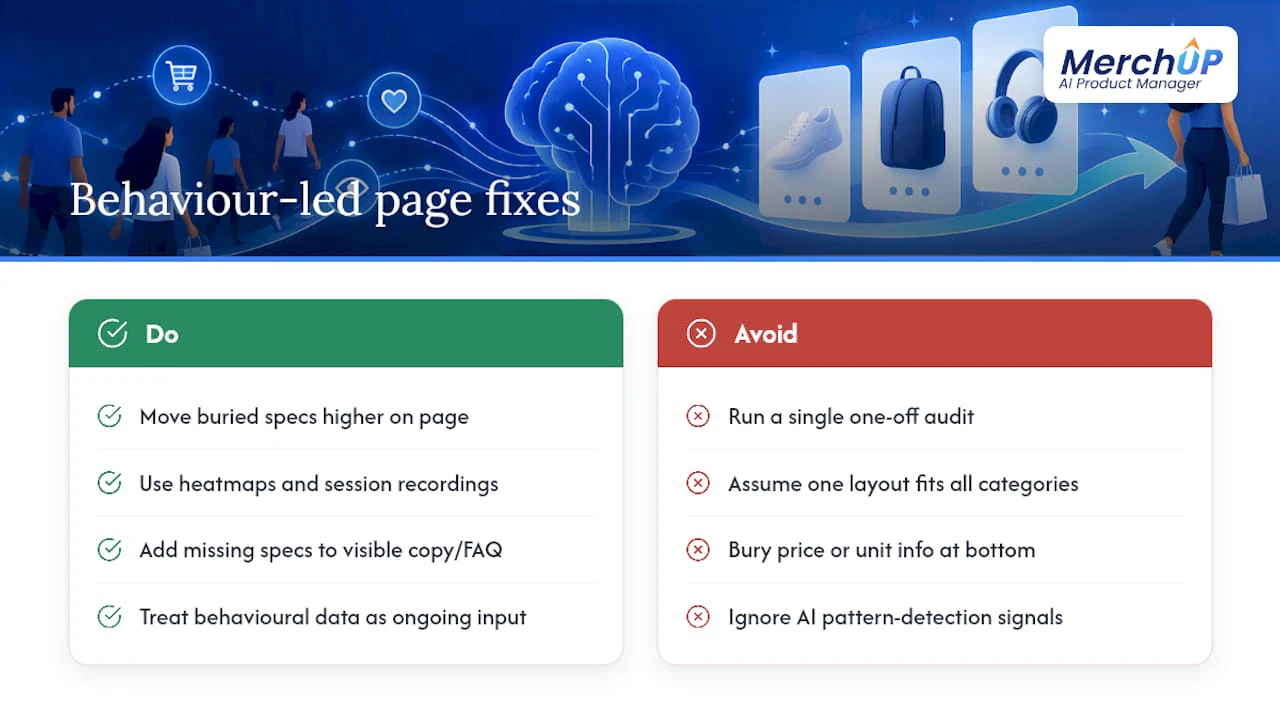
If behavioural data shows shoppers consistently abandon before reaching a spec table buried at the bottom of the page, that is a direct signal to move it higher, not just for conversion but because AI crawlers weighted towards content near the top of the DOM will extract it more reliably too. Research into ecommerce product page UX has found that a high share of ecommerce sites have mediocre product page UX, with poor review handling and missing price-per-unit information among the common failings that drive abandonment.
Heatmap and session-recording tools, increasingly paired with AI-driven pattern detection, can surface which specific questions shoppers hover over or search for on-page, useful evidence for deciding what belongs in your FAQ block. If a spec is consistently searched for on-page but missing from the visible copy, that is a gap worth closing before investing further in unrelated content.
Behavioural analysis works best as an ongoing input, not a one-off audit. Layouts that convert well for one catalogue category may underperform for another, so treat the data as a rolling signal for prioritising fixes rather than a single verdict.
Ethical considerations and data privacy in AI-driven product page optimisation
AI-driven personalisation and behavioural analysis both depend on shopper data, which means privacy obligations sit underneath every technique described above, not alongside them.
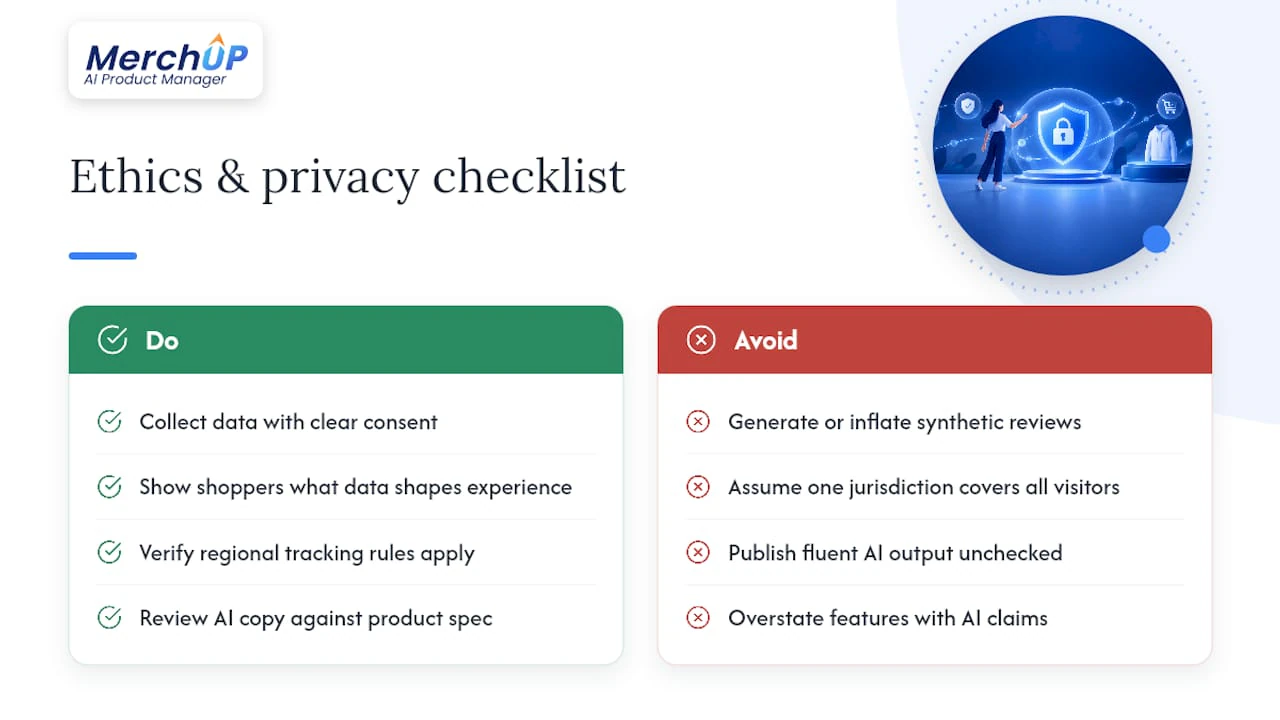
Personalisation based on browsing history or purchase patterns should rely on data collected with clear consent, and shoppers should have a straightforward way to see what is being used to shape their experience. Region-specific rules on tracking and data use vary, so confirm what applies in your market rather than assuming one jurisdiction’s standard covers every visitor.
There is also an honesty obligation specific to AI-generated content. Descriptions, images or review summaries produced or heavily edited by AI should still describe the product accurately, an AI-generated claim that overstates a feature is just as misleading as a human-written one, and arguably more likely to slip through unnoticed at scale. Review AI-generated copy against the actual product spec before publishing, rather than trusting output that reads fluently but was never checked against reality.
Fake or synthetic review content is a firm line not to cross. AggregateRating and Review schema exist to reflect genuine customer sentiment, and using AI to generate or inflate reviews undermines the exact trust signal that schema is meant to provide, for shoppers and AI agents alike.
Author perspective: where AI product page optimisation is headed
Most teams reach for copy rewrites first because copy feels like the visible lever. Schema completeness and attribute fill rate deserve the earlier investment, since an AI agent cannot recommend what it cannot parse. Treat AI citation rate as a KPI you check regularly, not a project you finish. And be wary of fully automated image or text generation with no human validation step, fluent output is not the same as accurate output.
— Jamie Moss
How MerchUp helps with AI-ready product pages
This tool generates product descriptions designed for SEO and structured-data completeness, then bulk-publishes them across a Shopify catalogue with a visual template editor and real-time tracking, so fixing hundreds of pages does not mean editing hundreds of pages by hand.

If you want to see the workflow before committing, the 30-second product description tutorial walks through a live example, and the pricing page lists the Starter, Growth, Pro and Scale plans for teams ready to move beyond manual edits.
Sources
Validate implementation with Google’s Product structured data docs, the Rich Results Test and your Merchant listings report before publishing at scale.
- New Amazon research reveals businesses are embracing data and AI tools to help unlock 2024 holiday sales
- Current state of ecommerce product page UX (Baymard Institute)
- How AI-driven shopping discovery changes product page optimisation (Search Engine Land)
FAQ
What is AI product page optimisation?
It is the practice of structuring product pages, through schema, copy and trust signals, so AI shopping agents and chatbots can read, verify and recommend them accurately. The core work is completing Product and Offer JSON-LD, then reinforcing it with clear copy and genuine reviews.
Which schema types matter most for AI visibility?
Product and Offer schema are the foundation, since they carry the identity, price and availability facts an AI agent needs to quote. AggregateRating, Review and FAQPage schema add the trust and conversational context that influence whether a page gets recommended over a competitor’s.
How do I stop AI crawlers merging my product variants?
Use ProductGroup schema with a unique URL and SKU for each variant, rather than relying on one page to represent several colours or sizes. This prevents an AI agent from attributing the wrong price or availability to the option a shopper actually wants.
How can I tell if my AI optimisation work is making a difference?
Track AI citation rate alongside conversion rate and referral traffic from AI platforms, rather than relying on organic search metrics alone. Running A/B tests that isolate schema changes from copy changes shows which specific fix moved the number.
Does MerchUp help with AI product page optimisation?
MerchUp AI generates SEO-oriented product descriptions and bulk-publishes them to Shopify through a visual template editor, which helps teams apply consistent, structured content across large catalogues. Plans are listed on the pricing page, starting at £12.99 a month for the Starter tier.


Comments
No comments yet — be the first to share what you think.