


Generative engine optimisation (GEO) is the practice of structuring product data and on-page facts so AI shopping assistants cite your products inside generated answers. Three actions move the needle fastest: confirm every product fact is present in raw HTML (not locked inside JavaScript), add an answer-first sentence to the first 60 words of each product page, and build a 30–50 prompt benchmarking set so you can actually measure whether any of it is working. Shopify’s Q1 2026 data shows AI-referred sessions grew more than 8x year-over-year and AI-referred orders grew nearly 13x. That is the commercial case in two numbers.
- Confirm machine-readable facts: price, stock, weight, return window and materials must live in server-rendered HTML and structured data, not a JavaScript bundle.
- Add answer-first snippets: open every product page with one sentence that names the product, its primary use case, and its most cited spec.
- Start prompt benchmarking: define 30–50 realistic shopping queries your customers ask, run them monthly across Google Gemini, ChatGPT and Perplexity, and log every citation.
What generative engine optimisation means for ecommerce teams
The unit of success in GEO is not a blue link. It is being quoted or cited inside a generated answer, whether that answer appears in Google’s AI Overviews, a Perplexity shopping summary, or a ChatGPT product recommendation. When a shopper asks “what is the best waterproof hiking boot under £150?”, the engine does not return ten links. It assembles a short answer from sources it trusts, names two or three products, and may never show the user a traditional results page at all.
Generative engines retrieve product facts by crawling structured data, extracting key attributes from product copy, and cross-referencing those facts against off-site sources such as reviews and editorial mentions. Price, star rating, return policy, material composition and warranty length are the attributes models most frequently pull into shopping answers. If any of those facts are missing, inconsistent, or buried in JavaScript, the engine either skips your product or, worse, hallucinates a detail from a competitor’s page.
The market signal is hard to ignore. Shopify’s enterprise data confirms that AI chatbot referrals are now a fast-growing revenue channel for UK merchants, with orders from those referrals growing nearly 13x year-over-year in Q1 2026. For most ecommerce teams, AI-referred traffic is still a small share of total sessions, but the growth rate means it will not stay small for long.
How GEO differs from traditional SEO — and where they overlap
SEO optimises for ranking signals and blue links. GEO optimises for extractability and citation inside generated answers. That distinction changes what you build, not just how you describe it.
The good news is that a strong SEO foundation accelerates GEO. E-E-A-T signals (experience, expertise, authoritativeness, trustworthiness), clean crawlability, and fast page load all still matter because generative engines use the same crawl infrastructure as traditional search. What GEO adds is a layer of factual density and corroboration that traditional SEO never required. A product page optimised for SEO might rank well with persuasive copy and a handful of keywords. That same page may be ignored by a generative engine if it cannot extract a clean answer to “what does this product weigh?” or “what is the return window?”
The Microsoft Ads AEO and GEO guide frames this as a shift from discovery to influence: traditional search gets you found; GEO gets you cited. Both matter, and neither replaces the other.
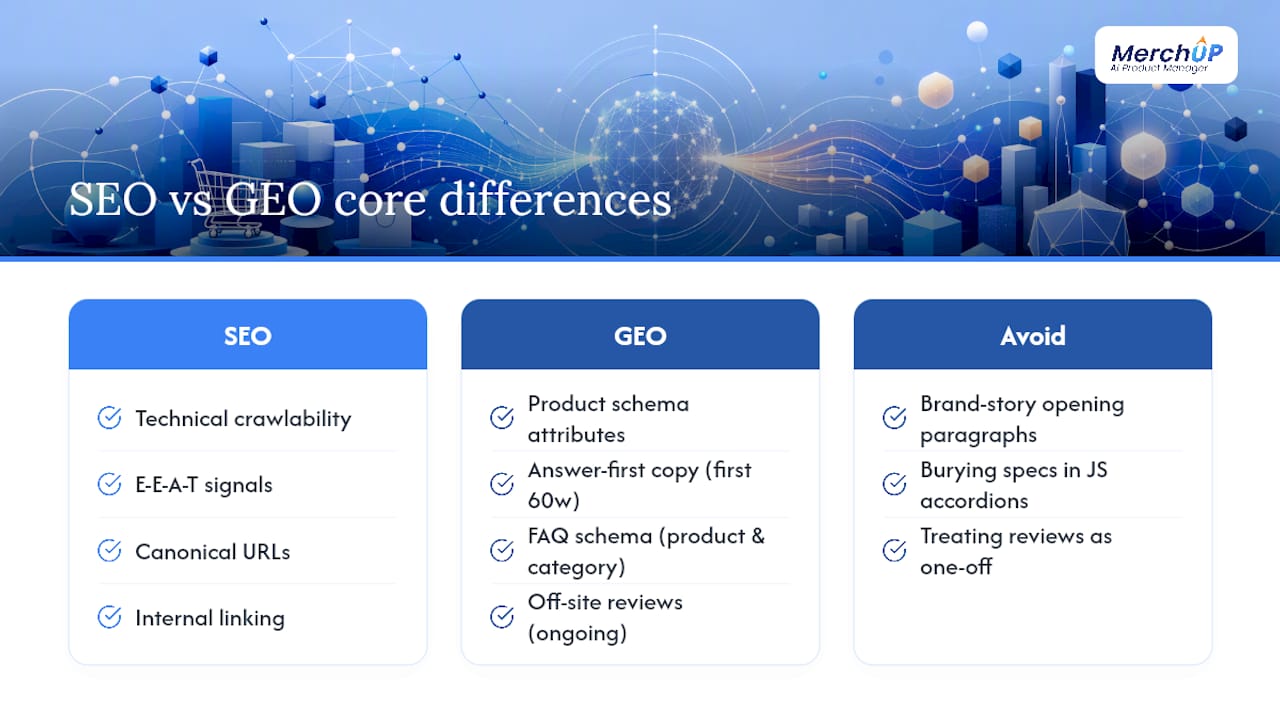
Keep from SEO: technical crawlability, E-E-A-T signals, canonical URLs, internal linking, page speed, and mobile-first indexing.
Add for GEO: Product schema with complete attribute sets, answer-first copy in the first 60 words, FAQ schema on product and category pages, off-site review depth, and a plain-text or .md fallback for AI crawlers.
Stop doing: opening product pages with brand story paragraphs, burying specs in accordions that require JavaScript to render, and treating review collection as a one-off task rather than an ongoing cadence.
For a deeper look at how product descriptions affect AI visibility, the overlap between traditional SEO and GEO is worth mapping before you start.
How to write product pages that generative engines will cite
The first 40–60 words of a product page are the most important real estate in GEO. Generative engines extract the opening sentence as the candidate answer to “what is this product?” queries. If that sentence is a brand tagline, you have wasted the most valuable citation slot on the page.
The answer-first sentence formula: [Product name] is a [category] designed for [primary use case], made from [key material], available in [variants], with [standout spec or certification]. Every fact in that sentence should also appear in your Product schema.
Before (marketing copy): “Discover the sock that redefines comfort. Our trail running sock is the choice of champions, crafted with passion and precision for those who demand the best from every step.”
After (GEO-ready copy): “The Merino Trail Sock is a cushioned running sock made from 80% merino wool, rated for temperatures down to -5°C, available in sizes UK 4–13, with a 60-day return window.”
The after version contains six extractable facts. The before version contains zero. That is the practical difference between AI writing for ecommerce that gets cited and copy that gets ignored.
For the schema side, a minimal Product JSON-LD block should include:
name,description,sku,brandofferswithprice,priceCurrency(GBP for UK stores),availability,returnPolicyaggregateRatingwithratingValueandreviewCountweight,depth,width,heightinside aadditionalPropertyarray
Hello Retail’s GEO guide confirms that adding FAQ schema to product pages and making claims machine-readable measurably increases citation rates. A short FAQ block answering “Is this product suitable for X?” and “What is the return policy?” at the bottom of each product page gives engines a second extraction point beyond the opening paragraph.
For a technical walkthrough of product schema markup deployment, the JSON-LD patterns above are a starting point rather than a complete specification.
How to measure GEO performance and run reproducible tests
GEO measurement starts with a prompt set, not a dashboard. Define 30–50 realistic shopping queries your customers actually ask, covering product-specific queries (“best merino running socks UK”), category queries (“waterproof trail socks under £20”), and comparison queries (“merino vs synthetic running socks”). Run them monthly across Google Gemini, ChatGPT, and Perplexity. Log every citation, the position of your product in the answer, and the specific fact the engine quoted.
| Metric | How to collect | What it tells you |
|---|---|---|
| AI citation rate (share of voice) | Manual prompt set run monthly; log mentions vs total prompts | Whether your products appear in generated answers at all |
| Citation position | Note rank order within generated answer (1st, 2nd, 3rd mention) | How prominently you are featured vs competitors |
| AI-referred sessions | GA4 source/medium filter for chatbot referrers (e.g. chat.openai.com) |
Volume of traffic arriving from generative engines |
| Conversion rate from AI referrals | GA4 segment on AI-referred sessions vs site average | Whether AI-referred visitors convert better or worse |
| Revenue attributed to AI referrals | GA4 e-commerce report filtered by AI referral segment | Commercial impact of GEO investment |
The E-GEO benchmark (Aggarwal et al.) provides the most rigorous methodology for reproducible testing. E-GEO contains over 7,000 realistic ecommerce queries and demonstrates that prompt meta-optimisation consistently outperforms heuristic rewrites for improving citation ranking in generative outputs. The practical implication: do not just rewrite copy based on intuition. Test specific copy variants against your prompt set and measure citation position before and after.
- Define your baseline prompt set (30–50 queries, covering product, category, and comparison intent).
- Run the set across target engines and record citation rate and position.
- Apply one content change (e.g. add answer-first sentence, add FAQ schema, add tabular attributes).
- Re-run the prompt set after 4 weeks and compare citation rate and position.
- Report citation share-of-voice, AI-referred sessions, and conversion lift as your three headline KPIs.
Operational tools and integrations for the UK ecommerce stack
UK ecommerce teams need a stack that covers five functional areas: product data management, schema generation and validation, review collection and markup, AI citation monitoring, and LLM-powered rewriting with a publishing connector.
- PIM and product enrichment: — A product information management system (Salsify is widely used for enterprise catalogues) centralises attribute data and pushes enriched records to Shopify and other channels. For smaller teams, Shopify’s native metafields can carry structured attributes if a full PIM is out of budget.
- LLM rewrite engines: — OpenAI’s GPT APIs and Google Gemini’s API are both available to UK teams and are the most commonly used engines for bulk product copy generation. Both support structured output modes that make attribute tabulation easier to enforce at scale.
For UK-specific considerations: check any LLM provider’s data residency terms if you are processing personal data as part of your catalogue workflow. The UK GDPR applies to any personal data processed in the pipeline, including customer review data used to train or fine-tune rewrite prompts. Prefer providers with UK or EU data residency options.
For a Shopify-specific schema and crawlability checklist, the integration notes above map directly to Shopify’s theme architecture.
Practical checklist and ready templates you can use today
The eevy.ai GEO guide and Hello Retail’s practitioner playbook both converge on the same practical starting point: make facts machine-readable before you do anything else. The templates below are designed to be pasted directly into your workflow.
Product description template (GEO-ready):
- Answer-first sentence: [Product name] is a [category] designed for [use case], made from [material], available in [variants], with [key spec or certification].
- Attribute table: Weight | Dimensions | Material | Colour options | Warranty | Return window.
- Three to five bullet points covering the top questions your prompt set surfaces.
- One verified review quote (with
Reviewschema markup). - FAQ block: three Q&A pairs answering the most common comparison and suitability questions.
90-day weekly task checklist:
- Week 1: Schema audit (top 50 pages), fix
returnPolicyandaggregateRating, define prompt benchmarking set. - Week 2: Rewrite answer-first sentences on top 50 pages, confirm server-side HTML rendering.
- Week 3–4: Deploy FAQ schema on top 10 category pages, run first prompt benchmark.
- Month 2: Fill missing attribute fields across full catalogue, launch review collection email sequence.
- Month 3: Roll out GEO-ready copy templates to remaining catalogue, run second prompt benchmark, report citation share-of-voice and AI-referred conversion rate.
For ready-to-use product description templates that follow the answer-first format, the template above is a starting point you can adapt to your category.
The part most teams get wrong about GEO governance
The conversation around GEO tends to focus on tactics: schema, copy rewrites, prompt sets. What gets far less attention is who owns it after the first sprint ends.
Most ecommerce teams treat GEO as a project with a finish line. They fix schema, rewrite 50 product pages, run a prompt benchmark, and then move on. Six months later, a price change goes live without updating the schema, a supplier changes a material spec without touching the product description, and the review cadence quietly stops because the email sequence broke during a platform migration. The generative engine that was citing your product starts citing someone else’s, and nobody notices until the AI-referred sessions line in GA4 goes flat.
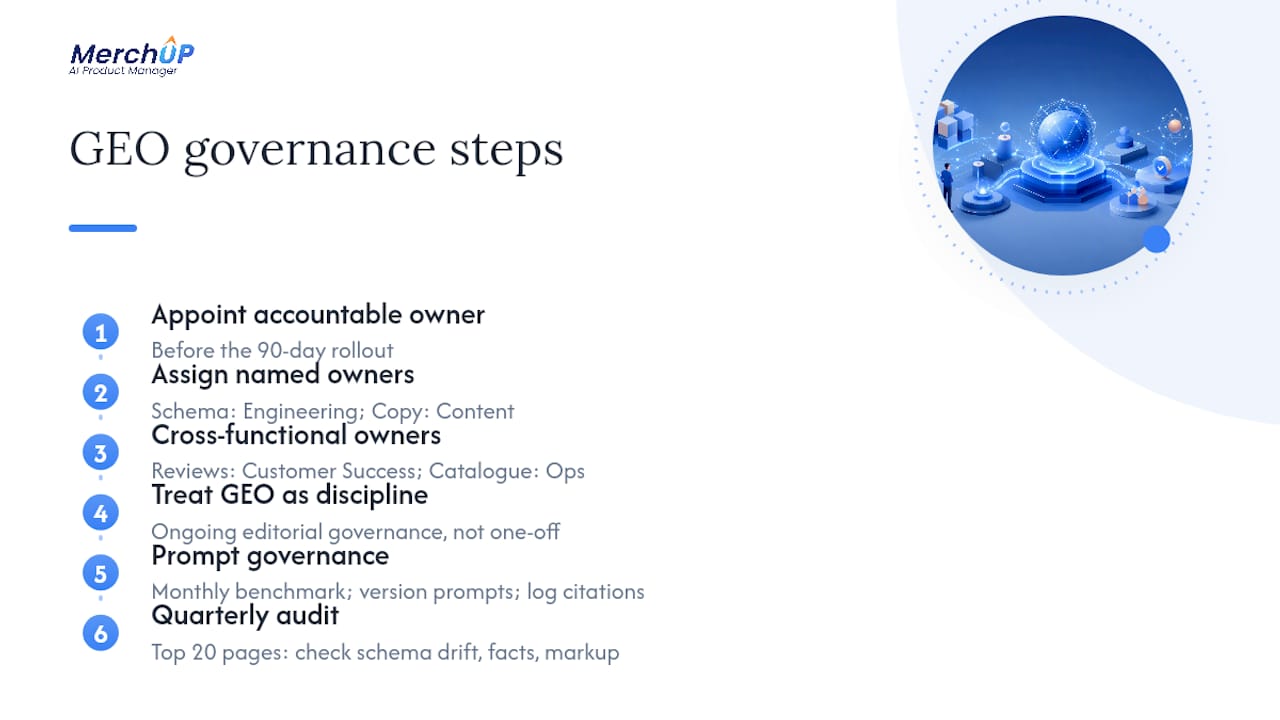
The teams that sustain GEO gains treat it as an editorial discipline, not a one-time technical fix. That means a named owner for schema governance (usually engineering), a named owner for copy freshness (usually content or product), and a quarterly audit that checks the top 20 pages for schema drift, outdated facts, and broken markup. It also means versioning your prompt templates the same way you version code: when you change a rewrite prompt, log what changed, why, and what the citation rate was before and after.
For UK teams specifically, cross-functional ownership is the structural challenge. Schema lives with engineering, copy lives with content, reviews live with customer success, and catalogue data lives with ops. GEO touches all four. Without a single person accountable for the monthly prompt benchmark and the quarterly audit, the work fragments and the gains erode. Appoint that person before you start the 90-day rollout, not after.
Merchup AI makes GEO copy at catalogue scale practical
Rewriting thousands of product pages to meet GEO standards is the part of this playbook that most teams stall on. The strategy is clear; the bottleneck is execution volume.

Merchup AI generates GEO-ready product descriptions in bulk, enforcing the answer-first format, attribute tabulation, and factual density that generative engines extract from. Its Shopify integration pushes updated copy and schema directly to your store without a developer in the loop, and its template library lets you standardise the answer-first sentence structure across every category. For teams managing hundreds or thousands of SKUs, that is the difference between a 90-day rollout and a 90-week one.
The platform’s visual editor lets content owners review and adjust AI-generated descriptions before publishing, keeping brand tone consistent without slowing the pipeline. Credit-based generation means you pay for what you use rather than committing to a fixed seat licence regardless of catalogue activity.
Start with Merchup AI’s free trial or review the plan and pricing options to find the tier that fits your catalogue size.
Useful sources to read next
- Shopify — Generative engine optimization
- E-GEO: A Testbed for Generative Engine Optimization in E-Commerce
- What is eCommerce GEO? Quick guide to generative engine optimization – Mirakl
- GEO for Ecommerce: Generative Engine Optimization Explained (2026)
- GEO for ecommerce: How to get your products cited by AI search engines | Hello Retail Blog
- Microsoft Ads — From discovery to influence: a guide to AEO and GEO (PDF)
- GEO Framework for Ecommerce: The Complete 2026 Guide
- doi.org — E-GEO (arXiv DOI)


Comments
No comments yet — be the first to share what you think.