


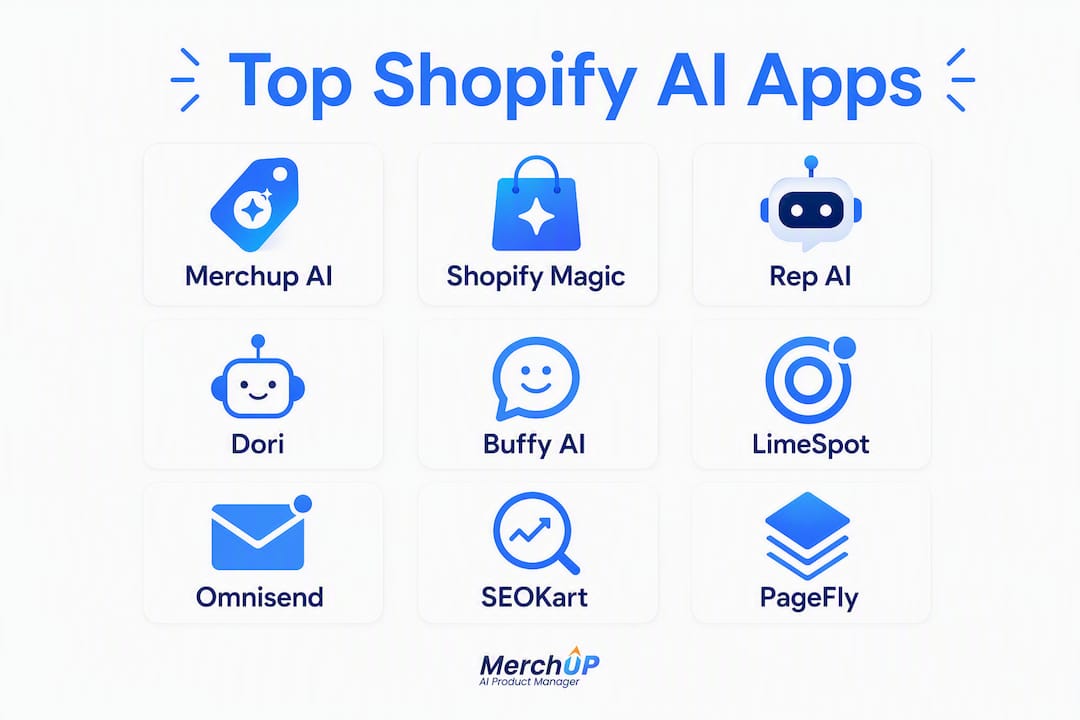
For most Shopify stores, the right answer is a small, deliberate stack rather than one all-in-one tool. No single app covers every job: you need one for product content, one for search and chat, one for personalisation, and the platform’s own native features underneath it all. Here is the shortlist that covers those bases for UK merchants:
-
Merchup AI — product descriptions at scale, with bulk publish, SEO templates and a visual editor that pushes directly to Shopify. Install this first if your catalogue has more than 20 SKUs.
-
Shopify Magic / Sidekick — free, built into the platform, and understands your store’s data natively. The right starting point for theme edits and one-off copy tasks.
-
Rep AI or Dori — proactive chat with behavioural triggers and human handoff; covers conversion and support without a separate helpdesk subscription.
-
LimeSpot or Rebuy — recommendation and upsell engines that learn from your catalogue and purchase history to lift average order value.
UK and GDPR note: Shopify Magic and Sidekick run on Shopify’s own infrastructure, which is GDPR-compliant for UK merchants. Most third-party apps in this list process data on US-based servers; check each app’s Data Processing Agreement before installing, particularly for customer chat logs and behavioural data.
How do the best Shopify AI apps compare at a glance?
| App | Best for | Starting price | Shopify integration | UK / GDPR notes | Automation level | Setup time |
|---|---|---|---|---|---|---|
| Merchup AI | Bulk product descriptions & SEO | Paid plans; free trial available | Native Shopify integration; direct publish | UK-available; check DPA for data residency | Autonomous (bulk generation + publish) | Under 30 minutes |
| Shopify Magic / Sidekick | Platform-native content & admin tasks | Free (included with Shopify) | Platform-level; zero friction | Shopify infrastructure; GDPR-compliant | Prompt-driven | Instant |
| Rep AI | Conversational commerce & ticket deflection | Paid; free trial | One-click install | US servers; DPA available | Autonomous triggers + human handoff | 1–2 hours |
| Dori | In-context product answers via chat | Free tier available | One-click install | US servers; check DPA | Autonomous (catalogue-trained) | Under 1 hour |
| Buffy AI | Natural-language search & discovery | Free tier available | One-click install | US servers | Autonomous (auto-trains on catalogue) | Under 1 hour |
| LimeSpot | Product recommendations & cross-sell | Free tier; pricing varies | One-click install | US servers; GDPR tools available | Autonomous | 1–2 hours |
| Rebuy | Cart upsells & checkout personalisation | Paid; scales with revenue | Native Shopify checkout integration | US servers | Autonomous | 2–4 hours |
| Octane AI | Product quizzes & lead capture | Paid; free trial | One-click install | US servers | Prompt-driven | 2–3 hours |
| Omnisend | Email & SMS automation | Free tier; pricing varies | Native integration | EU/UK data centres available | Autonomous journeys | 2–4 hours |
| Gorgias | Support helpdesk & ticket automation | Paid; from ~£10/mo per user | Deep Shopify integration | EU data residency option | Autonomous routing | 1 day |
| Tidio | Live chat + AI bot | Free tier; paid plans | One-click install | EU servers | Hybrid | Under 1 hour |
| Postscript | SMS cart recovery & re-engagement | Paid; usage-based | Native Shopify | US servers | Autonomous flows | 1–2 hours |
| TxtCart | SMS abandoned cart recovery | Paid; usage-based | One-click install | US servers | Autonomous | Under 1 hour |
| Wiser | Upsells, bundles & recommendations | Paid; free trial | One-click install | US servers | Autonomous | 1–2 hours |
| SEOKart / SEOWILL | Product SEO & image optimisation | Free tier; paid plans | One-click install | US servers | Autonomous | Under 1 hour |
| AdScale | Paid ad automation & optimisation | Paid; pricing varies | Native integration | US servers | Autonomous | 1–2 hours |
| Boost AI Search & Discovery | Onsite search & filtering | Free tier; paid plans | One-click install | US servers | Autonomous | 1–2 hours |
| Heatmap | Behavioural analytics & revenue attribution | Paid plans | Script install | US servers | Analytics/prompt-driven | 1–2 hours |
| Sirge: AI Insights | Ad analytics & attribution | Paid plans | Native integration | US servers | Autonomous reporting | Under 1 hour |
| eesel AI | Chat & automation integrations | Paid; free trial | API/integration | US servers | Prompt-driven | 2–4 hours |
| Freshdesk / LiveChat / Drift / Crisp | Enterprise support with AI routing | Free tiers; paid plans | Integration via app | Varies by provider | Hybrid | 1–2 days |
| Omnisend | Email/SMS journeys | (see above) | — | — | — | — |
| Alia Popups | Popup lead capture | Paid plans | One-click install | US servers | Prompt-driven | Under 1 hour |
| Instant.so | Landing page builder | Paid plans | Native Shopify | US servers | Prompt-driven | 1–2 hours |
| Storebuild.ai / BuildYourStore.AI | Full-store AI generation | Paid plans | Native Shopify | US servers | Autonomous generation | Under 1 hour |
| GemPages / Shogun / PageFly / Replo | Page building with AI assist | Free tiers; paid plans | Native Shopify | US servers | Prompt-driven | 2–4 hours |
| Squirai / Yodel / Fiidom | Single-product AI descriptions | Free tiers; paid plans | One-click install | US servers | Prompt-driven | Under 30 min |
| VOC AI Live Chat & AI Chatbots | AI chat & voice-of-customer analysis | Free tier; paid plans | One-click install | US servers | Hybrid | Under 1 hour |
| AskFlow AI | Product quiz & recommendation | Free tier; paid plans | One-click install | US servers | Prompt-driven | 1–2 hours |
| StoreSEO: AI for SEO & Image | SEO & image alt-text automation | Free tier; paid plans | One-click install | US servers | Autonomous | Under 1 hour |
Pricing note: Shopify’s own tools are free. Most third-party apps quote in USD; expect to pay in GBP at the prevailing exchange rate. Several apps (Omnisend, Gorgias, Tidio) offer EU or UK data-residency options, which matters if you handle personal data under UK GDPR.
Quick trade-offs for UK merchants:
-
Shopify Magic is free but limited to prompt-driven, one-at-a-time tasks; it cannot bulk-generate and publish 500 descriptions overnight.
-
Catalogue-trained apps (Buffy AI, Dori, Rep AI) outperform generic ChatGPT wrappers for product-specific answers, but require a few hours of onboarding.
-
SMS tools (Postscript, TxtCart) are US-centric; confirm UK carrier support before committing.
-
Heatmap and Sirge are analytics-first; they inform decisions rather than automate them.
App profiles: what each tool actually does
Merchup AI
Merchup AI generates, edits and bulk-publishes product descriptions directly to Shopify. The visual editor lets you adjust tone, structure and SEO fields without leaving the platform, and the template library covers most product categories out of the box. It suits any store with a catalogue large enough that writing descriptions one by one is a genuine bottleneck — typically 20 or more SKUs.

Key features: bulk generation with one-click Shopify publish; SEO-optimised templates; activity tracking and real-time catalogue management.
Pros: saves hours per catalogue update; consistent brand voice across SKUs; direct Shopify integration means no copy-paste. Cons: focused on product descriptions rather than chat or personalisation; works best when paired with a search or recommendation app.
Pro Tip: Run a two-week A/B test: generate descriptions for 10 products with Merchup AI and leave 10 unchanged. Compare conversion rate and time-on-page in Shopify Analytics before rolling out to the full catalogue.
Shopify Magic and Sidekick
Shopify Magic is the right first stop for any merchant because it costs nothing and understands your store’s data structure better than any third-party wrapper can. It handles one-off description drafts, image background removal, and theme code snippets. Sidekick extends that to admin tasks: you can ask it to create a discount, pull a sales report, or adjust a collection from a plain-English prompt.

The limitation is volume. Prompt-driven, one-at-a-time generation does not scale to a catalogue of hundreds of products. That is where a dedicated tool like Merchup AI picks up the work.
Rep AI
Rep AI monitors visitor behaviour and triggers a chat proactively when a shopper shows exit intent or hesitation. The GPT-powered conversation handles product questions, recommendations and basic support, then hands off to a human agent with a full conversation summary. That summary feature alone saves agents several minutes per ticket.
Best for: stores with moderate support volume that want to deflect repetitive queries without losing the human touch on complex issues.
Dori
Dori sits on product pages and answers questions in context: “Does this come in a size 12?” or “What’s the return policy?” It trains automatically on your catalogue and lets shoppers add to cart directly from the chat window. Brand voice customisation is available, which matters for stores where tone is part of the product experience.
Buffy AI
Buffy AI auto-trains on your catalogue and handles natural-language search queries, product recommendations and bundle suggestions. Setup is quick; the app reads your product data without manual configuration. Useful for stores where shoppers struggle to find the right product through standard filtered navigation.
Personalisation and upsell engines: LimeSpot, Rebuy, Wiser, Octane AI
These four tools all lift average order value, but through different mechanisms. LimeSpot surfaces behavioural recommendations across the store. Rebuy focuses on cart and checkout, offering dynamic upsells at the moment of highest purchase intent. Wiser adds flexible bundling rules on top of recommendations. Octane AI takes a different angle entirely: quiz-based personalisation that captures zero-party data and routes shoppers to the right product.
For most UK stores, start with one. Rebuy suits stores where checkout conversion is the primary lever; Octane AI suits stores where shoppers need guidance to find the right product (beauty, supplements, pet care).
Email, SMS and support: Omnisend, Postscript, TxtCart, Gorgias, Tidio
Omnisend covers email and SMS in one platform with pre-built ecommerce journey templates. Postscript and TxtCart are SMS-first; both focus on abandoned cart recovery, though UK merchants should verify carrier coverage before committing. Gorgias is the go-to helpdesk for stores with high support volume: it pulls order data into every ticket and automates routine responses. Tidio is the lighter option, combining live chat with an AI bot that handles FAQs without a full helpdesk setup.
SEO tools: SEOKart, SEOAnt (SEOWILL), StoreSEO, Boost AI Search & Discovery
SEOKart and SEOAnt (SEOWILL) automate meta titles, descriptions and image alt text across your catalogue. StoreSEO covers similar ground with image compression. Boost AI Search & Discovery improves onsite search relevance and filtering, which affects both conversion and SEO indirectly. None of these replace a proper Shopify SEO strategy, but they remove the manual overhead of optimising hundreds of product pages.
Page builders and store generators
GemPages, Shogun, PageFly and Replo are drag-and-drop builders with AI-assisted content or layout suggestions. Storebuild.ai and BuildYourStore.AI go further, generating entire store structures from a prompt. Zeno Builder and Framer AI sit at the design-forward end. These are most useful at launch or during a redesign; they are not ongoing AI tools in the same sense as the apps above.
Lighter description tools: Squirai, Yodel, Fiidom
Squirai AI Product Descriptor, Yodel: AI ChatGPT Descriptions and Fiidom: AI Product Description all generate copy for individual products. They are free or near-free, which makes them reasonable for stores with small catalogues. For anything above 30–40 SKUs, the lack of bulk workflow and direct Shopify publish becomes a real friction point.
Other tools in the category
DropMagic, Atlas and PagePilot serve dropshipping and product research workflows. AskFlow AI is a quiz app similar to Octane AI. VOC AI Live Chat & AI Chatbots combines chat with voice-of-customer analysis. Alia Popups handles AI-assisted popup lead capture. Instant.so builds landing pages. Freshdesk, LiveChat, Drift and Crisp are mature support platforms that have added AI routing and draft-response features; they suit organisations that already use one of these platforms and want to add AI without switching tools.
How do you choose the right AI app for your Shopify store?
The category is crowded and the marketing copy is nearly identical across apps. These criteria cut through it.
Selection criteria:
-
Goal alignment: define whether you need more traffic (SEO tools), higher conversion (chat, personalisation), or operational efficiency (bulk content, support automation) before browsing the app store.
-
Catalogue training: apps that train on your actual product data outperform generic prompt wrappers for product-specific tasks. Ask explicitly whether the app indexes your catalogue or relies on you to paste in product details.
-
Automation depth: some apps act autonomously (Rebuy adjusts offers in real time); others require you to write prompts for each task. Match the level to your team’s capacity.
-
Human handoff: for chat and support apps, a clear escalation path to a human agent is not optional. Customers who hit a dead end in an AI chat and cannot reach a person leave and rarely return.
-
UK GDPR compliance: confirm the app has a Data Processing Agreement, understand where customer data is stored, and check whether the app supports data deletion requests.
-
Pricing transparency: usage-based pricing can scale unexpectedly. Calculate your expected monthly cost at current traffic before committing.
-
Support and onboarding: a free trial with no onboarding help is not the same as a free trial with a setup call. Check what is included.
Eight questions to ask before installing any AI app:
-
Does it train on my specific catalogue, or does it use generic AI prompts?
-
How does it handle a query it cannot answer — does it hand off to a human or return an error?
-
Where is customer data stored, and does the vendor have a UK GDPR-compliant DPA?
-
What does the pricing look like at 10x my current traffic?
-
How long does setup realistically take, and what does the vendor count as “live”?
-
Can I customise brand voice, tone and restricted topics?
-
What metrics does it report, and can I connect them to Shopify Analytics?
-
Is there a free trial long enough to run a meaningful A/B test?
Red flags to watch for:
-
Claims of “fully autonomous” AI with no mention of human oversight or escalation.
-
No brand voice training or catalogue indexing — a sign the app is a thin wrapper over a generic model.
-
Pricing that is unclear until after installation.
-
App store listings with no recent reviews or a sudden spike in five-star ratings.
-
No DPA or privacy documentation available on request.
How we selected and tested these apps
Every app in this article was assessed against four filters before inclusion.
Selection filters:
-
Available to UK merchants via the Shopify App Store or direct integration.
-
Demonstrated genuine AI capability beyond a simple prompt box — catalogue training, behavioural triggers, or autonomous optimisation.
-
Coverage across the four functional categories UK stores need: content generation, search and chat, personalisation, and conversion or support automation.
-
Transparent pricing with a free trial or free tier, or a clear paid entry point.
Testing approach:
Apps were evaluated on: speed of catalogue training (how quickly the app learned product data after install); sample output quality for product descriptions and chat responses; install friction (number of steps from app store to first output); and support responsiveness during the trial period.
For content tools, sample descriptions were assessed against three criteria: factual accuracy against the source product data, SEO structure (heading use, keyword placement, meta description quality), and brand voice consistency across multiple outputs.
Rating axes:
-
Integration friction: number of manual steps required to go live.
-
Automation depth: whether the app acts autonomously or requires ongoing prompts.
-
ROI potential: whether the app addresses a measurable revenue or cost metric.
-
Support quality: responsiveness and depth of onboarding documentation.
What merchants consistently get wrong about Shopify AI
The apps in this article are genuinely useful. But the gap between what they promise and what they deliver is almost always a governance problem, not a technology problem.
Most merchants install an AI chat tool, point it at their catalogue, and assume it will handle customer queries accurately. It will handle the easy ones. The trouble starts with edge cases: a return on a personalised item, a query about a product that was discontinued last week, a complaint from a customer who received the wrong size. These are exactly the situations where a confident AI response without a human fallback causes real damage to trust.
The same pattern appears in content generation. Merchants generate 500 product descriptions in an afternoon, publish them all, and never review a sample. Three months later, they wonder why conversion rates have not moved. The descriptions are grammatically correct and keyword-rich, but they all sound the same. The brand voice that made the store distinctive has been averaged out.
The merchants who get the most from AI tools do two things differently. First, they treat AI output as a first draft, not a final one, at least for the first few weeks. Second, they define what “good” looks like before they start: a description template, a tone guide, a list of phrases the brand never uses. Feed that context into the tool and the output quality improves substantially.
Realistic timelines matter here too. A well-configured AI description tool can show measurable SEO lift within six to eight weeks, because search engines need time to re-index updated pages. Chat and personalisation tools tend to show conversion impact faster, sometimes within two to three weeks, because the effect is immediate and measurable at the session level. Do not judge any tool in the first fortnight.
Merchup AI: built for Shopify product descriptions at scale
Writing product descriptions one by one is the task most Shopify merchants know they should fix and never quite get to. Merchup AI is built specifically for that job: it generates SEO-optimised descriptions in bulk, lets you edit them in a visual editor, and publishes directly to your Shopify catalogue without copy-pasting.
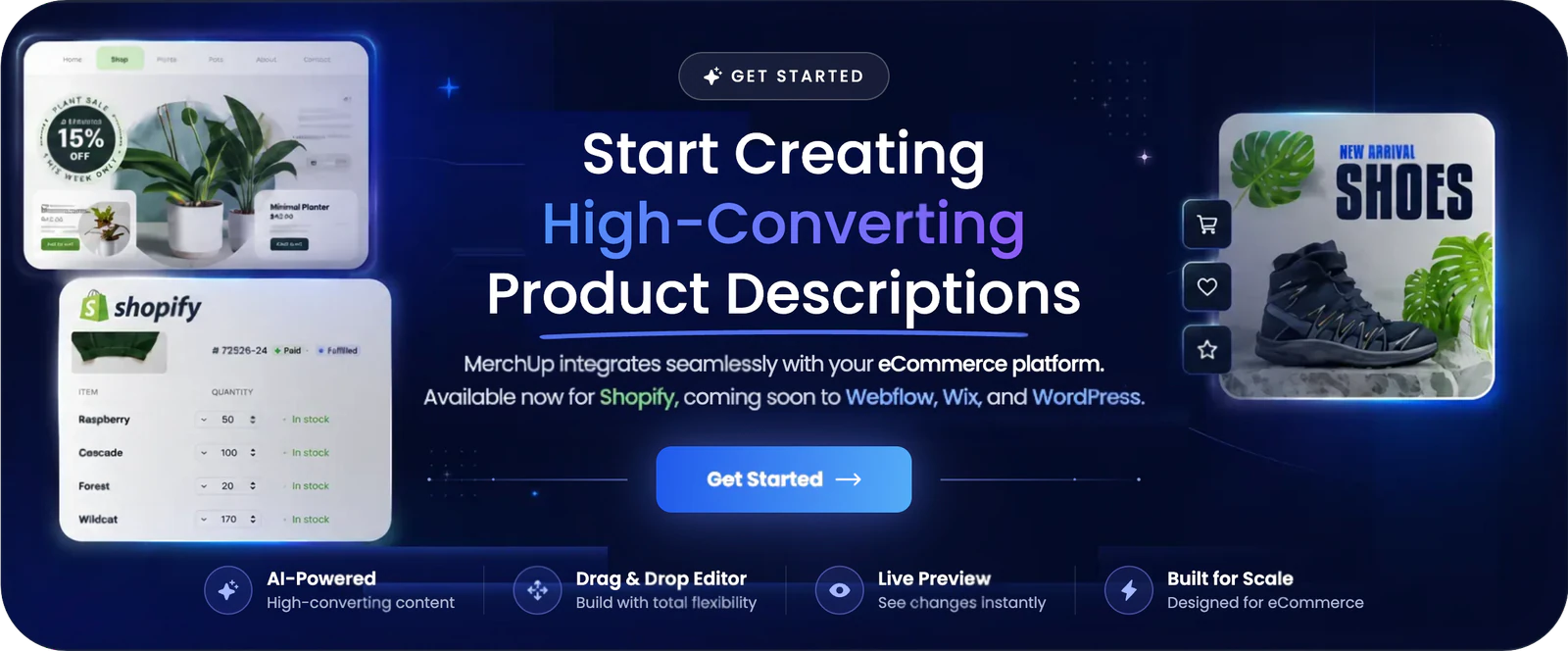
Where generic AI tools give you a text box and a prompt, Merchup AI gives you templates calibrated to product categories, a bulk workflow that handles hundreds of SKUs in one session, and activity tracking so you can see what has been updated and what has not. The direct Shopify integration means descriptions go live the moment you approve them.
The practical test: generate descriptions for 10 products, compare conversion rate against your existing listings over two weeks, then scale to the full catalogue. Most merchants see the case for rolling out within that window. Start your trial at merchup.ai and run that test before committing to a plan.
Frequently asked questions
What is the best AI app for Shopify?
It depends on the job you need done. For product content — descriptions, titles and SEO fields kept consistent at catalogue scale — Merchup AI leads the picks above. For support automation, search or imagery, the category specialists in this guide are the stronger fits. Choose by the workflow you repeat most, not by the longest feature list.
Are AI Shopify apps worth it for small stores?
Yes when the app replaces work you repeat. A store rewriting fifty product pages each season saves real hours with an AI content app; a two-product store rarely will. Run the value test on a free trial before paying: if the first batch does not obviously beat what you would have written, stop there.
Do AI apps slow down a Shopify storefront?
Admin-side apps — content generation, analytics, bulk editing — run outside your theme and add no storefront weight. Only apps that inject scripts into the storefront itself (widgets, popups, chat bubbles) affect page speed, so check which kind you are installing before worrying about performance.
Useful sources and further reading
-
Shopify Magic (Shopify Help Centre) — official documentation covering Shopify’s native AI features, including text generation, image tools and app-store review summaries.
-
Shopify Sidekick — Shopify’s AI commerce assistant; explains what admin tasks Sidekick can perform from natural-language prompts.
-
Buffy AI Search & Sales Agent (Shopify App Store) — app listing with feature details and merchant reviews for the catalogue-trained search and sales tool.
-
Rep AI: AI Agent & Live Chat (Shopify App Store) — listing covering behavioural triggers, GPT-powered chat and human handoff features.
-
Dori: AI Search & AI Chatbot (Shopify App Store) — listing for the in-context chat and add-to-cart tool with catalogue training details.
-
Best AI tools for Shopify stores (Star Apps) — independent overview arguing for a stacked approach rather than a single all-in-one solution.
-
Guide to AI-powered apps (Shopify Stories) — Shopify’s own editorial on AI app selection, including notes on human handoff and governance.
-
Best Shopify SEO apps for AI product descriptions — Merchup AI’s guide to how AI description tools affect SEO and conversion on Shopify.
-
Product description templates: copy-and-paste guide — practical templates for merchants A/B testing AI-generated descriptions against existing listings.


Comments
No comments yet — be the first to share what you think.