


The fastest, safest way to get consistent product descriptions at scale is template-led, attribute-driven AI generation running inside a governed pipeline with staged human review. This structural approach, not a clever prompt, stops hallucinated claims, keeps brand voice intact across thousands of SKUs, and gives both shoppers and AI search agents copy they can trust and cite.
TL;DR:
- Consistent product descriptions rely on schema-aware AI generation with fixed field order, attribute validation, and staged human review to prevent drift and hallucinations.
- Structured templates should match purchase risk, with short forms for low-consideration products and detailed long forms for technical, high-value items, including objections and trust signals.
- Regular audits based on revenue impact, with KPI tracking like Add-to-Cart rates, ensure descriptions stay accurate and aligned with current specifications, ideally monthly for top SKUs.
- Human review remains essential for high-risk SKUs involving safety claims or regulatory details, especially when AI generates copy in high-volume catalogues.
- Using a dedicated platform like MerchUp supports scalable, governance-driven AI production, maintaining voice consistency and schema alignment across extensive product catalogues.
What are consistent product descriptions and why do they matter now?
Inconsistent copy costs you twice. Shoppers hit a product page that reads nothing like the last one they browsed, and that mismatch chips away at trust before they even reach the price. Shopify’s guidance on product copy is blunt about this: lead with the benefit, answer “why buy” in the first sentence, and make it scannable. Do that consistently across a catalogue and conversion follows.
The second cost is newer. AI answer engines and shopping agents extract attributes directly from your copy, and they favour plain, low-perplexity sentences over florid marketing language. Bluestone PIM’s research found that structured, attribute-rich descriptions get pulled into AI-generated answers far more often than vague, adjective-heavy copy.
What actually breaks consistency at scale:
- Different writers or prompts producing different field orders on similar products
- No fixed rule for where the “who it’s for” line sits
- Specs buried mid-paragraph instead of stated as clean attributes
Pro tip: Write your opening sentence as if it will be read by a phone screen and an AI crawler simultaneously. If it doesn’t answer “what is this, and who is it for?” in under 15 words, rewrite it.
How do you build AI governance into the description workflow?
Consistency isn’t a writing skill. It’s a pipeline property. If your generation process depends on someone remembering the brand rules, you’ll get drift the moment a new team member joins or a deadline gets tight. The fix is schema-aware generation: field-level AI that writes into the same structure every time, in the same order, pulling from the same attribute set.
Sanity’s Agent Actions documentation describes exactly this pattern: generation tools that write to specific schema fields and validate the values against allowed types before anything gets saved. That’s a meaningfully different guarantee than asking a language model to “write a product description” and hoping the format holds.
You’ve got two generation modes worth understanding:
- In-editor generation (human-in-the-loop). A merchandiser triggers generation from within the CMS, reviews the draft against the product record, and approves it before publish. Best for high-risk SKUs, regulated categories, or anything with a safety claim.
- Event-driven generation (functions). Copy generates automatically whenever a new product record is created or an attribute changes, skipping manual triggering entirely.
Governance sits on top of both: attribute validation booleans (does the record actually have a waterproof value before the copy claims waterproofing?), allowed-value lists, audit logs, and staged content releases that let you review a batch before it goes live rather than after. This is what a structured CMS approach to AI generation is built to enforce, and it’s the difference between AI as a productivity tool and AI as a liability.
What template structure keeps product copy uniform?
Two templates cover most catalogues, and the split depends on purchase risk rather than product category.
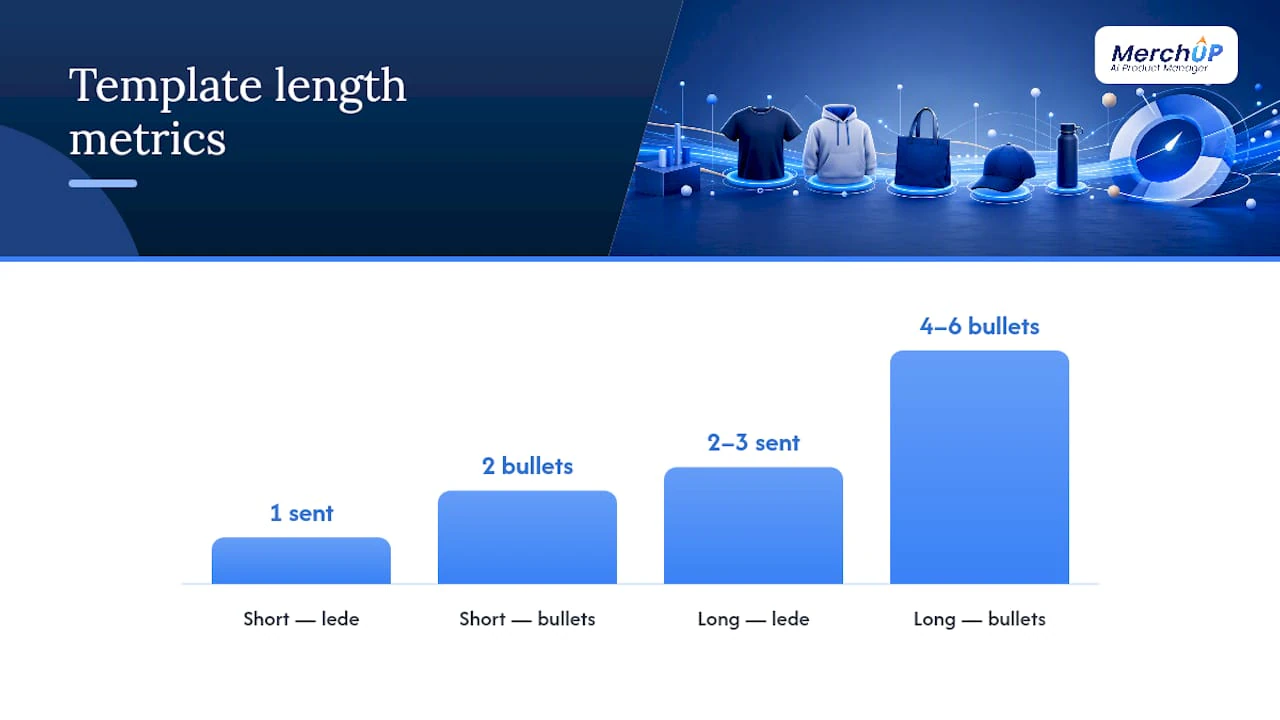
The short template suits low-consideration items: a phone case, a mug, a basic accessory. Structure it as a one-line lede stating the core benefit, two supporting feature bullets, then a spec block. BigCommerce recommends exactly this kind of scannable short-form copy for items shoppers decide on in seconds.
The long template suits considered purchases: electronics, furniture, anything technical or expensive. It needs a benefit-led opening story, a full specification section, an objections block that pre-empts the questions a buyer would otherwise ask support, and a trust element such as a warranty note or certification.
| Template element | Short form | Long form |
|---|---|---|
| Opening lede | 1 sentence, core benefit | 2–3 sentences, benefit + context |
| Feature bullets | 2 | 4–6 |
| Spec block | Yes, compact | Yes, detailed |
| Objections handling | No | Yes |
| Trust signal | Optional | Recommended |
Field-level rules matter as much as the template shape. Every SKU record should carry boolean flags for critical claims, waterproof: true/false, machineWashable: true/false, so the generation prompt can check the flag before writing the sentence rather than inventing one. Map each CMS field directly to a prompt input variable, and you get reusable description templates that produce traceable, reproducible output instead of a fresh guess every run.
How do you make product descriptions visible to AI search and Google?
Pick one primary keyword per product page and place it in the title, the opening sentence, and once more naturally in the body. Resist the urge to repeat it every paragraph. BigCommerce’s SEO guidance stresses factual clarity over keyword density, and that holds true for uniform product description SEO as much as for any other copy type.
Structured data matters just as much as the prose. AI agents and search engines read specific schema fields first, before they ever parse the description: name, brand, model, material, size, intended use, and rating. If your schema says one thing and your description says another, both search engines and AI shopping agents lose confidence in the listing, and that gap is exactly what Bluestone PIM’s research flags as a trust killer.
Practical steps that keep both audiences happy:
- Write attribute sentences as flat, declarative statements: “The frame is aircraft-grade aluminium” beats “crafted from premium aircraft-grade aluminium for that extra edge.”
- Keep the brand-voice lede short and human, then let the spec section carry the low-perplexity, machine-readable language.
- Audit schema against prose quarterly using a checklist, not memory. A product-page SEO and AEO framework is a useful reference for structuring that audit.
Pro tip: If you had to read only the first sentence of a product page to know what it is, who it’s for, and one reason to buy it, could you? If not, that’s the sentence AI agents will skip too.
How often should you audit and test product descriptions?
Catalogues drift. A description that was accurate at launch quietly falls out of sync with a changed spec sheet, and nobody notices until a customer complains. Set a cadence that matches revenue exposure rather than trying to review everything constantly.
- Monthly for top-revenue SKUs: check factual accuracy against the current spec, look for tone drift from the brand voice guide, flag any duplicated copy across variants.
- Quarterly for the mid-tail: same checks, lower frequency, batched through the catalogue in sweeps.
- Annually for the long tail: a single pass to catch stale claims and outdated pricing language.
For testing, Add-to-Cart rate is the KPI that matters most for description experiments, not page views or time on page. Run each test for two to four weeks against your current control copy before calling a winner. Every generated field should carry a run ID and an editor ID, so if an A/B test underperforms or a claim turns out wrong, you can trace it to the exact batch and roll it back through a staged content release rather than hunting through version history. A regular SKU audit process built around this cadence catches drift before it reaches customers.
When should a human review AI-generated copy?
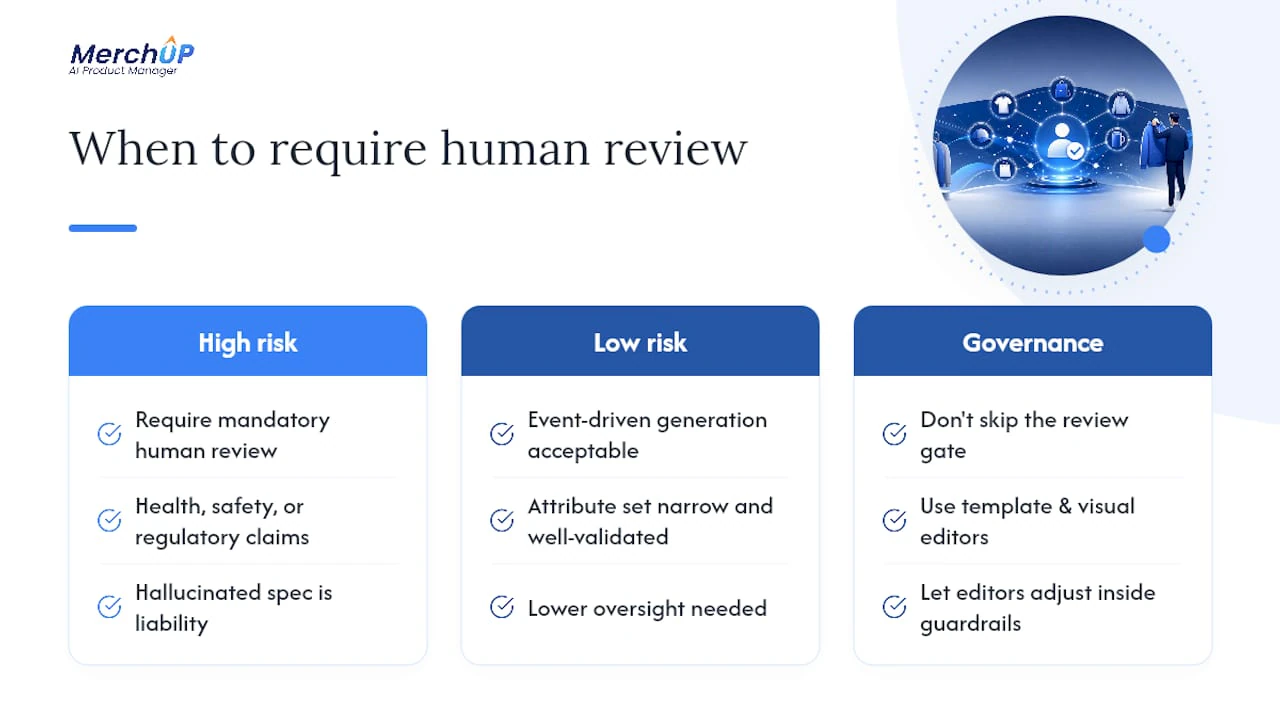
The instinct to automate everything is understandable and usually wrong. In-editor generation with mandatory human review earns its keep on high-risk SKUs: anything with a health, safety, or regulatory claim, where a hallucinated spec isn’t just embarrassing, it’s a liability. Event-driven generation is fine for low-risk categories where the attribute set is narrow and well-validated.
The pitfall I see most often isn’t bad AI output. It’s teams skipping the governance layer because it feels like friction, then wondering why tone drifts after the fifth new hire touches the prompt library. Tools with template and visual editor features exist precisely to keep that friction low without removing the review gate, letting editors adjust copy inside guardrails rather than starting from a blank page every time.
— Jamie Moss
Where MerchUp fits if you’re building this now
Some platforms are built around the exact approach this guide argues for: template-led AI generation, a visual editor for fine control, integration with eCommerce platforms, and bulk publishing that keeps a whole catalogue in the same voice. It’s the right fit if you’re managing more than a handful of SKUs and need governance and scale at the same time, not one at the expense of the other.
Where a spreadsheet-and-prompt workflow starts breaking down around a few hundred products, a structured pipeline with field-level templates keeps holding. If you want to see the mechanics rather than take that on faith, the MerchUp tutorial walks through generating a full product description in around 30 seconds, template, fields and all. From there, the MerchUp product page covers the subscription tiers and current integrations if you’re ready to move a live catalogue onto it.
Sources
- How to write product descriptions that sell (Shopify)
- Ecommerce product description best practices (BigCommerce)
- Sanity docs: Agent Actions
- Can you trust AI to write product descriptions? (Bluestone PIM)
FAQ
What is an example of a consistent product description?
A consistent description follows the same field order every time: a one-line benefit lede, feature bullets, then a spec block with attributes matching the product schema exactly, whether it’s written for a mug or a laptop.
How can I optimise my product descriptions for AI and search?
Place your primary keyword in the title, opening sentence, and once more in the body, keep schema fields aligned with the prose, and write attribute sentences as flat, factual statements rather than adjective-heavy claims.
How do you describe a good-quality product without exaggerating?
State the specific material, construction detail, or certification behind the quality claim instead of using words like “premium” or “superior.” A sentence like “stitched with double-locked seams rated for 50kg” earns more trust than “built to last.”
What are common mistakes when writing product descriptions at scale?
The most common failure is skipping governance: no shared template, no attribute validation, and no review gate, which lets tone drift and hallucinated specs slip through as the catalogue grows. Platforms like MerchUp address this by tying generation to the same schema and template across every SKU.


Comments
No comments yet — be the first to share what you think.