


The single rule behind every high-converting product description is this: lead with the one outcome your buyer actually wants, then remove every reason not to buy. That is it. Everything else is execution.
Here is the short formula you can paste into any listing:
[Outcome the buyer wants] + [primary benefit that delivers it] + [proof or spec that removes the top objection] + [risk reversal or CTA]
Every description worth reading contains:
- A headline that names the outcome, not just the product
- One or two sentences that make the benefit concrete and sensory
- Three to five bullets that answer the most common objections
- A single, clear next step
1. Why your product description is a 24/7 salesperson
A product page has no shop assistant to fill the silence. The description does that job, and when it fails, the browser leaves. Product descriptions convert browsers into buyers — when written well, they raise perceived value and make customers willing to pay more.
The conversion consequences of weak copy are direct. A vague description forces the shopper to guess whether the product fits their need. Guessing leads to hesitation. Hesitation leads to the back button.
Stat to know: Research cited by ConversionStudio finds that well-written descriptions answer “Why should I care?”, overcome the primary objection, and make Add to Cart feel inevitable — the three jobs most manufacturer copy never attempts.
There is also an SEO dimension. Manufacturer-provided text is often indexed as duplicate content across dozens of retailers. Rewriting even 40–50% of that text is usually enough to differentiate your page for search engines, giving you a ranking advantage your competitors who copy-paste the spec sheet will never have.
The most common purchase objections by category:
- Apparel: Will it fit? What does the fabric feel like?
- Electronics: Is it compatible with what I already own?
- Food and drink: What are the ingredients and allergens?
- Premium items: Is this worth the price? What is the returns policy?
A description that addresses the category-specific objection head-on is already doing more than most.
2. How the 5 Ps framework gives every description a spine
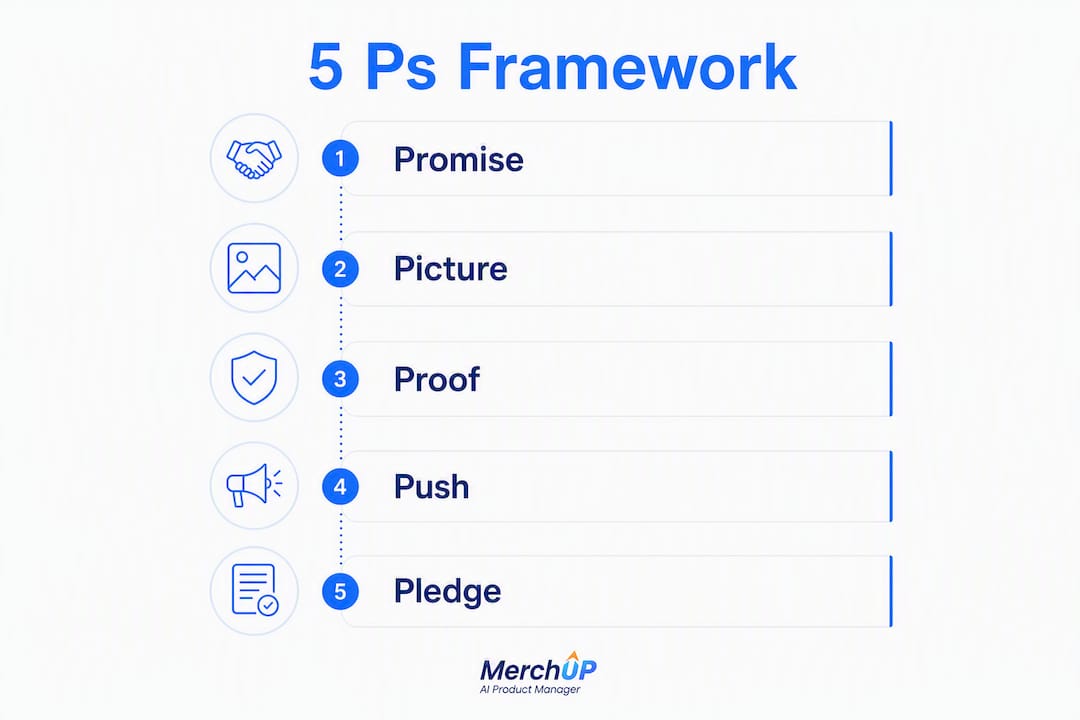
The 5 Ps framework from BigCommerce gives you a compact editorial checklist that prevents generic, audience-less copy. Each P answers one question before the shopper has to ask it.
| P | Question it answers | Where it appears on the page |
|---|---|---|
| People | Who is this for? | Headline or opening line |
| Purpose | What problem does it solve? | First sentence of the paragraph |
| Promise | What outcome does the buyer get? | Core benefit statement |
| Proof | Why should they believe it? | Social proof, certifications, materials |
| Positioning | Why this over alternatives? | Closing line or CTA |
Example: a UK-made wool throw (£85)
- People: Cold-house dwellers who hate synthetic fabrics
- Purpose: Stay warm without the static cling and pilling of acrylic
- Promise: Pure Shetland wool that softens with every wash
- Proof: Woven in Scotland since 1987; rated 4.8 stars by 340 buyers
- Positioning: Priced below department-store equivalents, made to last a decade
Mapped to the page, that becomes: a headline (“The wool throw that gets softer, not scratchier”), a one-sentence hook, three bullets covering warmth, care instructions and origin, and a line of social proof before the CTA.
The 5 Ps do not add length. They add structure. A 60-word description can hit all five if the writer is disciplined.
3. Features, benefits, and emotion: the conversion copy chain
Most product descriptions stop at the feature. That is the single most common reason they fail to convert.

The chain runs: feature → benefit → emotional outcome. A feature is what the product has. A benefit is what that feature does for the buyer. The emotional outcome is how the buyer feels as a result. The most effective copy explicitly links all three — elite descriptions push to the emotional outcome so the product feels necessary before purchase.
Before → After: running shoes
Before (feature only): “Breathable mesh upper with a 4mm heel-to-toe drop.”
After (feature → benefit → emotion): “The breathable mesh upper keeps your feet cool on long runs, while the low 4mm drop encourages a natural stride — so you finish a 10K feeling strong, not wrecked.”
Fill-in-the-blank formula:
Example: “This cast-iron skillet has a pre-seasoned surface, which means nothing sticks from the first use, so you spend less time scrubbing and more time eating.”
Pro Tip: Use sensory language to replace the in-store experience. Describe texture (“buttery soft”), sound (“satisfying click”), smell (“fresh cedar”), or weight (“substantial without being heavy”). Sensory words raise perceived value and purchase intent — and they cost nothing extra to write.
4. Practical templates you can use today
Product descriptions can be short-form or long-form; the right length depends on the product’s complexity and the purchase risk the buyer perceives. A £12 phone case needs a different treatment from a £1,200 espresso machine.
| Price / complexity | Recommended length | Format |
|---|---|---|
| Low (under £30) | 50–100 words | Headline + 2 sentences + 3 bullets |
| Mid (£30–£150) | 100 words | Headline + paragraph + 4–5 bullets + CTA |
| High (£150+) | 150 words | Hook + story + bullets + specs + social proof + CTA |
| Technical / B2B | — | Full spec table + benefit narrative + compatibility notes |
Short-form template (low-price, impulse products):
[Headline: outcome in 8 words or fewer]
[1–2 sentence hook: primary benefit + sensory detail]
• [Objection 1 answered]
• [Objection 2 answered]
• [Key spec or proof point]
[CTA: "Add to bag" / "Get yours today"]
Long-form template (considered purchases):
[Headline]
[Hook paragraph: problem → solution → emotional payoff]
• [Benefit 1 with supporting detail]
• [Benefit 2 with supporting detail]
• [Benefit 3 with supporting detail]
[Extended story: origin, materials, or use-case scenario]
[Specs table or bullet list]
[Social proof: review snippet or rating]
[CTA]
SEO-aware product title pattern:
Example: “Merino Wool Running Socks — Cushioned, Anti-Blister, UK Sizes 4–12”
Meta description example:
For mobile shoppers, front-load the benefit into the first sentence. On a small screen, only the first 80–100 characters of your description may be visible before a “Read more” truncation. If those characters are a generic product name and a material list, you have already lost the sale.
Pro Tip: Layered structure serves both scanners and detail readers. Put the headline and bullets first for people who skim; put the story and specs below for people who research. Both groups convert better when the page is built for their behaviour.
5. On-page SEO for product descriptions: what actually moves the needle
Shopify’s guidance is clear: place the primary keyword (product name + category) in the title and within the first 50 words of the description, then write for humans. Secondary phrases belong naturally in bullets, not forced into the paragraph.
SEO stat: Product schema with price, availability, and review ratings improves how listings appear in search results and can increase click-through rate when those rich snippets surface on the SERP.
On-page SEO checklist for every product page:
- Primary keyword in the H1 product title and first sentence of the description
- Unique description for every SKU — never paste the manufacturer’s copy
- Meta description: 150–160 characters, benefit-led, includes primary keyword
- Image alt text: descriptive and keyword-relevant (“navy merino wool crew-neck jumper, size M”)
- Product schema (JSON-LD): include name, description, price, currency, availability, and aggregateRating
- Canonical tag: set to the product’s own URL to avoid variant-page duplication
- Internal links: link to relevant category pages or buying guides from the description where natural
What to avoid:
- Keyword stuffing in bullets (reads badly, penalised by Google)
- Thin descriptions under 50 words on high-value products
- Identical copy across colour or size variants — change at least the opening sentence
For deeper product description SEO tactics, the placement rules, schema setup, and canonical strategy are covered in full.
6. Before → after examples across four UK eCommerce categories
The fastest way to learn persuasive product writing is to see the same product rewritten. Each example below names the primary objection addressed and the persuasive device used.
Clothing
Before: “Women’s linen shirt. Available in white, blue and sage. Machine washable.”
After: “The linen shirt that looks polished at 9am and still feels cool at 5pm. Breathable European flax means you stay comfortable in summer heat without sacrificing the crisp, structured look of a proper work shirt. Machine washable; no dry-cleaning bills.”
Objection addressed: “Will linen look crumpled by lunchtime?” Devices: Sensory language, time-of-day scenario, risk reversal (no dry-cleaning). Recommended length: 80–120 words. Include a size guide link and fabric composition.
Electronics
Before: “Wireless earbuds. 8-hour battery. Bluetooth 5.2. IPX4 water resistant.”
After: “Eight hours of music without touching your phone — and if you get caught in the rain, these keep playing. Bluetooth 5.2 pairs in under three seconds, and the IPX4 rating means sweat and drizzle are not a problem. Compact charging case adds a further 24 hours.”
Objection addressed: “Will they cut out or break if I use them at the gym?” Devices: Scenario-led opening, spec translated into real-world benefit, total battery figure. Recommended length: 100–180 words. Include compatibility note (iOS/Android) and returns policy.
Beauty
Before: “Vitamin C serum. 20% concentration. 30ml bottle.”
After: “Brighter skin in two weeks or your money back. This 20% Vitamin C serum fades dark spots and evens skin tone while you sleep — without the irritation that higher-concentration formulas cause. Dermatologist-tested, fragrance-free, and suitable for sensitive skin.”
Objection addressed: “Will it irritate my skin?” Devices: Outcome-first headline, risk reversal (money-back), social proof (dermatologist-tested). Recommended length: 80–150 words. Include full ingredients list and allergen statement.
Food and drink
Before: “Artisan hot sauce. Made with chillies. 150ml.”
After: “The hot sauce that adds heat without hiding the flavour. Made with sun-dried Calabrian chillies and a splash of apple cider vinegar, it builds slowly — enough kick to notice, not enough to ruin the meal. Vegan, gluten-free, and made in small batches in Bristol.”
Objection addressed: “Is it too hot? What is actually in it?” Devices: Flavour-first sensory copy, ingredient transparency, provenance. Recommended length: 60–100 words. Allergen and nutritional information must appear on the page per UK food labelling law — place it in a dedicated specs section below the description.
For a full catalogue of annotated before→after rewrites, the Merchup AI examples library covers over a dozen UK eCommerce categories.
7. Power words, CTAs, and matching your tone of voice
Words carry weight. The right ones create urgency, trust, or desire. The wrong ones sound like every other listing on the page.
High-impact power words for eCommerce (use with proof, not as empty claims):
- Proven, tested, certified — credibility
- Exclusive, limited, only — scarcity (only use when true)
- Effortless, instant, ready — ease
- Handmade, small-batch, British-made — provenance and quality
- Guaranteed, risk-free, free returns — risk reversal
- Loved by, rated, trusted by — social proof
Never use a superlative (“best”, “most powerful”, “unbeatable”) without a fact to back it. “The UK’s best-selling cast-iron skillet” needs a source. “Loved by over 12,000 home cooks” needs a real number.
CTA templates mapped to buyer intent:
| Buyer intent | CTA example |
|---|---|
| Impulse purchase | “Add to bag — ships today” |
| Research phase | “See all specs and reviews” |
| Premium / considered | “Order now — free UK delivery and 30-day returns” |
Tone of voice quick guide:
- Cheeky/playful: Short sentences, contractions, a little irreverence. Works for gifting, snacks, novelty products. (“Life’s too short for boring hot sauce.”)
- Premium/aspirational: Longer sentences, precise vocabulary, no slang. Works for luxury, jewellery, high-end homeware. (“Crafted from a single piece of Italian marble.”)
- Utility/functional: Direct, spec-led, no fluff. Works for tools, office supplies, B2B. (“Fits standard A4 files. Locks with a key. Ships flat-packed.”)
- Technical: Detailed, jargon-appropriate, compatibility-focused. Works for electronics, software, professional equipment.
Match the tone to the buyer, not to what sounds impressive to you. A tradesperson buying a drill does not want poetry.
8. How to test and measure the lift from description changes
Rewriting a description is a hypothesis, not a guarantee. The only way to know whether the new copy converts better is to test it.
High-impact A/B test ideas (run one at a time):
- Swap the headline: outcome-led vs. product-name-led
- Add a social proof line to the opening paragraph
- Reorder bullets: objection-first vs. benefit-first
- Change the CTA: “Add to bag” vs. “Get yours — free delivery”
- Add or remove the extended story paragraph
KPIs to track:
- Add-to-cart rate (primary signal — fastest to move)
- Conversion rate (purchase / sessions)
- Revenue per visitor
- Returns rate (a drop here signals the description is setting accurate expectations)
- Average order value (relevant when cross-sell copy is in the description)
Prioritisation checklist — which SKUs to test first:
- Highest revenue products (top 20% that drive roughly 80% of sales)
- High-traffic pages with below-average conversion rates
- Products with the most returns (description may be misleading)
- New launches with no established copy baseline
For a minimum sample size, most A/B testing tools recommend at least 100 conversions per variant before drawing conclusions. Running a test for less than two weeks risks day-of-week bias. The product page conversion playbook covers a 30/60/90-day optimisation schedule if you want a structured rollout.
9. Common mistakes and UK compliance checks
The mistakes that kill conversion most often:
- Pasting the manufacturer’s description verbatim (duplicate content, no differentiation)
- Generic opening lines (“Introducing our new…”, “This product is…”)
- Bullet points that list features with no benefit attached
- Ignoring the top objection entirely
- Descriptions formatted for desktop that break on mobile (long unbroken paragraphs, no bullets)
UK-specific compliance checks — non-negotiable:
- Price and VAT: Under the Consumer Rights Act and the Price Marking Order, prices displayed to consumers must include VAT. If you sell B2B and display ex-VAT prices, state this clearly.
- Misleading claims: The Consumer Protection from Unfair Trading Regulations 2008 prohibit false or misleading statements about a product’s nature, quantity, or price. “Clinically proven” requires clinical evidence. “Organic” requires certification.
- Allergen labelling: For food products sold online, UK food labelling law (retained from EU Regulation 1169/2011) requires the 14 major allergens to be declared. Place allergen information in a clearly labelled specs section on the product page.
- Safety information: For products covered by UK product safety regulations (toys, electrical goods, cosmetics), relevant safety marks and warnings must be accessible on the page.
- Distance selling: Under the Consumer Contracts Regulations 2013, buyers have a 14-day right to cancel most online purchases. Your returns information should be accessible from the product page — a link in the description or footer is sufficient; it does not need to be in the copy itself.
Pro Tip: Legal lines do not have to kill the copy’s rhythm. Place allergen statements, safety marks, and returns information in a collapsible “Product details” or “Specifications” section below the main description. The conversion copy stays clean; the compliance information is still on the page and accessible.
10. Scaling descriptions across your Shopify catalogue: a practical Merchup AI workflow
Writing one great description is craft. Writing 500 is a logistics problem. Prioritise rewriting by revenue, traffic, and low conversion — start with the top 20% of products that drive 80% of revenue, then use AI-assisted drafts for the long tail.
Step-by-step workflow:
- Audit and prioritise — Export your Shopify product catalogue. Sort by revenue, then by traffic-to-conversion ratio. Flag the top 20% for manual rewrite; mark the remainder for AI-assisted drafts.
Where AI saves time: generating first drafts, applying consistent structure, and handling the long tail of lower-traffic SKUs.
Where human review is still required: size and compatibility accuracy, legal compliance lines, allergen statements, and any claim that requires a source (ratings, certifications, “best-seller” labels).
For guidance on using AI for product descriptions in the UK market, including ethical use and quality control, that resource covers the full picture.
The copy most sellers never write
There is a version of product copy that almost no one publishes: the description that treats the buyer as an intelligent adult who has already decided they want this type of product and just needs one good reason to buy this one.
Most descriptions fail that test. They describe the product to someone who has never heard of it, list features in the order the manufacturer printed them, and close with a CTA that sounds like it was written by a committee. The result is copy that is technically accurate and commercially inert.
The fix is not a formula, though formulas help. It is a shift in perspective: you are not describing a product, you are making a case. Every sentence either advances that case or it does not belong on the page. The feature→benefit→emotion chain, the 5 Ps, the before→after rewrite — these are all tools for making the case more efficiently.
One thing worth saying plainly: AI-generated copy is not a shortcut around this thinking. It is a shortcut around the typing. The editorial judgement — which benefit matters most to this buyer, which objection is most likely to kill the sale, whether the tone fits the brand — still has to come from a person who understands the product and the customer. Use AI to generate volume and maintain consistency; use human review to make sure the copy is actually making the case.
Merchup AI: write once, publish hundreds
Writing great copy for your top ten products is satisfying. Writing it for 500 SKUs is where most eCommerce teams stall, and where the gap between your conversion rate and your potential becomes expensive.
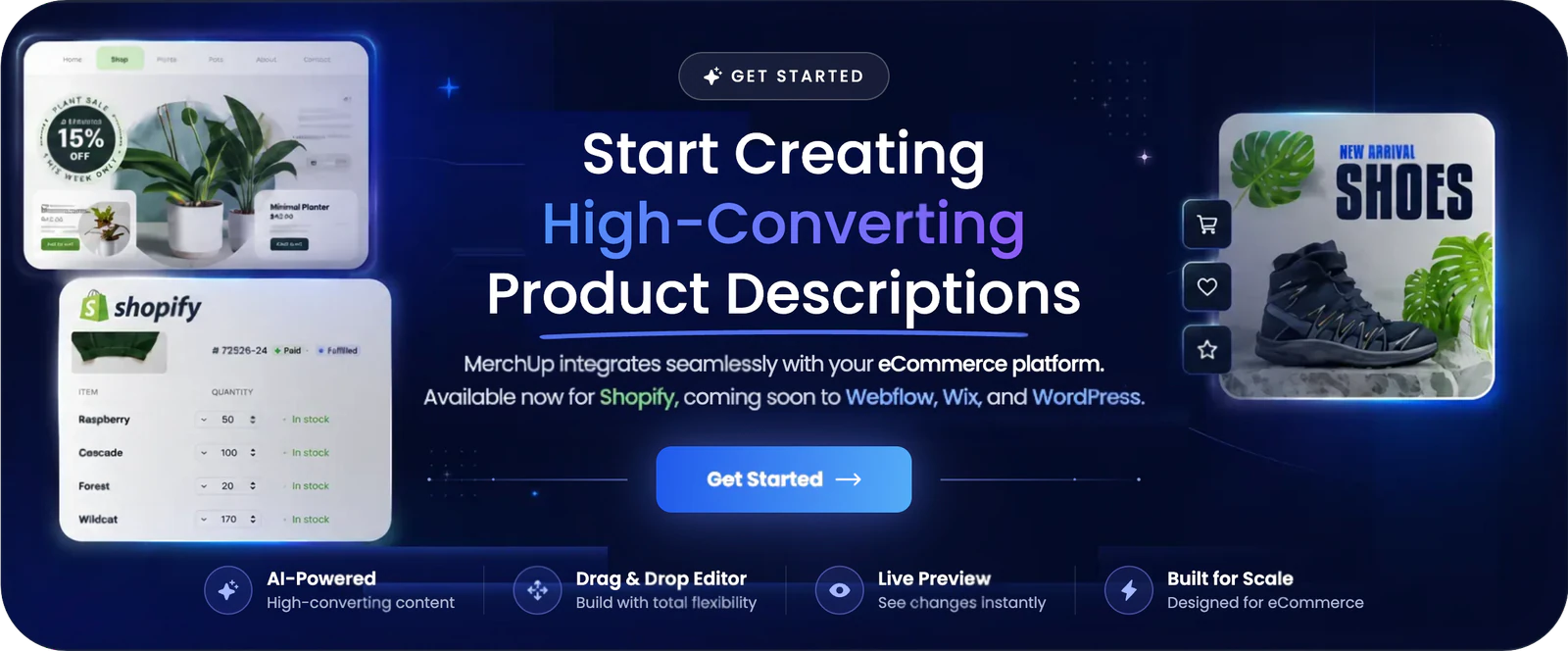
Merchup AI is built specifically for that gap. The platform generates SEO-optimised product descriptions using your chosen tone, template, and brand rules, then pushes them live to Shopify in bulk. You get a visual editor for manual tweaks, activity tracking so nothing gets published without a review trail, and customisable templates that apply your structure consistently across every category.
The workflow in Section 10 above maps directly to how Merchup AI works in practice: prioritise your catalogue, generate drafts at scale, review the high-value SKUs, and publish. For Shopify stores with large catalogues or frequent product launches, the time saved per SKU adds up quickly.
Start generating descriptions with Merchup AI or view pricing and credit plans to find the right tier for your catalogue size.
Further reading and sources
- How to Write a Product Description That Sells — Shopify: Eleven practical techniques with real examples; the most widely cited starting point for UK Shopify sellers.
- Product Description Copywriting: A Selling Framework — Rob Palmer: The definitive treatment of the feature→benefit→emotion chain with worked examples.
- How to Write Product Descriptions That Sell — Scale Growth Digital — Prioritisation matrix and AI-assisted workflow guidance for large catalogues.
- Product description examples that actually convert — Merchup AI: Annotated before→after rewrites across UK eCommerce categories.
- Product description templates: copy-and-paste guide — Merchup AI: Plug-and-play templates and fill-in-the-blank formulas for short and long formats.
- Product Description SEO: 2026 guide for eCommerce sellers — Merchup AI: Schema setup, canonical tags, and keyword placement rules for product pages.
For UK regulatory guidance on product claims, pricing, allergen labelling, and distance-selling obligations, refer to the Competition and Markets Authority and Food Standards Agency directly. Rules change; always verify against the primary source before publishing claims at scale.
This article provides general guidance on copywriting and eCommerce best practice. It is not legal advice. Confirm your compliance obligations with a qualified professional or the relevant UK regulatory body.


Comments
No comments yet — be the first to share what you think.