


Shopify catalog sync, in this context, means keeping AI-generated product titles, descriptions and SEO fields current on your live Shopify product pages, not syncing stock levels or prices. MerchUp handles this by generating SEO-optimised copy, mapping it to the correct Shopify fields, and publishing it, while inventory and pricing stay untouched and under your existing systems.
TL;DR:
- Catalog sync updates only product titles, descriptions, and SEO metadata; inventory levels, SKUs, and prices remain managed separately.
- MerchUp generates content using templates, reviews it in a visual editor, and tests a small batch before bulk publishing to prevent widespread errors.
- Shopify’s API mutations update specific fields with limited scope, requiring careful permission management and field-specific requests to avoid unintended overwrites.
- Google Merchant Center requires AI-generated descriptions to be marked in the structured_description attribute for proper attribution and compliance.
- Confirm that updates are live by inspecting product pages, verifying structured data, and comparing against Merchant Center feeds to catch common publishing issues.
What exactly gets synced when you talk about catalog sync
The phrase gets used loosely, so it helps to draw a hard line. Description sync covers the written content on a product page: the title, the body copy, the SEO title and meta description, and sometimes specific metafields used for structured text. It does not touch SKUs, stock counts, price changes or variant creation, which belong to separate inventory and merchandising workflows.
The fields typically in scope for AI-generated content sync are:
- Product title, the customer-facing name shown on the storefront and in search results.
- descriptionHtml (also called body_html), the main product description, which accepts formatted HTML.
- SEO title and SEO description, the metadata fields that control how a listing appears in search snippets.
- Selected metafields, used when a store needs channel-specific or structured text beyond the standard fields.
Because Shopify descriptions accept HTML rather than plain text, generated copy can include headings, bullet points and bold emphasis, but that also means templates need to produce clean, theme-safe markup. Mapping decisions here (which generated field goes where) shape how review workflows are set up and who signs off before anything goes live.
How MerchUp generates and publishes descriptions to your store
MerchUp’s workflow is built around keeping a human in the loop without turning every product update into a manual chore. The typical path from draft to published page looks like this:
- Generate copy using a rules-based template or a visual editor pass, drawing on product attributes already in your catalogue.
- Review the output in the visual editor, adjusting tone, structure or keyword placement before anything is scheduled.
- Map the approved copy to the correct Shopify fields: title, descriptionHtml, SEO title and SEO description.
- Run a pilot publish on a small batch to confirm formatting and rendering behave as expected.
- Bulk publish across the wider catalogue, with activity tracking recording what changed and when.
Mapping choices matter more than they first appear. SEO fields are the right home for search snippet text, while metafields suit channel-specific structured content that shouldn’t appear in the main body copy. Governance matters just as much: deciding who can trigger a bulk publish, and who reviews flagged items first, keeps a large catalogue from drifting into inconsistent copy.
A pilot batch of 50 to 200 SKUs with a clear rollback procedure before a full run reduces the chance of a formatting error reaching your entire catalogue at once. Activity tracking then gives you an audit trail if something needs reverting.
Pro Tip: Publish your pilot batch on your lowest-traffic collection first, so any formatting issue shows up before it touches your best-selling pages.
Permissions and safe update patterns on the Shopify API
Under the surface, MerchUp’s Shopify integration relies on the same API operations any developer would use to update product content, so it’s worth knowing what they do. Shopify’s productUpdate GraphQL mutation modifies only the fields you include in the request, which is what makes it suitable for description and SEO updates without touching variants or pricing. productSet is the equivalent for syncing larger, more complete product datasets in a single call, while variant-specific mutations handle stock and pricing changes separately and fall outside description sync entirely.
Access requires the write_products OAuth scope. A few habits keep this safe in production:
- Request only the scope you need, since write_products alone is enough for description and SEO updates.
- Use staged or sandbox credentials during template testing, before connecting a live production store.
- Update only the fields you intend to change, rather than resending an entire product object.
- Prefer asynchronous operations for large batches, since bulk description updates across hundreds of SKUs can otherwise hit rate limits.
- Capture userErrors from every GraphQL response, so a partial failure in a batch gets logged rather than silently skipped.
These patterns matter because a mutation that resends more fields than necessary can overwrite something unrelated by accident. Field-level updates keep the blast radius limited to exactly what you meant to change.
Getting AI descriptions right for Google Merchant Center
Publishing a description to Shopify is not the same as making it usable across every channel your products feed into. Google Merchant Center treats AI-generated descriptions as a distinct case: guidance on structured_description states that generative AI text should be supplied via that attribute with digital_source_type set to trained_algorithmic_media, rather than relying solely on the standard description field. Skipping this step risks Merchant Center treating AI-written copy the same as any other description, without the provenance marker Google expects.
Well-formatted, comprehensive descriptions support richer product page eligibility, since Google’s structured data guidance recommends accurate, detailed product information, though it does not guarantee any specific search enhancement.
Practical steps worth building into your process:
- Align three representations of the same content: the visible Shopify page HTML, the page’s JSON-LD, and any Merchant Center feed attribute.
- Place structured data in the initial HTML rather than injecting it with JavaScript afterwards, since Google’s guidance on JS-generated markup warns it can be crawled less reliably.
- Keep descriptions reasonably substantial, formatted in short paragraphs or bullets rather than a single dense block.
- Mark AI-generated copy explicitly where a channel asks for it, rather than assuming plain text is sufficient.
Confirming the sync worked and fixing common problems
Once a batch is published, a short checklist catches most issues before they become customer-facing problems.
- Load the product page and confirm the new descriptionHtml and SEO metadata are visible, not just saved in the admin.
- View page source and check for JSON-LD structured data, confirming it matches the visible description rather than an older cached version.
- Compare the live page against your Merchant Center feed, since a mismatch here is one of the most common causes of disapproval warnings.
- Check GraphQL responses for userErrors, which flag field-level failures that a bulk job might otherwise report as successful.
- Rule out theme or caching issues, since some themes re-render descriptions with JavaScript, and a CDN cache can serve a stale version for a period after publishing.
Pro Tip: If a Merchant Center warning appears shortly after a bulk publish, check the feed refresh timing before assuming the sync itself failed, since feeds often lag behind the live storefront by a few hours.
When a batch produces repeated errors, rolling back the affected SKUs and logging the failure pattern before re-attempting is safer than retrying the same request immediately.

What reliable content sync actually changes for a marketing team
The real gain from getting this right isn’t speed alone, though publishing hundreds of updated listings without manual copy-pasting is faster than any hand-built process. It’s consistency: the same tone, the same structural pattern for titles and descriptions, applied across a catalogue that would otherwise drift as different people made ad hoc edits over months.
The trade-off is governance. Faster publishing only stays safe when provenance tagging, review gates and staged rollouts are built into the process rather than added after the first mistake. Teams that skip this step tend to find out the hard way, usually through a Merchant Center warning or a batch of oddly formatted pages.
— Jamie Moss
How MerchUp handles this for your store
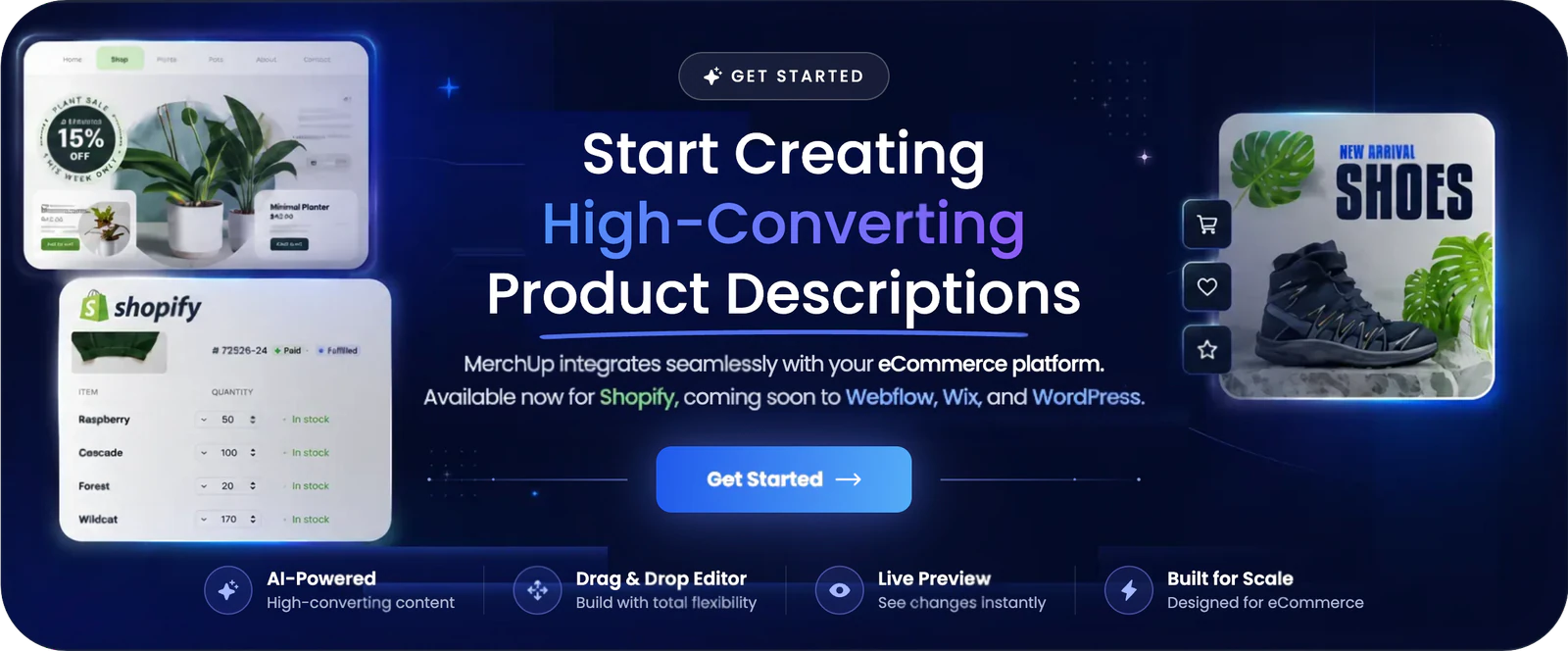
MerchUp is built around exactly this job: generating SEO-optimised product copy, letting you adjust it in a visual editor, and publishing it to Shopify in bulk without touching inventory or pricing. Drag-and-drop templates keep tone and structure consistent across a large catalogue, and activity tracking gives you a record of what changed and when.
If you’re evaluating whether this fits your catalogue, a few starting points:
- Compare plans on the MerchUp pricing page for current pricing and plan details.
- Try the workflow hands-on with the MerchUp tutorial, which walks through generating a description in under a minute.
- See the templates in action in the guide to bulk product description workflows.
Where to go for the technical detail
For mutation examples, see Shopify’s productUpdate documentation. For AI content governance, see Google’s structured_description guidance and its product structured data reference. For schema alignment, see MerchUp’s guide to Shopify product schema, and for broader Shopify SEO technique, this Shopify SEO automation guide covers complementary ground.
FAQ
What does Shopify catalog sync mean for product descriptions?
It means keeping AI-generated titles, body copy and SEO metadata current on live Shopify product pages, distinct from inventory or price syncing. MerchUp generates and publishes this content while leaving stock levels and pricing to your existing systems.
Which Shopify fields does MerchUp update when publishing?
MerchUp maps generated copy to product title, descriptionHtml, SEO title and SEO description, and selected metafields where needed. Variant, price and inventory fields are handled separately and are not part of this sync.
Do I need special Shopify permissions for description syncing?
Yes, updating product descriptions through Shopify’s API requires the write_products OAuth scope. Limiting the integration to that scope, and testing with staged credentials first, reduces the risk of unintended changes.
Why does Google Merchant Center need AI descriptions marked differently?
Google’s Merchant Center guidance asks for generative AI descriptions to be supplied through the structured_description attribute with a trained_algorithmic_media marker, rather than the standard description field alone. Skipping this marker can mean Merchant Center treats the copy without the provenance it expects.
How do I check that a catalogue sync actually published correctly?
Load the live product page to confirm the new description and SEO metadata are visible, then view the page source to check the JSON-LD matches. Comparing the live page against your Merchant Center feed catches most mismatches quickly.


Comments
No comments yet — be the first to share what you think.