


The right product-page brand voice is concise and outcome-first, with personality dialled down to a handful of recognisable signals rather than full storytelling. Write the hero sentence for clarity and payoff, keep bullets scannable, and hold back brand flourish for spots where it costs nothing to read. Everything else in this guide, templates, governance, testing, exists to protect that trade-off at scale.
TL;DR:
- Product-page brand voice should focus on clear, outcome-oriented language with traits like confidence, specificity, warmth, and consistency, avoiding hyperbole and long sentences.
- Effective microcopy, including benefits, microcopy buttons, and shipping notes, must match the overall voice and be tested for impact via A/B experiments on conversion metrics.
- A dedicated editorial owner with veto power and structured onboarding, including annotated examples, is essential to maintain voice consistency at scale.
- Cross-category audits and deliberate variation based on the customer profile prevent voice drift across a multi-product catalog.
- Automating voice application through tools like MerchUp AI enables bulk publishing of on-brand descriptions, saving time while preserving tone.
What is product page brand voice, exactly?
Product page brand voice is how your brand’s distinct way of speaking gets applied specifically to product description pages, where the job is conversion, not entertainment. It sits one level below the umbrella term most marketers already use: brand voice.
Voice is the consistent personality behind everything you write, the word choices, the attitude, the things you’d never say. Tone is how that personality flexes by context: a returns policy needs a calmer tone than a launch email, even though both come from the same voice. Microcopy is the smallest unit of all this, the two or three words on a button, a size guide, or an error message, where voice either survives contact with real usability constraints or gets abandoned entirely.
Product pages are where the distinction matters most, because they’re a “turn down” moment for voice. Shoppers scanning a PDP want quick clarity, not a chapter of brand storytelling, so the strongest DTC copywriting practice is to preserve personality in small, recognisable cues rather than long-form narrative. Think of it like a radio DJ switching from an energetic on-air voice to a quieter, still-recognisable register when reading traffic updates. Same person, same personality, adjusted volume.
Most brand guidelines describe voice in the abstract, three adjectives and a mood board, without ever showing what it looks like applied to a £45 product listing with four variants and a returns clause. That gap is exactly where product-page voice work needs to happen, and it’s the gap most teams never close.
Core elements of a product-page brand voice
Documenting a workable PDP voice means writing down enough detail that a new copywriter, or an AI tool, can reproduce it without guessing. Vague adjectives like “friendly” or “premium” don’t survive contact with an actual product page. You need traits with teeth.
Five traits tend to earn their place on most product pages:
- Clarity first: never sacrifice comprehension for personality; if a joke or flourish slows down understanding, cut it.
- Confident, not boastful: state what the product does plainly, without hedging or over-claiming.
- Specific over generic: swap vague superlatives for concrete detail (a fabric weight, a battery life, a warranty term).
- Warm but brief: a touch of personality in one line, not stretched across a paragraph.
- Consistent posture on price and value: decide once whether you frame value through savings, quality, or status, and repeat that framing everywhere.
Vocabulary rules matter as much as traits. Ban hyperbole like “game-changing,” “revolutionary,” or “must-have”, they read as filler and erode trust fast. Keep sentences short enough to scan on a phone screen; aim for one idea per sentence and break up anything over twenty words. Rhythm matters too: alternate a short punchy line with a slightly longer explanatory one, rather than stacking five uniform sentences that all sound the same length.
None of this holds without proof writers can check against. An annotated example library showing real product copy marked up with “why this works” notes teaches voice faster than any style guide alone, because it shows the trade-offs in context rather than describing them in theory.
Pro Tip: Print three of your best-performing product pages, mark up every sentence with a one-line reason it works, and use that annotated sheet as onboarding material before any style document.
How to apply voice to every product-page element
Voice only earns its keep once it’s mapped to the actual components a shopper scrolls past. Start at the top.
- Hero sentence: structure it as who it’s for, what it does, and the payoff. “Built for early risers who hate cold coffee, this mug holds heat for six hours.” That single line carries more conversion weight than the paragraph below it, so it deserves the most editing attention.
- Benefit bullets: convert three to five raw feature lines into benefit statements. A spec sheet says “18/8 stainless steel.” A voiced bullet says “Won’t rust, dent, or hold onto old coffee smells, so it still looks new after a year of daily use.” The rule: feature first, consequence second, always in that order.
- CTA and buy-area microcopy: match the button and supporting line to your voice posture. A confident, minimal voice might use “Add to Cart, ships Tuesday.” A warmer voice might add “You’ll love this, or it’s free to return.”
Microcopy is a genuinely underused space for voice, because it’s read at high frequency with almost no friction cost. Shipping notes, sizing guidance, and variant labels are exactly the kind of low-stakes brand moments competitors rarely bother with, which makes them cheap wins.
A few concrete examples worth stealing and adapting:
- Sizing: “Runs true to size. Between sizes? Go up.” rather than a bare size chart link.
- Shipping: “Out the door by 2pm, at your door by Thursday.” rather than “Ships in 1-2 business days.”
- Error state: “That code’s expired. Here’s a fresh one.” rather than “Invalid code.”
Image captions and alt text should carry the same discipline: describe what’s actually visible (colour, material, angle) rather than reaching for a slogan, because alt text serves accessibility and search indexing first, brand flourish second.
Practical templates, short examples and wiring for writers and designers
Three structures cover most product categories, and each follows the same skeleton: hero sentence, three bullets, a CTA shell.
- Outcome-led: leads with the result the customer gets. Hero: “Finally, a desk lamp that doesn’t hurt your eyes by 10pm.” Bullets focus on flicker-free light, adjustable warmth, and battery life. CTA: “Add to Cart, glare-free evenings start tonight.”
- Objection-led: opens by naming the doubt before the shopper has to. Hero: “Worried wireless earbuds always fall out? These don’t.” Bullets address fit, grip, and sweat resistance. CTA: “Try Risk-Free, 60-day returns.”
- Identity-led: speaks to who the buyer wants to be. Hero: “For people who show up early and leave the excuses at home.” Bullets tie features to that self-image. CTA: “Join the Early Crew.”
Each template also needs a microcopy variant so writers aren’t guessing tone for the smaller lines:
| Page spot | Confident/minimal variant | Warm/playful variant |
|---|---|---|
| Shipping note | “Ships today if ordered by 3pm.” | “We’ll get this to you fast, promise.” |
| Size guide prompt | “Check sizing before you buy.” | “Not sure what size? We’ve got you.” |
| Low stock warning | “3 left in stock.” | “Almost gone, don’t wait too long.” |
When you add a new page to the example library, annotate it the same way every time: mark the hero sentence, note which template it follows, and write one sentence on why the voice choice fits that product. That consistency is what lets a new writer teach themselves from the library instead of asking for a meeting.
Governance: roll out, protect and train for voice consistency at scale
Voice consistency doesn’t survive a static PDF. Handing new writers a 40-page brand guide and expecting adoption is one of the most common failures teams run into, because a document has no authority to correct drift once copy is already published.
What actually works is a named owner. Appoint a managing editor, or a comparable editorial lead, with clear authority to reject or rewrite copy that drifts off voice, even after a product manager has approved it for launch. Without that single accountable role, voice erodes a little with every review cycle, because nobody has the standing to say no.
The transmission system matters just as much as the role. Annotated examples, structured onboarding sessions built around real pages (not hypothetical ones), and a recurring feedback loop where the editor points at specific lines rather than giving vague notes, all move faster than a style guide read once and forgotten.

Tooling helps but doesn’t replace judgment. A shared content hub, reusable templates, and AI-assisted quality checks can catch obvious drift, banned words, missing bullets, inconsistent CTA phrasing, but they can’t yet judge whether a joke lands or a claim feels earned. Human review still closes that gap.
A short do/don’t checklist speeds up every review:
- Do open with the payoff, not the feature.
- Do keep bullets under fifteen words each.
- Don’t use hyperbole the product can’t back up.
- Don’t let microcopy go untouched just because it’s small.
Pro Tip: Give your managing editor veto power in writing, not just in principle. A role without documented authority gets overridden by whoever’s launch deadline is closest.
Measure and test voice changes: A/B testing and metrics
Voice changes should be tested exactly like any other copy variant, isolated, measured, and judged on the metrics that actually matter for that page.
- Pick the right metrics. Conversion rate and add-to-cart rate are the primary signals; average order value and bounce rate on the PDP are useful secondary checks.
- Isolate the variable. Test the hero sentence and bullets as one experiment; test microcopy changes (shipping notes, CTA phrasing) as a separate one. Never change imagery or price in the same test window, or you won’t know which change moved the number.
- Segment by traffic source. Paid social traffic and email traffic often respond differently to the same voice, so segment results before drawing conclusions.
- Set a KPI gate before launch. Decide upfront what counts as a win, for example a minimum lift in add-to-cart rate before a variant graduates into the template library.
Consistent voice isn’t just a copy preference; it has a measurable business case. Enterprises maintaining a unified voice across touchpoints have seen revenue uplifts of 23 to 33% tied to a more coherent customer experience. That’s the number worth citing when a stakeholder asks why voice governance deserves a line in the roadmap.
Aligning voice with the customer standing in front of the product
A single brand voice still needs to flex toward whoever is actually reading a given PDP, and the fastest way to do that without fragmenting into a dozen inconsistent tones is to pick one dominant narrative angle per SKU. Choose from objection removal, outcome-first, identity or belonging, or technical confidence, and let that choice drive every line on the page, rather than trying to hit all four angles at once.
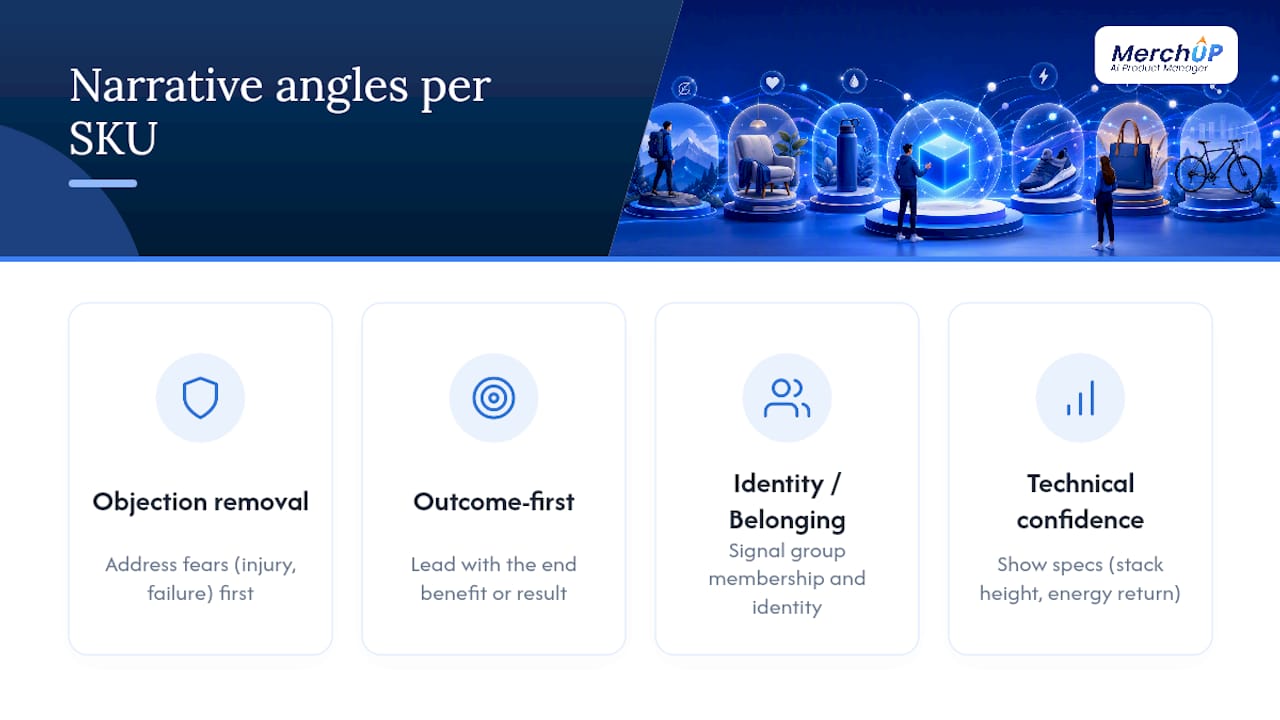
A running shoe aimed at first-time marathoners probably needs objection removal (fear of injury, fear of failure) while the same brand’s carbon-plated racing shoe for competitive runners needs technical confidence (stack height, energy return data). Same brand voice, same vocabulary rules, different narrative lens.
Persona work only pays off when it changes something concrete on the page, the bullet order, the objection addressed first, the level of technical detail included. A persona document that never touches actual copy decisions is decoration, not strategy.
Guidelines for integrating SEO keywords naturally within the brand voice
Search visibility and brand voice don’t have to fight each other, but they do require sequencing. Write the voiced version of the hero sentence and bullets first, then check whether your primary keyword and its natural variants are present anywhere a shopper (or a search engine) would expect them, the hero sentence, the first bullet, or a specification line.
Never force an exact-match keyword into a sentence where it breaks rhythm or reads like a list of search terms strung together. If a keyword doesn’t fit the sentence a real customer would say aloud, rewrite the sentence structure rather than bending grammar around the keyword. Product-page copy that reads naturally and still ranks well tends to lead with the primary benefit and let supporting keywords sit in specification bullets and alt text, where precision is expected rather than intrusive.
Title tags and meta descriptions get a slightly more flexible rule: they can carry keyword phrasing a touch more directly, since they’re competing in a search results list rather than being read as narrative prose. Even there, though, avoid stacking synonyms just to widen match potential, one clear phrase beats three redundant ones.
Keeping voice consistent across product lines and categories
Multi-category catalogues fracture voice fastest, because different product teams often write copy in isolation, each unconsciously drifting toward their own preferred tone. The fix isn’t a single monolithic voice applied identically everywhere, it’s a shared foundation with documented, deliberate variation.
Keep the vocabulary rules, sentence-length guidance, and CTA posture identical across every category. Let the narrative angle and level of technical detail vary by category, a home goods line can lean warmer, a technical accessories line can lean more confident and spec-heavy, without either one breaking brand rules on hyperbole or clarity.
Cross-category audits catch drift before it compounds. Pull ten random product pages from different categories once a quarter and check them against the same do/don’t checklist used in individual reviews. If two categories have quietly developed incompatible tones, that audit is where you catch it, not six months later when a customer complains the brand “feels different” depending on what they bought.
Author perspective: implementing product-page voice in the real world
Most teams treat brand voice as a document problem. It’s an editorial ownership problem. A style guide sitting in a shared drive changes nothing if nobody has the authority to reject copy that drifts, and the small fixes matter more than the big rewrites, tightening one confusing sizing line has, anecdotally, done more for return rates than any hero-sentence overhaul I’ve seen discussed.
Give someone real veto power over final copy, and the whole system holds together. Skip that step, and even the best-written guidelines quietly erode with every review cycle.
— Jamie Moss
How MerchUp helps teams put this into practice
Everything in this guide, hero sentences, voiced bullets, microcopy variants, an annotated example library, still has to get written and published across potentially thousands of listings. That’s the actual bottleneck for most teams, not knowing the theory. Merchup AI is built around exactly that gap: customisable drag-and-drop templates and a visual editor let you encode your voice rules once, then apply them at bulk-publish scale rather than rewriting the same structure by hand for every SKU.

For Shopify stores specifically, A live integration means templates built from the structures in this guide, outcome-led, objection-led, identity-led, can generate and publish on-voice copy across a full catalogue without a writer touching every listing individually. See it applied to real product descriptions in the 30-second tutorial, or compare plans, Starter at £12.99 a month, Growth at £29.99, Pro at £69.99, and Scale at £149.99, on the pricing page to find the tier that matches your catalogue size.
Sources
FAQ
What is a brand voice example?
A brand voice example is a real piece of copy annotated to show why specific word choices, sentence lengths, or structures reflect the brand’s personality. On a product page, that might be a hero sentence like “Built for early risers who hate cold coffee” marked up to show the who/what/payoff structure behind it.
What is the 3-7-27 rule in branding?
This isn’t a standard, widely documented branding framework, and definitions circulating online vary considerably. Rather than repeat an unverified rule, focus on the documented practice that does hold up: pick one dominant narrative angle per product and apply your voice traits consistently against that angle.
What are the five C’s of branding?
Frameworks using “five C’s” vary by source and aren’t a single agreed standard in branding literature, so treat any specific version cautiously. What matters more for product pages is documenting concrete traits, vocabulary rules, and rhythm guidance, the elements covered in this guide, rather than fitting your brand into a borrowed acronym.
How do I determine my brand voice?
Start by writing down three to five traits with concrete do/don’t examples, not vague adjectives, then test them against real product copy to see which traits actually survive contact with a conversion-focused page. An annotated example library built from your best-performing pages will teach you faster than a brainstorming session ever will.
Does Merchup AI help maintain brand voice across product pages?
Yes. Merchup AI’s customisable templates and visual editor let teams encode voice rules once and apply them consistently across bulk-published listings, with Shopify integration live and pricing starting at £12.99 a month on the Starter plan.


Comments
No comments yet — be the first to share what you think.