


Every product title, description, photo caption and review on your store is advertising in the eyes of the US Federal Trade Commission (FTC). You need a reasonable basis for each claim before it goes live, any limits must sit right next to the claim, and reviews and endorsements must be genuine and honestly labelled. The risk grows as you publish faster, because one careless template can repeat a wrong claim across hundreds of listings. The fix is a review step between generation and publishing. With MerchUp AI, every change is reviewed before it goes live, with full history and restore, so a claim check can sit in your routine.
This guide is for store owners and merchandisers who add products every week. It explains the rules in plain words and ends with a repeatable routine. It is general information, not legal advice. For health, safety or regulated products, have an advertising attorney look over your claim wording.
TL;DR
- The FTC judges the overall impression of a listing, including text, product name, images and implied meaning, not only the literal words.
- You need a reasonable basis for each claim before publishing, and the more specific or health-related the claim, the stronger the evidence.
- Qualifications must be clear, close to the claim and unavoidable. A disclosure can qualify a claim but cannot rescue a false one.
- Since October 21, 2024, the FTC’s consumer reviews rule bans fake reviews, undisclosed insider reviews and review suppression.
- When AI writes your listings, build a review gate and a change history into your workflow, so every claim has been seen by a person.
What the FTC counts as a product claim
A claim is anything a reasonable shopper would take away about what your product is, does or is made of. That includes the obvious statements (“waterproof”, “made in the USA”, “clinically proven”) and the implied ones. The FTC’s guidance tells advertisers to identify all express and implied claims conveyed to reasonable consumers, assess the ad’s overall net impression, and substantiate each reasonable interpretation.
Three consequences matter for a store owner.
The whole page is the ad. The FTC’s .com Disclosures guidance says an ad is judged as a whole, including text, product name and depictions. A product called “Anti-Aging Serum” makes a claim before anyone reads the description. A photo of a smiling athlete next to a knee brace can imply a result the copy never mentions.
Every channel counts. The same guidance lists packaging, promotional materials, the internet and digital content, social media and influencer marketing, and press releases as advertising subject to the same truth-in-advertising principles. Your Shopify product page, your email, your Instagram caption and your marketplace feed all need to say consistent, supportable things.
Implied claims are yours too. If a line could reasonably be read two ways and one reading is untrue, you need support for both readings. “Our detox tea cleanses your system” is a good example: the shopper reads a health claim whether or not you meant one.
Common claim types on a product page
| Claim type | Examples | What to hold on file |
|---|---|---|
| Performance | “Lasts 10 hours”, “waterproof to 50 m” | Test results, supplier specs, your own test method |
| Comparative | “Twice as strong as the leading brand” | Side-by-side data on the named or implied comparison |
| Origin | “Made in the USA” | Manufacturing and sourcing records |
| Environmental | “Eco-friendly”, “recyclable”, “biodegradable” | Evidence matching the Green Guides |
| Health or safety | “Reduces joint pain”, “non-toxic” | Competent and reliable scientific evidence |
| Customer experience | Testimonials, star ratings, “best seller” | Real reviews, sales data, any material connection disclosed |
The evidence you need before you publish
The core rule is simple to state. Under FTC law, advertisers must have a reasonable basis for product claims before disseminating an ad, and the type of evidence depends on the product and the claim. A claim that your mug is dishwasher safe needs a manufacturer spec or a test. A claim that a supplement supports heart health needs far more.
For health-related claims, the FTC expects “competent and reliable scientific evidence”: tests, analyses, research or studies conducted and evaluated objectively by qualified experts, and sufficient in quality and quantity. As a general matter, the FTC’s guidance says health-benefit substantiation needs randomized, controlled human clinical testing. If you sell supplements or anything that touches health, read our guide to FDA supplement claim types and the legal gate for automation before you automate any copy.
Two more points from the FTC’s guidance catch small sellers out:
- The level of support you imply is the level you need. If the ad says tests show a result, you must have at least that level of support, according to the .com Disclosures guidance.
- Evidence must exist first. The reasonable basis has to be in hand before the claim is published, not collected after a complaint.
Environmental claims and the Green Guides
Words like “sustainable”, “recyclable” or “compostable” are everywhere in product copy and AI drafts. The FTC’s Green Guides (16 CFR Part 260) were first issued in 1992 and most recently revised in 2012. For each covered claim they explain how reasonable consumers are likely to interpret it, what is needed to substantiate it, and how qualifications can avoid deception. The Guides are not directly enforceable by themselves, but they show how the FTC reads Section 5 of the FTC Act. The FTC opened a periodic review of the Guides in December 2022, so check the FTC’s site for the current version before you rewrite your sustainability wording.
Disclosures: where limits and qualifiers belong
Some claims are only honest with a qualifier attached: “free shipping on orders over $50”, “results vary”, “requires a separate battery”. The FTC’s rule of thumb is that required disclosures must be clear and conspicuous: placed close to the claim, prominent, unavoidable, understandable and repeated where needed. When practical, build the limitation into the claim itself rather than parking it elsewhere.
The guidance also draws a firm line: a disclosure can qualify a claim but cannot cure a false one. “Cures back pain*” with fine print underneath is still a problem.
Material information is a separate duty. An ad can be misleading if it leaves out information that is material in light of its claims or how people customarily use the product. The FTC’s example is that significant safety risks or limits on a health benefit must be disclosed even where the ad makes no safety claim at all.
Practical placement rules for a Shopify product page:
- Put the qualifier in the same sentence or the line directly under the claim, not in a footer or a tab.
- Do not rely on a link or hover icon to carry the qualifier.
- Check the mobile layout. A disclosure that sits beside the claim on desktop may drop far below it on a phone.
- Make sure the image, the title and the description do not contradict each other.
Reviews, testimonials and endorsements
Customer voices are the most persuasive content on a product page and the most heavily regulated. Three layers apply.
Endorsements are your claims
Under the FTC’s Endorsement Guides, an ad using consumer endorsements must be supported as if the advertiser made the claims directly. If a featured customer’s result is not typical, the ad should clearly and conspicuously disclose what consumers can generally expect. A customer testimonial is also not a substitute for scientific evidence where that is what the claim requires.
The Guides are administrative interpretations of Section 5 of the FTC Act, and practices inconsistent with them can trigger corrective action after an investigation. The revised Guides took effect July 26, 2023. They made clear that online disclosures must be unavoidable and that advertisers, endorsers and intermediaries can all be liable for deceptive endorsements.
Material connections must be disclosed
If someone promoting your product has a relationship with you that the audience would not expect, such as payment, free product, early access, an affiliate commission or employment, that relationship needs disclosing. Commentary on the 2023 changes notes that the FTC wants disclosures that are difficult to miss and easily understood by ordinary consumers, and that a platform’s built-in “sponsored post” label may not be enough on its own. The same commentary says naming the brand, as in “Sponsored by [brand]”, is clearer than a bare tag. Another legal analysis of the 2023 Guides adds that a disclosure must appear through the same means as the claim: if the claim is spoken in a video, the disclosure needs to be audible too.
The consumer reviews rule
The FTC’s Trade Regulation Rule on the Use of Consumer Reviews and Testimonials (16 CFR Part 465) was published in August 2024 and took effect on October 21, 2024. It prohibits:
- selling or buying fake reviews or testimonials;
- buying positive or negative reviews;
- undisclosed insider reviews;
- company-controlled review sites that falsely pose as independent;
- certain review suppression practices;
- fake indicators of social-media influence.
The points that most often affect small stores are these. You may offer an incentive for reviews, but not one conditioned on sentiment: a discount offered only for a positive review breaks the rule. An online disclosure is not compliant if a shopper has to click a link or hover over an icon to see it. Reviews written by officers or managers, or testimonials from employees and agents, need a clear and conspicuous disclosure of the relationship unless it is otherwise obvious to the audience. And review gating, where you only invite happy customers to post publicly, falls under the rule’s suppression provisions as well as the Consumer Review Fairness Act.
Reviews also drive search visibility, so the stakes run both ways. For the SEO side, see this piece on online reviews and ecommerce SEO. If you use customer language in your copy, our workflow for review mining for product copy shows how to turn real reviews into wording while keeping claims grounded in what customers actually said.
Checking claims when you publish at scale
At ten products a year, an owner can read every line. At fifty a week, that stops working, and the risk changes shape: a single unsupported phrase in a template or prompt gets copied everywhere. Here is a routine that scales.
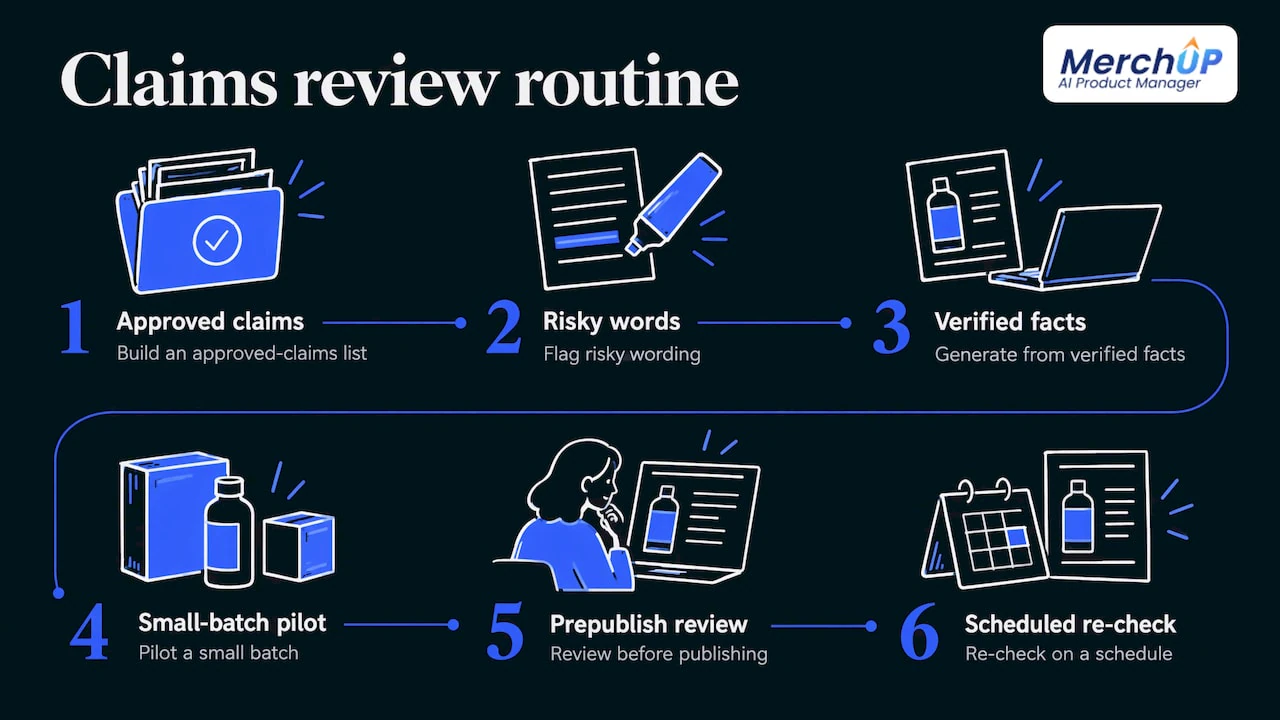
Step 1: Build an approved-claims list per category
For each product type, write down the claims you can support and where the evidence lives: supplier spec sheet, lab report, certificate, your own test. Anything not on the list is not published. Keep it short and specific. “Water-resistant (IPX4, per supplier test report)” is useful, while “high quality” needs no file at all.
Step 2: Mark the risky words
Make a watch list of terms that always trigger a second look: health and medical terms (cures, treats, prevents), “clinically proven”, “non-toxic”, “eco-friendly”, “made in USA”, “#1”, “best”, “guaranteed”, and any comparison with another brand. Environmental terms should be checked against the Green Guides, and health terms against evidence of the kind described above.
Step 3: Generate from facts you supply
AI drafts are only as safe as the inputs. Feed the tool the verified attributes (materials, dimensions, origin, certifications) and let it write around them. When an AI tool fills in gaps from general knowledge, that is where invented claims appear. Our guide to consistent product descriptions with field templates explains how fixed fields keep the facts the same on every listing.
Step 4: Pilot before you bulk publish
Run a small batch first. Our playbook on scaling Shopify product pages with AI starts with a pilot of 20 to 50 products, and a claims pass fits that stage well: read every draft, tally which phrases keep tripping your watch list, and fix the template before you go wide.
Step 5: Review before anything goes live
This is the step that matters most. A person who knows the product should read the title, description, alt text and meta description for each listing and compare claims with the approved list. Keep a record of who approved what and when, because if a claim is ever questioned you will want to show what you published, when, and what evidence you held at that point.
Step 6: Re-check on a schedule
Claims go stale. A supplier changes a material, a certificate expires, a rule is revised. Re-audit your top sellers quarterly and any listing whose supplier or formulation changes.
Where MerchUp AI fits
MerchUp AI is an AI product manager for Shopify. It turns a product photo, barcode or trading-card scan into a complete listing: title, type, vendor, price, tags and SEO. It writes the description into a designed template and creates AI product photos. For card shops it identifies cards against real catalogues, prices them from the market and estimates centering and condition. Because every change is reviewed before it goes live, with full history and restore, your claims check from Step 5 has a natural home, and you can roll back a listing if wording needs to change.
When you run SEO through the app, it reads your store’s own Google Search Console data and live Google results, picks keywords, writes meta titles, descriptions and image alt text, checks rankings and pushes everything to the store. No SEO knowledge is needed. That is a lot of text produced quickly, which is exactly why the review step matters: meta descriptions and alt text are advertising copy too, and the same claim rules apply to them.
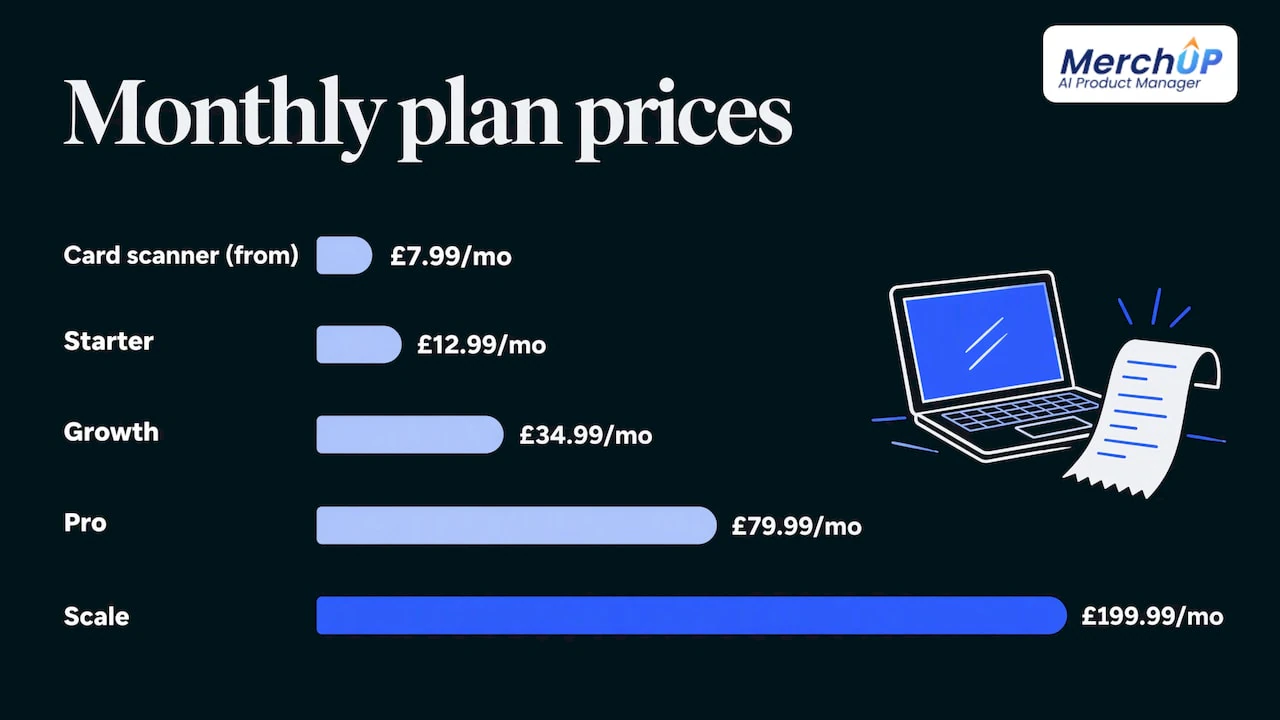
There is a free plan, and paid plans start at £12.99 a month with Starter. Growth is £34.99, Pro is £79.99 and Scale is £199.99 a month. Card sellers can add the card scanner from £7.99 a month. See MerchUp AI plans and pricing, or look at how the tools work together first.
Our view: speed needs a gate, not a brake
Most compliance trouble in ecommerce does not start with a bad actor. It starts with a good template that nobody reread. A store owner writes one confident line for one product, copies it to forty others, and by the time anyone questions it the wording is everywhere.
That is why we built MerchUp AI around review. The app does the heavy lifting of scanning, listing, describing and writing SEO, but nothing reaches your storefront until you have looked at it. Every change is kept in a full history that you can restore. For a seller, that history is peace of mind: you can see what went live and put the previous version back.
Our advice is to treat the review screen as your claims desk. Check the title, the description, the alt text and the meta description against what you can prove. Keep the claims you can support, trim the ones you cannot, and let the tool handle the rest of the work. You get the speed of automation and an editor’s final say.
Jamie Moss
FAQ
Does the FTC apply to small Shopify stores?
Yes. The FTC’s truth-in-advertising principles apply to businesses of any size, and the guidance covers the internet and digital content, social media and influencer marketing. Your product pages, emails and social posts all count as advertising. A small store has the same duty to hold a reasonable basis for its claims before publishing.
Can I use AI to write product descriptions and still be compliant?
Yes, as long as the claims in the finished text are ones you can support. The FTC looks at what the ad says and implies, not at who or what wrote it. Supply verified product facts, read each draft before it goes live, and keep a record of what you approved. MerchUp AI reviews every change before it is published and keeps a full history you can restore.
Can I offer a discount in exchange for a review?
You can offer an incentive for reviews, but it must not depend on what the review says. According to a summary of the FTC rule, a reward offered only for a positive review violates it. Ask all buyers in the same way, and disclose the incentive clearly where the review appears when it is relevant.
Do I need to disclose affiliate links and free products?
Yes. Payment, free or discounted products, early access and affiliate commissions are relationships the audience may not expect, and the FTC’s Endorsement Guides expect them to be disclosed clearly and close to the endorsement. Put the disclosure in each post or listing where the endorsement appears, and say plainly who the brand is.
Are “eco-friendly” and “sustainable” safe words to use?
Only when you can back them up and the wording is specific. The FTC’s Green Guides explain how shoppers tend to read environmental claims and what evidence and qualifiers are needed. Say what is recyclable or recycled and how, rather than using broad terms, and check the current Guides on the FTC’s site before publishing.
Sources
- FTC Health Products Compliance Guidance
- FTC .com Disclosures: How to Make Effective Disclosures in Digital Advertising
- Federal Register: Guides for the Use of Environmental Marketing Claims (2022)
- Federal Register: Green Guides review notice (2023)
- eCFR: 16 CFR 255.2 Consumer endorsements
- eCFR: 16 CFR Part 255 Endorsement Guides
- Federal Register: Guides Concerning the Use of Endorsements and Testimonials in Advertising (2023)
- Federal Register: Trade Regulation Rule on the Use of Consumer Reviews and Testimonials (2024)
- NADA: Dealerships and the Use of Consumer Reviews
- Holland & Knight: FTC final rule banning fake consumer reviews and testimonials
- FBT Gibbons: 2023 Updates to FTC Endorsement Guides
- Steptoe: FTC Unveils New Endorsement Guides


Comments
No comments yet — be the first to share what you think.