


A wholesale product description is a short, factual spec that lets a retailer decide in seconds whether to stock an item: what it is, what it is made of, how big it is, how it is packed and what it costs at wholesale and retail. A consumer description sells a feeling. A wholesale one sells sell-through. If you add products every week, the fastest way to keep that standard is to build one structure and let MerchUp AI fill it from the product itself, with every change reviewed before it goes live.
TL;DR
- Lead with material, dimensions, colourways and pack details. Put persuasion second, in one or two lines.
- Give the buyer the numbers they need: item number, case pack, minimum order, wholesale price and suggested retail price.
- Write a unique description for every product. Copying supplier text creates duplicate content and weakens your search visibility.
- Trading cards and collectibles need a searchable title, the card number, the set and the grade or condition.
- For weekly catalogue growth, use one fixed template and review each draft before publishing. MerchUp AI has a free plan, and paid plans start at £12.99 a month.
What makes a wholesale description different
A shopper on your retail page asks, “Do I want this?” A buyer for a shop asks, “Will this sell, and can I stock it easily?” Those are different questions, so the copy is different.
One guide for wholesalers suggests a three-second clarity test: the first line should say what the product is, who it is for and why it sells. If a buyer scanning your line sheet or wholesale page cannot get that from the first line, they move on to the next supplier.
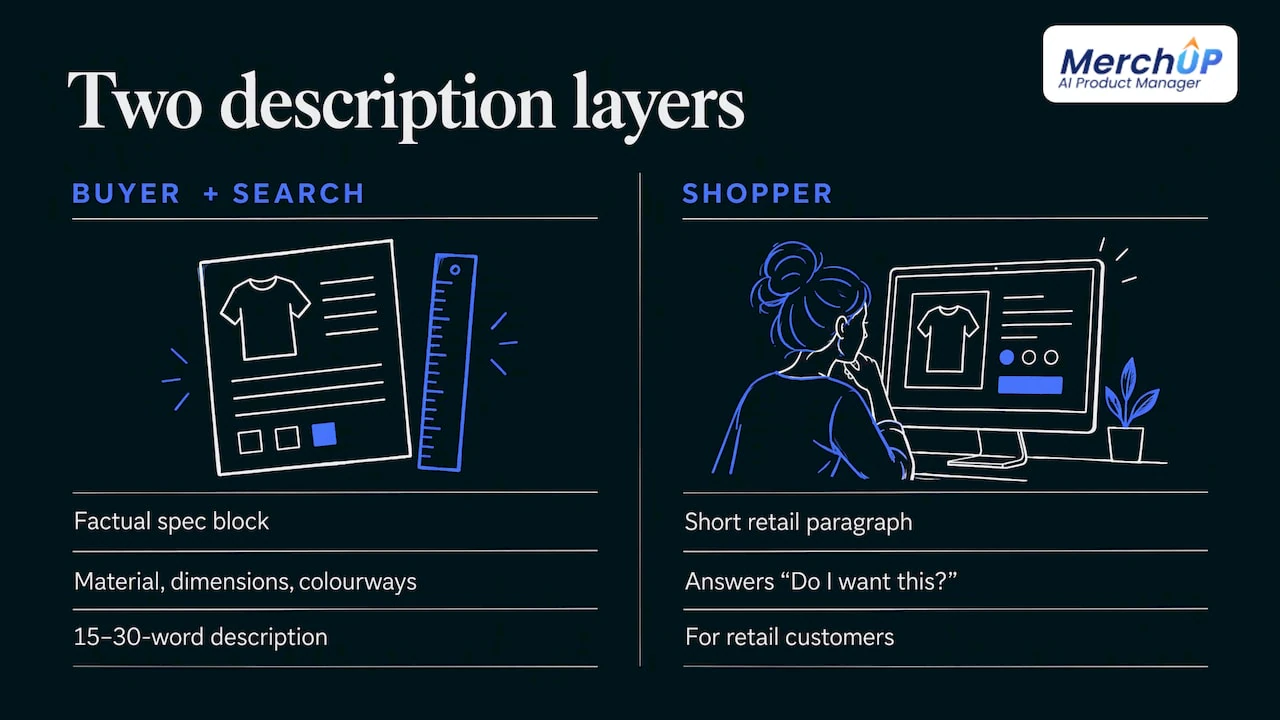
A wholesale line sheet guide goes further. It recommends flat, factual descriptions of roughly 15 to 30 words that lead with material, dimensions and colourways, and keep to what a retailer needs to know to stock the item. Adjectives like “stunning” and “must-have” take up room and tell the buyer nothing.
There is a second reader too. Many stores run retail and wholesale from the same Shopify catalogue, so the same text may be read by a shopper, a buyer and Google. The practical answer is a description with two layers: a short, factual spec block that serves buyers and search engines, and a short paragraph that serves the shopper.
The facts a stockist expects to see
A retailer is planning shelf space, margin and reorders. Give them the data to do that without emailing you.
| Fact | Why the buyer needs it | Example |
|---|---|---|
| Item number / SKU | Ordering and reordering | BR-114 |
| Material and finish | Quality and price tier | Hand-formed brass, sterling silver chain |
| Dimensions and weight | Shelf and shipping planning | 45 cm, 12 g |
| Colours or variants | Range planning | Raw brass, oxidised |
| Case pack | Order size | Case pack of 6 |
| Wholesale and suggested retail price | Margin check | $42 wholesale, $84 RRP |
| Minimum order | Whether the line is viable | State it plainly |
For packaged goods, the same wholesale description guidance points to container dimensions, net weight, case-pack quantities, shelf life and any barcode, ingredient-labelling or display-box details. Add whatever your category’s buyers always ask for in their first email. That list is your template.
The necklace example in the table comes from the line sheet guide, which writes it as one tidy line: item number, name, material, chain, length, weight, colours, case pack and both prices. That is the level of density to aim for.
If you want more detail on structuring these specs, our guide to B2B product descriptions covers structure, specs and SEO in depth.
A worked example, before and after
Here is a weak wholesale description:
Beautiful handmade ceramic mug, perfect for coffee lovers. A great addition to any shop!
It says nothing a buyer can act on. Here is the same product rewritten:
MG-209 Stoneware Mug, 350 ml
Handmade stoneware mug with a speckled glaze, dishwasher and microwave safe. 9 cm tall, 8 cm wide, 340 g. Colours: oat, slate, moss. Case pack of 12 (4 of each colour). Minimum order 2 cases. Wholesale £7.50, suggested retail £15.
The first line says what it is. The second says what it is made of and how it can be used. The third gives the buyer everything for planning space and margin. If you have it, add one line on sell-through, such as which colour sells first or which products it sells alongside. Retailers value a supplier who helps with merchandising, and styling or cross-merchandising suggestions build that trust.
Structure the page so it can be scanned
Buyers do not read, they scan. Shopify’s own guidance recommends short paragraphs and bullets for specifications, materials, sizing charts and comparisons. Use that split:
- One opening line that says what the product is, who buys it and why it sells.
- A short paragraph of two or three sentences on features and benefits.
- A bullet block for the hard specs: material, size, weight, colours, case pack.
- A commercial block for wholesale price, suggested retail price, minimum order and any tier pricing.
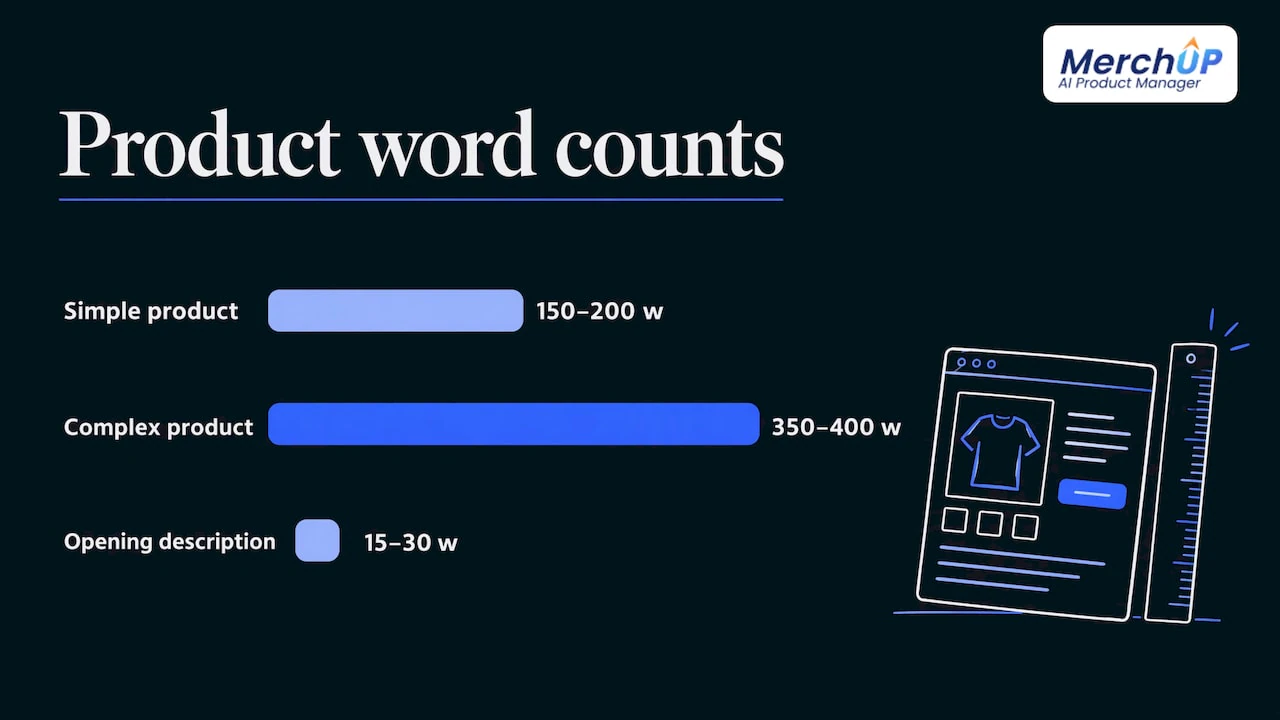
On length, one content guide suggests 150 to 200 words for simple products and 350 to 400 for complex ones, with the paragraph telling the story and the bullets carrying the detail. For wholesale spec lines, the shorter 15 to 30 word range is the right target for the opening description, with the bullets sitting beneath it.
On how many features to list, an analysis of product listings, updated in May 2026, found that most products list five or six features. Treat that as a guide, not a rule: list the features your buyers actually ask about, and stop there.
Keep the text objective. Amazon’s style guide for industrial products tells sellers to focus on relevant, factual, accurate and quantifiable attributes. That is a good test for any marketplace or your own store: if a claim cannot be measured or checked, it does not belong in the spec block.
Trading cards and collectibles
Collectibles are the clearest case where precision is the description. A buyer or collector searches for an exact card, and the title does most of the work.
eBay’s seller guidance for trading cards says sports card titles should include the year, brand and edition, player, special features and grading details. For card games, it lists the franchise, edition, card name, grading details and special features. Its example title is “1952 Topps #311 Mickey Mantle Rookie PSA 6.5”. The same logic works for your own Shopify store, because it is also how people search Google.
For each card, record:
- Card name, set and card number
- Rarity and edition
- Grade or condition, with the grading company and certificate number if graded
- Photos of the actual card, front and back
Condition is the detail most often missing, and it is the one buyers care about most. Centering and surface condition drive price, so a description that skips them leaves the buyer guessing.
This is where MerchUp AI is built for collectibles sellers. Its trading card scanner identifies cards against real catalogues and prices them from the market, and AI card grading estimates centering and condition. The listing, with its title, tags and SEO, is created from the scan. The card scanner add-on costs £7.99 a month for 1,000 scans, £19.99 for 5,000 or £39.99 for unlimited scans. If you also buy and trade in person, buy, sell and trade works with Shopify POS.
If you resell in bulk or list on marketplaces as well, check each channel’s rules. Amazon’s sports collectibles style guide asks for consistent bullet order and capitalisation, keeps promotional, pricing and shipping information out of the text, and caps descriptions at 2,000 characters.
Write for search without stuffing keywords
A wholesale catalogue is usually large and repetitive, which is where search problems start. Two habits matter most.
Write each description from scratch. Shopify’s description guide says original text for every product beats manufacturer-provided text, which can create duplicate content and hurt search performance. If twenty stores publish the same supplier paragraph, none of them has a reason to rank.
Place keywords where people read. The same guide recommends using your main and long-tail keywords naturally in the title, first paragraph and headings, and avoiding stuffing. For a wholesale item, a long-tail phrase might be “stoneware mug wholesale case pack”. Use it once, in a natural place.
If you feed products to Google Shopping, Google’s Merchant Center specification asks for accurate descriptions with no promotional text, using the description or structured_description attribute. Your factual wholesale spec block already fits that.
SEO is the part many small sellers skip because it feels technical. MerchUp AI does all your SEO in one click. It reads your store’s own Google Search Console data and live Google results, picks keywords, writes meta titles, descriptions and image alt text, checks rankings on live Google and pushes everything to your store. You need no SEO knowledge. For a deeper look, read our product description SEO guide, and for structured data, our guide to Shopify product schema.
Keeping up when you add products every week
The real problem for a growing store is not knowing what to write. It is writing it forty times a week in the same format. A workable routine looks like this:
- Fix your template once. Decide the order: opening line, short paragraph, spec bullets, commercial block. Use the same order on every product so buyers learn where to look. Our product description templates give you copy-and-paste starting points.
- Capture the product data at the source. Photograph the item or scan its barcode. MerchUp AI turns a photo or barcode into a complete Shopify listing with title, type, vendor, price, tags and SEO, then writes the description into a designed template and can create AI product photos.
- Add what only you know. Case pack, minimum order and wholesale price are your business terms. Check them on every draft, because no tool can guess your pricing tiers.
- Review before it goes live. In MerchUp AI, every change is reviewed before it is published, with full history and restore, so a mistake is never permanent.
- Publish in batches. For a large intake, see our guide to bulk product descriptions, and for governed templates across 50 or more SKUs, bulk generating descriptions.
If you want to see the flow first, the tutorial shows AI product descriptions in 30 seconds. Understanding AI-assisted description workflows more broadly can also help you decide which parts of your routine to automate. For writing facts like materials, dimensions and order minimums clearly, this overview of stockist-focused product details is a handy companion.
From scan to published listing with MerchUp AI
MerchUp AI is an AI product manager for Shopify. You scan or photograph a product, get a full listing, a description in a designed template and AI photos, then publish it and sell online or in person with Shopify POS. For card sellers it adds identification, market pricing and centering and condition estimates.
There is a free plan, and paid plans are Starter at £12.99 a month, Growth at £34.99, Pro at £79.99 and Scale at £199.99. See the pricing page for what each includes, or look at how the tools work together.
Our view: describe the sell-through, automate the rest
The best wholesale description is the one a buyer never has to email you about. Every question they would ask, such as size, pack, minimum or price, is already answered in the same place, in the same order, on every product.
That consistency is hard to keep by hand once you are adding products every week. We built MerchUp AI as a product manager rather than a text box: it starts from the photo, barcode or card scan, builds the whole listing, writes the description into a template you have designed and publishes it, so the structure holds from the first product to the five hundredth.
We think the sensible split is simple. The tool does the repeatable work and keeps your SEO current from your own Search Console data. You supply the commercial terms and the one line of sell-through knowledge only you have. Every change is reviewed before it goes live, so you stay in charge of what your customers and stockists read.
Jamie Moss
FAQ
What is a good wholesale product description example?
Start with the item number and name, then material, dimensions, weight, colours, case pack and both prices. A line sheet guide shows a brass necklace written as one dense line with exactly those elements. Add one short line on who buys it and why it sells.
How long should a wholesale product description be?
For the opening spec line, 15 to 30 words is the recommended range. If the same page also serves retail shoppers, add a short paragraph and a bullet list beneath it. Complex products can run longer, as long as the key facts stay near the top.
Should I reuse the supplier’s description?
No. Shopify’s guidance says original descriptions for every product avoid duplicate content problems, which can hurt search visibility. Use the supplier’s facts, but write the text in your own words and your own structure.
What should a trading card listing include?
Include the card name, set, card number, rarity, edition and grade or condition in the title and bullets. eBay’s trading card guidance lists the year, brand, player or franchise, special features and grading details. Add photos of the actual card.
Can I create descriptions for a whole catalogue quickly?
Yes. With MerchUp AI you can turn photos, barcodes or card scans into complete Shopify listings with descriptions in a template, then review and publish them. There is a free plan to start, and paid plans begin at £12.99 a month.
Sources
- How to Write Product Descriptions That Sell (line sheet guide)
- How Do You Write a Product Description for Wholesale?
- Product Page: 15 Examples + Best Practices (Shopify)
- How to Write Great Product Descriptions
- How to Write Product Descriptions That Convert (Real Data)
- Amazon Category Style Guide: Industrial and Scientific
- Selling trading cards (eBay Seller Center)
- Amazon Category Style Guide: Sports Collectibles Store
- How To Write a Product Description (Shopify)
- Product data specification (Google Merchant Center)


Comments
No comments yet — be the first to share what you think.