


Review mining for copy means reading customer reviews, your own and your category’s, to find the words buyers use for their problems, wants and doubts, then writing product descriptions in those words. You do not paste reviews into the page. You pull out patterns (what people were trying to fix, what almost stopped them, what surprised them) and turn them into claims, headings and answers that sound like your buyer. This guide gives you a workflow you can run in an afternoon for one product and repeat for every new listing.
TL;DR
- Collect 50 to 100 reviews per product or category into one spreadsheet, with source, date, rating and full text.
- Tag each mention by theme (problems, outcomes, objections, unexpected uses) and count, so you act on patterns, not single loud opinions.
- Rewrite in customer wording, never copy a review verbatim into your description, and keep a record of where each phrase came from.
- Keep it honest: only genuine reviews, and nothing that implies a claim your product cannot back up.
- Measure with one main metric, such as conversion rate or add-to-cart rate, and change one thing at a time.
What review mining actually is
Most definitions agree on the core idea. Review mining is analysing customer reviews, often across a whole category, to uncover the problems, motivations, desires and anxieties of your audience, so your copy connects with how they really see things. It works on your own products and on competitors’ products alike, which is why even a brand-new store can use it: you do not need a pile of your own testimonials to start listening.
The reason it works is simple. Customers explain product value better than marketers do, and copy in their own words resonates more. A manufacturer says “premium durable construction”. A buyer says “survived two winters of dog walking and still looks new”. The second line is a specific, believable benefit, and it is the one a shopper recognises.
What you are after is a short list of things:
- The problem that sent them shopping.
- The outcome they wanted, in their phrasing.
- The objection, meaning what nearly made them leave.
- The surprise, a use or benefit they did not expect.
- The comparison, how they describe alternatives they tried.
Step 1: Choose the decision before you collect anything
Start from a decision, not from the data. “Which three points should lead the description of this jacket?” is a decision. “Let’s analyse our reviews” is a hobby. A reliable review-mining process begins by defining the decision and the scope, then collecting evidence, structuring it, clustering patterns and validating the themes before anyone acts.

For a Shopify store adding products each week, a good scope is one product type at a time. Writing copy for a new cast-iron skillet? Your scope is skillet reviews: your own if you have them, plus those for similar products you stock or sell against.
Step 2: Collect reviews into one spreadsheet
For small volumes you do not need software. Keep everything in one shared structure, such as a spreadsheet, with the same fields for every source: an ID, the source, the channel, the date, an optional score, the full text and the language. One approach for small businesses is one row per comment, with empty columns for theme and mood to fill in later.
A workable layout:
| Column | What goes in it |
|---|---|
| ID | A running number, so you can trace any quote back |
| Source | Your store, marketplace listing, social comment, support email |
| Product or segment | Which product the review refers to |
| Date | When the customer wrote it |
| Rating | Stars, if there are any |
| Text | The full review, unedited |
| Theme | Filled in during tagging |
| Type | Problem, outcome, objection or surprise |
Collect the score and the date as well as the text. The score helps validate sentiment, and the date lets you see change over time. That matters when a complaint was fixed by a product revision two years ago and no longer applies.
Where to look
- Reviews on your own product pages and in your support inbox.
- Customer questions you get by email or chat. Take only the first message of a thread, so a long back-and-forth does not count as many opinions.
- Public reviews for comparable products in your category.
- Post-purchase survey answers and social comments.
If you pull the same review from more than one place, keep one version, usually the most recent, so each opinion counts once.
Which star ratings to read first
One analysis of ad-copy mining notes that five-star reviews tend to be short, one-star reviews are often about shipping or a single bad experience, and the richest material sits in three- and four-star reviews, where people explain what they liked and what almost put them off. Read those first. Then skim the five-stars for phrasing and the one-stars for deal-breakers.
Step 3: Tag themes and objections
This is the step that separates mining from reading. Build a short codebook: a list of themes, each with a one-line definition. Tag each mention as positive, negative or mixed. Count by theme and by period, and check dates, spread and persistence to tell patterns from one-offs.
Two habits keep the tagging clean:
- Tag mentions, not whole reviews. One review can praise the grip, complain about the weight and doubt the sizing. That is three tags. Apply the same themes and definitions to every source.
- Stay high-level. Focus on broad issues rather than individual features, and use tags that make sense whoever is doing the reading.
Flag text that is too vague to classify (“great product!”) instead of forcing it into a theme.
Eight kinds of language worth capturing
One workflow for AI-assisted mining lists pain, desired-outcome, value, objection, comparison, trigger, trust and workaround language as useful categories. For product copy, three of them pay off fastest:
- Pain language gives you the opening line of a description (“tired of mugs that stain”).
- Objection language gives you the FAQ and the reassurance lines (“runs small”, “is it loud?”).
- Workaround language reveals the job the product really does, such as people using a camera bag as a nappy bag.
A worked example
Say you sell a stainless steel water bottle and you have coded 80 reviews. Your count shows:
| Theme | Mentions | Type |
|---|---|---|
| Keeps drinks cold all day | 31 | Outcome |
| Lid leaks in a bag | 14 | Objection |
| Fits in a car cup holder | 12 | Surprise |
| Hard to clean the straw | 9 | Objection |
| Colour looks different in person | 6 | Objection |
The numbers here are made up to show the method, but the logic is real. The lead benefit is cold all day. The page needs a clear line about the lid and how it seals, a note on cup-holder fit, and cleaning instructions. The colour objection is fixed with better photos, not words.
Step 4: Turn the findings into copy without copying reviews
The goal is to write claims in customer wording, not to lift customer sentences. A useful loop is mine language where buyers talk, extract pains, desires and objections into a swipe file, rewrite claims in customer words, test variants against a control, and feed the winners back in.
Before you write, make an evidence brief for each recurring point. One recommended format is the recurring objection or gap, three to five verbatim examples, and the pages it should influence. It keeps the writer honest, because every line on the page traces back to something real.
From insight to line
| What buyers say | What the copy does |
|---|---|
| “I was worried it would leak in my tote” | Adds a heading about the sealed lid and what it was designed to do |
| “Still cold at 6pm after a full day” | Leads with the outcome in the buyer’s phrasing, stated as your claim only if you can support it |
| “Wish I’d known it fits my cup holder” | Adds the base diameter to the specs and the bullets |
A few rules of thumb:
- Use the vocabulary, not the sentence. If buyers say “cup holder”, do not write “beverage receptacle”.
- Turn complaints into answers. A repeated worry is a gap in your page.
- Put the most frequent theme first. That is your messaging hierarchy, and it comes from counts, not from taste. If you want to go deeper on the next step, our guide to features versus benefits shows how to turn a spec into a reason to buy.
- Never write a claim that a review made but your product cannot back up. A buyer saying it “cured my back pain” is not something you can repeat as your promise.
For layout ideas once the language is settled, see these product description examples.
Step 5: Keep it honest and legal
There is a US dimension here. The FTC’s rule on consumer reviews and testimonials, 16 CFR Part 465, prohibits selling or buying fake reviews, buying positive or negative reviews, insiders posting reviews without disclosing their relationship, company-run sites that falsely pose as independent review sites, and certain review suppression practices. If you display reviews on your store, the FTC’s guidance says to have processes in place so those reviews reflect feedback from genuine customers.
In practice:
- Mine only genuine reviews, and do not write or commission your own to fill gaps.
- If you quote a customer on your page, keep the wording intact and check you have permission to use it. A record of the review ID, source, date, context and permission status is worth keeping for every quote, which is what one AI review-mining workflow recommends.
- Filter out suspicious reviews before you analyse. One guide suggests spotting identical phrasing, gibberish and generic praise, and down-weighting or excluding them.
- Strip names and personal details from your working file.
- Check the terms of any marketplace you collect from. Rules on copying content out of a platform differ, and for anything specific to your situation, a lawyer who handles advertising law is the right person to ask.
Step 6: Use AI to speed it up, and keep a human in charge
When volume grows, AI helps. It is strong at pattern synthesis: recurring pain-point language, repeated objections, decision triggers and desired outcomes, but a person still decides whether a pattern is commercially important, representative and worth acting on. Treat AI output as a first draft of your codebook.
Teams that analyse at scale often follow a staged playbook: consolidate reviews, run aspect-based sentiment analysis, identify unique aspects, cluster similar topics and visualise the results. A small store can mimic that with a spreadsheet and a weekly hour.
Step 7: Make it routine as you add products
The store that mines once and stops loses the benefit. A simple cadence, adapted from one feedback-organising guide: collect continuously, classify weekly and watch for spikes, count by topic and source monthly, and review your category definitions quarterly.
For each new product:
- Pull 50 to 100 reviews of the closest comparable products.
- Tag and count them in your existing codebook.
- Write an evidence brief of three to five points.
- Draft the description, bullets, FAQ and alt text from it.
- Publish, then recheck after your own first reviews arrive.
If your catalogue has grown messy, a consistent structure helps the mining stay comparable across products, and product taxonomy for copy covers how to set that up.
Step 8: Measure whether it worked
Pick one primary metric and a couple of guardrails. For product pages on Shopify, useful KPIs include product conversion rate, add-to-cart rate, reached-checkout rate, average order value, return rate and search visibility, all of which you can follow through the sales funnel in Shopify Analytics. Review-informed copy that sets expectations well can also lower returns, so watch that number.
Change one thing at a time. If you rewrite the headline, bullets and photos together, you will not know which did the work. Research on testing descriptions against AI shopping recommendations makes the same point at a technical level: vary only one type of content, hold the competitor set fixed and compare against a baseline. For a store-level view, our 30/60/90 product page playbook and the guide to product description analytics show how to audit your top SKUs.
Our perspective
We built MerchUp AI as an AI product manager for Shopify because we saw the same pattern in busy stores: the insight is rarely the problem. Sellers often know what their buyers worry about. What they lack is the time to turn that knowledge into a finished listing for every new product.
Review mining is the best input for copy, and it works best when the output is consistent. That is why we think a listing should be treated as one connected job: a title, tags and SEO, a description written into a designed template, and product photos that answer the questions your reviews keep raising. When a buyer keeps asking whether a bag is big enough, the photo, the description and the alt text should all say so.
Our approach is to take care of the repetitive production work, so your time goes to the part only you can do: reading what customers say and deciding what matters. Every change in MerchUp AI is reviewed before it goes live, with full history and restore, so you stay in control of what your store says.
Jamie Moss
Turn your findings into live listings
Once you know what your buyers care about, the bottleneck is producing the listings. MerchUp AI turns a product photo or barcode into a complete Shopify listing with title, type, vendor, price, tags and SEO, then writes the description into a designed template and can create AI product photos. Its AI description generator is where you feed in the angles your review mining surfaced.
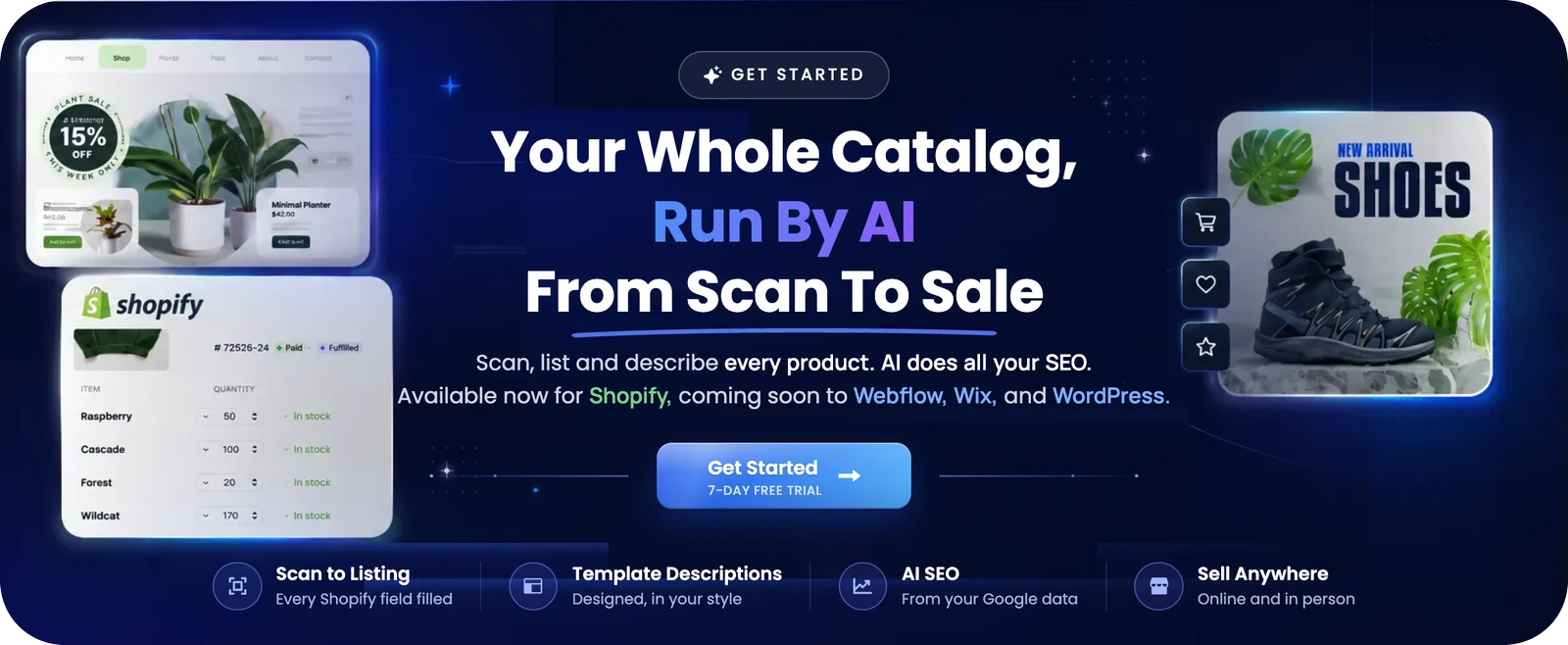
For SEO, MerchUp AI does it in one click: it reads your store’s own Google Search Console data and live Google results, picks keywords, writes meta titles, descriptions and image alt text, checks rankings and pushes everything to your store, with no SEO knowledge needed. There is a free plan, and paid plans start at £12.99 a month. See the plans and pricing, or look at how the AI tools work together.
FAQ
How many reviews do I need for review mining to be useful?
There is no magic number, but 50 to 100 reviews per product or category is enough to see recurring themes. Count themes rather than reading impressions, and treat anything mentioned once as a one-off. If you have few of your own reviews, use those of comparable products.
Can I quote customer reviews in my product descriptions?
You can feature genuine reviews, but keep the wording intact, record the source and check you have permission to use the quote. The FTC’s rule on reviews and testimonials prohibits fake reviews and certain suppression practices, so never invent or edit one to say something the customer did not. For anything borderline, ask an advertising lawyer.
Should I mine competitors’ reviews or only my own?
Both are useful. Your own reviews show what your buyers value, while comparable products’ reviews show unmet needs and the language of the whole category. Use competitor reviews for themes and vocabulary only, and write your own original wording.
Which reviews hold the most useful copy insights?
Start with three- and four-star reviews, where buyers explain what they liked and what nearly put them off. Five-star reviews are short but show the phrases buyers use for praise. One-star reviews often reflect shipping or a single bad experience, so look for repeated issues before acting.
How do I know if the new copy is working?
Choose one main metric, such as conversion rate or add-to-cart rate, and track it in Shopify Analytics before and after the change. Watch return rate as a guardrail. Change only one element at a time so you can credit the result properly.
Sources
- Google review mining, a shortcut to gathering VoC fast
- Review Mining: Scrappy Buyer Research
- Using message mining to create copy that converts
- Review Mining for Product Development
- How to organise customer feedback
- Customer feedback with AI: how small businesses sort reviews
- Data collection for review and sentiment analysis
- A Guide to Using Product Review Data for Sentiment Analysis
- How to Mine Customer Reviews for Ad Copy That Converts
- How to Analyze Customer Reviews to Find What to Fix
- How to Analyze Customer Feedback (Help Scout)
- Build an AI Review Mining Workflow for Customer Insights
- From Comments to Copy: Voice of Customer Copywriting
- How to Turn Customer Feedback Into Actionable Content
- FTC final rule on consumer reviews and testimonials (16 CFR Part 465)
- FTC: Endorsements, Influencers, and Reviews
- AI for Voice of Customer, Objection Mining, and Messaging Insights
- Review Analysis: AI Tools and Process
- Ecommerce Product Page Optimization (Shopify)
- How to Test Whether Your Product Descriptions Influence AI Recommendations


Comments
No comments yet — be the first to share what you think.