


Product copy collaboration works best when writers, designers and product managers draft copy concurrently, inside the actual design file, using a single source of truth and a formal PASS, REPAIR, or BLOCK release gate for every claim. Teams adopting this pattern cut factual errors, publish faster, and stop the endless “final final v3” file chaos. The rest of this piece breaks down exactly how to build it.
TL;DR:
- Teams using integrated, design-linked workflows reduce copy errors by up to 98 percent, especially by moving away from disconnected, manual file handoffs.
- Clarifying ownership roles with explicit responsibilities prevents late-stage rework and speeds up the review process across product managers, writers, designers, developers, and reviewers.
- A three-state release system (PASS, REPAIR, BLOCK) tied to verifiable sources ensures factual claims are accurate before publication, lowering liability risks.
- Writing and editing copy within the actual design context prevents costly redesigns and re-reviews caused by unseen constraints or late discovery of limitations.
- Utilizing a single source of truth, structured templates, and live integrations streamlines collaboration, reduces friction, and helps teams track progress efficiently in large catalogs.
What is product copy collaboration, and why does it need a process?
Product copy is not just the description box on a listing page. It covers titles, feature bullets, spec tables, use cases, and the microcopy scattered through checkout, onboarding, and error states. The essential elements of a product detail page include the product name, key features, technical specs, what’s included, sizing, and shipping information, and every one of those fields has an owner, a source, and a deadline attached to it.
Collaboration becomes a formal process rather than a habit because copy touches so many hands on the way to publish: a product manager sets the acceptance criteria, a UX writer drafts the words, a designer decides how much space those words get, a developer implements the final string, and a locale reviewer checks it translates cleanly. Skip a structured handoff and you get the classic failure mode: a writer finishes a beautiful 40-word description for a card that only fits 12 words, discovered two days before launch.
Core principles that actually change outcomes
Six habits separate teams that ship clean copy from teams that firefight it:
- Treat copy as a concurrent stream, not a post-design task. Writing after the layout is locked guarantees rework, because words that don’t fit force late redesigns or bad truncation.
- Agree shared goals and metrics up front. Consistency scores, time-to-publish, and post-launch error rate give the team something concrete to improve, rather than vague “make it better” feedback.
- Adopt a single source of truth for strings and versions. One editable record beats five Slack threads and three Google Docs with conflicting “final” copy.
- Give writers full design context. A writer who can see character limits, component behaviour, and accessibility constraints writes better copy on the first pass.
- Document decisions with a searchable audit trail. When a claim gets questioned six months later, someone needs to find the source in under a minute.
- Set short, regular review cadences. Weekly or twice-weekly syncs catch drift early; monthly reviews let small inconsistencies compound into a rebrand-sized cleanup job.
Design-integrated authoring paired with an explicit claim-review step is exactly what practitioner guidance recommends to avoid the chicken-and-egg problem between design and copy, where neither side wants to commit first.
Pro Tip: Run your first review cadence at 20 minutes, not 60. Teams that book an hour fill an hour; teams that book 20 minutes bring only the decisions that actually need a room.
What does a step-by-step copy workflow from brief to publish look like?
A repeatable workflow removes the guesswork from who does what, and when. Five steps cover the full lifecycle from kickoff to live monitoring:
- Kick off with a shared brief and acceptance criteria. Define the goal, the target user, hard constraints (character limits, banned phrases, required disclaimers), and what “done” looks like before anyone opens a document.
- Draft inside the design or linked workspace. Writers who see the actual component, spacing, and states write copy that fits first time, instead of copy that gets rewritten under deadline pressure.
- Apply a claim-level fact lock and release states. Every factual statement gets tied to a source, then marked PASS, REPAIR, or BLOCK before it can move forward. This single step separates evidence-controlled workflows from those that publish on hope.
- Automate exports to localisation and developer pipelines. Manual copy-paste between a doc and a codebase is where truncation, missing variables, and stale strings creep in.
- Monitor live copy and keep a fast repair path. Publishing isn’t the finish line; a broken claim discovered in production needs a route back to REPAIR within hours, not sprint cycles.
One published case shows what step 2 and step 3 combined can achieve: a team using an integrated, design-linked copy workspace reported a 98% reduction in copy errors after moving away from disconnected files. That’s not a marginal tidy-up. That’s the difference between chasing errors after launch and catching them before a customer ever sees them.
An evidence-controlled approach with a fact lock and explicit release states is exactly the mechanism the Apex Product Creative Engine prescribes to keep unverified claims from reaching production, and it maps directly onto step 3 above.
Who owns what: roles and responsibilities across the team
Ambiguity about ownership is the single biggest cause of late-stage rework. Assign these five roles explicitly and most duplication disappears on its own.
- Product manager: owns the business goal, writes the acceptance criteria, and makes the final launch call. If a claim is disputed, the PM decides whether it ships, gets revised, or gets cut.
- UX writer: owns evidence-backed microcopy, voice consistency, and flags anything that won’t translate cleanly before it reaches a localisation queue.
- Designer: owns layout, spacing, and the accessibility constraints that quietly dictate how long a sentence can actually be.
- Developer: owns implementation constraints (variable strings, character encoding, truncation behaviour) and runs the final production QA pass.
- Reviewer or locale owner: owns legal and compliance checks plus translation accuracy, and is the last human gate before a claim goes live in a new market.
Nobody on this list should be discovering a colleague’s constraints for the first time during a handoff meeting. A designer who tells a writer about a 60-character limit after the copy is written has cost the team a full revision cycle that a five-minute conversation at kickoff would have avoided.
Which tools and integrations actually reduce friction?
Tool choice matters less than tool pattern. The pattern that works: authoring in context, one copy workspace, and a structured link to catalogue systems.
- Authoring in-context through a design-tool plugin or a linked editor, so writers see the live component rather than a static screenshot. Working directly inside the agent in Figma Design cuts the copy-paste cycle that turns a five-minute edit into a half-day round trip.
- A centralised copy workspace that tracks versions and status flags, so “which version is live” stops being a Slack question.
- PIM or CMS links that keep structured specs consistent and let one source of truth generate channel-specific variants without manual duplication. Teams juggling multiple storefronts benefit from clarity on where a PIM fits against a CMS before they build an integration around the wrong system.
- Export automation between the copy workspace and the codebase, removing the manual step where truncation and stale variables sneak in.
- A lightweight comment channel tied to the actual string, not a general chat thread, for fast clarification without derailing a whole team meeting.
Lightweight combinations tend to beat heavyweight platforms for smaller teams: a design plugin, a shared copy workspace, and a simple export script will usually outperform one sprawling all-in-one tool that nobody fully learns. A Figma-integrated, plugin-plus-workspace pattern covers most of what a mid-sized team needs without a lengthy procurement process.
Pro Tip: If your writers still take a screenshot of a Figma frame and paste it into a doc to write against, you don’t have a design-integrated workflow yet. That screenshot is the tell.
How do release states keep product copy safe to publish?
A three-state gate turns copy QA from a vague “does this sound right?” conversation into a decision anyone on the team can make consistently.
- PASS: the claim is tied to a verified source (spec sheet, legal copy, confirmed measurement) and matches it exactly. It ships.
- REPAIR: the claim is directionally correct but needs a tweak, a missing citation, or a tone adjustment before it can pass. It stays in the queue, visible, not silently sitting in someone’s inbox.
- BLOCK: the claim cannot be verified against a source, or contradicts one. It does not move forward under any circumstance until resolved.
Every factual claim needs a fact lock: a documented link between the sentence and the document or spec that justifies it. Without that link, “REPAIR” and “BLOCK” become guesswork rather than a checklist. Version history matters just as much as the gate itself, because a claim that passed review in March may need re-verification in September if the underlying product changed.
A workflow that binds every generated claim to its source evidence, then forces it through PASS, REPAIR, or BLOCK before publishing, produces copy that survives scrutiny in regulated categories where a wrong claim isn’t just embarrassing, it’s a liability.
Define your repair workflow before you need it. A live copy failure discovered by a customer support ticket needs a same-day fix path, not a place in next sprint’s backlog.
What templates and checklists make this repeatable?
Three templates and one short agenda are enough to run this entire process without inventing new forms for every project.
- Shared brief template: goal, target user, hard copy constraints (length, banned words, required disclaimers), and known edge cases (out-of-stock states, multiple variants, regional restrictions).
- Copy verification checklist: source evidence attached, character limits respected, accessibility read-aloud check passed, localisation tags present.
- Developer handoff checklist: final approved strings, current release state, any implementation notes (variable fields, pluralisation rules, truncation behaviour).
Keep the review meeting agenda short and specific:
- Open with items stuck in REPAIR or BLOCK, not the smooth ones.
- Confirm any brief changes since the last sync.
- Assign owners and deadlines for open items before the meeting ends, not after.
Teams building product description libraries at scale can adapt existing product description templates rather than designing the structure from a blank page, and multi-storefront teams have a head start using a four-step workflow for multi-store descriptions as the starting skeleton.
How does a centralised platform support this workflow in practice?
The YouVersion case is worth returning to for what it actually demonstrates, not just the headline figure. Moving copy management into a workspace tied directly to design files didn’t just tidy up file storage. It removed the gap where errors were entering production: the moment copy left the design context and got manually re-typed somewhere else.
The reduction wasn’t cosmetic. A 98% drop in copy errors after adopting shareable links and status flags shows that most copy errors aren’t writing mistakes. They’re handoff mistakes.
That distinction matters for how teams choose tools. A templated, visual-editor approach where product specs feed directly into on-brand copy, and where a status flag travels with the string rather than living in a separate tracker, addresses the handoff gap directly rather than adding another review layer on top of a broken process.
How do you write with context and avoid late-stage content changes?
Late-stage content changes almost always trace back to one root cause: the writer drafted copy without seeing the real constraints. A headline written in a Google Doc has no character limit, no line-break behaviour, and no idea what happens on a small screen. A headline written inside the actual component has all three visible immediately.
Writing with context means three things in practice. First, the writer works against the live layout or a faithful mock, not a wireframe with placeholder “Lorem ipsum” text standing in for real constraints. Second, edge cases get written early: what does the copy look like for an out-of-stock variant, a five-star review count of zero, or a product name that runs unusually long? Third, constraints get documented once, at the brief stage, rather than discovered piecemeal across three review rounds.
The cost of skipping this is predictable. A description approved at 45 characters that later needs to become 90 characters to include a required disclaimer forces a redesign, a re-review, and a delayed launch, all because the constraint wasn’t visible when the copy was first written. Drafting concurrently with design, inside the same context the copy will actually live in, is the single highest-leverage habit in this entire process, because it prevents rework rather than catching it after the fact.
What handoff patterns keep quality assurance from becoming a bottleneck?
Handoff fails most often at the exact moment ownership changes hands, so the fix is making that moment explicit rather than implicit. A clean handoff pattern has three parts: a status that travels with the string, a checklist that’s actually checked rather than skimmed, and a named receiving owner who confirms receipt.
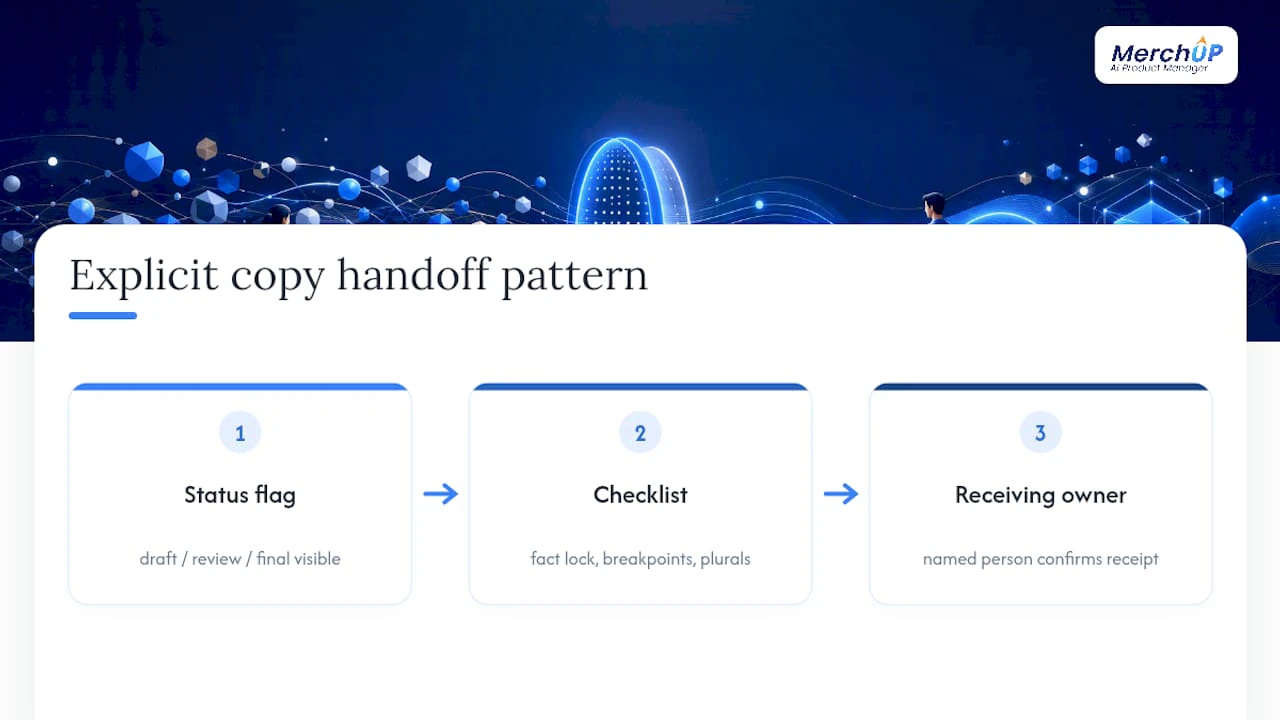
Status flags matter more than most teams realise. A simple draft, review, or final flag visible inside the design file stops developers from accidentally shipping a placeholder string that was never meant to go live. Without a visible flag, “is this final?” becomes a question asked in a chat thread, hours after the string has already been built into a release.
Quality assurance works best as a checklist run at the handoff point, not a general “does this look right” review at the end. Check the string against its fact lock, confirm it fits every breakpoint it needs to fit, and confirm any pluralisation or variable logic actually renders correctly, not just in the happy path. A five-item checklist run consistently beats a thorough review run inconsistently, because the second one only happens when someone remembers to do it.
What communication and feedback loop strategies actually work?
Communication fails in collaborative copy work for a specific reason: feedback arrives too late to be cheap. A comment on a live product page costs a developer ticket, a redeploy, and a delay. The same comment made during drafting costs thirty seconds.
Three habits fix most of this. Comment directly on the string in context, rather than in a separate document that requires cross-referencing to understand what’s being discussed. Keep feedback specific and tied to the acceptance criteria set at kickoff, rather than general style preferences raised late in the process. And separate the “urgent, blocks launch” feedback from “nice to have, next cycle” feedback explicitly, so a minor tone preference doesn’t hold up a release the way a factual error should.
Short, frequent syncs beat long, infrequent ones for exactly the reason stated earlier: a 20 minute weekly check-in surfaces friction while it’s still small. A monthly review surfaces the same friction after it’s compounded into ten related decisions that now all need untangling together. Teams that treat feedback as a scheduled, structured input, rather than an ad hoc interruption, ship copy with noticeably fewer rounds of last-minute rewriting.
How do you align product copy tone and brand voice across teams?
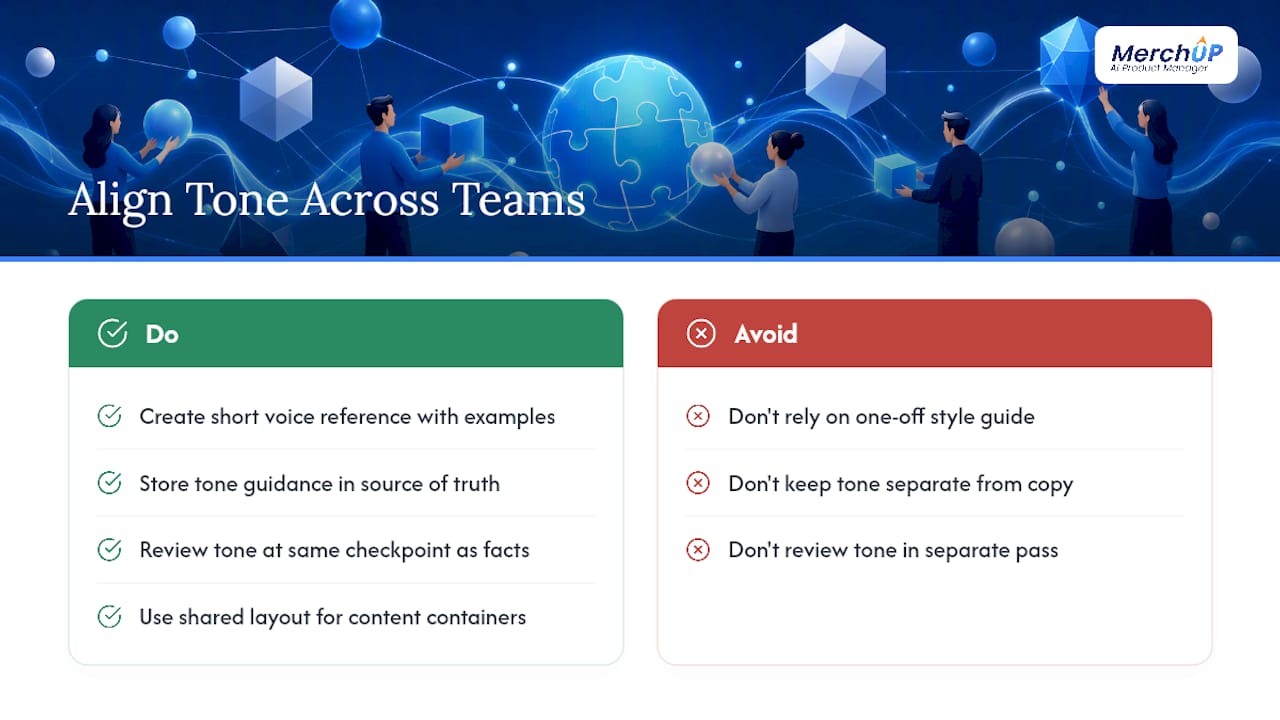
Tone drift happens quietly. One writer leans playful, another defaults to formal, and six months later the product sounds like it was written by three different companies. The fix is a shared reference, checked at the same cadence as everything else in this workflow, not a one-off style guide nobody revisits.
Build a short voice reference with real examples, not abstract adjectives. “Friendly but not casual” means very little to a new writer; three actual sentences that hit that register, next to three that miss it, teach the distinction in seconds. Tie the reference to the same single source of truth used for strings and versions, so tone guidance lives next to the copy it governs rather than in a separate deck nobody opens.
Review tone at the same checkpoint as factual claims, not as a separate pass. A claim can be factually accurate and still off-brand, and catching that during the PASS or REPAIR review is far cheaper than catching it after a customer notices the shift. When multiple writers work across a large catalogue, a shared conversion-focused layout structure gives everyone the same content containers to write into, which naturally narrows tone variance because the format itself is doing some of the work.
How do you resolve conflict in copy collaboration without stalling launches?
Disagreement over copy is normal; unresolved disagreement that stalls a launch is a process failure. Most copy conflicts fall into one of three categories, and each has a different resolution path.
Factual disputes get resolved by the fact lock, not by opinion. If a claim’s source document says one thing and a stakeholder insists on another, the source wins, or the source gets updated first. This removes an entire category of argument from the room.
Tone and preference disputes get resolved by the voice reference and the PM, in that order. If the reference doesn’t settle it, the product manager makes the call, because someone has to own the decision and revisit it if it’s wrong.
Timeline disputes, where a reviewer wants more rounds than the schedule allows, get resolved by scoping: ship with a documented REPAIR item flagged for the next cycle, rather than holding the whole release hostage for one unresolved preference. The goal isn’t zero disagreement. It’s a default path that resolves disagreement without every dispute becoming a meeting.
How do you measure the impact of collaborative copy on engagement and conversion?
Three metrics track whether the collaboration itself is working, separate from whether any single piece of copy performs well: consistency score, time-to-publish, and post-launch error rate. Falling time-to-publish and falling error rate together indicate the workflow is doing its job, not just that the team got lucky on a quiet sprint.
Conversion impact should be measured the same way any copy change is measured: against a baseline, over a defined window, ideally with a controlled comparison rather than a before-and-after guess influenced by seasonality. A structured 30/60/90 day conversion playbook gives teams a concrete measurement cadence rather than checking a dashboard sporadically and drawing conclusions from noise.
Watch for a lagging signal too: support tickets referencing confusing or inaccurate product copy. A drop in copy-related tickets after adopting a fact lock and release-state gate is a strong secondary indicator that the collaboration process, not just the words themselves, is reducing friction for the customer.
How do you onboard new team members into a collaborative copy workflow?
New writers, designers, or PMs joining an established workflow need three things in the first week, in this order: access to the single source of truth, a walkthrough of the release states, and a shadowed review cycle before they own anything solo.
Start with the source of truth, not the style guide. Someone who can find the current version of every string, its status, and its fact lock understands the system faster than someone handed a 40-page brand document first. Walk through what PASS, REPAIR, and BLOCK actually mean with real examples from recent work, since abstract definitions don’t stick the way a concrete “here’s why this got blocked last week” does.
Have new team members shadow one full review cycle, watching how conflicts get resolved and how a brief translates into a final string, before they submit their own work into the queue. This single step catches most of the confusion a written onboarding doc can’t anticipate, and it usually takes less time than the documentation would take to write.
Why product teams underrate the cultural shift this actually requires
The mechanics in this piece, fact locks, release states, shared workspaces, aren’t the hard part. Any team can adopt a checklist in an afternoon. The hard part is the cultural shift underneath it: treating copy as a product decision with the same rigour as a feature spec, rather than a finishing touch applied after the “real” work is done.
Start with one workflow, not five. Pick a single product line, run the fact lock and release states on it for a month, and let the results argue for expansion rather than mandating the whole system company-wide on day one. Governance that arrives as an edict gets resented; governance that arrives as a proven fix to last month’s launch fiasco gets adopted willingly.
— Jamie Moss
How MerchUp AI helps teams run this workflow without building it from scratch
Everything in this playbook, a single source of truth, templated structure, and copy that stays tied to real product context, is easier to run with the right platform underneath it. A platform with a visual editor and customisable templates can keep copy structured and on-brand across a catalogue, so writers aren’t rebuilding format decisions for every listing.

Because MerchUp AI integrates directly with Shopify, catalogue changes and copy updates stay linked to the storefront rather than living in a separate document that drifts out of sync. Real-time catalogue management and activity tracking can give teams a visible status trail without needing to stitch together a spreadsheet and several chat threads to know what’s live.
If you’re running a catalogue with dozens or thousands of listings and want to see how templated, AI-assisted copy fits into a design-integrated workflow, the 30-second product description tutorial is the fastest way to see the editor in action before committing a whole team’s process to it.


Comments
No comments yet — be the first to share what you think.