


A good handmade product description says what the item is in the first sentence, shows what went into making it, gives the practical details a buyer needs (size, materials, care, dispatch time) and makes only claims you can back up. Done well, it does the job a shop assistant does at a craft fair. Done across a growing catalogue, it is also the part that eats your week, which is why we built MerchUp AI to turn a product photo into a full Shopify listing, with a designed description, that you review before anything goes live.
This guide is for Shopify sellers and small shops who make or source handmade goods and add new products regularly. It covers the structure, the details, the legal meaning of “handmade” in the US, search, and how to keep quality up when you have dozens of listings to write.
TL;DR
- Open with one plain sentence on what the item is, then the outcome for the buyer, then materials and process, then what arrives in the parcel, then specs.
- Aim for roughly 80 to 250 words, in short paragraphs or a list, because most buyers skim on phones.
- Be specific instead of grand: “vegetable-tanned full-grain leather” beats “premium quality”.
- In the US, “handmade” has an FTC definition, and objective claims need a reasonable basis before you publish them.
- Put your main search phrase in the first sentence, and review every description before it goes live, whether you write it yourself or use MerchUp AI.
What a handmade description has to do
A handmade buyer cannot pick the item up. They are judging the maker, the materials and the risk of disappointment from a few photos and a few lines of text. The description has to close that gap.
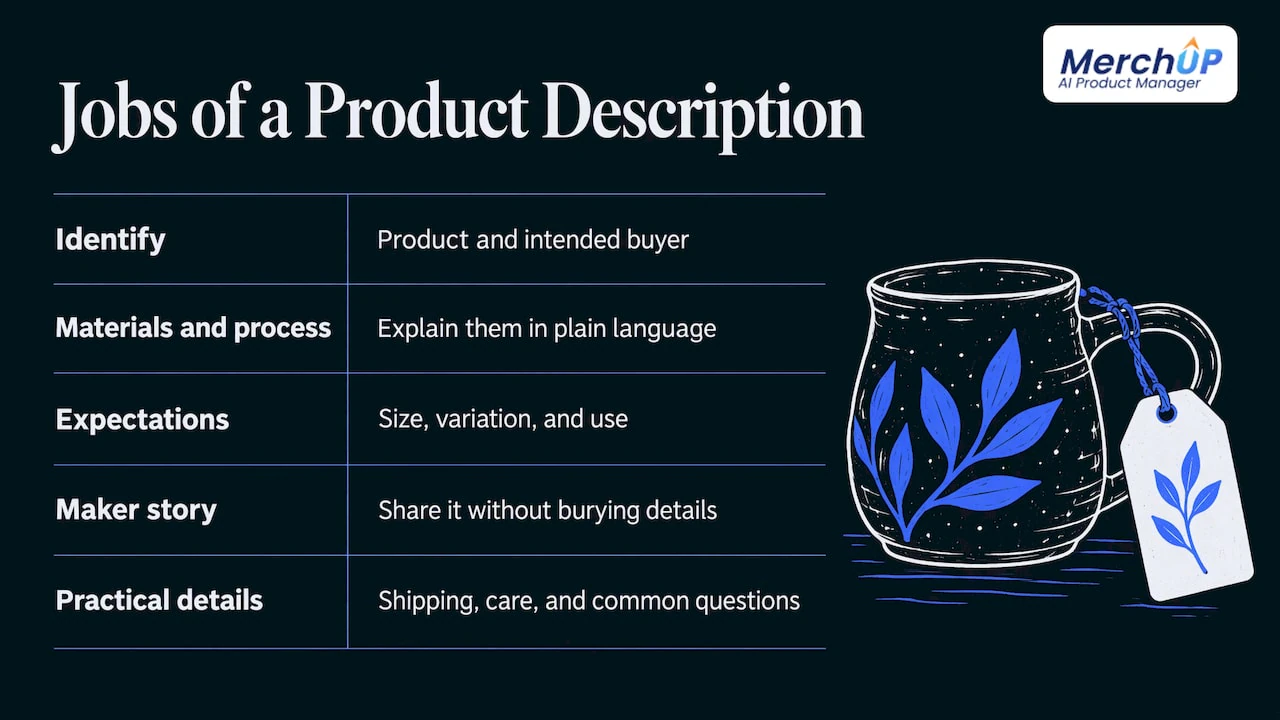
One useful way to think about it comes from a handicrafts guide, which says a description does five jobs: it explains what the product is and who it is for, describes materials and process in plain language, sets expectations about size, variation and use, shares the maker story without burying key details, and reduces hesitation by covering shipping, care and common questions.
There is a tension in that list. Story sells, but facts reassure. Handmade U recommends leading with the outcome the customer will experience rather than technical details, then explaining what makes the piece special, then giving the practical details. The Etsy Seller Handbook agrees on the facts-first side, advising that essential information such as sizes, dimensions, colours or ordering directions goes at the top, with the product’s story at the end.
The way to reconcile both: put the one thing a buyer must know in the first sentence, give the feeling in the second or third, and keep the full spec list at the bottom where skimmers can find it.
A five-part structure you can reuse
Fenfair’s 2026 guide for handmade sellers lays out a five-part template that totals 120 to 200 words. It works because every part has a single job.
| Part | What it covers | Length |
|---|---|---|
| 1. What it is | One clean, specific sentence, with no marketing language | 1 sentence |
| 2. Why it exists | The problem it solves or the feeling it creates | 1 to 2 sentences |
| 3. What goes into it | Materials, technique and time | 2 to 3 sentences |
| 4. What the buyer gets | Packaging, lead time, lifespan | 1 to 2 sentences |
| 5. Specs | Dimensions, materials, care instructions, country of origin, as bullets | A short list |
Two practical notes on using it.
Keep part 1 boring on purpose. “A hand-poured soy candle in a recycled glass jar” tells a shopper, and a search engine, exactly what the page is about. Save the poetry for part 2.
Write in the first person if you are a solo maker. Etsy’s guidance says first-person perspective can be a big selling point for shoppers who love to connect personally with makers, and it warns that the royal “we” or third person can confuse shoppers about who is making the products. If you run a small team, say so plainly: “our studio” is clearer than a vague “we” that could mean a factory.
The details every handmade listing needs
Most returns and “is this what I think it is?” messages trace back to a missing detail. A UK marketplace guide from Crafter’s Market lists what a handmade description should include: what it is and who it is for, how you make it, the size, materials and colour, care instructions, any personalisation details, and how long dispatch takes. Use it as a checklist:
- What it is and who it is for. “A beeswax wrap set for keeping half a lemon or a sandwich fresh” beats “eco wraps”.
- Size. Give dimensions in the units your buyers use. For US customers that usually means inches first, with metric alongside if you ship abroad.
- Materials. Be exact. The handicrafts guide above makes the point that “solid brass hook” is stronger than “metal accents”.
- How it is made. One or two sentences on technique and time. This is the proof of “handmade”.
- Variation. Hand-dyed, hand-glazed and hand-carved items differ from piece to piece. Say so, and say what the buyer can expect. Handfair’s listing guide recommends covering expected variation and what is not included.
- Care. Wash, wipe, oil, keep out of sunlight.
- Personalisation and lead time. If it is made to order, state how long it takes before dispatch.
- What is in the parcel. Gift box, care card, or nothing extra.
On length, sources differ slightly: Crafter’s Market suggests 80 to 200 words for most items, and JADUZ’s listing guide recommends 120 to 250 with short paragraphs for phone readers. A sensible target is somewhere around 100 to 220 words. Complex or high-priced pieces earn more room, and a simple stocking filler needs less.
One technical point: Handfair notes that its description field allows up to 2,500 characters and that the search preview uses the opening text, so the opening should make sense on its own. The same logic applies on any storefront: the first sentence often becomes the snippet.
A worked example
Here is an illustrative before and after for a candle. The details are invented for the example, so replace them with your own facts.
Before:
Luxurious, high-quality handmade candle. Perfect gift for anyone. Smells amazing and burns beautifully.
It contains no size, no wax type, no burn time and no process. “Luxurious” and “high-quality” tell the buyer nothing they can check.
After:
A hand-poured soy wax candle in a reusable amber glass jar, scented with cedar and orange peel.
I make these for the evenings when you want the room to feel calmer without a heavy perfume. Each candle is poured in small batches at my kitchen studio and left to cure for a week, so the scent throws evenly.
Details
- 8 oz (227 g) soy wax, cotton wick
- Jar: 3 in wide, 3.5 in tall
- Burn time: about 45 hours
- Care: trim the wick to 1/4 in before each burn
- Ships in 2 to 3 working days in a recycled-card box
The pattern is what matters: what it is, why it exists, how it is made, what arrives, then specs. Notice that it states the maker’s actual process rather than a superlative. Anything like “burn time” should come from your own testing, which brings us to the next point.
Telling the story without overclaiming
The maker story is your edge against mass-produced listings, and it is also where sellers get into trouble. There are two guardrails.
Be specific, not superlative
Fenfair advises skipping corporate vocabulary such as premium, luxurious, exceptional and elegant, and using words like American full-grain leather, vegetable-tanned in Wisconsin, because specificity is what builds trust in handmade copy. A concrete, observable feature plus the decision behind it is the safest story: “I tested two handle lengths before choosing this one” is believable, while “the best mug you will ever own” is not. That is the approach set out in this guide to telling a product’s story, which warns against claims of being the best, the only one of its kind or right for everyone.
Know what “handmade” means in the US
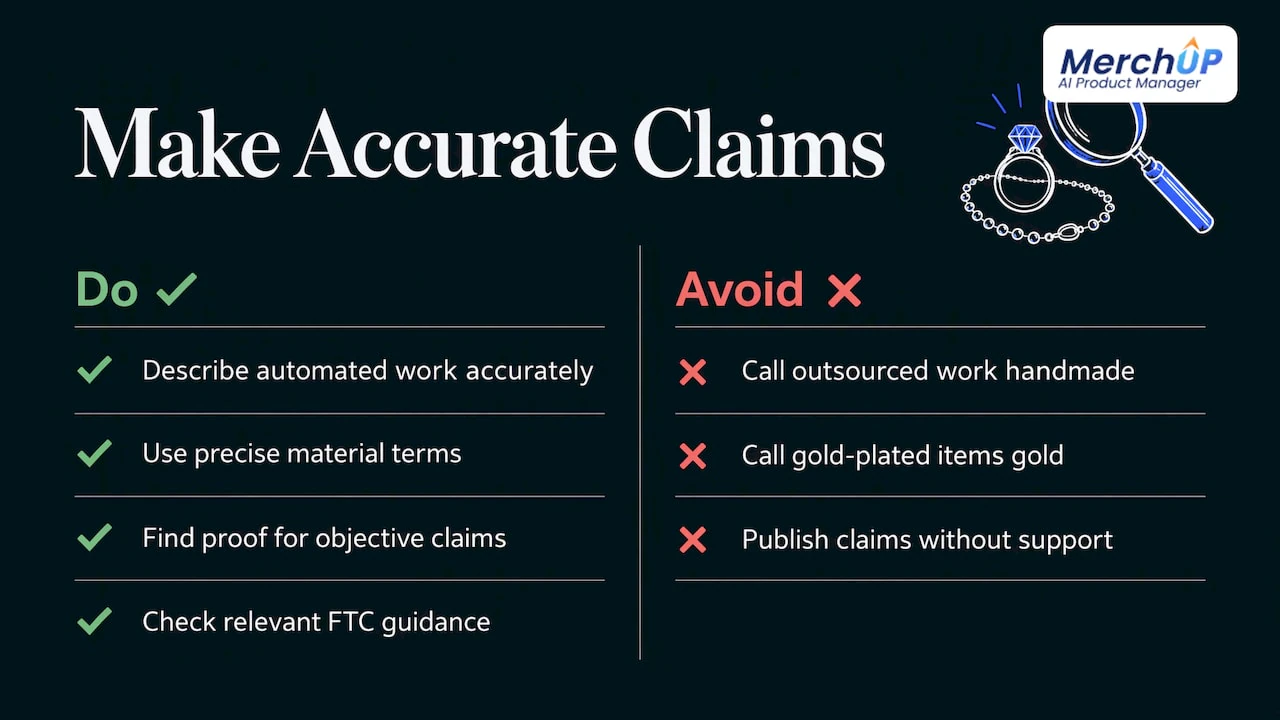
If you sell to US customers, the word has a legal definition, at least for jewellery. Under the FTC’s 16 CFR § 23.2, an item qualifies as handmade only when the entire shaping and forming from raw materials, and the finishing and decoration, were done by hand labour and manually controlled methods that let the maker control and vary the construction, shape, design and finish of each part of each individual product. That rule sits in the FTC’s jewellery guides. The principle is useful for any craft: if part of your process is automated or outsourced, describe it accurately, for example “hand-assembled from cast components” rather than “handmade”.
More broadly, the FTC expects advertisers to have a reasonable basis for objective claims before publishing them. Etsy’s guidance on truthful advertising points the same way: photos and descriptions should reflect materials, origin, quality and condition, using precise language, such as calling an item gold-plated rather than simply gold.
A short sentence can hide several claims. “Locally made from recycled material for years of daily use” speaks about place, composition and durability, and each part needs its own support. Before you publish, ask of every objective phrase: where would I point if someone asked for proof? If the answer is nowhere, soften it or cut it.
If you are unsure whether a specific claim (a health benefit, an “organic” label, a safety rating) is allowed for your product, check the relevant FTC guidance or speak to a lawyer who handles advertising law. Those rules vary by product type.
Writing handmade descriptions that search engines can read
Shoppers find handmade items two ways: on marketplaces and on Google. Both read your description.
The Etsy Seller Handbook states that search considers keywords and phrases in listing descriptions when ranking, and advises placing relevant keywords in the first few sentences without copying the title word for word. It also recommends an inverted pyramid: the most important information first, then the supporting detail.
For your own Shopify store, the same habits apply:
- Choose one primary phrase per product. Use the words a buyer would actually type, such as “hand-poured soy candle” rather than your internal product name.
- Use it naturally in the first sentence. Then use related terms (materials, use, occasion) through the rest of the copy, without stuffing.
- Use real search data. Made Urban suggests using Google Analytics and Google Search Console to see which queries bring people to your site, and then using those words in titles and descriptions.
- Write the opening so it works as a snippet. If it is cut off after 150 characters, it should still say what the item is.
For a deeper look at placement, see our guides on product description SEO and how to place one primary keyword on a product page.
Keeping quality up when you list every week
Writing one careful description is a pleasure. Writing forty is a different job. Sellers who add new products every week tend to hit the same three problems: descriptions drift in tone, details get missed (care instructions are the usual casualty), and SEO work gets postponed indefinitely.
The fix is a repeatable routine. Here is how it looks with MerchUp AI on Shopify:
- Start from the product itself. Photograph the item or scan its barcode, and MerchUp AI builds a complete Shopify listing draft: title, product type, vendor, price, tags and SEO fields.
- Get a designed description. The description is written into a template, so every product page has the same layout, such as an intro, details and care in the same places. You can browse description templates to see how that structure works.
- Add what only you know. This is the step that makes it handmade. Edit the draft so it states your real materials, process, batch size and lead time. A generated draft is a starting point, and your facts are what make it true.
- Create AI product photos where your own shots need extra variety.
- Review and publish. Every change is reviewed before it goes live, with full history and restore, so you can always return to an earlier version.
The tutorial shows the description flow in about 30 seconds, and the AI description generator page explains it in more detail. If you use more than one tool, how the tools work together is a good map.
The SEO step is where most small shops stall, so it is worth a closer look. MerchUp AI does all your SEO in one click. It reads your store’s own Google Search Console data and live Google results, picks keywords, writes meta titles, descriptions and image alt text, checks rankings on live Google and pushes everything to your store. No SEO knowledge is needed.
If you sell trading cards or collectibles as well as handmade items, the same app identifies cards against real catalogues, prices them from the market and estimates centering and condition, and you can buy, sell and trade in person with Shopify POS. See the trading card scanner for how that works.
Pricing the item your description is selling
A strong description cannot rescue a price that loses you money, and handmade sellers underprice more often than anyone. The common formula is materials plus labour plus overhead, then a margin or multiplier. Craftybase’s pricing guide presents it as Materials + Labour + Overhead + Profit Margin, with a typical margin of 20 to 40% before platform fees. In its worked example, a soy candle with $4.20 of materials, $8.33 of labour and $3.00 of overhead comes to a $22.00 retail price at a 30% margin before fees.
For labour, Michigan State University Extension notes that many professional crafters use $12 to $20 an hour. Whatever formula you use, make sure your own time is in it.
Once the price is set, the description should explain it. A line about the hours of work or the cost of a specific material helps a buyer see why your piece costs more than a factory version.
Start free, scale when you list more
If you are writing handmade descriptions for a Shopify store and want to cut the time per listing without losing your voice, MerchUp AI has a free plan. Paid plans start with Starter at £12.99 a month, then Growth at £34.99, Pro at £79.99 and Scale at £199.99 a month. The card scanner add-on starts from £7.99 a month for trading-card sellers. You can compare them on the pricing page.

MerchUp AI is available now for Shopify, and Webflow, Wix and WordPress are coming soon.
Our view: the maker’s facts are the product
We build MerchUp AI for sellers who list products every week, and our view on handmade copy is simple: the description should carry the maker’s facts, and the tool should carry the repetition.
The parts of a handmade listing that earn trust are the ones nobody else can supply: your materials, your process, your lead time, the reason you made it. The parts that cost you hours are the ones every listing shares: the layout, the title format, the tags, the meta title, the image alt text. Those are the jobs we automate, so that your time goes into the sentences only you can write.
That is why MerchUp AI works as a product manager and not only a text writer. It starts from a photo or barcode, builds the whole Shopify listing, designs the description into a template, creates product photos if you need them, handles SEO from your own Google Search Console data and live Google results, and lets you review every change before it is published. Because nothing goes live unreviewed and every change has history and restore, you stay in control of what your shop says about your work.
A handmade shop grows when listing a new piece takes minutes rather than an evening. We think that is the real use of AI for makers: not replacing the voice, but clearing the admin around it.
Jamie Moss
FAQ
How long should a handmade product description be?
Most sources land between 80 and 250 words. Crafter’s Market suggests 80 to 200 and JADUZ recommends 120 to 250. Use short paragraphs or bullets, put the essentials first, and add length only when the piece is complex or expensive.
What can legally be called handmade in the US?
For jewellery, the FTC’s 16 CFR § 23.2 says handmade means the shaping, forming, finishing and decoration were all done by hand labour or manually controlled methods that let the maker vary each piece. If any step is machine-made or outsourced, describe that step accurately instead of using the word. For other products, check the guidance that applies to your category.
Should I write in the first person?
If you are a solo maker, yes. Etsy’s Seller Handbook says first person helps shoppers who like to connect with the maker, and it warns that third person or the royal “we” can blur who is making the goods. If you have a team, name the studio plainly.
Can I use AI to write descriptions for handmade products?
Yes, as long as you check the result. With MerchUp AI, you get a template-designed description from your product photo, then edit it to include your actual materials, process and lead time. Every change is reviewed before it goes live, and full history and restore are kept, so the final text is yours.
Which details matter most to shoppers?
Size, materials, care and dispatch time. Those are the details listed in every handmade guide above, and they answer the questions buyers would otherwise email you. Add expected variation for anything hand-dyed, glazed or carved.
Sources
- Write Product Descriptions That Actually Sell (Handmade), Fenfair
- 5 tips for writing item descriptions, Etsy Seller Handbook
- The Anatomy of a Well-Crafted Etsy Listing, Etsy Seller Handbook
- Understanding Truthful Advertising and Discount Practices, Etsy Seller Handbook
- How to Write Product Descriptions That Sell for Handmade, Handmade U
- How to Write Handmade Product Descriptions
- How to Write Product Descriptions That Sell (Handmade), Crafter’s Market
- How to write a clear handmade product listing, Handfair
- How to write a handmade product listing, JADUZ
- 16 CFR § 23.2, Misuse of the terms “handmade”
- Advertising Substantiation: The FTC Policy Statement
- Product Descriptions that Sell: 3 Answers you Must Know, Made Urban
- How to Price Handmade Products, Craftybase
- Pricing my craft item, MSU Extension


Comments
No comments yet — be the first to share what you think.