


A product taxonomy is the classification system that sorts every item in your catalogue into categories, subcategories, attributes and tags, and it changes copy from a one-by-one writing task into a repeatable system. Get it right and shoppers find what they want faster, search engines index your pages more accurately, and your team writes SEO-friendly product descriptions at scale without reinventing the wheel for every SKU. This guide shows you how to build that structure and turn it directly into copy.
TL;DR:
- A well-structured taxonomy directly supports SEO, discoverability, and trust by standardizing categories, attributes, and tags using validated industry references and identifiers like GTIN codes.
- Clear ownership roles for taxonomy, product data accuracy, and copy ensure consistent updates, error prevention, and alignment with product releases, reducing misinformation and SEO dilution.
- To maximize efficiency, map structured taxonomic fields to specific copy components, tailoring word counts and content depth to SKU complexity and buyer intent.
- Regular audits, including keyword performance and data consistency checks, help identify issues like duplicate descriptions, conflicting claims, or untagged SKUs, maintaining catalog integrity.
- AI tools can reliably generate taxonomy-driven descriptions when fed accurate, validated product data and integrated into verified workflows, but require manual checks before publication.
What is product taxonomy for copy?
Product taxonomy organises products into logical categories, subcategories and attributes so shoppers and search engines can find things without friction. For a copywriter, that same structure is the scaffolding for every sentence you write. Instead of starting from a blank page for each product, you start from a data field: category, attribute, use case, benefit.
Three layers do the heavy lifting.
- Categories and subcategories group products by what they are (Footwear > Running Shoes > Trail Running Shoes). These categories drive your category page copy and site navigation.
- Attributes describe specific, structured facts (size, material, wattage, compatibility). These populate spec blocks and filter menus.
- Tags capture cross-cutting descriptors that don’t fit a strict hierarchy (waterproof, gift-worthy, limited edition). These feed campaign copy and cross-sell blurbs.
Standard reference lists matter more than most copy teams realise. Google’s product taxonomy gives you a canonical, industry-agreed category structure, so when your merchandiser says “Home & Garden > Kitchen & Dining > Small Appliances,” everyone from the SEO analyst to the freelance copywriter is working from the same map. Product identifiers such as GTIN codes from GS1 go further still, giving each item an unambiguous identity that survives being renamed, re-photographed or re-platformed. When a product is sold under three slightly different titles across three channels, the GTIN is what confirms it’s genuinely one product, not three.
This matters more with regulation on the horizon. The EU’s digital product passport initiative is pushing structured product data toward mandatory transparency requirements around sustainability and origin. Taxonomy is no longer just a merchandising nicety; it’s becoming the backbone that structured disclosure sits on.
For copy teams specifically, the payoff of using standard lists is ambiguity reduction. When five people write descriptions for the same “Category” without a shared definition of what belongs in it, you get inconsistent tone, duplicated claims, and category pages that contradict the products sitting inside them.
Why does taxonomy affect search and conversion?
Taxonomy is not a back-office chore. It shapes what shoppers can find, how search engines rank your pages, and whether an AI shopping assistant can accurately describe your product to someone who never visits your site.
A well-structured taxonomy improves discoverability across three channels at once. Internal site search returns more relevant results because products are consistently tagged. Organic search benefits because clean category structures produce cleaner URLs and clearer topical signals. And AI assistants, which increasingly summarise product pages to answer shopping queries, rely on unambiguous labelled specs and structured schema to describe your product correctly rather than guessing from a vague paragraph.
Category intro copy carries more weight than most content strategists give it credit for. A short, well-written intro at the top of a category page confirms the shopper has landed in the right place, sets expectations for what’s inside, and orients them before they even scan the first product card. Sense Central’s research on category page copy found that this kind of orientation copy can lift engagement and conversion across an entire collection, not just on the page it sits on. One paragraph, written once, improves the performance of every product beneath it.
Pro Tip: Treat your category intro as leverage. A single well-tested paragraph at the top of “Trail Running Shoes” affects the conversion rate of forty products at once, so it deserves the same scrutiny as your best-performing product description, not less.
Track a small, consistent set of metrics to know whether taxonomy changes are actually working:
- Category page click-through rate from search results
- Internal search success rate (searches that lead to a product view or purchase)
- Add-to-cart rate segmented by category
- Bounce rate on category landing pages before and after intro copy changes
- Organic ranking movement for category-level keywords
Category-level copy also needs to answer real buyer questions, not just describe the collection in the abstract. Copy that addresses transactional, bottom-of-funnel intent, such as “which of these is right for wide feet,” converts better than copy that simply restates the category name in different words.
How is a taxonomy structured for copywriters?
Most taxonomy failures in copy teams come from confusing categories with tags, or trying to force every product attribute into the navigation menu. Keep one primary category logic. Everything else becomes a filter or a tag.
The primary category answers “what is this, fundamentally?” A jacket is a jacket whether it’s waterproof, insulated, or on sale. Waterproof, insulated and on sale are filters and tags layered on top. When teams blur this line, you end up with a navigation menu containing forty near-duplicate categories, half of them nearly empty, all of them diluting your SEO authority instead of concentrating it.
For writing purposes, six canonical fields cover almost every product you’ll describe:
- Audience — who this is genuinely for (commuter cyclists, not “everyone”)
- Use case — the specific job the product does
- Top benefit — the single strongest reason to buy, stated plainly
- Specs — the labelled, factual attributes (dimensions, material, capacity, wattage)
- Compatibility — what it works with, or what it replaces
- Legal or safety flags — certifications, age restrictions, warranty terms, care instructions
Feed these six fields consistently and a copywriter, or an AI drafting tool, can produce a description without guessing. Skip one, and you get either a thin description or a writer inventing a plausible-sounding detail to fill the gap, which is exactly the kind of drift that damages trust and accuracy.
Naming conventions matter as much as the fields themselves. If “Material” is sometimes “Fabric” and sometimes “Composition” across your catalogue, your writers will use three different words for the same fact in three different descriptions, and your category pages will read as though five different brands wrote them. Build a controlled vocabulary document, even a simple spreadsheet, listing the approved term for every recurring attribute, and require every contributor, human or AI, to draft from it. It takes an afternoon to build and saves months of inconsistent copy.
How do you map taxonomy fields to copy?
Taxonomy only earns its keep when it turns directly into text. The most reliable way to do that is a field-to-copy mapping: each structured attribute has a designated home in the finished description.
- Category hero line pulls from the primary category and top benefit fields, giving you a headline that states what the product is and why it matters in one sentence.
- Who-it’s-for line pulls from the audience field, addressing the reader directly rather than describing the product in the abstract.
- Benefits block pulls from top benefit plus one or two secondary attributes, translated from spec into outcome (not “600 fill power” but “keeps you warm past freezing without the bulk”).
- Specs block pulls the raw attribute data verbatim, labelled clearly, because shoppers comparing options want facts, not more adjectives.
- Compatibility and legal line pulls flags and compatibility fields, stated plainly to avoid returns and complaints.
Not every SKU needs the full treatment. A £12 phone case and a £1,200 espresso machine shouldn’t get the same word count.
- Low-complexity, low-price SKUs (under roughly £30, few variants): 40 to 80 words, hero line plus a compact specs list is enough.
- Mid-complexity SKUs (£30 to £200, some technical detail or comparison shopping): 100 to 180 words, full benefits block plus specs.
- High-complexity or high-price SKUs (technical products, big-ticket purchases, safety-relevant items): 180 to 350 words, with a dedicated compatibility and legal section, because these buyers research harder and abandon at the first unanswered question.
Templates keep this consistent without flattening your brand voice into something robotic. Build the template around sentence structure, not sentence wording. Specify “one-sentence hook stating the top benefit in the brand’s tone” rather than a fixed sentence to fill in. This lets every writer, and every AI-generated draft, sound recognisably like your brand while still pulling from the same underlying fields. A well-built product description template does exactly this: rigid where facts belong, flexible where voice belongs.
Who owns taxonomy accuracy at scale?
A taxonomy without an owner degrades within a quarter. New products get slotted into the wrong category under deadline pressure, attributes go unfilled, and nobody notices until customer complaints or a search ranking drop forces a review.
Assign three distinct roles, even if one person holds more than one of them in a smaller team:
- Category owner — accountable for the overall structure, merges duplicate categories, and decides where genuinely new product lines belong.
- Product owner — accountable for the accuracy of individual product records: correct attributes, correct GTIN, correct compatibility data.
- Copy owner — accountable for how the taxonomy translates into finished text: template adherence, voice consistency, and flagging when a product’s data is too thin to write from.
The data itself needs one home, whether that’s a full PIM (product information management) system or, for smaller catalogues, a rigorously maintained master spreadsheet. Either way, templates should pull from that single source rather than from whatever a writer was told verbally in a Slack message last month. When the PIM updates a spec, the description should update with it, not silently go stale.
Build in three review gates before anything publishes: a fact check against the PIM record, a policy review for legal and safety claims, and a voice check against the brand’s style guide. Skipping any one of these is how factually wrong specs or off-brand tone end up live on a category page for months before anyone catches it.
Run a lightweight audit on a quarterly cadence rather than leaving it to an annual scramble:
- Are any categories still tagged with attributes that no longer exist in the product line?
- Do any two products in the same category have contradictory claims about the same attribute?
- Has any category grown past the point where the intro copy still accurately describes what’s inside it?
- Are new SKUs landing in the taxonomy within one week of launch, or sitting untagged?
Can AI reliably classify and draft from taxonomy?
Yes, with real guardrails, and the guardrails matter more than the model you pick. GPT-style models paired with fuzzy-matching libraries can cluster and auto-classify product records at a speed no manual process can match, but automated classification drifts without deliberate evaluation and human checks.
The non-negotiable input is canonical fact data. Feed the model your PIM’s structured fields and GTIN identifiers rather than letting it infer specs from a marketing blurb, which is how you end up with confidently wrong wattage numbers in a generated description. Feeding the generator a validated facts block first, then applying your voice rules, then generating, then running a quality check before publishing, keeps hallucinated details out of live copy.
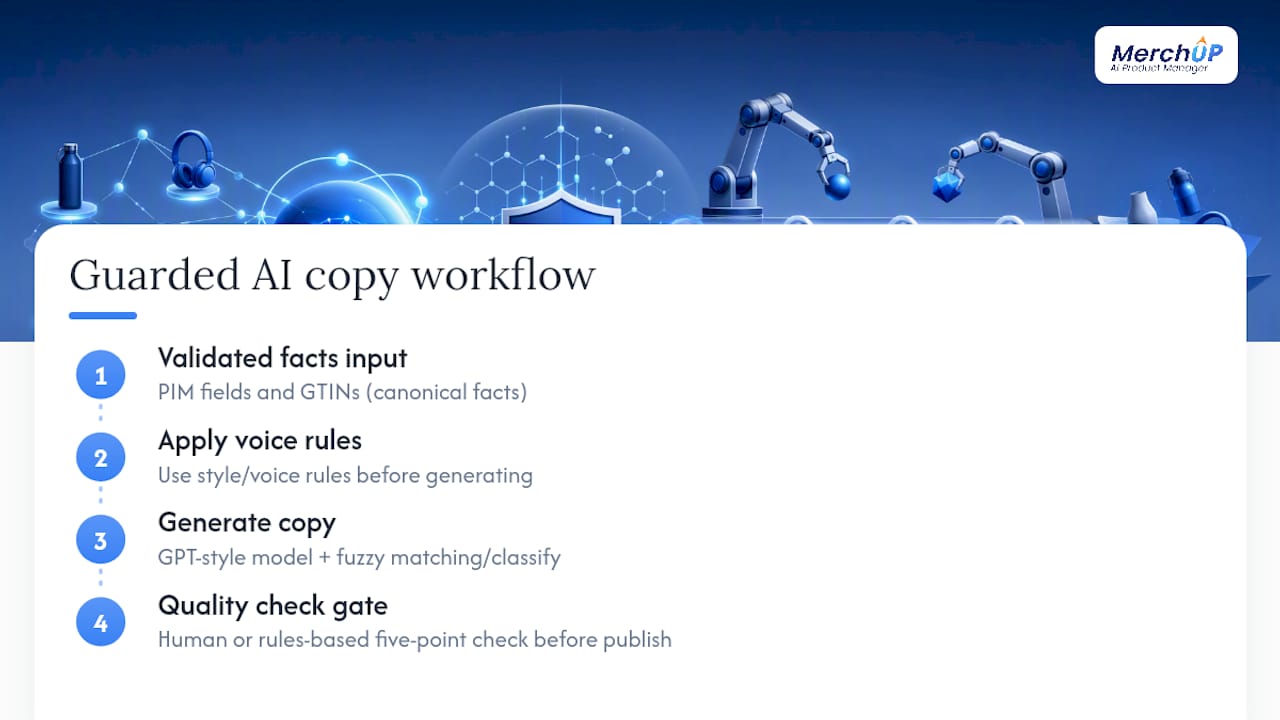
Measure classifier accuracy against a held-out sample of manually verified products, and measure draft quality separately against your voice and factual-accuracy checklist. These are two different failure modes: a model can classify correctly and still write badly, or write beautifully and misclassify.
Pro Tip: Never let an AI tool publish directly from classification to live page. Insert one human or rules-based verification step between draft and publish, even if it’s just a five-point checklist, because that single gate catches the errors that cost you customer trust.
What do good taxonomy-driven copy templates look like?
A category intro template needs very little to work: a headline naming the category and its core value, two or three sentences orienting the shopper (what’s inside, who it’s for, how to narrow the choice), and a soft call to action pointing toward the best-selling or most-relevant subcategory.
A product description skeleton built from taxonomy fields follows a similarly tight structure:
- One-line hook stating the top benefit in plain language
- Three benefit statements, each translating a spec into an outcome
- A labelled specs block pulling attributes verbatim from the PIM
- A short call to action, or a compatibility note where relevant
Word count should track complexity, not habit:
- Simple, low-price items: keep the whole description under 80 words
- Mid-range items: 100 to 180 words with a full benefits block
- Complex or expensive items: up to 350 words, prioritising the specs and compatibility sections
Structures like this are exactly what a reusable product description skeleton is built to hold, and they scale cleanly whether one writer is producing them or a template is generating hundreds at once.
How do you measure and audit taxonomy-driven copy?
Copy performance tied to taxonomy needs its own KPIs, distinct from general site metrics, so you can tell whether a taxonomy change actually moved the needle or just reshuffled traffic.
- Category page click-through rate from organic search
- Product page click-through rate for taxonomy-tagged versus untagged SKUs
- Add-to-cart rate by category, tracked before and after a category intro rewrite
- Return rate on products with recently corrected or expanded spec data
Run structured A/B tests rather than guessing. Test two category intro lengths against each other. Test a benefits-led product description opening against a specs-led opening for the same SKU. Test whether adding a compatibility line reduces returns on technical products over a fixed measurement window.
| Audit check | What it catches |
|---|---|
| Duplicate description scan | Copy-pasted text across near-identical SKUs, which weakens SEO and reads as lazy to shoppers |
| Thin category review | Categories with too few products or too little intro copy to justify their own page |
| Orphan tag check | Tags applied to products that no longer exist in that line, or tags nobody is using in navigation |
| Contradiction check | Two products in the same category making conflicting claims about a shared attribute |
Run this audit alongside the quarterly governance review described earlier rather than as a separate exercise. It’s the same underlying question asked from a copy-performance angle instead of a data-integrity angle.
Where should you start a taxonomy-to-copy rollout?
- Identify your top revenue-generating categories and pull a representative sample of SKUs from each.
- Assign category, product and copy owners before touching a single description.
- Build the field-to-copy template and controlled vocabulary document first, not last.
- Export clean, canonical data from your PIM or master spreadsheet to feed the templates.
- Pilot on one category, measure against your chosen KPIs for two to four weeks, then adjust the template.
- Scale the validated template across the rest of the catalogue in batches, auditing as you go.
Author perspective: when to keep taxonomy lean
The mistake I see most often is copy teams building taxonomy like an engineer, not a writer. One primary category logic, with tags carrying everything cross-cutting, beats forty finely-sliced categories every time. Thin categories don’t help SEO; they dilute it. Start with your highest-revenue categories, measure before you scale, and resist the urge to model every possible attribute before you’ve written a single description. Perfect taxonomy that ships in six months loses to a decent one that’s improved every quarter.
— Jamie Moss
Generate taxonomy-driven copy without the manual rebuild
Everything in this guide, the field-to-copy mapping, the controlled vocabulary, the templated benefits block, is exactly what Merchup AI is built to run on. Instead of briefing a writer for every SKU or copying the same spec block by hand across many product pages, an AI tool can pull your product data into customisable drag-and-drop templates and a visual editor, then generate and bulk-publish SEO-optimised descriptions that stay consistent across your catalogue.

It plugs directly into the workflow described above: canonical facts in, template applied, voice preserved, published straight to your storefront through integration with platforms such as Shopify, with support for more platforms on the way. If you’re running a catalogue where taxonomy keeps outgrowing your writing capacity, see the 30-second tutorial to watch the generate-and-publish flow in action, then take a look at the full product overview to see which template tier fits your catalogue size.
Sources
FAQ
What is a product taxonomy?
A product taxonomy is a hierarchical classification system that organises products into categories, subcategories, attributes and tags, making them easier for shoppers, search engines and AI assistants to find and understand.
What are the main classifications used in product taxonomy?
Most taxonomies rely on four core classification types: category (what the product fundamentally is), subcategory (a narrower grouping within it), attribute (structured, factual detail like size or material), and tag (a cross-cutting descriptor that doesn’t fit the hierarchy).
How do I create a product taxonomy?
Start by mapping your top revenue categories against a standard reference list such as Google’s product taxonomy, assign one primary category logic per product, layer attributes and tags on top, then feed that structure into your copy templates and PIM.
Can AI tools like Merchup AI generate copy directly from my taxonomy?
Yes. Tools such as Merchup AI can pull structured product fields and generate SEO-optimised descriptions through customisable templates, provided the underlying taxonomy and product data are clean and consistently labelled.
How often should I audit my product taxonomy?
A quarterly audit cadence catches most drift, checking for duplicate descriptions, thin categories, orphaned tags and contradictory attribute claims before they damage search rankings or shopper trust.


Comments
No comments yet — be the first to share what you think.