


A readable product description is one a shopper can scan in seconds and still come away knowing what the item is, whether it fits their need and what to do next. That means useful facts first, short sentences, plain words, clear structure and wording that is genuinely your own. This guide shows how to get there, how to measure it without being fooled by a score, and how to keep descriptions original when you write at volume or use templates and AI.
TL;DR
- Put the most useful information at the top of the description and at the start of each line, because online shoppers skim.
- Use short sentences, plain words and bullets for specifications. Test bullets against paragraphs by product category rather than assuming one wins.
- Use a readability score such as Flesch-Kincaid only as a quick screen. It cannot judge clarity, brand voice or whether the facts are right.
- Write original copy. Facts are not protected, but distinctive manufacturer wording is a risk, and AI output is a draft to fact-check.
- Test one change at a time and watch conversion, plus returns and support questions as a guardrail.
What readability means for a product description
Readability is how easily a shopper can read and understand your copy. For a product page, that has a narrower meaning than it does for an essay. The reader is not there to enjoy the prose. They are deciding whether to buy, and they want answers: what is it, what is it made of, will it fit, how do I look after it.
A 2024 study in the Journal of Electronic Commerce Research describes commercial descriptions as needing clarity, relevance, succinctness and informativeness, because they support the whole buying journey: recognising a need, searching, evaluating, choosing and using the product afterwards. So readability is not decoration. It is part of how the page does its job.
It helps to separate three things that often get mixed up:
- Legibility: font size, contrast, line length and spacing. This is mostly a theme and design question.
- Readability: sentence length, word choice, structure and flow. This is the copy.
- Usefulness: whether the content answers the shopper’s real questions. A perfectly readable description of the wrong facts still fails.
This article is mainly about the second, with the third always in view.
Why it matters to shoppers (and to your sales)
The same 2024 research looked at descriptions that human raters judged to be low quality. Those descriptions tended to be long, with long sentences of very uneven length, repeated words and concepts, and either excessive uniqueness or unsuitable word sophistication. That reads like a list of habits worth avoiding: padding, rambling sentences, saying the same thing three times and reaching for fancy vocabulary where a simple word would do.
The opposite failure is real too. Baymard’s research reports that overly brief product descriptions can leave shoppers without enough confidence to consider buying, and that descriptions should back up the images by explaining details that look ambiguous or confusing. So readable does not mean short at any cost. It means as long as the shopper needs and no longer, with every sentence earning its place.
Put the useful information first
Shoppers do not read a product page from top to bottom. Nielsen Norman Group reports that online users typically skim, reading more near the beginning of a description and at the start of each line. Its advice follows directly: place useful information early, keep descriptions concise, use bulleted lists for details and support the copy with clear, detailed images.
In practice, that gives you a simple order for most products:
- One opening sentence that says what the product is and who it is for, with the single most important benefit.
- A short paragraph (two to three sentences) on what makes it different or how it is used.
- A bulleted block of specifications: dimensions, materials, compatibility, what is in the box.
- Care, fit or usage notes, the things that cause returns when missed.
Shopify’s own guidance on writing engaging product descriptions lists much the same raw material: benefits, features, dimensions, materials, functions, care instructions, fit, ideal use cases and what makes the product special, with bullets suggested for features and benefits. If you want a deeper look at ordering and layout, our guide to product description structure goes through it section by section.
Headings, bullets and white space
On a short product page you rarely need subheadings, but on a long one (a technical product, a bundle, a collectible with a grading story) they do the same job they do in an article: they let the reader jump to the part they care about. Keep paragraphs to two or three sentences, leave space between blocks, and start each bullet with the word that matters most, such as the material or the measurement, because readers scan the start of each line.
On Shopify, how you format the description in the admin affects how it renders in the theme. Our Shopify product description formatting guide covers the practical side.
Sentences and words: keep them plain
Most readability problems in product copy come from the same few habits.
- Long sentences that carry three ideas. Split them. One sentence, one point.
- Stacked adjectives. “Premium, luxurious, high-quality, durable” tells the shopper nothing. A measurement or a material does.
- Jargon the buyer has not met. Use the term your customer uses. If you must use a technical term, explain it once in plain words.
- Repetition. If the title says “waterproof”, the first line does not need to say it again in different words.
- Vague claims. “Great for everyday use” is weaker than “fits a 13-inch laptop and a water bottle”.
A quick before and after
Here is an invented example to show the difference. The product is a ceramic mug.
Before: “Our exquisitely crafted premium ceramic mug, which has been designed with the discerning coffee enthusiast in mind, offers an unparalleled drinking experience through its ergonomic handle and superior heat-retaining construction, making it the ideal choice for any occasion.”
After: “A 350 ml stoneware mug with a wide handle that fits two fingers. The thick walls keep coffee warm for longer. Dishwasher and microwave safe.”
The second version is shorter, has no stacked claims and answers three real questions: how big, how does it feel in the hand, and can I put it in the dishwasher. Only state the facts you can verify about your own product, of course. The point is the shape of the copy, not the specific claims.
Using readability scores without being misled
Readability formulas are popular because they give you a number. Flesch-Kincaid, for example, estimates the US school grade level needed to understand a text from sentence length and word complexity, with lower scores meaning easier text. The same research notes that automated metrics can miss creativity, brand voice, contextual relevance, cultural sensitivity, storytelling, humour and how well copy suits a particular audience.
Official guidance says the same thing more bluntly. The US Centers for Medicare and Medicaid Services toolkit for clear written material explains that readability formulas count word and sentence features mechanically and ignore things like cohesion, paragraph connections and what the reader already knows. It recommends using them only as a quick screen for long or difficult words and sentences, not as the sole measure of whether text is understood or suitable.
Here is how to use a score sensibly on product copy:
- Run it as a smoke alarm. If a description scores far harder than your other products, look for long sentences and unfamiliar words.
- Do not chase a number. You can lower a score by chopping sentences into fragments and make the copy worse.
- Judge by category. A description for a technical component will use terms a shopper in that category expects. Simplifying them away can reduce clarity.
- Read it aloud. If you run out of breath, the sentence is too long.
- Ask one person who does not know the product. Can they tell you what it is and who it is for after ten seconds?
In the 2024 study, the researchers used human raters alongside Coh-Metrix, a tool that supplied 106 linguistic metrics across lexical, cohesion, syntax and readability categories. The point for a seller is that even the researchers did not rely on a single score. Neither should you.
Bullets or paragraphs: test, do not assume
Bullets are the standard advice, and for specifications they usually make sense. But the evidence suggests format effects depend on the product. CXL’s eye-tracking study found a statistically significant difference in mean fixation time between paragraph and bullet formats for a hard-drive product (p = 0.0199), which supports testing formats for specification-heavy items rather than assuming either one always wins.
A reasonable rule of thumb:
| Content | Usually works best as |
|---|---|
| Dimensions, materials, compatibility, what is in the box | Bullets or a short table |
| What the product is and why it suits the buyer | A short paragraph |
| Care, fit and usage steps | Bullets or numbered steps |
| Brand story or provenance | A short paragraph, placed lower down |
Then check it against your own products and your own shoppers.
A readability checklist you can run on any listing
- Does the first sentence say what the product is and who it is for?
- Are the most useful facts in the first two lines?
- Is every sentence one idea, with no sentence you would struggle to say in one breath?
- Are specifications in bullets or a table, with the key word at the start of each line?
- Have you replaced vague praise with measurable facts?
- Do the images and the copy agree, and does the copy explain anything the photos leave ambiguous?
- Are care, fit and compatibility notes included, since they prevent returns?
- Is any term unexplained that a first-time buyer would not know?
- Is nothing repeated between title, opening line and bullets?
- Is the wording yours, and every fact checked?
For worked examples of finished copy, see our product description examples, and for reusable layouts, the product description templates guide.
Originality and plagiarism in product descriptions
Readers searching this topic often ask about plagiarism as well, and it is closely linked to readability: copied manufacturer text is often written for a catalogue, not for your shopper, and the same paragraph appears on dozens of other stores.
The legal picture is more nuanced than “never copy a word”. A legal commentary summarising US copyright principles explains that copyright protects original creative expression, not facts, ideas, ordinary phrases or purely factual product information. Dimensions, materials and model numbers are facts. A distinctive, creative paragraph is expression.
A legal blog on Amazon listings adds that there is no fixed safe number of copied words or sentences, and copying a distinctive or central sentence may be problematic. Its practical advice is to write original descriptions, confirm you have permission to use manufacturer copy, and make sure product details and images are accurate and authorised.
Turning that into a routine:
- Treat supplier copy as raw facts. Take the specifications, then write the description yourself for your own customer.
- Ask for permission in writing if you want to reuse a manufacturer’s marketing text or images.
- Run a similarity check before publishing a batch, especially if several people or tools wrote the copy.
- Make each description specific to the item, its audience and its use. Specific copy is naturally harder to duplicate and easier to read.
- If you sell in a regulated or high-stakes category, or you receive a takedown notice, speak to a lawyer who handles intellectual property. This article is general guidance, not legal advice.
Templates and AI: structure from the template, substance from the product
Templates help readability because they give every product the same predictable layout, so shoppers learn where to find the size or the care notes. The risk is sameness: when every description has the same filler sentences, the copy stops being about the product.
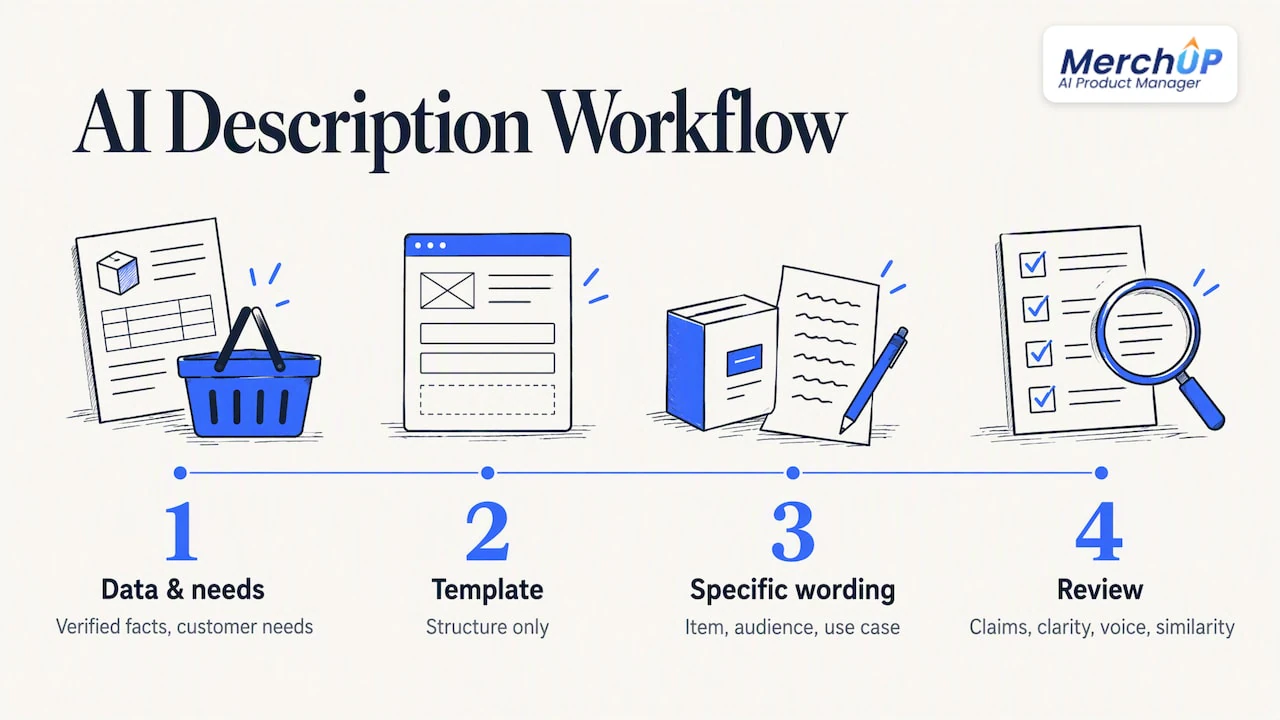
The 2024 research gives a sound workflow for templates and AI. Start from verified product data and customer needs, use templates only for structure, and make the final wording specific to the item, audience and use case. When using AI, treat the output as a draft: check every specification and claim, remove anything unsupported or copied-looking, edit by hand for clarity and brand voice, and run a similarity check before publishing.
If you are weighing AI for volume, our guide to AI product descriptions that convert goes into the details, and the product descriptions that sell guide covers the writing fundamentals. If search visibility is part of your goal, product description SEO shows how readable copy and keywords fit together.
How to test whether shoppers understand your copy
You do not need to guess. Before rewriting, look at what customers already tell you: support emails, product reviews, on-site search terms and returns reasons. If the same question keeps arriving (“does this fit a king-size bed?”), the description is not answering it.
Then change one thing at a time. A sound test starts with a specific hypothesis, such as “moving the dimensions into the first bullet will reduce sizing questions”. Use purchase conversion or revenue per visitor as the main measure, add-to-cart and checkout starts as secondary measures, and refunds or support contacts as guardrails, as one Shopify testing guide suggests. Small stores may not have the traffic for a statistically clean test, so a simpler before-and-after comparison on your best sellers, with the limits in mind, is better than no check at all. Our product description analytics guide shows how to audit your top SKUs.
Our perspective: readable copy is a workflow problem
Most stores do not have a writing problem. They have a volume problem. When you add new products every week, the description is the last job on the list, so it gets copied from the supplier, pasted from the last product, or left thin. Readability suffers because nobody has time to edit.
We built MerchUp AI as an AI product manager for that reason. The listing, the designed description, the photos and the SEO are one job, not four. When the copy is written into a template that already has a sensible structure, the human time goes where it matters: checking the facts, trimming the sentences and making sure the wording sounds like your shop. We would never suggest that a tool replaces that last review, and neither does the research: AI output is a draft.
Our advice is to decide on your structure once, keep sentences short, put the facts first, and review everything before it goes live.
— Jamie Moss
Make every listing readable without rewriting by hand
MerchUp AI is available now for Shopify. You can scan or photograph a product, get a full listing with a description written into a designed template, add AI product photos and publish. For trading-card sellers, it also identifies cards and estimates centering and condition. Its AI product description generator gives you consistent structure across your catalogue, and there is a free plan to try it on a few products. Paid plans are Starter at £12.99 a month, Growth at £34.99, Pro at £79.99 and Scale at £199.99, all listed on the pricing page.

If search is part of the picture, MerchUp AI does all your SEO in one click. It reads your own Google Search Console data and live Google results, picks keywords, writes meta titles, descriptions and image alt text, checks rankings and pushes everything to your store, with no SEO knowledge needed. Every change is reviewed before it goes live, with full history and restore.
FAQ
What is a good readability score for a product description?
There is no single target. Flesch-Kincaid gives a US school grade level, and lower means easier, so plain consumer products usually benefit from a low grade. But the score only counts sentence length and word complexity, so use it as a quick screen and judge the copy by whether a first-time shopper understands it.
Should product descriptions be short or long?
As long as the shopper needs. Research from Baymard shows overly brief descriptions can undermine buyer confidence, while research on poorly rated descriptions links them to excess length and repetition. Cover what a buyer must know, put it in order of importance and cut the rest.
Is it plagiarism to reuse a manufacturer’s product description?
Facts such as dimensions and materials are not protected by US copyright, but creative wording can be. There is no safe number of copied words, so write your own description, get permission to use supplier text, and run a similarity check. For a specific dispute, ask an intellectual property lawyer.
Can I use AI to write product descriptions and keep them readable?
Yes, as long as you treat the output as a draft. Feed it verified product data, fact-check every specification, remove unsupported claims and copied-sounding phrases, and edit for clarity and brand voice before you publish.
Are bullet points always better than paragraphs?
No. Bullets suit specifications and steps, while a short paragraph suits explaining who the product is for. Eye-tracking evidence suggests the effect varies by product, so test formats on your own categories.
Sources
- How Texts Confuse Online Buyers: Quantifying Text Quality (Journal of Electronic Commerce Research, 2024)
- Baymard Institute: Product descriptions research
- Shopify Help Center: Writing engaging product descriptions
- Nielsen Norman Group: Tips for Better Product Descriptions on Websites
- CXL: How Does Product Copy Format Affect User Engagement?
- Machine Generated Product Advertisements: Benchmarking LLMs
- Toolkit for Making Written Material Clear and Effective
- Copyright Law: Copyrightability of product descriptions
- Amazon product descriptions: legal guidelines
- The Complete Guide to A/B Testing Product Descriptions on Shopify


Comments
No comments yet — be the first to share what you think.