


Product copy for a large catalogue works when you stop treating each listing as a blank page. Start with clean product data, agree one structure and voice, let AI draft from that data, and review by exception rather than line by line. Do that and hundreds or thousands of listings can read as if one careful writer produced them.
This guide covers what catalogue copy is, why it falls apart past a few hundred products, how to build a repeatable system, and how to automate it on Shopify without publishing errors.
TL;DR
- Catalogue copy is short, factual and consistent: product type, key features and specifications, written to one structure across every listing.
- Fix the data first. Copy generated from missing or messy attributes will be thin or wrong, however good the writer or the model.
- Use AI for the first draft and humans for exceptions, high-value products and anything with legal weight, such as origin claims.
- Add structured data and unique meta titles, descriptions and image alt text so search engines can read the catalogue at scale.
- Review every batch before it goes live, keep a history, and measure what changes.
What product catalogue copy actually is
Catalogue copy is the text that sits beside a product in a catalogue or store: the name, a short description, a list of features and the specifications. It is not a brand essay. Its job is to help a shopper decide quickly, and to let a search engine understand what the item is.
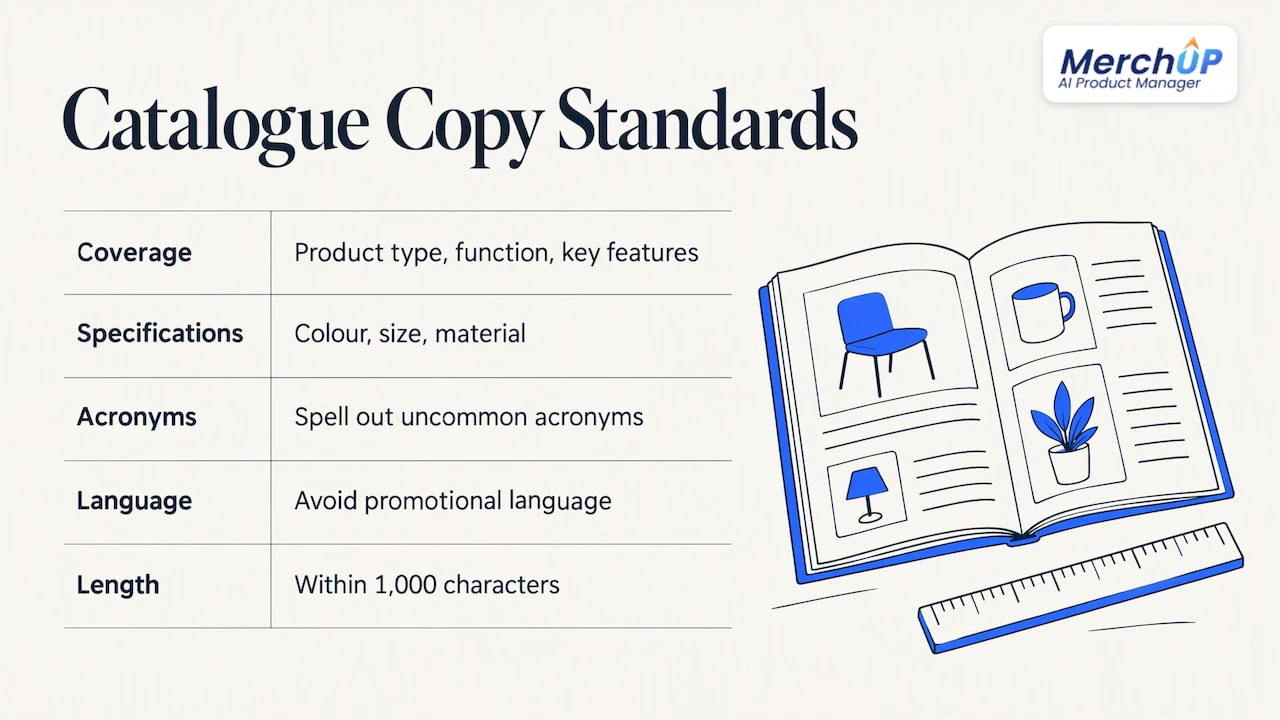
The constraint is space and repetition. You are writing the same kind of text hundreds of times, so the structure matters more than any single clever line. One useful public benchmark comes from the US General Services Administration, whose catalogue standards ask for descriptions that cover product type, function, key features and specifications such as colour, size and material, spell out uncommon acronyms, avoid promotional language and stay within 1,000 characters. You do not have to follow a government standard, but it shows how disciplined catalogue writing is meant to be.
For a Shopify store, the same idea applies to fields beyond the description: title, product type, vendor, tags and SEO fields all belong to the copy. If you want the building blocks, our guide to product description structure breaks down the order that works.
Why copy breaks down as the catalogue grows
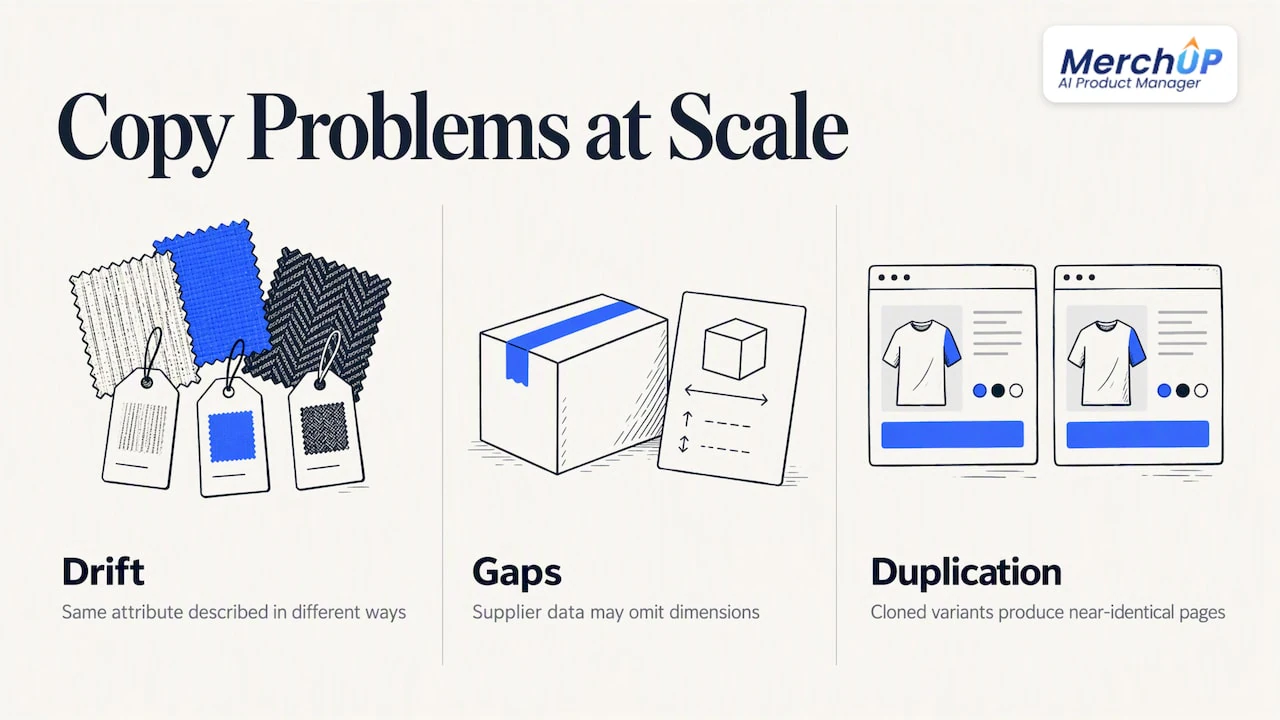
With 30 products, one person can hold the tone in their head. With 3,000, three things go wrong.
Drift. Different writers, or the same writer on different days, describe the same attribute in different ways. One listing says “100% cotton”, another says “pure cotton”, a third omits it. Shoppers filtering or comparing cannot trust the page.
Gaps. Products arrive with whatever data the supplier sent. Some have dimensions, some do not. Copy written over gaps either invents detail or goes vague.
Duplication. Copying supplier text or cloning near-identical variants produces pages that look the same to shoppers and to Google. Cloning tools solve the speed problem but not the quality one, and that is why a search for catalogue copy mostly returns product-duplication utilities rather than writing help.
A Shopify-focused agency makes a related point: a style guide with no owner is only a suggestion, and systems tend to document ideal products while ignoring the awkward exceptions. Both warnings shape the system below.
Build the system before you write a word
1. Decide the attributes each product type needs
List your product types and, for each, the facts a buyer needs: material, size, compatibility, capacity, set contents, care. This becomes the skeleton of every description. Our piece on attribute-based descriptions shows how to drive copy from data when you have thousands of SKUs.
2. Allow for exceptions
Not every attribute applies to every product. The same Shopify agency suggests defining an exception budget for categories where a mandatory attribute is missing or irrelevant. That prevents rigid fields filled with nonsense on one side and uncontrolled, messy descriptions on the other. In practice: mark which fields are required, which are optional, and who may approve a gap.
3. Write a one-page style guide
Keep it short enough that people use it:
- Voice: first or second person, sentence length, words you avoid.
- Structure: opening sentence, feature bullets, specification block.
- Formatting: units, capitalisation, how you write sizes and colours.
- Claims: what needs evidence before it appears.
A consistent voice also helps shoppers feel the business is talking to their needs, a point made in catalogue copywriting guidance from Ilise Benun.
4. Name an owner
Someone must be able to say no. For a small store that is you; for a team it is one named editor who reviews samples each week.
5. Choose a template per product type
Templates are what make scale feasible. If you want ready-made starting points, see our product description templates and the guide to bulk product descriptions.
What good catalogue copy looks like
Every guide to the craft lands in roughly the same place. Marketplace content standards from Sears describe effective copy as short, informative, truthful, accurate and substantiated, with the most useful features first and simple, scannable language. They also recommend separating a short paragraph description from a bulleted list of features, ordered from most to least relevant.
On the persuasion side, advice from catalogue specialists agrees that copy should focus on benefits and customer pain points, stay short, use active voice and familiar language, and avoid technical jargon. Another long-standing view is that because space is limited, concise copy built on nouns and verbs that connects features to benefits and answers likely objections does the most work.
Here is how that looks for a single product, a stainless steel water bottle:
| Layer | Weak | Strong |
|---|---|---|
| Opening line | A great bottle for everyone. | Keeps drinks cold for a full day of walking, or hot for a morning commute. |
| Features | Premium quality, durable. | Double-wall stainless steel, 750 ml, fits standard cup holders. |
| Specifications | Missing. | Height, weight, lid type, dishwasher safety. |
| Objection handled | None. | Leak-proof lid, with the seal replaceable. |
Note that the strong version only works if the capacity, lid and dishwasher data exist. This is why data comes before copy. For more worked examples, browse our product description examples and the guide to descriptions that sell.
Automating copy without making things up
At volume, manual writing is not realistic. Researchers at DoorDash argue that manually enriching catalogues at scale is impractical and recommend systems that check proposed attributes against several sources of evidence. Their TRACE framework uses one agent to gather evidence and another to verify it, and reported 98.2% extraction accuracy on a human-evaluated dataset, with 74.7% attribute coverage. The lesson for a store owner: accuracy and coverage trade off, so a good process fills what it can prove and flags the rest.
Wayfair researchers describe a similar pattern, where e-commerce AI often begins with a cold-start problem in which human review is needed until the system is trusted, then shifts gradually towards automation. Their router sends easy cases straight through and escalates likely failures to people. You can copy that idea with no engineering team:
- Auto-approve simple, low-risk products with complete data.
- Spot-check a sample of each batch, say one listing in ten.
- Always review high-margin products, new categories and anything with claims.
- Escalate products with missing attributes to whoever owns the data.
Claims that need a human
Some statements carry legal weight in the United States. The FTC’s guide to online advertising notes that a product labelled Made in the U.S.A. must be all or virtually all made in the United States, and that textile and wool product descriptions in catalogues and internet ads must state country of origin. An AI model will happily write a confident sentence about origin. Make sure origin, safety, compatibility and health statements come from your data, not from the model’s guess.
Keeping listings distinctive
Distinct does not mean decorative. Use the specific attributes of each product, its variants and its use cases so no two pages share a block of text. For genuinely differentiated ranges, such as premium goods, tone matters more; our guide to luxury product descriptions covers that.
Optimising a large catalogue for search
At scale, SEO is mostly about consistency and completeness: every product needs a unique title, meta title, meta description and image alt text, and the page needs structured data.
Google’s documentation says that Product and ProductGroup data tell Google about your products, that BreadcrumbList helps it understand page hierarchy, and that structured data can improve its understanding of content and intent. If you want to see which types to add first, this rundown of ecommerce schema markup types is a practical companion, and our own guide to product schema markup covers the setup.
The usual failure with large catalogues is not technical. It is that nobody has the time to research keywords for 2,000 products. The efficient approach is to use your store’s own Search Console data to see which queries already bring impressions, then write meta titles and descriptions around them, and check rankings afterwards. Prioritise your top sellers and the products with impressions but few clicks first.
How a small business can do this efficiently
A small team cannot afford a month of copywriting. A workable weekly rhythm looks like this:
- Monday: import or scan new products and complete the attribute fields.
- Tuesday: generate drafts from the template for each product type.
- Wednesday: review a sample, fix patterns in the template rather than individual listings.
- Thursday: publish, with SEO fields and alt text filled.
- Following week: check which pages gained impressions and clicks.
The key habit is to fix the template, not the output. If three drafts overuse the same phrase, edit the instruction once and regenerate, instead of repairing every page by hand.
Reviewing and measuring quality at scale
You cannot read everything, so build checks:
- Completeness: share of products with every required attribute and SEO field filled.
- Consistency: units, capitalisation and structure match the guide.
- Uniqueness: no two products share a long block of identical text.
- Accuracy: sampled listings checked against supplier or product data.
- Outcome: impressions, clicks, add-to-cart and conversion by product group.
Evidence that data quality pays off exists, though it is modest and specific: in an online experiment, surfacing enriched product attributes from the TRACE system was associated with a 0.48% increase in checkout conversion. Treat that as a reminder that better product information moves numbers, not a promise for your store.
Our perspective
Most advice about large catalogues is really advice about writing, but at volume the bottleneck is rarely the sentences. It is the steps before and after them: getting the product into the store with correct data, then getting the finished page found. That is why we built MerchUp AI as an AI product manager rather than only a description writer. You scan or photograph a product, get a full Shopify listing with a designed description and AI product photos, and publish it.
We also think automation without review is a bad trade. Every change in MerchUp AI is reviewed before it goes live, with full history and restore, so a bad batch is a few clicks to undo rather than a weekend of repair. Speed is only useful when you can trust what you ship.
— Jamie Moss
Doing it on Shopify with MerchUp AI
MerchUp AI is available now for Shopify. It turns a product photo, barcode or trading-card scan into a complete listing: title, type, vendor, price, tags and SEO. It writes the description into a designed template, creates AI product photos and publishes. Its SEO tool reads your store’s own Google Search Console data and live Google results, picks keywords, writes meta titles, descriptions and image alt text, checks rankings on live Google and pushes everything to the store in one click, with no SEO knowledge needed.

There is a free plan, so you can test it on a small batch. Paid plans are Starter at £12.99 a month, Growth at £34.99, Pro at £79.99 and Scale at £199.99. To see how the pieces fit, look at the AI description generator or the AI product scanner. If you sell trading cards, the trading card scanner identifies cards and prices them from the market, and the card scanner add-on starts from £7.99 a month.
FAQ
What is catalogue copy?
Catalogue copy is the concise product text in a catalogue or online store: names, short descriptions, feature lists and specifications. It prioritises clear facts and benefits over long storytelling, and it follows one structure across all products so shoppers can compare items quickly.
How long should each product description be?
Long enough to answer the main purchase questions and no longer. A short paragraph plus a bulleted feature list works for most products, and the GSA catalogue standards cap descriptions at 1,000 characters. Complex or high-value items can run longer, with the specifications in a separate block.
Can AI write product copy for a whole catalogue?
Yes, for drafting, provided it works from accurate product data and you review the output. Let it handle routine products and keep a person on high-value items, new categories and any claim about origin, safety or compatibility. Reviewing in batches with a restore option keeps mistakes cheap.
How do I stop descriptions sounding the same?
Drive each description from the product’s own attributes, variants and use cases, and use more than one template per product type. Avoid copying supplier text. Sameness is mostly a data problem: the more specific the attributes, the more distinct the copy.
Do I need schema markup on every product page?
It is strongly worth having. Google’s documentation recommends Product and related structured data for ecommerce pages, and a template-level setup applies it to every product at once, so you do not add it page by page.
Sources
- GSA Catalog Standards: product name and description guidelines
- How to keep product descriptions consistent across a large catalogue
- Catalogue copywriting: write effective product descriptions
- Marketplace Seller Content Standards
- Writing great catalogue copy: 7 tips
- 4 secrets for writing compelling catalogue copy
- TRACE: agentic catalogue enrichment
- The Differential Reasoning Router
- FTC: Advertising and marketing on the internet
- Google Search Central: structured data for ecommerce sites
- Ecommerce schema markup types


Comments
No comments yet — be the first to share what you think.