


A good fashion product description does three jobs. It tells shoppers what they cannot feel (fabric, fit, drape), it makes them picture themselves wearing the piece, and it gives search engines clear words to match. Get those right and the page sells more and returns less. This guide shows what to include, how to word it, and how to keep quality up when you add new styles every week.
TL;DR
- Lead with what the item is and who it is for, then cover fit, fabric, styling and care in a predictable order.
- Be specific: measurements, fibre content, model height and worn size beat adjectives like “gorgeous” every time.
- Write in one consistent brand voice, directly to your customer, using “you”.
- Use the words shoppers actually search for in titles and descriptions, and link to related products and collections.
- With weekly drops, work in small batches, review every draft against your source data, and use return reasons to fix weak pages.
What a fashion description has to do
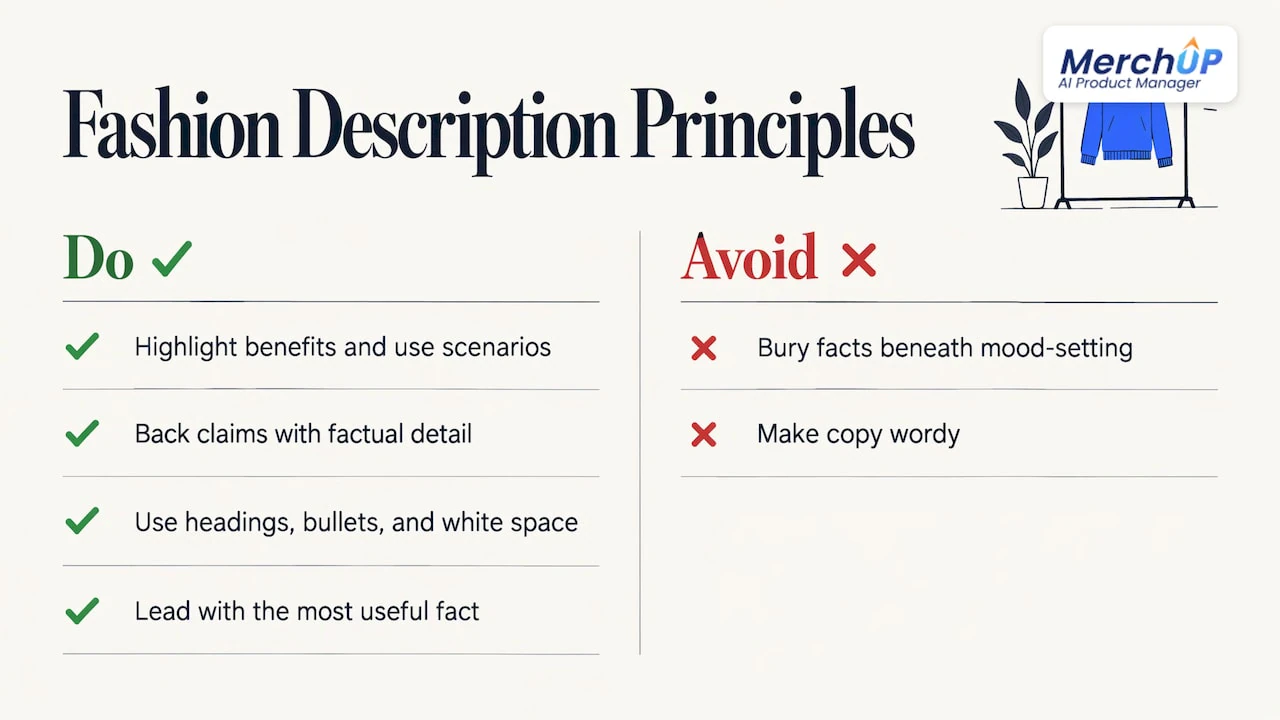
Shoppers cannot touch the cloth or try the cut. The description stands in for the fitting room. Shopify’s own guidance on writing product descriptions says to highlight benefits and use scenarios, back claims with factual detail and make the text scannable with headings, bullets, white space and readable type. For fashion specifically it points to dimensions, materials, function, care instructions and fit.
There is also a reading habit to design for. The Nielsen Norman Group finds that online shoppers skim, paying most attention to the start of a description and the start of each line. Their advice is to answer the questions users have, stay direct and be complete without being wordy.
In practice that gives you a simple rule: put the most useful fact first in every paragraph and every bullet. “Relaxed fit, true to size” at the start of a line does more work than a paragraph of mood-setting that buries the same fact.
Benefit first, detail second
A feature is what the garment has: a lined bodice, a 100% linen weave. A benefit is what that does for the wearer: stays cool on a 30°C day, holds its shape after a long train ride. Pair them. “Fully lined, so it does not cling” is stronger than either half alone.
Keep every claim checkable
Fashion copy drifts into superlatives fast. “The softest jersey you will ever own” cannot be verified, and it sets an expectation the fabric may not meet. Shopify’s guidance asks for factual support behind claims, so swap the superlative for something measurable: weight of the fabric, fibre blend, stretch percentage, how it feels against skin compared with the same style in another fabric you sell.
The details to include, item by item
Shoppers who cannot find a detail do one of two things: leave, or buy and return. A style guide published by a major retailer for its suppliers lists the fields for clothing: product type and intended wearer, silhouette or fit, length, fibre composition, fabric or finish, stretch, closures, colour or pattern, size range, model measurements and worn size, care, origin and occasion. For accessories it adds dimensions, materials, hardware, capacity, included pieces, and condition or authenticity for resale.
Amazon’s US fashion style guide agrees on the core: it recommends highlighting material, fit and country of origin, and keeping the order consistent across listings. It also advises against promotional or pricing language in bullets, because prices and offers change while the garment does not.
Here is a working checklist you can adapt.
| Item type | Always include | Include when relevant |
|---|---|---|
| Dresses and tops | Silhouette, length, fibre content, size range, model height and worn size, care | Stretch, lining, neckline, closure, occasion |
| Trousers and denim | Rise, inseam, fit, fabric weight or composition, size range | Stretch, wash, pocket details, tailoring notes |
| Outerwear | Length, fill or lining, fabric, closures, fit over layers | Water resistance, hood, origin |
| Knitwear | Fibre blend, gauge or thickness, fit, care | Itch factor, shrinkage guidance, pilling care |
| Shoes | Materials, sole, heel height, width, sizing note | Arch support, break-in time |
| Bags and accessories | Dimensions, materials, closure, capacity, hardware | Strap drop, what fits inside, items pictured but sold separately |
Two small habits pay off. State anything pictured but not included (a belt, a scarf, jewellery). And give the model’s height and the size they are wearing, ideally in the same place on every page.
Words, voice and the customer you are talking to
Words that work in fashion are sensory and specific: brushed, crisp, fluid, structured, heavyweight, cool to the touch. Words that do not work are the ones that fit every garment: stunning, perfect, must-have. If a word could sit on any product page in your store, replace it.
Pick a voice and hold it
A useful test is to read a description with the logo hidden and ask whether a regular customer would still know whose it is. A laid-back label can keep sentences short and relaxed. A refined label can be more measured and confident. A sustainability-led brand will talk about materials and values in a warm, thoughtful tone. Whichever you choose, write it down: three to five personality adjectives and a short “we sound like / we never sound like” list are enough to keep several writers, or an AI tool, on track.
Write to one person. Using “you” and “your” makes the garment feel like it belongs in a real life: “Wear it with trainers on a weekend, or with loafers for the office.” That single line covers styling and occasion at once.
Describe the scene, not the mood board
Brands often write about a feeling (“effortless elegance”) when the shopper’s question is practical. Cover both, in that order of priority. First what the piece does: the dress is cut to sit just below the knee, the fabric is opaque, it does not need ironing. Then the picture: a summer wedding, a commute, a weekend market.
A structure you can reuse for every product
A repeatable structure keeps pages consistent and lets shoppers find the same fact in the same place. One that works for most apparel:
- Opening line (one or two sentences). What it is, who it is for, the main reason to want it.
- Fit. Cut, length, how it sits, model height and worn size.
- Fabric and feel. Composition, weight, stretch, finish.
- Styling. Two or three ways to wear it, with the occasion.
- Care and origin. Washing instructions, where it was made.
- Bullet summary. The hard facts, scannable.
Here is an illustrative example for an invented product:
The Harbour Shirt Dress. A relaxed, knee-length shirt dress in washed cotton poplin, made for warm days that turn into cool evenings.
Fit: Easy through the body, with a tie waist you can loosen or cinch. Model is 5’9" and wears a size 8.
Fabric: 100% cotton poplin, medium weight and opaque. Softens with each wash.
Style it: Open over a white tee with trainers, or buttoned and belted with ankle boots.
Care: Machine wash cold, line dry.
It is short, front-loads the useful words and leaves nothing for the shopper to guess about fit or care.
Making descriptions findable in search
Shoppers search the way they talk: item, colour, occasion. Amazon’s style guide recommends using customer language and synonyms in titles and search terms, and that principle carries over to your own store. Someone looking for a “linen midi dress” may also type “summer dress for a wedding guest”. Your copy should naturally contain both phrasings where they are true.
Practical rules for your own store:
- Put the main product phrase in the title, the first sentence and the meta description, where it reads naturally.
- Add secondary phrases such as the fabric, the occasion and the fit in the body, never as a stuffed list.
- Write unique copy for each product, even for near-identical colourways. Mention the colour-specific facts, like dye or finish.
- Link to related products, matching collections and your size guide, so shoppers and crawlers can move through the catalogue.
- Write meaningful image alt text: “Model wearing navy linen midi dress, front view” rather than “IMG_4821”.
Structured data helps too. If you want to understand how product information reaches search engines in a machine-readable way, our guide to Shopify product schema covers it.
Search work that does not need a specialist
MerchUp AI does all your SEO in one click. It reads your store’s own Google Search Console data and live Google results, picks keywords, writes meta titles, descriptions and image alt text, checks rankings on live Google and pushes everything to your Shopify store. No SEO knowledge is needed, and every change is reviewed before it goes live, with full history and restore.
Writing descriptions every week without losing quality
A boutique adding twenty styles a week cannot hand-write each page from scratch, and should not publish raw machine output either. The workable middle is a template plus a review step.
- Build a source sheet. One row per product with fibre content, measurements, sizes, colours, care and origin. Everything in the description should trace back to this row.
- Write your rules. Voice adjectives, opening-line pattern, word range, words to avoid.
- Run a small first batch. Ten to twenty products is plenty. Read all of them and note what repeats or sounds off, such as long openers, same sentence patterns or the wrong tone, then fix the template.
- Check facts line by line. Every number, material and care claim must match the source sheet exactly.
- Publish, then scale up.
If you prompt an AI tool, give it the audience, the features, the benefits, the format and the length limit, then edit for accuracy and voice. Treat the first batch as the one that teaches you the most. Later batches should need lighter edits.
This is where MerchUp AI fits. It is an AI product manager for Shopify: it turns a product photo or barcode into a complete listing with title, type, vendor, price, tags and SEO, writes the description into a designed template, can create AI product photos, and publishes it. You review the result before it goes live. Our tutorial shows the flow, and our guides to bulk product descriptions and bulk editing descriptions in Shopify go further on handling many SKUs at once. For fashion, AI product photos also help keep the imagery consistent across a catalogue.
Checking whether your descriptions are working
Descriptions are not finished at publication. Returns are a direct signal of what the page failed to say. A simple monthly loop works:
- Collect a structured return reason for each return (too small, too large, colour different, fabric not as expected).
- Group reasons by product.
- Flag any product where one fixable reason keeps coming up.
- Edit the matching part of the page: a measurement, a material note, a photo, a fit caveat.
- Look at the next month’s returns to see whether it moved.
Free-text comments are worth reading too. If three customers say a jacket “runs short in the sleeve”, the fix is a sleeve length in the fit section, not a rewrite of the whole page.
Alongside returns, watch conversion rate and time on page for your top sellers, and compare pages you rewrote with similar pages you did not.
What we think about fashion copy
We build MerchUp AI around one belief: a product page is a whole product, not a block of text. The description, the photos, the title, the tags and the search data all have to agree, or the shopper senses something is off.
That is why we do not treat description writing as a separate job. In MerchUp AI you start from a photo or barcode, get a complete Shopify listing, and have the description written into a designed template so every style in your store looks like it belongs to the same brand. Our AI is designed to take away the repetitive work, and you stay in control, because every change is reviewed before it goes live and can be restored from the history.
For fashion sellers adding new pieces weekly, the benefit is consistency at pace. Your fit section sits where shoppers expect it, your SEO is handled from your own Google Search Console data and live Google results, and your time goes into choosing stock and telling your brand’s story.
Jamie Moss
Put it into practice with MerchUp AI
If you are adding fashion products to Shopify regularly, MerchUp AI turns a product photo into a full listing, writes the description into your chosen template, creates AI product photos, handles your SEO in one click and publishes it. There is a free plan, and paid plans start at £12.99 a month with Starter, then Growth at £34.99, Pro at £79.99 and Scale at £199.99. See the details on the pricing page.
MerchUp AI is available now for Shopify, with Webflow, Wix and WordPress coming soon. To see how the tools work together, take a look at how MerchUp AI’s tools fit together.
FAQ
How long should a fashion product description be?
Long enough to answer the shopper’s questions about fit, fabric and care, and no longer. For most apparel that means a short opening paragraph plus a few labelled lines or bullets. Because shoppers skim, put the key facts at the start of each line.
What are good words to describe fashion items?
Choose words that describe how the item looks, feels and behaves: crisp, fluid, structured, brushed, lightweight, heavyweight, stretchy, relaxed. Tie each to a fact, such as the fabric or the cut. Avoid vague words like “stunning” that could apply to anything in your store.
Should every colour of the same style have its own description?
Yes, it is better when each page has its own copy, at least for the opening line, the colour and any finish or dye detail. Shared facts like fit and care can stay the same. Unique text helps each page stand on its own in search.
Can AI write fashion product descriptions?
Yes, as a first draft built from your own product data. Give it the audience, features, benefits, format and length, then review every draft for accuracy and brand voice before publishing. In MerchUp AI, drafts are written into your template and reviewed by you before they go live.
What should I do about returns caused by unclear descriptions?
Track the return reason per product and look for repeated, fixable causes like sizing or colour. Add the missing measurement, material note or photo to the page, then watch the next month’s returns to check it worked.
Sources
- Shopify Help Center: Writing engaging product descriptions
- Nielsen Norman Group: Tips for Better Product Descriptions on Websites
- David Jones: Online Product Guidelines
- Amazon: US Fashion Style Guide


Comments
No comments yet — be the first to share what you think.