


A good furniture product description answers the questions a shopper would ask if they could walk around the piece: how big is it exactly, what is it made of, how does it feel, will it fit through my door, and how do I look after it? Put those answers in a scannable block of specifications, then use a short paragraph of prose to explain what the piece is like to live with. Everything below shows you how to do that, category by category.
TL;DR
- Lead with a short benefit-led paragraph, then give labelled specifications. Never bury dimensions inside prose.
- Shoppers look hard for material and care information, so state both on every product page.
- Match the fields to the category: seating, tables, storage and lighting each need different measurements.
- Describe every variant (size, colour, material) in the same format, using the same units across the catalogue.
- Review each description against search and shopper data, then fix the pages that get views but no sales.
Why furniture descriptions work differently from other products
Furniture is big, expensive and hard to return. A shopper cannot sit in the sofa or feel the oak. The description and photos have to do that job.
Baymard Institute’s usability research, based on more than 275 test sessions, found that users need plenty of detail about features and specifications. Nearly all participants went looking for material and care information to understand a product’s look and feel, its composition and its maintenance needs.
The Home Furnishings Association says core furniture eCommerce content should include dimensions, materials, construction details and care instructions. It should be easy to scan, with more depth available for shoppers who want it. It also notes that dimension diagrams help people judge scale more accurately.
That gives you two jobs for every product page:
- Remove doubt with precise facts.
- Help the shopper picture the piece in their own room.
The anatomy of a furniture product description
A structure that works for most pieces has five parts, in this order.
1. A title that names the piece
Use the product type, the defining material or style, and one differentiator. “Walnut Mid-Century Sideboard with Three Doors” tells a shopper and a search engine more than “The Oslo Collection”. Put the collection name after the plain description if you use one.
2. An opening paragraph of two to three sentences
Say what the piece is, who it suits and the main reason to choose it. Keep it concrete: “A compact two-seater sofa for apartments, with a solid beech frame and removable washable covers” beats “elevate your living space”.
3. Feature and benefit bullets
Four to six short bullets. Each one pairs a fact with what it means for the buyer. The Home Furnishings Association describes the shift from features to benefits as explaining how construction, materials and design solve the customer’s problem. For example:
- Kiln-dried hardwood frame, joined with dowels and corner blocks, built for everyday use.
- High-resilience foam seat cushions that you can rotate and plump.
- Removable covers, so a spill does not mean a new sofa.
Only write what you can stand behind. If the maker’s data does not state a load rating or a warranty, leave it out.
4. A labelled specification block
This is where most furniture pages fall short. More on it in the next section.
5. Care, delivery and assembly notes
Cover how to clean it, whether it ships assembled, how long assembly takes and what delivery involves. These are the details that otherwise turn into support emails.
Dimensions and specifications: the block shoppers actually use
“80 inches wide” is rarely enough. Attribuly’s furniture product page checklist says that for seating you should show overall width, depth and height, plus seat width, seat depth, seat height, arm height, back height, leg clearance and removable components. It also recommends packaged dimensions and weight, minimum doorway width, whether legs, arms or backs detach, and a diagram that labels every measurement.
Present these as a table or a two-column list, not a paragraph. Crawlable HTML text is better than an image of measurements: the EcomSEO Academy playbook advises structured dimension tables rather than dimension images, so search engines can read the numbers.
Field checklist by category
| Category | Dimensions to show | Other fields to include |
|---|---|---|
| Sofas and chairs | Overall W x D x H, seat width, seat depth, seat height, arm height, back height, leg clearance | Frame material, cushion fill, upholstery type and cleaning code, removable covers, box size, doorway clearance |
| Tables | Overall size, top thickness, apron clearance, leg spacing | Recommended seating count, top material, finish, whether leaves or legs detach |
| Storage (wardrobes, sideboards, shelves) | Overall size and internal dimensions | Shelf adjustability, drawer runners, door type, wall fixing, weight capacity |
| Beds | Mattress size, overall frame size, headboard height, under-bed clearance | Slat type, assembly time, box dimensions |
| Lighting | Canopy, cord, drop and shade dimensions | Bulb type, wattage, indoor or outdoor rating |
The seating, table, storage and lighting fields follow the checklist from Attribuly. Beds follow the same logic: give every measurement a buyer needs to check against their room.
Units and consistency
The Racklify entry on marketplace product specifications lists common seller errors: inconsistent units, imprecise colour names, package dimensions where product dimensions belong, and key assembly or load fields left blank. Its fixes are practical:
- Pick one unit order and use it everywhere. US shoppers expect inches and pounds first. Add metric in brackets if you ship abroad.
- Take figures from the maker’s spec sheet or drawings, not from a tape measure on a sample.
- Name colours with a common term plus a short descriptor, such as “Grey: cool slate”.
Write numbers with the unit every time: 84 in, not 84. And avoid vague words such as “large” or “standard”. If you must give a range, say so: “seat height 17 to 18 in depending on cushion compression”.
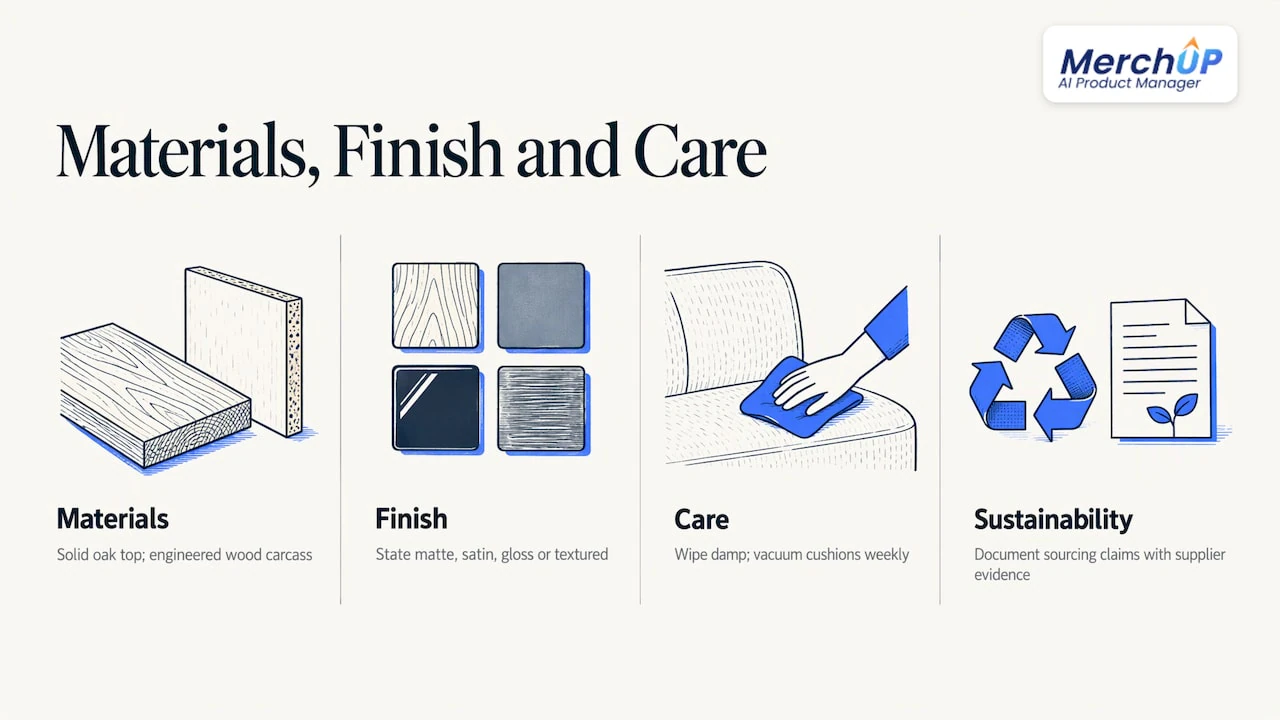
Materials, finishes and care
Material and care are the other half of the Baymard finding, so treat them as required fields, not optional extras.
Materials. Name the exact material for each part: solid oak top, engineered wood carcass, powder-coated steel legs, 100% polyester performance fabric. “Wood” and “fabric” are not answers. For upholstery, say the fibre, the colour and the pattern, and mention any treatment such as stain resistance only if the maker supplies it.
Finish. State matte, satin, gloss or textured. Photographs distort sheen, so words carry the weight here.
Care. Give one or two lines: wipe with a damp cloth, keep out of direct sunlight, vacuum cushions weekly, use coasters on veneer. If the fabric has a cleaning code, print it.
Sustainability. Jellyfish observes that shoppers increasingly care about waste and environmental impact, and suggests mentioning fair-trade provenance, ethical sourcing or recyclable materials in individual product descriptions. Include this only when you hold documents for it, such as a certificate from the supplier.
Natural variation, said plainly
Solid wood, leather and handmade pieces vary. Say so in one sentence on the page: “Each piece is unique; grain and tone will vary.” It sets expectations and answers the question before it becomes a complaint.
Turning features into benefits without overclaiming
Benefit writing goes wrong when it drifts from the facts. Use this three-step test on every line:
- Fact: what is true of the product? (“Solid beech frame”)
- Meaning: what does that do for the buyer? (“A rigid base that stays steady over years of use”)
- Evidence: where does the fact come from? (The maker’s spec sheet)
If a line fails step 3, cut it. Words such as “indestructible”, “lifetime” and “hypoallergenic” need paper behind them.
Here is the same sofa described badly and well.
Weak: “Our stunning sofa is the perfect addition to any home. High quality materials. Very comfortable.”
Stronger: “A two-seater sofa sized for apartments: 72 in wide, 36 in deep, with a 17 in seat height that suits most adults. The frame is solid beech with corner blocks. Seat cushions are removable, and the covers are machine washable at 86°F. It arrives in two boxes, and the narrowest box is 28 in wide, so it clears most standard doorways.”
The second version is longer, but each sentence answers a real question. The measurements above are illustrative, so replace them with your own product data.
Describing variants: sizes, colours and materials
One product with six colours and three sizes is a content problem. Google Merchant Center advises sending product data that shows how each variant differs, including colour, size, pattern and material, and using the parent SKU as the item group ID for all variants of one product.
Practical rules:
- Keep the shared description on the parent product and put only the differences in variant fields.
- Use identical wording for the same attribute across the catalogue. “Width” should never be “Length” on a different page.
- Update dimensions per size. A queen bed and a king bed have different box sizes and assembly needs.
- Write the colour name in the title or variant label, not only in the swatch.
If your catalogue runs into hundreds of SKUs, structure your attributes first and generate descriptions from them. Our guide to attribute-based descriptions shows how, and the guide to product description templates gives layouts you can adapt.
Writing for search without stuffing keywords
Furniture shoppers search by type, material, size and room: “small walnut console table”, “sectional sofa with chaise”, “narrow bookcase”. Your description will rank for those phrases when it genuinely contains those attributes in natural sentences.
What helps:
- A title and first sentence that name the product type and its main material or size.
- Attribute words used where they are true: material, colour, dimensions, room, style.
- Structured data. The EcomSEO Academy playbook recommends Product schema with name, brand, description, SKU, GTIN, image, offers, material, colour, width, height, depth and weight, and says dimensional properties help Google understand products in finer detail.
- Unique copy on each product page, rather than a manufacturer paragraph repeated across stores.
- Descriptive image alt text, such as “walnut sideboard with three doors in a dining room”.
What hurts: repeating “modern sofa” six times in one paragraph. If a sentence reads awkwardly aloud, rewrite it.
If you sell through Google’s shopping surfaces too, our note on Google Shopping descriptions for large catalogs covers how to adapt the text.
How to improve descriptions using shopper and store data
A description is never finished. Use the signals your store already gives you.
- Read the questions. Customer emails, chat logs and reviews that ask “does it fit…” or “what is the seat height” show you exactly which fields are missing. Add the answer to the page and the same question stops arriving.
- Check returns and complaints. If a colour or size mismatch keeps coming up, tighten the colour name, add a finish note or add a diagram.
- Compare views with sales. Pages with plenty of visits and few orders are your first rewrite candidates. Check the specification block and the first paragraph first.
- Look at search data. Google Search Console shows which queries already bring people to a product page. If shoppers arrive for “counter height stool” and your page says “bar chair”, align the wording.
- Change one thing at a time. Rewrite the opening and the spec block on a handful of pages, wait for a reasonable stretch of traffic, then compare against similar untouched pages.
Where MerchUp AI fits
MerchUp AI is an AI product manager for Shopify stores. For furniture, it can take a product photo or barcode and turn it into a complete Shopify listing with title, type, vendor, price, tags and SEO. It then writes the description into a designed template, so the layout stays consistent across the catalogue, and it can create AI product photos for the page.
On the search side, MerchUp AI does all your SEO in one click. It reads your store’s own Google Search Console data and live Google results, picks keywords, writes meta titles, descriptions and image alt text, checks rankings on live Google and pushes everything to your store. No SEO knowledge is needed. Every change is reviewed before it goes live, with full history and restore.

There is a free plan, and paid plans run from Starter at £12.99 a month through Growth at £34.99, Pro at £79.99 and Scale at £199.99 a month. See the MerchUp AI plans, or look at the AI description generator and AI product photos to see how they work on your own catalogue. For many products at once, read our guide to bulk product descriptions.
Our perspective
Furniture is the category where a description does the most work and gets the least attention. Stores spend on photography and then paste a supplier paragraph beneath it. The shopper still cannot tell the seat depth or whether the sofa clears the stairwell.
We built MerchUp AI around a simple idea: a product page is a whole job, not a block of text. The photo, the listing fields, the designed description, the images and the search metadata all have to agree with each other. When one tool handles them together, a store adding new pieces every week keeps the same structure on every page.
That is why we put the template first. Once your specification block, benefit bullets and care notes sit in a designed layout, new products inherit it. The AI fills the content and you review it before anything goes live, with history so you can restore an earlier version.
Our advice to any furniture seller is the same: decide your fields by category, keep your units consistent, and let tooling carry the repetitive work so your time goes on the details only you know, such as the real finish, the real lead time and the real delivery terms.
Jamie Moss
A reusable template
Copy this skeleton and fill it from the maker’s data.
Title: [Product type] in [material/finish], [key feature]

Opening (2-3 sentences): what it is, who it suits, main reason to choose it.

Highlights:
- [Fact] so you [benefit]
- [Fact] so you [benefit]
- [Fact] so you [benefit]

Specifications:
Overall size: W x D x H in
Seat / shelf / top details: ...
Material: ...
Finish: ...
Weight: ... lb
Assembly: [none / required, about X minutes]
Box size: ...   Minimum doorway width: ...

Care: ...
Natural variation note: ...
For a wider set of layouts, see our product descriptions that sell guide.
FAQ
How long should a furniture product description be?
Long enough to answer the shopper’s questions, which for most pieces means a short opening paragraph, a handful of bullets and a full specification block. The prose can be brief, since the measurements and material details carry the weight. Pricier or more complex pieces, such as sectionals, deserve more.
Should dimensions go in the description or in a table?
Put them in a labelled table or two-column list, with a diagram when you can. Dimensions buried in a paragraph are hard to find and hard for search engines to read. Repeat the overall size in the opening sentence if it is a selling point.
What should I say about colour when photos look different on screen?
Use a precise colour name with a short descriptor, such as “Grey: cool slate”, and state the finish (matte, satin or gloss). Add one line that natural materials and screens can look slightly different from the photograph.
Can AI write furniture descriptions?
Yes, provided it works from accurate product data and you review the output. MerchUp AI builds the listing from your photo or barcode, writes the description into a template and lets you check every change before it is published.
Sources
- 3 Key Takeaways For Furniture & Home Decor UX, Baymard Institute
- Designing Better Buying Experiences with Furniture eCommerce UX Strategy, Home Furnishings Association
- From Transactional to Consultative Selling, Home Furnishings Association
- Furniture & Home Decor Product Page Checklist, Attribuly
- Home & Garden SEO Playbook, EcomSEO Academy
- What Are Wayfair Product Specifications, Racklify
- Why product descriptions are the unsung heroes of homeware, Jellyfish
- Best practices for advertising customized products, Google Merchant Center Help


Comments
No comments yet — be the first to share what you think.