


Cross-channel product copy is the same product, described consistently everywhere you sell it. The facts, the positioning and the proof stay fixed. Only the length, tone and emphasis change for each channel. The practical way to do it is to write one accurate core listing first, then adapt it for your online store, marketplaces, social posts and in-person sales, instead of writing each version from scratch.
This guide shows how to build that core listing, how each channel should change it, what to check before you publish, and how a small team can automate the work without letting errors slip in.
TL;DR
- Cross-channel product copy means one set of product facts and one positioning, expressed in a form that suits each channel.
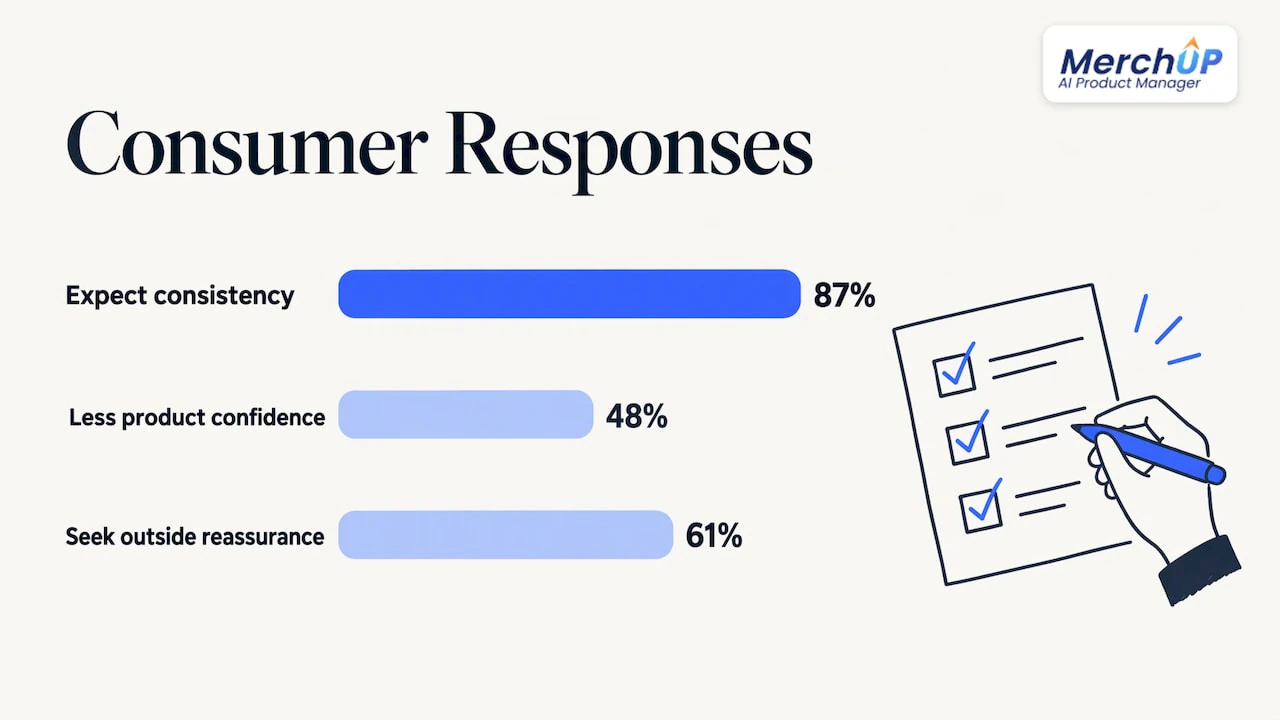
- Mismatched messaging costs trust: in one 2026 survey, 48% of consumers felt less confident in a product when messaging did not match across channels.
- Start with a core listing: verified attributes, a clear benefit, proof and limits. Derive every channel version from it.
- Adapt tone and detail per channel, never the facts. Check specs, price, sizes and claims before every publish.
- AI can draft each version quickly, but only from data you actually hold, and every change should be reviewed before it goes live.
What cross-channel product copy actually means
Cross-channel marketing is usually described as coordinating messaging and content across platforms such as email, social, web and mobile, so the customer’s experience feels connected rather than fragmented. That definition is about campaigns and customer data.
Product copy is the narrower, more practical layer underneath. It is the title, description, bullet points, image alt text, captions and short scripts that describe an individual product wherever a shopper meets it. If your campaign says one thing and your product page says another, the best campaign in the world will not fix the confusion.
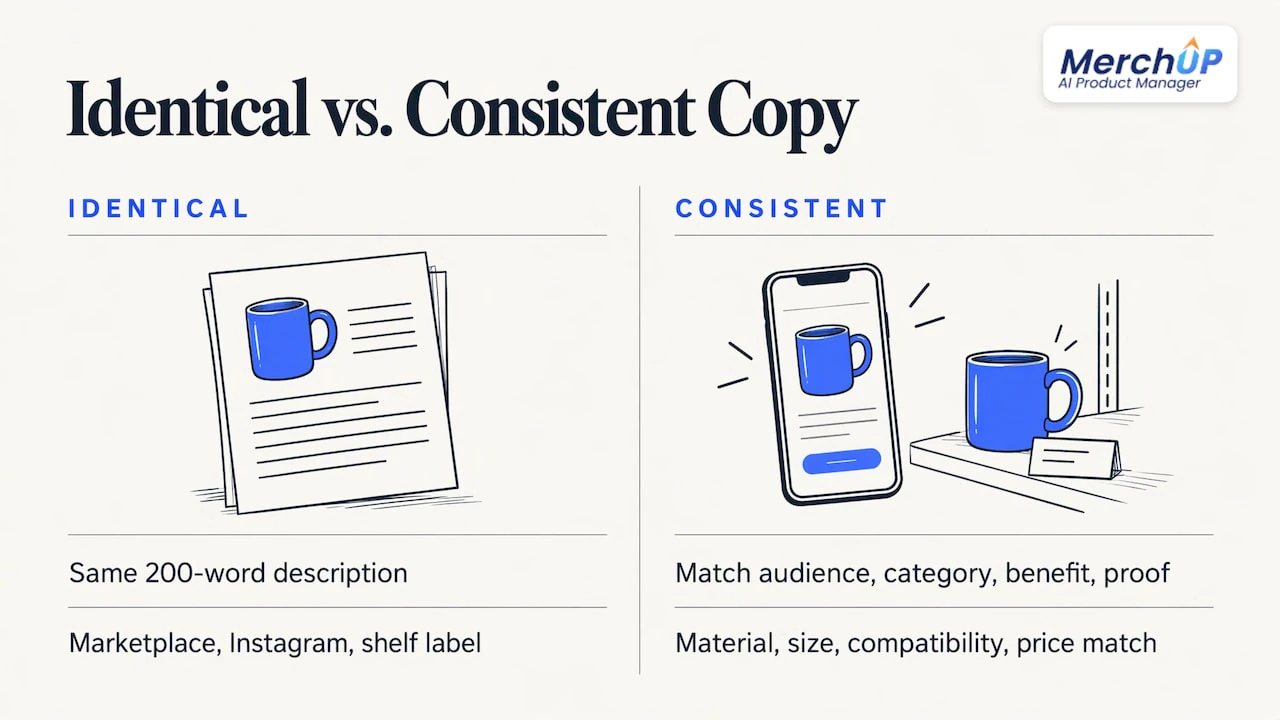
The key distinction is between identical copy and consistent copy. You should not paste the same 200-word description into a marketplace, an Instagram caption and a shelf label. You should make sure that the audience, the category, the main benefit and the proof are the same in all of them, and that no channel contradicts another on a fact such as material, size, compatibility or price.
Why consistency is worth the effort
Shoppers compare. They move from your product page to a marketplace listing to a social post, and they notice when things disagree.
A 2026 survey reported that 87% of consumers expect a consistent experience across all online touchpoints, including company websites, social media, marketplaces and AI-generated search results. The same survey found that 48% feel less confident in a product when messaging does not match, and 61% look for outside reassurance, such as reviews, when they spot inconsistencies.
For a small store this has a direct meaning. Every mismatch sends a shopper off your page to look for proof elsewhere, and some do not come back. Consistency is not a branding nicety. It protects the sale.
It also matters for search. Product titles and descriptions do two jobs: they help shoppers evaluate products and signal relevance to search engines and feed destinations. Specific, accurate language tends to serve both. Vague or contradictory wording serves neither.
Build one core listing first
The most common mistake is to write the store description, then rewrite it for each channel, then rewrite again when something changes. Facts drift. A size chart is updated in one place and not the others.
Instead, create a core listing that is the single source for everything else. It has four layers.
Layer 1: verified product data
This is the plain list of attributes: product type, brand or vendor, materials, dimensions, colour, compatibility, condition, quantity, price, SKU or barcode. Nothing here is persuasive. It is simply true.
One rule keeps AI-assisted copy safe: the model should only write from data you actually hold. If the material of a jacket is not in your catalogue, no version of the description mentions the material. Every claim traces back to a real attribute value.
Layer 2: the positioning line
One sentence that states who the product is for, what category it sits in, and the main value. For example: “A waterproof daypack for commuting cyclists who need a laptop sleeve.” This is the part that must survive in every channel, in whatever words fit.
Layer 3: modular copy blocks
Write small blocks that can stand alone and be recombined:
- Search line: the product named the way shoppers search for it.
- Benefit line: the main thing it does for the buyer.
- Proof line: a fact, a test result you hold, a review summary or a spec that backs the benefit.
- Use-case line: who uses it, and when.
- Constraint line: what it does not do, sizes it is not available in, or what it is not compatible with.
A full product page can use all five. A marketplace listing may need only three. A social post or a short video script can take the benefit and proof lines and turn them into a hook without inventing a new claim. Because each block is true on its own, recombining them cannot create a contradiction.
Layer 4: channel notes
A short note for each channel: character limits, required fields, tone, image rules and whether links are allowed. This is the only layer that changes from channel to channel.
If you want a deeper walk-through of the page itself, our guide to product description structure covers the order of blocks on a product page, and attribute based descriptions shows how to generate copy from structured data across large catalogues.
How copy should change channel by channel
The facts stay still. What moves is the job the copy is doing.
| Channel | Job of the copy | What to keep | What to adapt |
|---|---|---|---|
| Your online store | Build confidence and answer every question | Full attributes, benefit, proof, constraints | Longest form; clear structure; detailed specs |
| Marketplaces | Match the search and meet the field rules | Exact attribute values, title keywords | Shorter, tightly structured; follow the platform’s title and bullet limits |
| Social media | Stop the scroll | Benefit and proof, same name for the product | Lifestyle angle, short hook, one claim per post |
| Get the click, remind the buyer | Price, name, main benefit | Tone and framing, one call to action | |
| In-person or POS | Help staff answer fast | Name, price, condition, key spec | Short shelf-ready line, no marketing language |
| Ads and shopping feeds | Qualify the right click | Consistent attributes and titles | Concise and precise; no promotional filler |
One way to put the social difference: social copy has to earn attention with a lifestyle payoff before it can persuade, while web copy has to build confidence and carry the detail. We would add that the payoff must still be something your product page can back up.
A worked example
Take an illustrative product: a stainless steel insulated bottle. These figures are invented purely to show the method.
- Core data: stainless steel, 750 ml, vacuum insulated, fits standard cup holders, available in three colours.
- Positioning line: a durable insulated bottle for daily commuters who want a drink to stay cold through the working day.
- Store page: the full description, a specification list, a care note and a constraint line that the lid is not dishwasher safe if that is true.
- Marketplace listing: the title with the search line (material, size, insulated), three bullets built from benefit, proof and constraint.
- Social post: a hook built from the benefit line, the same size and material, one photo of it in a cup holder.
- Shelf card: name, size, colour options and price.
Nobody had to invent anything new. Every line is a rearrangement of the same verified blocks.
Titles, descriptions and images across channels
Titles carry the heaviest load because they travel furthest: into search results, feeds, marketplaces and ads. Keep the product type, key attributes and brand in a predictable order, and use the same attribute values everywhere. Our guide on how to optimise product titles goes into the patterns.
Descriptions change most. On your own store, put the main keyword where search intent points: the title and the first paragraph take priority, but mechanical insertion hurts readability. Our piece on one primary keyword and five placements shows where those placements sit.
Images are copy too. Alt text should describe what the image shows in the same terms as the title. A lifestyle shot suits social, a clean studio shot suits marketplaces and feeds. If you do not have the photos, AI product photos can fill the gap.
Writing for shoppers and search engines at the same time is a skill of its own, and a guide on writing SEO titles is a good companion when you work on the title layer.
Product data and search visibility
Consistency is also a data issue. Google’s product data specification requires accurate, consistent attribute values for products to be eligible for listings and ads. Standardising those values prevents the same product from being filtered, grouped or submitted differently across storefront search, marketplaces and paid shopping feeds.
In practice that means one spelling of each colour, one unit for each measurement, and one name for each variant. If your store says “navy”, your feed says “dark blue” and your marketplace says “midnight”, you have three products in the eyes of a filter.
For feed-driven channels, see our notes on Google Shopping descriptions for large catalogs. For the store itself, our product description SEO guide and the piece on writing product meta descriptions cover the on-page side.
What to check before you publish or update
This is the checklist we would run before any copy goes out on any channel.
- Facts: do material, size, compatibility, condition and quantity match your product data exactly?
- Price and availability: is the same price and stock state shown wherever the product appears?
- Claims: can every claim be traced to a data field, a document or a review you hold? Remove any that cannot.
- Positioning: does the audience, category and main benefit read the same in every version?
- Attribute values: are colour, size and variant names identical across store, feeds and marketplaces?
- Channel rules: does the version fit the title limit, field format and image rules of the channel?
- Alt text and titles: do they describe the same product in the same words?
- Review step: has a person read the final version, and can you roll back if something is wrong?
The last point matters most when you update. Changing a spec in one channel and forgetting the others is how contradictions appear months after launch. Whenever a fact changes, update the core listing first, then regenerate or edit each channel version from it.
Automating cross-channel copy without losing accuracy
Writing five versions of every product by hand does not scale for a store adding new items every week. AI helps, as long as it is treated correctly. An AI model should never be a source of truth. Treat its output as a draft built from approved product data, and remove any claim that cannot be traced back to that data.
A style guide also helps. It should control repeatable editorial decisions such as tone, length and structure, not product facts. Facts come from your data. Style comes from your guide.
Our article on AI product descriptions that convert and the free AI description generator for Shopify show how this works in practice.
Perspective: why we treat the product as one record
We built MerchUp AI around a simple belief: a product is one record, and every channel is a view of it. When copy is written separately for every place a product is sold, the facts drift, and the shopper is the one who notices.
That is why MerchUp AI works as an AI product manager rather than only a description writer. You scan or photograph a product, or scan a trading card, and it builds the full Shopify listing: title, type, vendor, price, tags and SEO. It writes the description into a designed template, creates AI product photos and publishes it. Because the listing starts from the product itself, the same facts feed the description, the photos and the SEO.
For trading-card sellers the same logic extends to the shop floor. Cards are identified against real catalogues, priced from the market, and given estimated centering and condition, so the online listing and the in-person sale with Shopify POS describe the same card in the same terms.
Our approach to SEO follows the same principle. MerchUp AI reads your store’s own Google Search Console data and live Google results, picks keywords, writes meta titles, descriptions and image alt text, checks rankings on live Google and pushes everything to your store. No SEO knowledge is needed, and every change is reviewed before it goes live, with full history and restore.
Jamie Moss
Put it to work with MerchUp AI
If you sell on Shopify and add products regularly, MerchUp AI turns a product photo, barcode or trading-card scan into a complete listing, writes the description into a template you choose, creates AI product photos and publishes. It also handles store-wide SEO in one click, with a review step before anything changes on your store.

There is a free plan. Paid plans start at £12.99 a month for Starter, with Growth at £34.99, Pro at £79.99 and Scale at £199.99 a month; you can compare them on the pricing page. Trading-card sellers can add the card scanner from £7.99 a month. To see how the tools fit together, visit MerchUp AI.
FAQ
What is the difference between cross-channel marketing and cross-channel product copy?
Cross-channel marketing coordinates campaigns and messaging across channels such as email, social and web. Cross-channel product copy is the product-level layer: the titles, descriptions, captions and alt text that describe each item. Marketing sets the story, and product copy makes sure the facts inside that story match everywhere.
Should product descriptions be identical on every channel?
No. Keep the facts, positioning and proof identical, and adapt the length, tone and detail to the channel. A store page can carry full specifications, a marketplace listing needs tighter structure, and a social post needs a short hook. What matters is that none of them contradicts another.
How do I create a core listing that works for several channels?
Start with verified product data, add a one-sentence positioning line, then write short modular blocks for search, benefit, proof, use case and constraints. Add a short note for each channel’s limits and rules. Every channel version is then assembled from those blocks, so updates start in one place.
Can AI write cross-channel product copy safely?
Yes, when it writes only from product data you hold and a person reviews the result. Any claim that cannot be traced to a real attribute should be removed. Keep tone, length and structure in a style guide, and keep facts in your catalogue.
What should I check before updating copy across channels?
Check facts, price, availability, attribute values, channel limits and alt text against your core listing, and read the final version before publishing. Update the core listing first whenever something changes, then refresh each channel from it.
Sources
- Cross-Channel Marketing glossary, Kentico
- 73% of consumers put off by mixed brand messaging, CMSWire
- Product Content Management in Ecommerce, Shopify
- AI Product Description Style Guide, Need to Know AI
- AI Product Descriptions at Scale for Shopify
- How to Write Product Descriptions That Sell in 2026, X8


Comments
No comments yet — be the first to share what you think.