


A product copy style guide is a short, strict document that tells everyone (and every AI tool) who writes for your store how a listing should sound, how it is structured and which facts it must state. For a Shopify store adding products every week, the best version is one page of checkable rules, tied to a template that applies them automatically. That is how MerchUp AI works: it turns a photo, barcode or card scan into a full listing and writes the description into a designed template, so the rules in your guide are applied to every product rather than remembered.
TL;DR
- A product copy style guide covers voice, title format, description structure, terminology, claims rules and a review step. Keep it to one page.
- Write rules you can check, such as “state the weight whenever you say light”, not “sound trustworthy”.
- Separate brand voice (which can flex) from verified product facts (which cannot).
- Pilot the guide on about ten products, then audit a sample of 20 to 30 listings.
- Put the rules into a template so new listings follow them by default.
What a product copy style guide is, and why it pays
A general brand style guide covers logos, colours and fonts. A product copy style guide is narrower and more practical. It governs the words on product pages: titles, descriptions, bullets, tags, meta text and image alt text. Shopify defines a content style guide as a document that sets standards for everyone creating brand content, covering voice and tone, key messaging, and grammar and formatting, so style decisions stop being subjective.
Why it matters for a store:
- Shoppers compare quickly. Consistent titles, images and bullets make products easier to compare, and Racklify’s product content guide links that consistency to fewer returns from size or compatibility surprises and fewer customer service contacts.
- Content sells. Walmart’s content standards describe the product detail page as the equivalent of product packaging and the most important part of the conversion funnel.
- Consistency builds trust. Shopify cites a 2023 Psychology & Marketing study in which aligned messaging across channels, called signal congruency, raised purchase intentions and perceived authenticity.
If you add new products every week, there is a further reason. Without a guide, each listing is written from scratch, and the tone drifts. With one, a new listing starts from agreed rules.
What to put in the guide
Start with the decisions you make repeatedly. Shopify’s guide lists voice and tone, grammar and formatting, terminology and accessibility as the core sections. Below is the version for a product catalogue.
1. Voice, in three words and two examples
Pick three words for your tone (for example plain, warm, precise). Seller Labs advises keeping the voice document to one page, with tone in three words, sentence style, bullet structure, words to use and avoid, and two example bullets from your best listing, because a longer document gets ignored by people and AI tools alike. Add one “before and after” edit. A rewritten line teaches more than an adjective.
If voice is your main concern, our guide to product page brand voice goes deeper.
2. Title format
Titles are the most rule-bound part of a listing, so give them a formula. Marketplaces show how strict this can be:
- Amazon’s consumer electronics guide prescribes Brand + Series + Model + Form Factor + “with” a unique feature + colour or packaging, in title case with numerals.
- Amazon’s automotive guide bans ALL CAPS, periods, seller names and promotional messages in titles, and spells out units such as inches.
- Sears Marketplace required titles of 80 characters or less (2019 standards).
You do not need to copy any of these. Your guide should state your own formula, a length limit, capitalisation, how to write sizes and units, and what never goes in a title. See how to optimise product titles for the search side.
3. Description structure
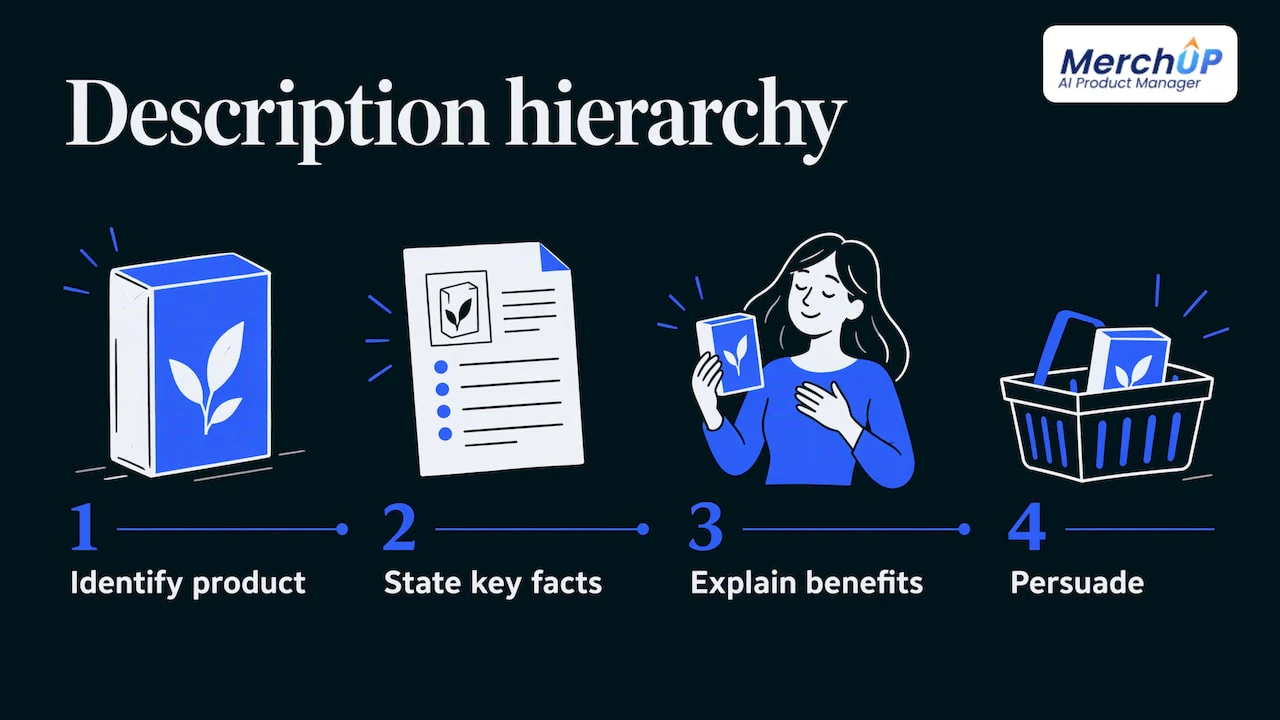
Decide the order once. Photoroom’s Raleigh Norris describes the strongest listings as following a hierarchy: identify the product, state the key facts, explain the benefits, then persuade. Racklify suggests a primary selling sentence, two to five benefit-led bullets and a technical details section.
Marketplaces again show the range of rules. Walmart’s copy standards ask for product details of 100 to 150 words (minimum 60, maximum 200) in plain sentence-case paragraphs that say what the product is, who it is for and the key benefit. The Home Depot’s vendor guide wants at least three sentences of marketing copy and at least four bullets without ending punctuation. These differ, which is the point: your guide should fix one structure for your own store, and adjust only where a sales channel demands it.
Templates make this concrete. Our pages on description structure and description templates give layouts you can adopt.
4. Terminology
Build a small table so every writer uses the same words.
| Preferred term | Meaning | Avoid | Note |
|---|---|---|---|
| Variant | A purchasable combination | Version, type | On Shopify, Colour is an option and Navy is an option value |
| Recycled material | Made from reused material | Eco-friendly | Do not treat as the same as recyclable packaging |
| Near Mint (cards) | Your stated condition grade | Mint-ish, like new | Use one scale across the shop |
The first two rows follow the example in the vow.design guide, which stresses that “recycled material”, “recyclable packaging” and a named certification state different facts. Also record search language. Walmart’s standards note that calling a product sandals when shoppers search for flip flops misses part of the audience.
5. Claims and hype rules
This is where guides earn their keep. The Content Authority suggests a banned-words list for vague claims such as “premium” and “high quality”, replaced by plain facts like “Solid oak frame, not veneer”, and backing every claim with a number (if you say light, give the weight).
Write each rule so someone can check it. The vow.design guide gives the model: “Place a material limitation beside the claim it changes” works, while “Always sound trustworthy” does not. Amazon’s style guide adds sensible basics: avoid ALL CAPS and multiple exclamation points, and make performance comparisons against sourced averages or maximums.
6. Required product details
List the attributes that must appear for each product type: material, size, compatibility, capacity, condition. Photoroom advises stating decision-critical attributes explicitly in structured fields instead of leaving shoppers or AI shopping agents to infer them from persuasive copy. For electronics, see our guide to electronics product descriptions. Grouping products sensibly helps too; product taxonomy explains how.
7. SEO and accessibility basics
Include rules for meta titles, meta descriptions and image alt text, plus reading level and how to describe images. Walmart advises repeating the product name in the description body and weaving in related keywords naturally. Our product description SEO guide covers the detail.
Separate voice from facts
The most useful idea in the research is to keep two layers apart. Voice is how you say things and can be edited freely. Facts are dimensions, materials, what is included and compatibility, and they cannot. The vow.design guide proposes layered approval: a brand owner approves voice, a product-data owner approves facts, someone owns claims and their evidence, and operations own purchase conditions. A writer may simplify a sentence but must not change compatibility, included items or material composition.
The Need to Know AI team makes the same cut: the guide controls repeatable editorial decisions, such as audience, voice, structure, length, terminology and prohibited language, while unique product facts live in the product record.
Worked example: a weak line and a guided line
Take a mug listing. Before the guide: “Premium, high quality mug, perfect gift!!!” After applying the rules above (banned vague words, fact beside every claim, one exclamation point at most, structure of selling sentence then bullets):
A 350 ml stoneware mug with a matte glaze, made for daily coffee.
- Holds 350 ml, enough for a large flat white
- Stoneware body, 340 g, dishwasher safe
- Fits most single-serve machine drip trays up to 11 cm
The second version states facts a shopper can compare, and it follows the same shape on every mug in the catalogue.
Piloting and maintaining the guide
Do not roll a draft across the whole catalogue. The vow.design guide recommends giving two writers the same verified fact pack and comparing their decisions, then fixing unclear rules. The Need to Know AI team suggests piloting on one category with ten representative products: simple ones, complex ones, compatibility-constrained ones, sparse-data ones and one known-good listing. Update the guide only when a correction is a reusable rule. A one-off exception belongs in the product record.
After launch, review a sample each time the catalogue changes. Razorcopy’s Riley Swanson recommends a review every six months and onboarding for new writers so the document does not become clutter.
If you use AI to draft, say in the guide what the AI may draft and what a person must check before publishing. The vow.design guide notes that automation can flag inconsistent terms and missing fields but cannot approve claims on its own.
How to check listings against the guide
Photoroom suggests a practical audit:
- Sample 20 to 30 products across bestsellers, long-tail items, new arrivals and main categories.
- Check titles for identification, useful attributes, variant detail and promotional clutter.
- Check descriptions for explicit facts, unsupported claims, missing specifications and contradictions.
- Compare structured attributes with the page copy.
- Confirm each variant updates image, title, price, stock and URL together.
- Fix the template and workflow first, then the catalogue, and add a check for every new product.
Neo Business Platform’s workflow adds automated checks (prohibited words, length, specs consistency) before human review, then monitoring results for 7 to 30 days and testing one element at a time. For stores with thousands of products, see our notes on a quality system for large catalogues and attribute-based descriptions.
Where MerchUp AI fits
A guide only works if it is applied on every listing. MerchUp AI is an AI product manager built for Shopify. It turns a product photo, barcode or trading-card scan into a complete listing (title, type, vendor, price, tags and SEO), writes the description into a designed template, creates AI product photos and publishes it. Every change is reviewed before it goes live, with full history and restore.

For SEO, MerchUp AI does all your SEO in one click: it reads your store’s own Google Search Console data and live Google results, picks keywords, writes meta titles, descriptions and image alt text, checks rankings on live Google and pushes everything to the store. No SEO knowledge is needed. Trading-card and collectibles shops also get card identification, market pricing and AI centering and condition grades, and can buy, sell and trade in person with Shopify POS.
There is a free plan, and paid plans start with Starter at £12.99 a month. Growth is £34.99, Pro £79.99 and Scale £199.99 a month; the card scanner add-on starts at £7.99 a month. See the plans and pricing or how the tools work together.

Our view
Most style guides fail because they live in a document nobody opens while writing listing number 400.
We build MerchUp AI around the opposite idea: the rules should sit where the listing is made. A designed description template carries your structure, a scan or photo supplies the product facts, and every change is reviewed before it goes live, with history to restore. That keeps voice flexible and facts fixed.
For stores that add products every week, the guide you write is short, and the tool does the repetition. You decide the voice and the claims rules once, then spend your time on the products.
Jamie Moss
FAQ
How long should a product copy style guide be?
One page is a good target. Seller Labs advises tone in three words, sentence style, bullet structure, words to use and avoid, and two example bullets, because longer documents get ignored. Put detailed category rules in separate short sheets.
What is the difference between a brand style guide and a product copy style guide?
A brand style guide mostly covers logos, colours, typography and overall voice. A product copy style guide governs the words on product pages: title formulas, description structure, terminology, claims rules, required attributes and metadata.
Should the guide apply to AI-written descriptions too?
Yes. State what AI may draft and what a person must check before publishing, especially facts and claims. Controls for audience, voice, structure, length, terminology and prohibited language apply equally to people and tools.
How often should I update it?
Review it about every six months and whenever you add a new product category. Change the guide only when a correction is a reusable rule. Keep one-off exceptions in the product record.
Sources
- How To Create a Content Guide for Your Business (2026), Shopify
- Product Content Style Guide, Racklify
- Walmart Content Standards: importance of content
- Walmart Universal Copy Standards
- Amazon Consumer Electronics Style Guide
- Amazon Automotive & Powersports Style Guide
- Sears Marketplace Seller Content Standards
- The Home Depot vendor content guide
- How to Create a Product Description Style Guide, vow.design
- How to structure product listings for AI shopping agents, Photoroom
- The Product Page Copy System, The Content Authority
- Brand Voice Consistency, Seller Labs
- AI Product Description Style Guide, Need to Know AI
- How to Create a Content Style Guide That Actually Gets Used, Razorcopy
- AI content workflow, Neo Business Platform


Comments
No comments yet — be the first to share what you think.